Gravitational Waves
Curve spacetime and hold still and you get a black hole. Shake it, and the curvature itself ripples outward at the speed of light: a wave not through space, but of it. It was Einstein's last untested prediction; on 14 September 2015 two detectors 3,000 km apart caught the same seven-millisecond wiggle, and a century of waiting ended.
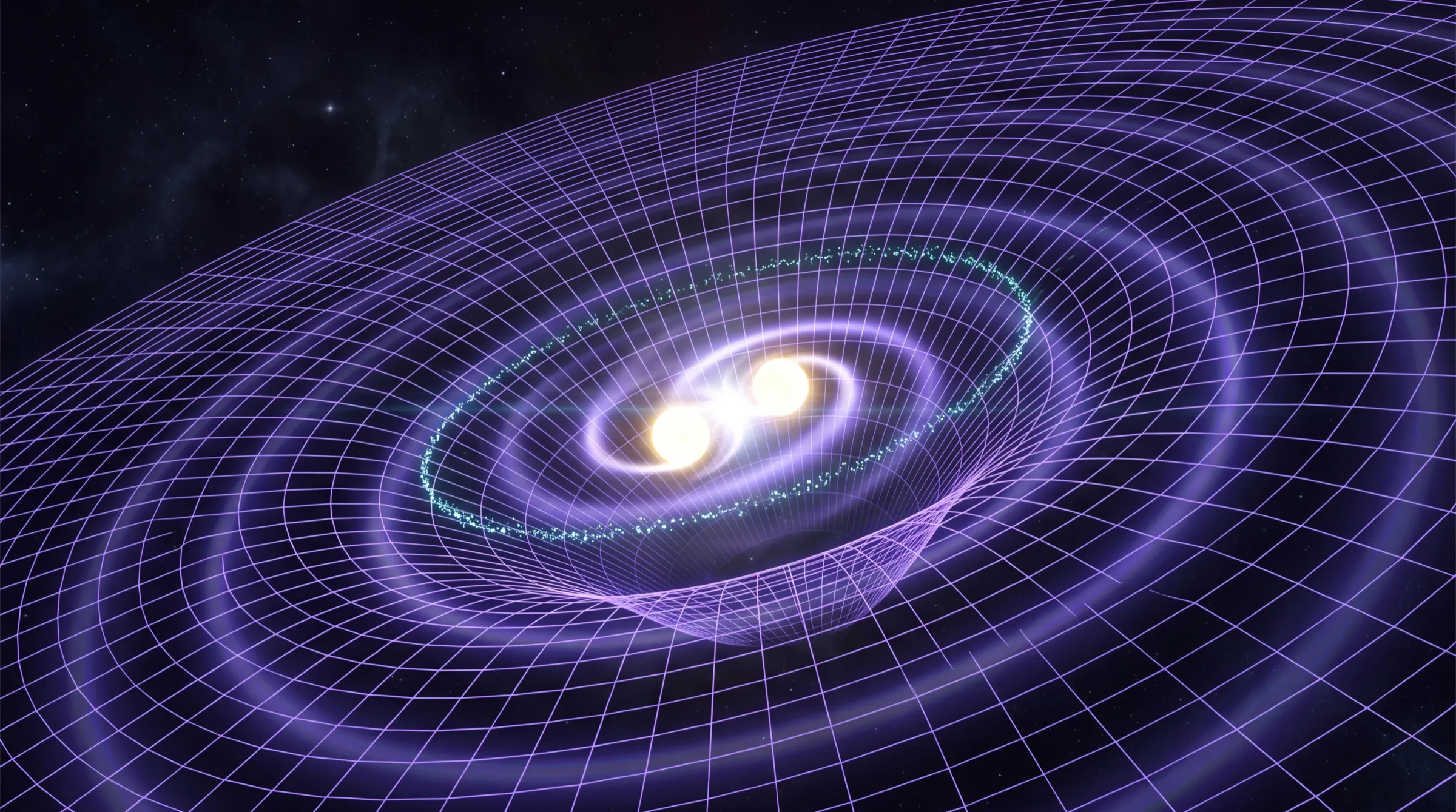 Open the interactive ▸
 What you're looking at
The Scene view is the whole event, read left to right: a source, a wave, and a detector. On the left, two compact bodies orbit, spiral in, and merge: the engine. Violet wavefronts carry the news outward across a stylised grid of space at the speed of light. In the centre, a ring of free-floating test masses shows what the wave actually does to space: it stretches one direction while squeezing the perpendicular one, then swaps, over and over. On the right, a LIGO interferometer, two long arms at right angles, feels the same passing wave, one arm lengthening as the other shortens. Along the bottom runs the strain trace h(t): the wiggling line that is, quite literally, the kind of data LIGO records.
The Membrane view is the payoff. The binary sits at the bottom of a deep well in a vast tilted spacetime sheet, and the wave is a real height displacement: a rotating quadrupole that radiates outward as travelling ripples across the whole sheet, the ring of test masses riding on top. It is the picture textbooks reach for, built in three dimensions and set moving.
Drag anywhere to scrub a whole merger by hand, from the slow early orbit, through the frantic chirp as the bodies plunge together, to the merger flash and the fading ringdown, or press play and watch it run. Presets load the two landmark detections (GW150914, two black holes; GW170817, two neutron stars), a generic looping inspiral, and three steady study waves: plus (+), cross (×) and circular. Everything else is instrument furniture: a live strain equation, a telemetry column, click-anywhere explainer cards, and an eight-chapter story. The exaggeration factor is displayed at all times, because the honest size of this effect is invisible.
Why it's here
The rest of the site keeps circling one idea: that spacetime is a physical thing that can be bent, named in The Bubble as two routes: extreme mass and extreme energy. The black hole and light bending show that curvature is real but static: mass bends space and sits there. Gravitational waves are the proof that the same spacetime is also dynamic: you can set it ringing, and the ring travels. It was Einstein's 1916 prediction and the last major one left untested, until LIGO caught it in 2015.
There is a sharper reason it sits here too. A LIGO arm is a Michelson interferometer: the very instrument Michelson and Morley built in 1887 to look for the luminiferous aether, and which returned a famous null. The same apparatus, a century later, returns a signal: not for a medium light moves through, but for spacetime itself flexing. That is the honest end of the aether argument the site has been working through: the answer was never "nothing is there," it was "the thing that is there is spacetime, and here it is, measured."
How it works
One rule draws the whole page. A wave is a change in the rule that sets distances:
ΔL = ½ h L · strain h ~ 10⁻²¹ across 4 km arms
A wave of distance itself. A gravitational wave is a ripple in the metric, in the rule that sets distances. It is transverse: it stretches and squeezes the plane it passes through, leaving its direction of travel alone. The fractional stretch is the strain h, and a separation L changes by ΔL = ½ h L. That half, and the stretch-one-way / squeeze-the-other pattern, is why a wave is heard as a difference between two directions, and why the detector is shaped like an L.
Two polarisations. There are exactly two independent patterns. Plus (+) stretches along one axis and squeezes the perpendicular one; cross (×) is the same turned 45°. A binary seen face-on emits a rotating circular blend: watch the ring's long axis spin. Switch to Cross × and the interferometer goes quiet: a wave shearing at 45° barely changes arms that lie along the x and y axes. A single detector is genuinely partly blind, which is exactly why it takes a network of Hanford, Livingston, Virgo and KAGRA to locate where in the sky a wave was born.
The chirp. Two orbiting masses radiate energy as waves, so the orbit shrinks, so they speed up, so they radiate harder still: a runaway. The wave frequency (always twice the orbital frequency) sweeps upward and its amplitude climbs together: the chirp. Its rate is set by one number, the chirp mass 𝓜 = (m₁m₂)^(3/5)⁄(m₁+m₂)^(1/5), which is why hearing the chirp reveals the masses. The slow inspiral is exact textbook physics; the final merger can only be computed by numerical relativity; and the ringdown is the new black hole shaking off its lumps at a pitch fixed by its mass and spin. For GW150914 the whole sweep, 35 Hz up to 250 Hz, lasted about a fifth of a second.
The smallest measurement ever made. The strain that reached Earth from GW150914 was about h = 10⁻²¹. Across LIGO's 4 km arms that is a length change near 10⁻¹⁸ m, far less than a proton, and the instrument's noise floor reaches ~10⁻¹⁹ m, about a ten-thousandth of a proton's width. It is measured by splitting a laser down the two arms and watching the beams fall out of step.
Every wiggle on screen is computed from these laws at the chosen point in the merger. Only two things are dialled: the strain is magnified (the true value is always shown), and the real sweep is slowed so the eye can follow it.
The presets
Six sources, from the landmark detections to clean single-polarisation study waves.
- GW150914: the first detection (14 Sep 2015): two black holes, 36 + 29 → 62 M☉, with 3 M☉ radiated as waves 1.3 billion ly away.
- GW170817: two neutron stars (17 Aug 2017), seen in waves and light; the closest, the multi-messenger one.
- Inspiral: a generic chirp on loop, to watch the runaway mechanism without event-specific numbers.
- Plus +: a steady linear wave, stretch-x / squeeze-y; use the frequency slider.
- Cross ×: a steady linear wave at 45°; watch the interferometer fall silent (the blindness is real).
- Circular: a steady rotating wave, the face-on binary's signature; the ring's axis spins.
Try this
- Scrub a merger by hand. Drag left and right through GW150914 and feel the chirp quicken, the flash, the ringdown fade.
- Switch to the Membrane view and watch the whole spacetime sheet ring: the picture the textbooks only draw flat, moving.
- Load Cross ×. The ring shears at 45° but the LIGO arms barely move and the strain trace flattens. That blind spot is real.
- Drop the exaggeration toward the bottom to feel how invisibly small 10⁻²¹ really is, then dial it back until the ring beats again.
- Compare GW150914 and GW170817: the black holes merge in a flash and ring; the neutron stars chirp for far longer and never ring down here.
- Run the story: eight chapters, from Einstein's 1916 prediction to Michelson's null becoming a signal.
Accuracy
The honest line between what is exact and what is stylised:
| Feature | Tier | What that means |
|---|---|---|
| The + and × polarisation patterns; ΔL = ½ h L | T1 Established | Exact linearised general relativity (transverse-traceless gauge). Sets how every test mass and grid point moves. |
| Waves are transverse and travel at c | T1 Established | A prediction of GR, confirmed by GW170817's light arriving 1.7 s after the wave from 130 Mly away. |
| Inspiral chirp: f_GW = 2 f_orb, df/dt ∝ f^(11/3), chirp mass 𝓜 | T1 Established | The leading-order post-Newtonian result (Peters 1964). Drives the rising frequency and amplitude; verified since the 1970s by the Hulse–Taylor binary pulsar. |
| A single L-detector is blind to some polarisations / directions | T1 Established | The antenna pattern of a Michelson detector: real, and the reason a multi-detector network is needed to localise a source. |
| GW150914 & GW170817 figures; ~350 events; strain 10⁻²¹, ΔL ~10⁻¹⁸ m | T1 Established | Published LIGO–Virgo–KAGRA values (GWTC catalogues; O4 completed Nov 2025), rounded for display. |
| Merger & ringdown waveform shape | T3 Stylised | The peak and the fading tone are sketched in the right spirit; the true merger comes only from numerical relativity, and the ringdown pitch from the final mass and spin. |
| Exaggeration of the distortion (× shown in the panel) | T4 Illustrative | The real strain is ~10⁻²¹, utterly invisible. It is magnified purely so the pattern can be seen; the true strain h is always displayed. |
| Spacetime grid / sheet, expanding ripples, slowed playback | T4 Illustrative | A picture of a field you cannot see; the real sweep (0.2 s for GW150914) is slowed so the eye can follow the chirp. |
In one line: what the wave does to space (the polarisation patterns, the chirp, the detector's response and its blind spots) is exact, measured physics; only how big and how slow it appears on screen is dialled up so you can see it.
Sources
- Einstein, A. (1916). Näherungsweise Integration der Feldgleichungen der Gravitation. Sitzungsber. Preuss. Akad. Wiss. The prediction of gravitational waves.
- Abbott, B. P., et al. (LIGO Scientific & Virgo) (2016). Observation of Gravitational Waves from a Binary Black Hole Merger. Phys. Rev. Lett. 116, 061102. (GW150914)
- Abbott, B. P., et al. (2016). Properties of the Binary Black Hole Merger GW150914. Phys. Rev. Lett. 116, 241102. (36 + 29 → 62 M☉; 3 M☉ radiated; ~1.3 Gly.)
- Abbott, B. P., et al. (2017). GW170817: Observation of Gravitational Waves from a Binary Neutron Star Inspiral. Phys. Rev. Lett. 119, 161101.
- Abbott, B. P., et al. (2017). Multi-messenger Observations of a Binary Neutron Star Merger. Astrophys. J. Lett. 848, L12. (GW + GRB 170817A, 1.7 s; the kilonova.)
- Peters, P. C. (1964). Gravitational Radiation and the Motion of Two Point Masses. Phys. Rev. 136, B1224. (The inspiral / df-dt result.)
- Hulse, R. A., & Taylor, J. H. (1975); Taylor, J. H., & Weisberg, J. M. (1982). The binary pulsar PSR B1913+16: the orbital decay matching radiated waves.
- Maggiore, M. (2008). Gravitational Waves, Vol. 1: Theory and Experiments. Oxford University Press.
- Misner, C. W., Thorne, K. S., & Wheeler, J. A. (1973). Gravitation. (TT gauge; the ring of test particles.)
- LIGO–Virgo–KAGRA Collaboration (2025). GWTC-4.0 (arXiv:2508.18082) and the close of the fourth observing run (O4), November 2025: ~350 confident detections to date.