The Mothership Ledger
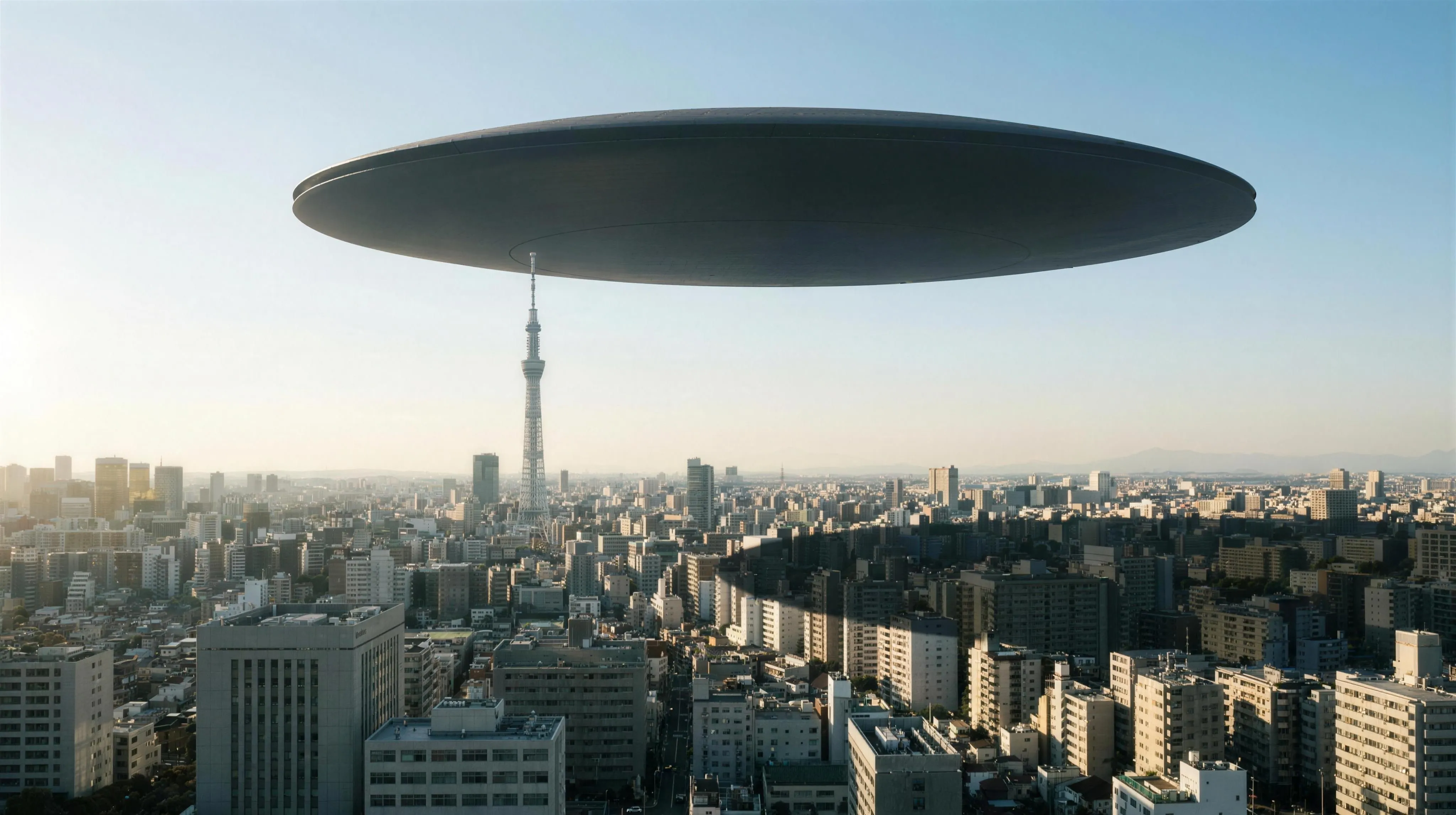
A vast ship hangs over a fictional Tokyo and life goes on underneath: that picture is the premise of the anime this station reviewed, and the review's point was that the normalisation, not the ship, is the story. This bench asks the smaller, harder question the picture skips past: what would the instruments say? Hovering is not resting. A hull's mass pulls up on every gravimeter beneath it; its weight must be paid in downwash, in buoyancy, or in some new physics that still has to put the bill somewhere; and its shadow is a measurement nobody has to fund. The arithmetic lands on three regimes: below about one aircraft carrier of mass a kilometre-wide hull can float in genuine silence, the balloon clause, and gravity itself goes quiet at ten thousand tonnes; in the battleship regime every ledger rings at once, hurricane columns, hundred-hectopascal footprints, microGal steps no tide model can hide; and in the new-physics regime the waiver itself is priced, down to the 3.9 mm the bedrock would confess to InSAR. Only the shadow cannot be waived at any mass, because opacity is what made it a sighting in the first place. The dials are assumptions and say so. The verdicts hang at equal size. The story stays a story, and the bill stays a bill.
 Open the interactive ▸
 What you're looking at
The Overhead view is 3D because scale, altitude and shadow throw are three-dimensional questions: the hull at its dialled diameter over a staged city grid, a broadcast tower of real height for scale, the sun computed from latitude, season and hour, and the umbra/penumbra ellipse moving over the blocks exactly as the closed forms say it must. Toggle the rotor clause and the momentum-theory downwash column appears at its computed speed. Press Run and the whole day plays: the shadow sweeps its track and vanishes into evening.
The Gravimeter view is the mass ledger: the dialled hull's signal curve against the published floors of real instruments, the superconducting field floor, the absolute gravimeter, the tide band, and one honest calibration, the 75 µGal an Alpine winter of snow writes into a real record. A staged strip chart shows why a static step stands out of a tide known to a hair.
The Lift bill prices the same weight three ways side by side: pay in momentum (downwash speed on a ladder with the CH-53E, the V-22 and the hurricane categories; induced power in gigawatts), pay in buoyancy (the hull's displaced-air ceiling, with the Hindenburg as the anchor), or pay on the ground (footprint overpressure against barometer floors, and the bedrock's InSAR-visible dip under the field clause).
The Shadow view is the ledger nobody can waive: the cross-section shows the nine-metre fringe that no cloud can imitate, the plan view walks the umbra's daily track by season, and the energy lines price the deleted sunlight against the one real full-scale test, the 2017 eclipse over California's grid.
The File lays the claims on cards, the ODNI sentence verbatim, the JAL 1628 phrase, Reagan's UN daydream, what silence can and cannot buy, and closes on two verdicts at equal size.
Why it's here
This station's review of Dead Dead Demon's Dededede Destruction argues a reading: the anime's real subject is not the ship but the normalisation underneath it, the speed at which the impossible is absorbed into the commute. The review quotes the ODNI 2021 assessment, objects that 'remain stationary in winds aloft... without discernable means of propulsion', as the rhyme between the record and the fiction. This bench turns the rhyme around and asks: if the picture were real, a kilometre-scale hull hanging quietly over a city, would physics permit the quiet? Hovering is not resting. Mass, lift and light each keep a ledger, and all three happen to be kept by real instruments with published floors.
It is also the third bench on this station's fiction-pricing line. INST-12, the warp ledger, prices one equation's energy term; INST-17, the Rendering Engine, prices 'the universe is software'; this one prices 'something enormous, hanging quietly'. And the record keeps its own giant: on INST-62, the JAL 1628 star bench, Captain Terauchi's translated statement gives the silhouette 'the size of two aircraft carriers'. People describe the impossible in ship-sized masses, and ship-sized masses are exactly what gravimeters, barometers and shadows hear best. Read side by side, the word 'hovering' weighs what it honestly weighs.
How it works
One unmeasured dial, mass, against three ledgers that cannot be argued with. The panel tags every number exact, modelled, reported or reading.
Δg = 2GM/R²·(1 − h/√(h²+R²)) · v = √(W/2ρA) · M ≤ ρ_air·V · ∫ΔP dA = W · fringe = L·tan 0.533°
Gravity, exact. The on-axis field of a uniform disk, cross-checked against brute-force ring integration in the tune script, inverted to answer the practical question: what is the smallest mass each published floor could hear at the dialled altitude?
Lift, exact. Momentum theory as used on every rotorcraft, calibrated against the CH-53E and V-22 before it is trusted with the hull; Archimedes for the silent ceiling; the pressure integral for the ground; Boussinesq for the field clause's bedrock bill.
Light, exact. The sun as a 0.533° disc: fringe width from path length, umbra survival altitude, shadow offset h/tan(elevation) by season and hour, blocked power from the '1 sun' surface reference.
The floors, reported. Every threshold the exact curves are read against, gravimeter, barometer, InSAR, eclipse cooling, grid loss, comes from a published spec or measurement and is carried with its source.
What is deliberately not computed. No verdict on the anime, no identification of any real UAP, no assumption about what the ship is made of. Where the fiction is silent, the bench carries a dial instead of a guess.
The three ledgers are exact and machine-audited; the instrument floors and case quotes are reported with sources; the city, the tower's address and the hull's shape are modelled and labelled; and what a quiet sky over a fictional city amounts to is a reading, for which the bench hangs two verdicts at equal size and adds no third.
The dials that decide what happens
Four assumptions and two clauses: between them they hold every version of the picture, from a drifting film of a balloon to a hovering mountain.
- Diameter, altitude, depth. The fiction never states a size, so the geometry is honestly dialled: diameter sets the footprint and the shadow, altitude sets the gravimeter's range and the shadow's throw, depth sets the volume and with it the one silent ceiling.
- Mass, the unmeasured dial. Seven orders of magnitude, from 100 t to a small mountain, with the aircraft carrier, the Great Pyramid and the hull's own neutral-buoyancy line marked on the curve. Every ledger on the bench re-prices live as it moves.
- The rotor clause and the field clause. Two ways to pay: push air, and the downwash column appears at its momentum-theory speed; or invoke new physics, and the air ledgers are struck through while the bedrock ledger opens, because a waiver is not the same thing as a receipt.
- Season and hour, with Run. The sun is computed, not staged: run the day and watch the umbra patrol its winter track 1,700 m from the point below the hull, then pull back to a fifth of that in summer.
The claims, as they stand
Five claims that orbit the picture of the quiet giant, from the arithmetic's own verdict to the objection the bench invites and declines, with where each lands once the ledgers are run.
| A kilometre-scale mass cannot hover quietly over a city made by this bench's arithmetic, run on published floors | BEST SUPPORTED | Best supported, and by every ledger at once. At 10⁹ kg the gravimeter under the rim reads 5.6 µGal against a 0.5 µGal floor; paying the weight in momentum demands a 71 m/s column at about 700 GW; paying it on the ground writes about 110 hPa across every barometer in the city; and the shadow needs no instrument at all. The three ledgers are independent: fooling one leaves the other two ringing. |
| A kilometre-scale SHIP could still hover quietly, if it is nearly empty made by the Archimedes clause, computed here | CONTESTED | True, and carried at full size: it is the loophole that keeps the bench honest. A 1 km × 100 m hull displaces about 96,000 t of air; below that mass it floats with zero downwash and zero net footprint pressure, and at 10,000 t even the superconducting floor goes quiet. Silence does not disprove a ship. It caps its mass at about one aircraft carrier, which is a real and checkable statement. |
| Unknown propulsion ("a field") voids the ledgers made by the standard rescue clause, priced here rather than dismissed | CONTESTED | Contested, because the clause pays in other currency. A field that hides mass and momentum from the air must still land the weight somewhere: handed to bedrock, 10¹⁰ kg dips the crust 3.9 mm, above the InSAR single-epoch floor; handed nowhere, the claim is now against momentum conservation itself, which is a far larger bill than the hover. And no clause reaches the shadow: opacity is what made it a sighting. |
| The ODNI's "stationary in winds aloft" objects were kilometre-scale masses made by a reading sometimes drawn from the 2021 assessment | DID NOT SURVIVE | Did not survive the units. The assessment describes point returns and video blobs with no measured size or mass; nothing in it weighs anything. What this bench shows is the converse: had anything kilometre-scale and massive truly parked over instrumented ground, the 2021 report would not have needed the word "appeared". The sentence is carried verbatim in the File, as a sentence. |
| The anime's quiet sky is a flaw the physics exposes made by the objection this bench invites | READING | A reading, and the bench declines it. Fiction pays no bills; that has always been its licence. What the arithmetic sharpens is the review's own point: a real ship this size would be the loudest object in the history of measurement, so a city that shrugs at one is a statement about people, not about plausibility. The instrument prices the picture and hands the story back. |
Try this
- Start in Overhead and just orbit. The tower is 634 m of real height; the default hull is a kilometre and a half of sky. Before any physics, let the scale itself register.
- Slide the mass from 10⁵ to 10¹² kg in the Gravimeter view. Watch the signal cross the superconducting floor around ninety thousand tonnes, the absolute floor near four hundred thousand, and the raw tide band after ten million. Silence, you will notice, is only available at the bottom.
- In the Lift bill, switch the rotor clause on at 10⁹ kg. The downwash ladder pins past Cat 5 and the power line reads about 700 GW. Then drop the mass until the buoyancy bar turns green: that is the whole silent-hover window, and it is one aircraft carrier wide.
- Turn on the field clause and read the third column. The air ledgers strike through; the bedrock dips 0.35 mm per billion kilograms; at 10¹⁰ kg InSAR sees it. A waiver, priced.
- In Shadow, set winter noon. The umbra lives 1,700 m from the point below the ship, with a nine-metre edge. Run the day once in each season and decide which streets get the scheduled eclipse.
- End on the File's two verdicts. They do not fight. Nothing kilometre-sized hovers for free, and fiction pays no bills. Holding both at once is the point of the bench.
Accuracy
The honest line between what is exact, what is modelled here, what is reported from published sources, and what is a reading:
| Feature | Tier | What that means |
|---|---|---|
| The three ledgers | T1 Exact | The on-axis gravity of a uniform disk, g = 2GM/R²·(1 − h/√(h²+R²)), cross-checked against brute-force ring integration; actuator-disk momentum theory v = √(W/2ρA) with induced power Wv; Archimedes for the buoyancy ceiling and ∫ΔP dA = W for the footprint overpressure; Boussinesq disk deflection for the field clause; the sun by plain spherical trig, and every shadow offset, umbra width and penumbra fringe in closed form. All of it audited by a re-runnable tune script; no fitted constant anywhere. |
| The instrument floors and anchors | T3 Reported | iGrav superconducting spec (0.05 µGal) and the honest 0.1 to 1 µGal field floor (Fores 2017), FG5-X accuracy (2 µGal), the 100 to 300 µGal solid-earth tide (Middlemiss 2016), the Zugspitze snowpack detection (75 µGal, Voigt 2021), CH-53E and V-22 gross weights and rotors, the Hindenburg's 200,000 m³ and 232 t, BMP390 barometer noise (~1 Pa), InSAR single-epoch precision (~2.5 mm), the 2017 eclipse cooling (2 to 5 °C) and the CAISO solar loss (4,194 MW), the ODNI sentence and the JAL 1628 phrase. Carried with sources, as published. |
| The staging | T2 Modelled | The city is a seeded scatter, not a map of Tokyo; the 634 m tower carries a real height at a staged address; the hull is a borrowed 3D model (BlackHawk0512, Sketchfab) scaled so its width is the dialled diameter and its depth the dialled hull depth, darkened from the chrome it shipped with so it reads as opaque rather than as sky, with its lit portholes damped to a hint; its shape enters no ledger, since every number on this bench is a function of diameter, altitude, depth and mass alone; the sky, by contrast, is not staged at all, being the Preetham daylight model scattering the computed sun and lighting the scene through its own environment map; the gravimeter strip chart is a staged illustration of a real procedure; the crust under the field clause uses a labelled staging stiffness (E = 30 GPa). The dials themselves, diameter, altitude, depth, mass, are assumptions and say so on their faces. |
| The fiction, as premise | T3 Reported | The anime and manga are quoted only as the picture under audit: a ship over Tokyo, no canonical size, appearing on an in-story August 31st and staying. The work proves nothing about any real case, and this bench returns the favour: it prices the picture without reviewing the story. The review next door does that, and is linked, not duplicated. |
In one line: the disk-gravity, momentum, buoyancy, pressure and shadow arithmetic is EXACT with no fitted constant anywhere, audited by a re-runnable tune script; the instrument floors, rotorcraft anchors, eclipse measurements and case quotes are REPORTED as published, with sources; the city, the tower's address, the hull's borrowed shape and the crust stiffness are MODELLED and labelled; and what a quiet sky over a fictional city amounts to is a READING, for which this bench hangs two verdicts at equal size and adds no third. Dial the mass, read the bills, and decide what silence is worth.
Sources
- GWR Instruments, iGrav superconducting gravity sensor specifications (0.05 µGal precision at one-minute averaging; sub-nanoGal frequency-domain noise; <0.5 µGal/month drift), with Warburton et al. 2011 as the introducing paper; and Fores et al., "Assessing the precision of the iGrav superconducting gravimeter for hydrological models", Geophysical Journal International 208 (2017), for the honest 0.1 to 1 µGal field floor the ledger actually uses.
- Micro-g LaCoste, FG5-X Absolute Gravimeter manual (2015), System Specifications: 2 µGal accuracy, 15 µGal/√Hz precision at a quiet site. Middlemiss et al., "Measurement of the Earth tides with a MEMS gravimeter", Nature 531 (2016), for the 100 to 300 µGal peak-to-peak solid-earth tide the signal sits on. Voigt et al., Hydrology and Earth System Sciences 25 (2021), for the Zugspitze superconducting gravimeter reading a winter snowpack at up to 75 µGal: the bench's proof that real instruments hear real loads.
- Actuator-disk momentum theory per Leishman, Principles of Helicopter Aerodynamics (v = √(T/2ρA), far-wake ≈ 2v); CH-53E gross weight 73,500 lb and 79 ft rotor, V-22 max VTOL 52,600 lb and two 38 ft rotors, from the published specifications; NOAA/NHC Saffir-Simpson thresholds (Cat 1 at 33 m/s) for the wind scale the downwash is read against.
- Airships.net, Hindenburg statistics: 200,000 m³ of gas lifting 232 t as operated, about 1.16 kg per m³, the buoyancy arithmetic this bench scales up; ISA sea-level air density 1.225 kg/m³ for the neutral-mass ceiling.
- Bosch Sensortec BMP390 barometric sensor (typical noise ~0.9 Pa, relative accuracy ±3 Pa) for the smartphone floor under the footprint-overpressure ledger; PS-InSAR single-epoch point precision of roughly 2 to 3 mm from the satellite-monitoring literature, for the bedrock ledger under the field clause; Boussinesq uniform-disk deflection w = 2(1−ν²)qR/E with staged crustal values, labelled as staging on the panel.
- NASA Sun fact sheet: solar angular diameter 0.533° (1919 arcsec) and total solar irradiance 1361 W/m²; the ASTM G-173 "1 sun" surface reference of 1000 W/m² for the blocked-power arithmetic. Mahmood et al. (University of Nebraska-Lincoln) and the boundary-layer literature on the 2017 US eclipse: ~4.5 °C average surface cooling along the Kentucky totality path with a lag of minutes; CAISO, "Solar Eclipse: ISO Report" (May 2017) and the post-event performance report: about 4,194 MW of utility-scale solar lost on schedule, with ~70 MW/min ramps.
- Office of the Director of National Intelligence, Preliminary Assessment: Unidentified Aerial Phenomena, 25 June 2021: the sentence carried verbatim in the File ("Some UAP appeared to remain stationary in winds aloft, move against the wind, maneuver abruptly, or move at considerable speed, without discernable means of propulsion", the report's own spelling), and the 144-reports-1-explained count. Captain Terauchi's translated FAA statement phrase "the size of two aircraft carriers" via the JAL 1628 case file, priced on INST-62.
- 3D hull model: "UFO Flying Saucer Spaceship OVNI" (sketchfab.com) by BlackHawk0512, under the Sketchfab Standard License. Used decimated from 344,000 to 76,500 triangles, scaled so its width is the dialled diameter and its depth the dialled hull depth, darkened from its delivered chrome finish so it reads as opaque, and with its lit portholes damped. The shape is illustration: it enters none of the three ledgers, all of which are functions of diameter, altitude, depth and mass alone.
- Dead Dead Demon's Dededede Destruction: manga by Inio Asano (Shogakukan, 2014-2022), anime dir. Tomoyuki Kurokawa (Production +h., 2024). Quoted as premise only: the ship has no canonical size and appears on an in-story August 31st. This station's signed review of the anime carries the reading; cross-referenced instruments INST-12 (warp energy), INST-17 (the Rendering Engine) and INST-62 (JAL 1628) carry the neighbouring prices.
Orbit the city. Dial the mass. Read the three bills. Then decide what a quiet sky is evidence of.
Open the interactiveCompiled August 2026