JAL 1628: The Star Bench
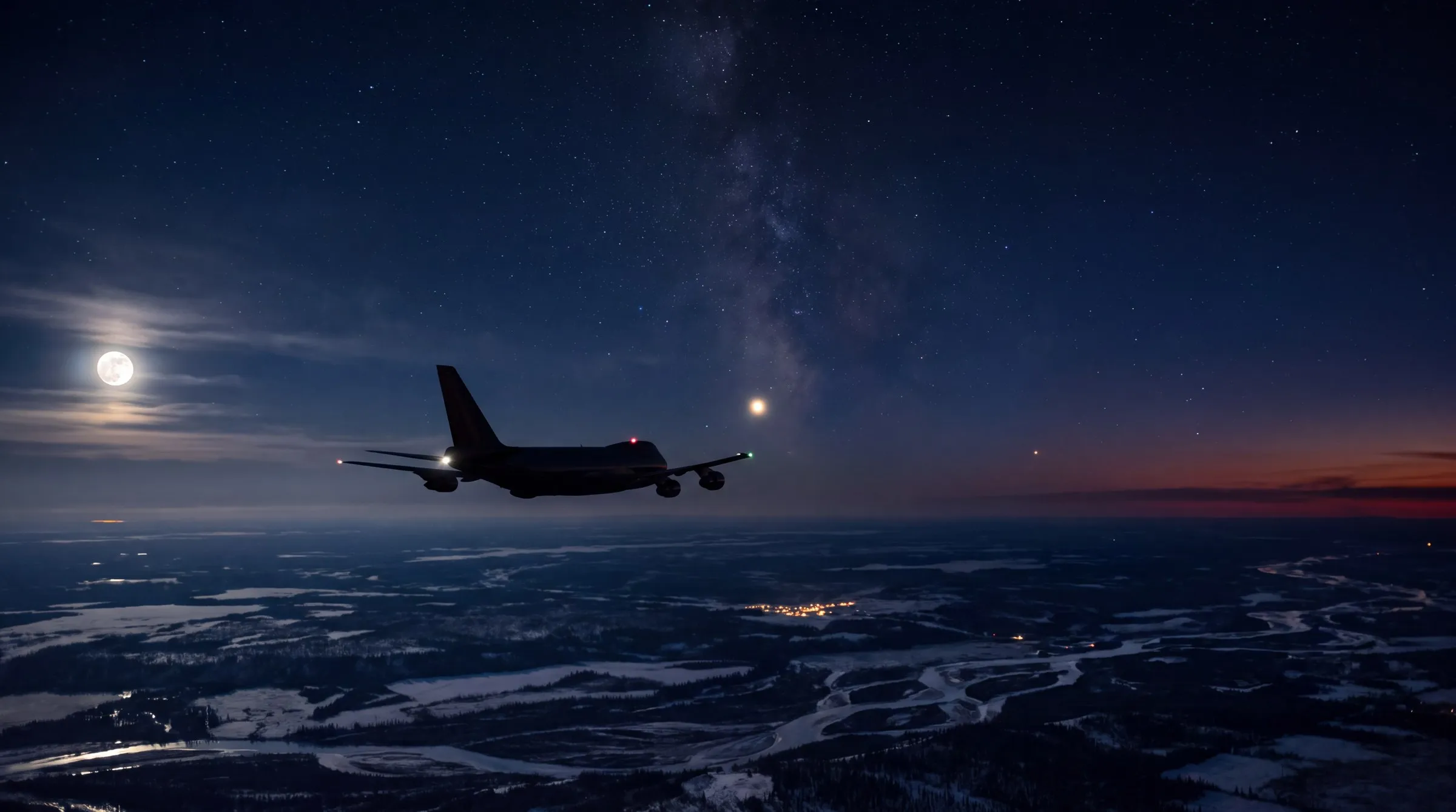
Fifty-five minutes of the evening of 17 November 1986 exist on tape: a JAL freighter crew reporting lights over Alaska, an Anchorage controller trying to make his scope agree with their windshield, military radar flagging its own data, and a United crew looking into the same sky and seeing nothing but the 747. This bench rebuilds the one thing every argument about the case stands under and none of the arguing parties could change: the sky itself. Jupiter, the brightest point over Alaska that evening, stood low off the 747's left nose and held its bearing through a 40-degree turn, a descent and a full circle, which is exactly what the famous 'it kept pace with us' describes and exactly what an object at celestial distance cannot help doing. The audit cuts both ways: Klass's numbers survive recomputation to the degree, Maccabee's horizon-dip figure fails by a factor of two, and yet the first act survives them both: two structured banks of lights at eleven o'clock, watched for minutes by three professionals, where no planet stood, never identified by anyone. Visual and radar are priced separately, the two verdicts hang at equal size, and the reading is yours.
 Open the interactive ▸
 What you're looking at
The Night view is 3D because the subject is a piece of celestial geometry lived from a cockpit: where the lights stood relative to the nose, minute by minute, through every heading change. The 747 flies the tape's own clock over moonlit interior Alaska; the star field overhead is computed for that exact evening and mounted on an equatorial frame driven by the same arithmetic the tune script audits; the amber lights are drawn at the record's clock calls and labelled as testimony. Press Run and 17:05 to 17:57 plays in under two minutes: the first lights, the arrays, the pale band, the silhouette, the 360, United 69.
The Bearings view is the case's core ledger: the record's own bearing calls as amber dots, from '30 degrees left front' to 'seven, ah, eight o'clock', plotted against the computed clock-position and elevation curves of Jupiter, Mars and the Moon. The reported drift around the clock face happens while the aircraft's heading walks from 215 through 255 and back to 198: a fixed patch of sky slides backward around the nose exactly this way.
The Radar view prices each scope on its own lane: the crew's eyes, the weather radar's single green echo, Anchorage Center's few primaries, the military's surge return and 'flight size of two', and the aircraft sent to look. Filled marks found something; hollow marks looked and found nothing. The FAA's split-return finding and Maccabee's objections ride the same lane, side by side.
The File view is the claims on ten cards: the size that grew tenfold in six weeks, the ninety-fold distance disagreement, the three-way witness split, the camera that photographed nothing, the FAA conclusion, the green return, Callahan, the captain's own January retraction, the career cost, and both auditors checked against the sky. It closes on two verdicts at equal size.
Why it's here
This station's wiki entry gives the case one paragraph: the captain, the mothership, Callahan, the meeting that 'never happened'. A paragraph cannot hold what makes this file genuinely interesting: it is that rare radar-visual case where nearly every minute is on tape. The Anchorage Center recording, the FAA tracking data, three separate crew interviews, and two duelling auditors, Klass and Maccabee, reconstructing the same evening, are all publicly readable. Where there is tape, there can be pricing; where there can be pricing, this station builds a bench.
It also picks up two older threads. INST-54, the Belgian Wave, built this station's exact-ephemeris pipeline for 'the sky that night'; this bench reuses it whole and adds the Moon with topocentric parallax. When Terauchi declined a military intercept, the lesson he says he remembered is the one INST-36, Mantell 1948, prices: do not send fighters after a light you have not identified. And the mechanism Klass offered for the first act, moonlit ice-crystal cloud, shares its atmospheric optics with INST-41, the Fata Morgana bench. Read side by side, the sentence 'a captain reported a light' weighs what it honestly weighs.
How it works
One exact sky, one exact geometry, zero fitted constants. The panel tags every number exact, modelled, reported or reading.
az/el = f(GMST(JD), α, δ, φ(t), λ(t)) · rel = az − hdg(t) · R = v²/(g·tanφ) · S = d·θ
The sky, audited. GMST from the IAU 1982 expression; the J2000 catalogue rotated to the aircraft's own interpolated position; Jupiter and Mars from Standish mean elements with the standard magnitude laws; the Moon from a truncated Meeus series with topocentric parallax. Every curve the instrument draws is asserted against JPL Horizons values in the tune script before it is allowed on screen.
The geometry, solved. Headings come from the reported route fixes by great-circle bearing, and land on the tape's own 215/255/240 sequence without being typed. Relative bearing is azimuth minus heading; a clock hour is thirty degrees; the horizon dip at FL350 is 3.3 degrees, a number one published rebuttal got wrong by half.
The manoeuvres, priced. The 360 is R = v²/(g·tanφ): the stated 30-degree bank at 500 knots buys 6.3 NM and 4.8 minutes, and the tape agrees to seconds. The one manoeuvre the case records in detail is ordinary flight mechanics.
The sizes, honest. S = d × θ, with the assumed distance as a dial because the crew's own numbers span 500 feet to eight miles. Jupiter's true disc that evening was 43 arcseconds: a pure point, unrangeable by eye, which is what lets a planet fly formation forever.
What is deliberately not computed. No identification of the first-act arrays (the mechanism on offer is carried as a candidate with its objections), no verdict on what three witnesses saw, no psychology. Where the record is silent or contested, the bench carries a label instead of a guess.
The sky, the bearings, the turn and the size arithmetic are exact and machine-audited; the staging of the lights and the terrain is modelled and labelled; the chronology, the quotes, the radar events and the aftermath are reported as documented; and what the unexplained first act amounts to is a reading, for which the bench hangs two verdicts at equal size and adds no third.
The dials that decide what happens
A clock, a sceptic switch and one distance dial: between them they hold the whole public argument about JAL 1628.
- The clock, with Run. 17:05 to 17:57 at thirty times real speed, with the record's fixed moments marked: 17:09 contact, 17:17 the arrays, 17:23 the pale light, 17:30 the silhouette, 17:37 the 360, 17:50 United 69. Scrub anywhere; every view shares the same clock.
- The sceptical annotations. Off, the evening plays as the crew reported it. On, the planets wear halos, each phase wears the reading the later analyses gave it, and the radar lanes carry the FAA's own words.
- The assumed distance. The single number every giant in this file is built on, and the one number nobody measured. Slide it from the captain's written 500 feet to the radar's eight miles and watch the claimed object grow from a DC-8 to a hillside of light while the testimony stands still.
The claims, as they stand
Six claims that orbit JAL 1628, from Klass's identification to the reading the case still carries, with who made each and where it lands once the sky is recomputed.
| The later "pacing" light was Jupiter, with Mars beside it made by Klass (1987), computed on this bench | BEST SUPPORTED | Best supported for the second act, and strengthened by the audit: the planet stood in the reported quarter at the reported apparent pace, the reported clock drift matches the aircraft's own heading changes, the crew never reported Jupiter as a separate object, and United 69, looking into that exact sky, saw nothing but the 747. A point source cannot be ranged, which is what makes 'seven to eight miles' sustainable for forty minutes. |
| The first-act arrays were moonlit ice-crystal cloud made by Klass's revised mechanism (SI, Summer 1987) | CONTESTED | Contested, and left as a candidate. It has the moon in the right place, explains the undulating flame colours, the coming and going, and the weak green weather-radar echo; Maccabee objects that the lights were reported above the aircraft while the clouds were below, that a reflection would be broad and dim, and that no source shows moonlit ice generating flame-coloured arrays. The bench carries mechanism and objections at equal size. |
| The radar blips recorded an object accompanying the flight made by the case literature, from December 1986 on | DID NOT SURVIVE | Did not survive the record's own words. The controller: 'a few primary hits... never a good track'. The FAA technical center attributed the extra blip to an uncorrelated split of the 747's own return; the ROCC's strongest sentence rests on one primary return from a scope whose operator had called his own data 'erroneous or whatever' eleven minutes earlier; Fairbanks approach radar, asked twice, saw nothing. Maccabee's objection to the split hypothesis is carried, and does not convert intermittency into a track. |
| A gigantic craft, twice an aircraft carrier, flew formation with JL1628 made by Captain Terauchi's later accounts and the press coverage | DID NOT SURVIVE | Did not survive its own paper trail. On the night the same witness put the object at 'bigger than a 747'; the carrier scale appears six weeks later through the press storm. The size claim is a distance assumption in costume: the crew's own distances disagree by a factor of ninety, and the silhouette was seen by one man of three, against city glow, and not recognised by the copilot from the sketch. |
| The CIA seized the data and erased the meeting made by John Callahan (2001) | DID NOT SURVIVE | Contested at best. Two other attendees of the meeting Callahan describes, one of them the CIA's own analyst, confirm the meeting and recall no seizure and no such order; Maccabee left it with the complete data set, and the FAA sold the whole package publicly for $194.30. The claim is carried whole, because that is what a file does, next to its contradictions, because that is also what a file does. |
| Something unexplained flew with JAL 1628 that evening made by the reading the case has carried since 1986 | READING | A reading, and it stays one. The first act, structured arrays at 11 o'clock watched by three professionals where no planet stood, was never identified: the FAA closed a blip and said on the record it had not analysed the lights. An unexplained report is a smaller thing than a spacecraft, and a more durable one. This station closes neither door. |
Try this
- Press Run and fly the whole evening once. Watch the amber lights and the gold planet at the same time. Notice which one does something a sky cannot do, and which one never does.
- At 17:37, watch the 360 from above. Zoom out. The circle is 6.3 miles wide and takes 4.8 minutes, exactly as a 30-degree bank at 500 knots must. Mid-turn the light disappears; out of the turn it is back where a fixed sky would keep it.
- In the Bearings view, follow the amber dots. They start at 11 o'clock, where no planet stands, and end at 7-8 o'clock after two right turns. Now follow Jupiter's curve through the same minutes and decide how much of the drift belongs to the light and how much to the nose.
- Slide the distance dial from 500 ft to 8 NM. The claimed object passes from DC-8 to double-carrier without a single word of testimony changing. That factor of ninety is the entire size case.
- In the Radar view, toggle the annotations and count filled versus hollow marks. Then click the controller's last entry: 'a few primary hits... never a good track, ever'. That sentence was spoken on the night, not written by a sceptic.
- End on the File's two verdicts. They do not fight. The pacing was the sky's; the arrays were never identified. Holding both at once is what this file actually supports, and it is rarer than either alone.
Accuracy
The honest line between what is exact, what is modelled here, what the record reports, and what is a reading:
| Feature | Tier | What that means |
|---|---|---|
| The sky over the route, audited | T1 Exact | GMST (IAU 1982), the J2000 bright-star catalogue, Jupiter and Mars from Standish mean elements with the standard magnitude laws, and the Moon from a truncated Meeus series with topocentric parallax, all evaluated at the aircraft's own interpolated position and checked against JPL Horizons to a third of a degree in the tune script. Jupiter -2.5 low off the left nose, Mars 19 degrees right of it, a 98% moon dead astern: Klass's published numbers land within a degree; Maccabee's Mars azimuth and his 1.5-degree horizon dip do not survive the audit. |
| Bearings, headings and the clock face | T1 Exact | The route's headings are solved from the reported fixes by great-circle bearing and land on the tape's own 215/255/240-true sequence without being typed in. Relative bearing is azimuth minus heading; a clock hour is thirty degrees. The reported drift of the light around the clock face, 11 to 10 to 9 to 7-8, is drawn against the computed planet curves through every turn. |
| The turn and the sizes | T1 Exact | The 360-degree turn is priced by R = v²/(g·tanφ): the captain's stated 30-degree bank at 500 knots gives a 6.3 NM radius and 4.8 minutes, matching the tape to seconds. The silhouette arithmetic is S = d × θ with the crew's own contested distances as a dial: the same lights are a DC-8 at 500 feet and two aircraft carriers at eight miles. |
| The staging | T2 Modelled | The amber lights are drawn at the record's own clock calls at staged distances, because no position of them was ever measured; the silhouette is the captain's walnut sketch rendered as a wireframe, deliberately not a solid. The terrain, the village lights, the aircraft model and the flight path between the reported fixes are set dressing and interpolation, and say so. |
| The record, whole | T3 Reported | The AARTCC tape chronology minute by minute, the three crew interviews with their disagreements intact, the weather-radar green return, the ROCC 'flight size of two', the FAA's split-return conclusion and Maccabee's objections, the size claim's six-week growth, the camera failure, the January 1987 sighting the captain himself withdrew, the career cost, and Callahan's 2001 account beside what two other attendees recall. Carried as documented, with the disagreements left visible. |
In one line: the sky over the route (audited against JPL Horizons), the bearing geometry, the turn physics and the size arithmetic are EXACT with no fitted constant anywhere; the staging of the reported lights, the terrain and the interpolated path are MODELLED and labelled; the tape chronology, the crew interviews, the radar events, the FAA finding, the sceptical case, its rebuttals and the aftermath are REPORTED as documented; and what the unexplained first act amounts to is a READING, for which this bench hangs two verdicts at equal size and adds no third. Fly the evening, check the sky yourself, and decide.
Sources
- Bruce Maccabee, "The Fantastic Flight of JAL1628", International UFO Reporter, March/April 1987: the minute-by-minute chronology from the AARTCC tape (17:09:20 initial contact to the 18:20 landing), the crew interview excerpts (Terauchi, Tamefuji, Tsukuba), the tracking-data headings (magnetic 182/222, true 215/255), the descent to FL310, the 360-degree turn timing, the weather-radar sketches, the camera episode, and his objections to the CSICOP release. The bench's spine chronology follows this reconstruction.
- Philip J. Klass, "FAA Data Sheds New Light on JAL Pilot's UFO Report", Skeptical Inquirer 11(4), Summer 1987: Jupiter at magnitude -2.6 near azimuth 143, Mars about 19 degrees right, the nearly full moon almost directly behind the flight, the sun about 11 degrees below the horizon, the moonlit ice-crystal mechanism for the first act, the green-return argument, the United 69 geometry, and the crew-interview quotes; with the CSICOP press release of 22 January 1987 (Sanduleak and Stephenson's computations) as its earlier draft.
- The FAA release of 5 March 1987 (spokesman Paul Steucke, Alaskan Region): the split-radar-return finding from the FAA Technical Center (specialist Dennis Simantel's uncorrelated primary-beacon attribution), the statement that the agency was unable to confirm the event, and the on-the-record note that the FAA did not analyse the visual sighting. The complete ~377-page FAA package (chronology, statements by controller Carl Henley and inspectors Wright and Mickle, transcripts, drawings) was sold publicly and is scanned at nicap.org and archive.org.
- Robert Sheaffer, "JAL 1628: Capt. Terauchi's Marvelous 'Spaceship'", Skeptical Inquirer 38(6), Nov/Dec 2014: the Callahan account and its contradictions (Ron Pandolfi's and Maccabee's recollections of the meeting), the January 11, 1987 second sighting and its agreed village-lights explanation, the pipeline-pumping-station episode, and the size-claim escalation through the press.
- John Callahan's Disclosure Project testimony (2001) as the claim under audit: the home-video radar playback, the briefing to Administrator Engen, and the 'this meeting never happened' account; carried beside the attendees' recollections above.
- JPL Horizons (ssd.jpl.nasa.gov), queried for this build: topocentric azimuth, elevation and magnitude of Jupiter, Mars and the Moon from the Fort Yukon leg for 02:10-03:00 UTC on 18 November 1986. The bench's own Standish-elements and Meeus-series ephemeris is asserted against these values, to 0.35 degrees for the planets and 0.25 for the Moon, in scripts/jal-1628-tune.mjs.
- Astronomy and flight mechanics: GMST per the IAU 1982 expression (Meeus, Astronomical Algorithms, which also supplies the truncated lunar series); Standish, "Keplerian Elements for Approximate Positions of the Major Planets" (JPL, 1800-2050 table); the Astronomical Almanac magnitude laws for Jupiter and Mars; the level-turn relation R = v²/(g·tanφ); the 4/3-earth horizon-dip and radar-horizon expressions. All constants are solved and printed by the re-runnable tune script; this bench fits no constant anywhere.
- Aircraft model: "Japan Air Lines Boeing 747SR-46 (JA8119)" (https://skfb.ly/pKPPs) by LB&SCR E2, licensed under Creative Commons Attribution 4.0 (http://creativecommons.org/licenses/by/4.0/). Modified for this bench: landing gear and wheels removed at the node level for the in-flight configuration. The SR passenger variant stands in for the case's 747-246F freighter: the same short-hump classic airframe, carrying a painted window band the freighter did not have.
- Cross-referenced instruments on this site: INST-54, the Belgian Wave, whose exact-sky pipeline this bench reuses; INST-36, Mantell 1948, the precedent Terauchi cited in declining an intercept; INST-41, Fata Morgana, for the atmospheric-optics family the ice-crystal mechanism belongs to; and the station's wiki entry on JAL flight 1628.
Fly the evening. Read the calls. Check the sky. Then decide what kept pace with the aircraft, and what was never identified.
Open the interactiveCompiled August 2026