Project Daedalus
In 1973 thirteen volunteers of the British Interplanetary Society set out to answer a question the Fermi paradox had sharpened: is crossing between stars possible at all with physics already on the table? Five years of unpaid evenings later they had the first complete engineering study of a starship: 190 metres, 54,000 tonnes, two stages burning 50,000 tonnes of frozen deuterium and helium-3 as 250 electron-beam-imploded fusion detonations a second, exhausted through a magnetic nozzle at 10,600 kilometres a second. Three years and ten months of thrust, 12.2 percent of light speed, a 46-year coast behind a seven-millimetre beryllium shield, and a flyby of Barnard's Star that is over in about three days, with the data crawling home for six years behind it. The fuel would be mined from Jupiter's atmosphere. The conclusion was two words, feasible in principle, and both words have held for fifty years: no physics forbids it, and no civilisation has come close to affording it. This instrument builds the whole argument as a machine: fly the stack, slow the pulse, drag the fifty years, price the braking, and read both verdicts.
 Open the interactive ▸
 What you're looking at
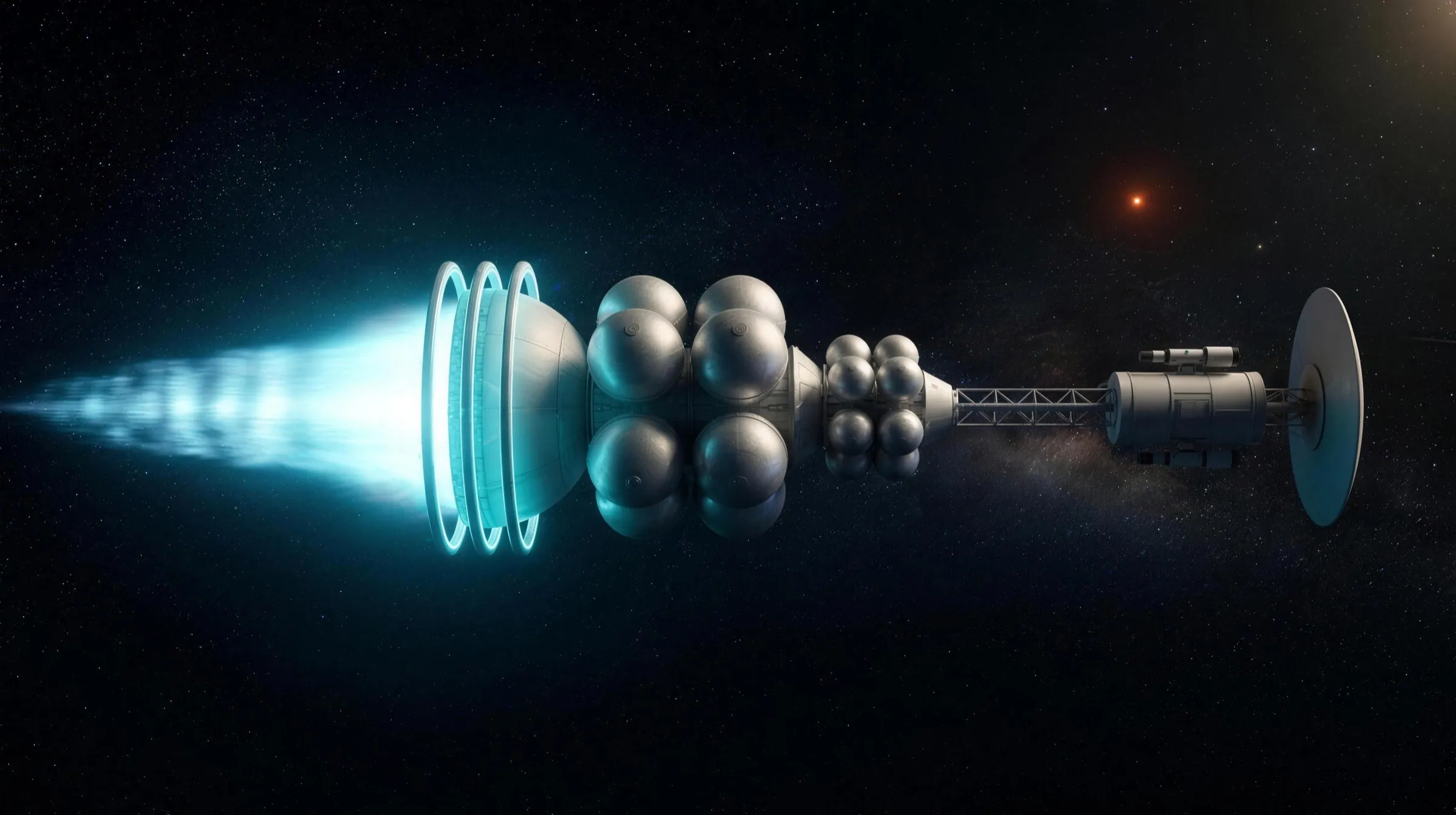
The Ship view is the 190-metre stack drawn to the report's dimensions, drive running, Barnard's Star a red point far ahead. Stage 1 is the 50-metre reaction chamber, three superconducting coil rings and six spheres holding 46,000 tonnes of cryogenic fuel; stage 2 repeats the design at three-quarter scale; forward of both sit the payload bay, two 5-metre telescopes, the ring of 18 sub-probes, the warden robots, and the beryllium erosion disc, drawn thick enough to see and labelled honest about it. Every label is clickable and carries its number from the report.
The Pulse view goes inside the stage-1 chamber, where the whole scheme lives or dies. At real speed 250 detonations a second merge into a continuous cyan exhaust; at one pulse a second you can follow individual pellets; in anatomy mode one four-millisecond cycle stretches across six seconds: the frozen pellet crosses the chamber, the diode ring fires its relativistic electrons, the surface ablates, the core lights, and the magnetic nozzle, a field, not metal, gathers the fireball and throws it backward at 10,600 km/s. Toggles strip the beams and field lines out so you can see what each part does.
The Voyage view is the mission as one draggable curve: the rocket equation climbing through 2.05 years of stage-1 burn to 7.1% of c, staging, 1.76 more years to 12.2%, then the long flat coast to a red encounter band about three days wide near year 50. A distance strip tracks the crossing from Sun to Barnard's Star; readouts derive velocity, mass, acceleration and signal delay from the same arithmetic. The braking-ledger toggle draws the case for the flyby: stopping multiplies the launch mass roughly thirty-one-fold, and the published stop-and-stay design runs past ten million tonnes.
The File view lays the case out card by card, 1973 to 2024: the thirteen volunteers, the 1978 supplement, the helium-3 problem and its Jupiter aerostats, NIF's one-shot-a-day ignition, the target's planets dissolving in 1973 and returning in 2024 as Barnard b, and the two descendants, Icarus and Starshot. Below hang the two verdict cards at equal size: what the study proved, and what fifty years have not built. This site's editorial stance, rendered as layout.
Why it's here
This station's propulsion line opens with INST-11 Project Orion: 1958, throw whole atomic bombs out the back and ride the blasts. Daedalus is that argument's direct sequel and its coming of age: the same pulse-propulsion physics, with "a bomb a second" traded for 250 fusion pellets a second imploded by electron beams, and the steel pusher plate traded for a magnetic field held open by superconducting coils. From 1973 to 1978 thirteen volunteers of the British Interplanetary Society, engineers with day jobs, spent five years of evenings computing it into a two-hundred-page engineering study, published as a JBIS supplement. It remains the first starship ever worked all the way through.
There is a deeper reason to pick it: Daedalus is the first time "is interstellar flight possible" received an engineering answer rather than a science-fiction one, and its central evidence happens to be entirely computable. The velocity curve is the rocket equation; the cost of stopping is the same equation run backward; the state of ignition has NIF's measured 2022 numbers to check against. So this bench neither celebrates the starship nor mocks it. It draws the 190-metre stack to the report's dimensions and opens it part by part, slows the four-millisecond pulse cycle to watchable speed, draws fifty years as a draggable curve, and hangs "what the study proved" and "what fifty years have not built" as verdict cards at equal size.
How it works
One equation runs the whole bench, and the panel tags every number as study, physics, modelled or reading.
Δv = vₑ ln(m₀/m₁) · stage 1: 46,000 t over 2.05 yr at vₑ = 10,600 km/s → 0.071 c · stage 2: 4,000 t over 1.76 yr at 9,210 km/s → 0.122 c · d = ∫v dt → 5.9 ly ≈ year 50 · stop: ×e^(Δv/vₑ) ≈ 31
The curve is Tsiolkovsky, pinned. Each stage burns at constant mass flow, so velocity follows the ideal rocket equation; a scale factor within a few percent of unity lands the curve exactly on the study's two milestones, absorbing the report's finer mission profile. Distance is the numeric integral, and arrival at 5.9 light-years falls where the study said it would: near year fifty.
The readouts derive, they do not decorate. Mass falls linearly with each burn and drops 1,690 tonnes at staging; acceleration is thrust over mass and never exceeds about 0.014 g; the signal-delay readout is the distance in light-years read as years. Scrub the clock and every number moves together, because they are all the same arithmetic.
The braking ledger runs the equation backward. Killing 12.2% of c with the study's own exhaust velocity costs a mass ratio of e^(Δv/vₑ) ≈ 31, so the 54,000-tonne flyby becomes a ~1.7-million-tonne stopping mission before the extra structure makes it worse. That idealisation is tagged MODELLED and drawn beside the published number: Freitas's 1980 REPRO, over 10 million tonnes. The three bars share a log scale, and the flyby explains itself.
The pulse cycle follows the report's anatomy. Inject, converge, burn, flush: the phase structure and the 250 Hz rate are the study's; the pacing is compressed or stretched to watchable speed and the dial says which is in force. The 2022 NIF result sits in the evidence table as the measured state of the art: ignition demonstrated, at one shot a day, with lasers, on the ground.
And the drawing confesses. The ship's proportions follow the report, but the shield is thickened from 7 mm to visible metres, the plumbing is schematic, and the plume is art directed by the numbers rather than a plasma solve. Every liberty is disclosed in the panel's own words, because the difference between a diagram and a painting is exactly what this instrument is about.
The masses, burns and milestones are quoted from the 1978 report; the curve, the integrals and the braking arithmetic are physics you can audit; the drawing's liberties are disclosed as modelling choices; and the NIF benchmark is a measured laboratory result. What this bench refuses to do is finish the study's sentence. "Feasible in principle" has read, for fifty years, either as the licence for every interstellar programme since or as the politest impossibility proof ever published. Both verdict cards hang in the file, and every number on this bench serves both.
The dials that decide the case
One clock, one ledger and three drive speeds, each a position from the report, not a mood.
- The mission clock. Fifty years on one slider. The first 3.81 years contain every newton the ship will ever feel; the remaining forty-six contain the mission. Scrub it once and you understand the study's quietest finding: the hard engineering is not thrust, it is time.
- The braking ledger. One toggle prices the difference between visiting a star and pausing at one: thirty-one times the launch mass, idealised, or Freitas's ten million tonnes, published. The flyby stops looking like a compromise and starts looking like the entire reason the numbers close.
- Real / 1-per-second / anatomy. The same drive at three clock speeds: a continuous cyan weather, a countable pulse, a six-second autopsy of four milliseconds. The study's whole propulsion argument lives in the anatomy pass; the other two speeds show why it adds up to a starship.
- Beams and field lines. Strip the electron beams out and the pellet crosses the chamber inert; strip the field and the fireball has no nozzle. Two toggles isolate the two inventions the entire 54,000 tonnes exists to carry.
- Labels. Ten clickable parts on the ship, six in the chamber, each carrying its figure from the report. The stack stops being a silhouette and becomes a bill of materials, which is what it always was.
The readings, as they stand
Five claims about the starship, with who argues each and where it lands. One leads and is fifty years old; three are live and share the arithmetic; one is a caution about ratios.
| Interstellar flight is feasible in principle argued by Bond & Martin, the report's stated conclusion, 1978 | LEADING | The study's own claim, and the narrowest reading of it has held for fifty years: no law of physics forbids a fusion flyby of a nearby star inside a human lifetime, and the mass budget closes on paper. Scrutiny has found optimism in the parts and no error in the principle. |
| The enabling technologies will arrive; redesign and wait argued by the Project Icarus lineage, 2009- | OPEN | The working assumption of the BIS-descended redesigns: ignition physics, rep-rate drivers and autonomous systems are engineering programmes, not miracles, and each decade's Daedalus should be redrawn with that decade's physics. NIF's 2022 ignition is this reading's best evidence, and its one-shot-a-day rate is its honest counterweight. |
| The fusion rocket is the wrong branch: leave the engine at home argued by the beamed-sail line, from Forward to Breakthrough Starshot | OPEN | The rocket equation punishes any ship that carries its own reaction mass; a laser-driven gram-scale sail carries none. Starshot's 20% c chip probes are Daedalus's numbers turned inside out, and INST-20 on this station runs that arithmetic. The two lines share a birthday: both descend from the 1978 proof that the question is engineering. |
| A 54,000-tonne ship needing Jupiter mines is a proof of impracticality argued by the standing sceptical reading | READING | The He-3 precondition makes the starship the last project of a civilisation that has already industrialised its solar system, which is an answer about civilisations, not spacecraft. On this reading the report succeeded as a boundary survey: it located interstellar flight precisely at the edge of the possible, and the edge has not moved much since. |
| Flyby science at 12% c is worth fifty years argued by questioned inside and outside the study since 1978 | OPEN | Three days of encounter for five decades of flying is the mission's most attackable ratio, and the study's own answer, 18 autonomous sub-probes flung ahead, is also its most prescient piece: machine autonomy is the one enabling technology that has substantially arrived. The ratio is on the bench; drag the clock and weigh it. |
Try this
- Let the clock run from launch without touching anything. The status bar walks BOOST 1, STAGING, BOOST 2, CRUISE while the ship view's drive burns and dies. Two years to throw away a fleet's worth of fuel, two more for the second stage, then silence at 12.2% of c. The mission's entire active life fits in the first four seconds of playback.
- Open the anatomy pass and watch one pellet die. Injection, the converging beams, the flash, the field-guided flush. Then switch to REAL and watch 250 of those a second merge into weather. The jump between those two clock speeds is the jump the study asks of engineering: NIF fires once a day.
- Drag the scrubber to year 25 and read the verdict. Mid-cruise: the telescopes have just started surveying a system nobody on Earth can see as well, the wardens are patrolling, and the signal delay reads two and a half years. Nothing is happening, and nothing may interrupt: this is what most of a starship mission is.
- Park the clock on the encounter and count the days. The red band near year 50 is about three days wide. Half a century of flying, sized against it on the same axis. Then find the probe window just before it: the study's answer, and the one piece of Daedalus the following fifty years actually delivered.
- Toggle the braking ledger and read the three bars aloud. Fifty-four thousand tonnes to wave; one point seven million to stop, idealised; ten million published. The log scale is doing its best and the bars still will not fit politely. This is the rocket equation's opinion of staying, and it is the whole case for the flyby.
- End in the File and read the two cards. A study that proved the crossing violates nothing, and a fifty-year ledger of technologies that have not arrived. Between them sits the target itself, whose planets dissolved in 1973 and returned in 2024. Every instrument on this station eventually reaches a fork like this; this is the one where both tines are engineering.
Accuracy
The honest line between what the study designed, what physics derives, what is modelled here, and what is a reading:
| Feature | Tier | What that means |
|---|---|---|
| The vehicle and the mission | T2 Study | Every mass, dimension, burn time, thrust and exhaust velocity, the 250 Hz pellet rate, the payload list, the warden robots, the beryllium shield, the Jupiter He-3 aerostats, and the two speed milestones (7.1% c at staging, 12.2% c at burnout): all from Bond & Martin's 1978 final report, quoted as designed, not certified as buildable. |
| The voyage curve | T1 Physics | Velocity follows the ideal rocket equation at constant mass flow per stage, scaled a few percent to land exactly on the study's milestones; distance is the numeric integral; arrival at 5.9 light-years falls near year 50. Acceleration, mass and signal-delay readouts derive from the same arithmetic. Nothing here needs fusion to work: it is Tsiolkovsky, auditable on paper. |
| The braking ledger | T1 Physics | Stopping from 12.2% c with the study's own exhaust velocity multiplies launch mass by e^(Δv/vₑ) ≈ 31: about 1.7 million tonnes idealised, ignoring the extra structure that would make it worse. Freitas's published 1980 deceleration variant, REPRO, exceeded 10 million tonnes. The flyby is arithmetic, not timidity. |
| The ignition benchmark | T1 Measured | In December 2022 the National Ignition Facility achieved the first laboratory pellet ignition: fusion energy out exceeding laser energy in, target gain about 1.5, roughly one shot per day, with lasers rather than electron beams, in a facility that does not fly. A real measured milestone, and a real measured gap of several orders of magnitude. |
| The target's planets | T2 Study | Barnard's Star was chosen partly on van de Kamp's claimed astrometric planets, which dissolved into a telescope artifact in 1973, the year the study began. In 2024 ESPRESSO confirmed the real sub-Earth Barnard b. Both turns are quoted in the file view as the record states them. |
| The ship drawing | T2 Modelled | Proportions follow the report but plumbing, radiators and rails are schematic; the 7 mm beryllium shield is drawn metres thick to be visible; the exhaust plume and plasma fireball are art directed by the numbers, not plasma solves. Each liberty is disclosed in the panel. |
| The pulse pacing | T2 Modelled | The real cycle is about 4 milliseconds. The three clock speeds (250 Hz shimmer, one pulse per second, slow anatomy) compress or stretch it to watchable rates, and the dial says which is in force. The phase structure (inject, beams, burn, magnetic flush) follows the report's description. |
| What "feasible in principle" is worth | T3 Reading | Proof that the crossing is engineering rather than magic, or a polite demonstration that the engineering is civilisation-sized: the two readings share every number on this bench. The file view hangs both verdict cards at equal size and adds no third. |
In one line: the vehicle, the drive and the mission milestones are quoted from the 1978 BIS final report and tagged as the study's design; the velocity curve, the distance integral, the braking arithmetic and the NIF benchmark are physics and measurement you can audit; the drawing's proportions, plume art and slow-motion pacing are disclosed modelling choices; and whether "feasible in principle" reads as a licence or as the politest impossibility proof is a reading, on which the report's heirs and its sceptics have disagreed for fifty years, which is precisely why this instrument belongs on this station. Drag the fifty years and decide for yourself.
Sources
- Bond, A. & Martin, A. R. (eds.), "Project Daedalus: The Final Report on the BIS Starship Study", Journal of the British Interplanetary Society Supplement, 1978. Every vehicle, propulsion and mission number on this bench: masses, burn times, exhaust velocities, thrusts, the 250 Hz pellet rate, the payload, the shield, the wardens, the Jupiter aerostats, the milestones.
- Martin, A. R. & Bond, A., the Daedalus papers in JBIS vols. 29-31 (1976-1978): the propulsion, structure and navigation studies the supplement collects.
- Freitas, R. A. Jr., "A Self-Reproducing Interstellar Probe", JBIS 33, July 1980: the REPRO deceleration-and-factory variant exceeding 10 million tonnes, quoted in the braking ledger.
- Lawrence Livermore National Laboratory, National Ignition Facility results of 5 December 2022 (announced 13 December 2022): first laboratory fusion shot with target gain above 1 (~1.5), the bench's measured ignition benchmark.
- González Hernández, J. I. et al., "A sub-Earth-mass planet orbiting Barnard's star", Astronomy & Astrophysics, 2024 (ESPRESSO/VLT): Barnard b confirmed; with the 1973 resolution of van de Kamp's astrometric planets as instrumental artifacts (Gatewood & Eichhorn; Hershey).
- Project Icarus (2009-, British Interplanetary Society / Icarus Interstellar) and Breakthrough Starshot (2016-): the study's two live descendants, cross-referenced to INST-20.
- The site wiki cluster: the British Interplanetary Society, Project Orion, nuclear pulse propulsion, Barnard's Star, Breakthrough Starshot.
Fly the stack. The physics permits it; the price tag is the case.
Open the interactiveCompiled July 2026