Project Stargate
From 1972 to 1995 the United States paid about twenty million dollars, through six code names and two laboratories, to find out whether a person in a sealed room can describe a place they have never seen. The protocol was clean on paper: targets drawn by a randomizer, viewers isolated, transcripts ranked blind against four candidates, chance at exactly 25 percent. The claimed result, by the end, was a hit rate near 32. Seven extra hits per hundred: that sliver is the entire empirical residue of a 23-year program. In 1995 the CIA asked two scholars to read the file. The statistician concluded the effect was real, far beyond what chance expects. The psychologist agreed the numbers were real and refused the conclusion. This instrument builds the machine those two verdicts share: run the protocol, watch chance build its bell, weigh the claimed margin against it, then open the leaky lab and see what procedure alone can buy. The file is open, and the reading is yours.
 Open the interactive ▸
 What you're looking at
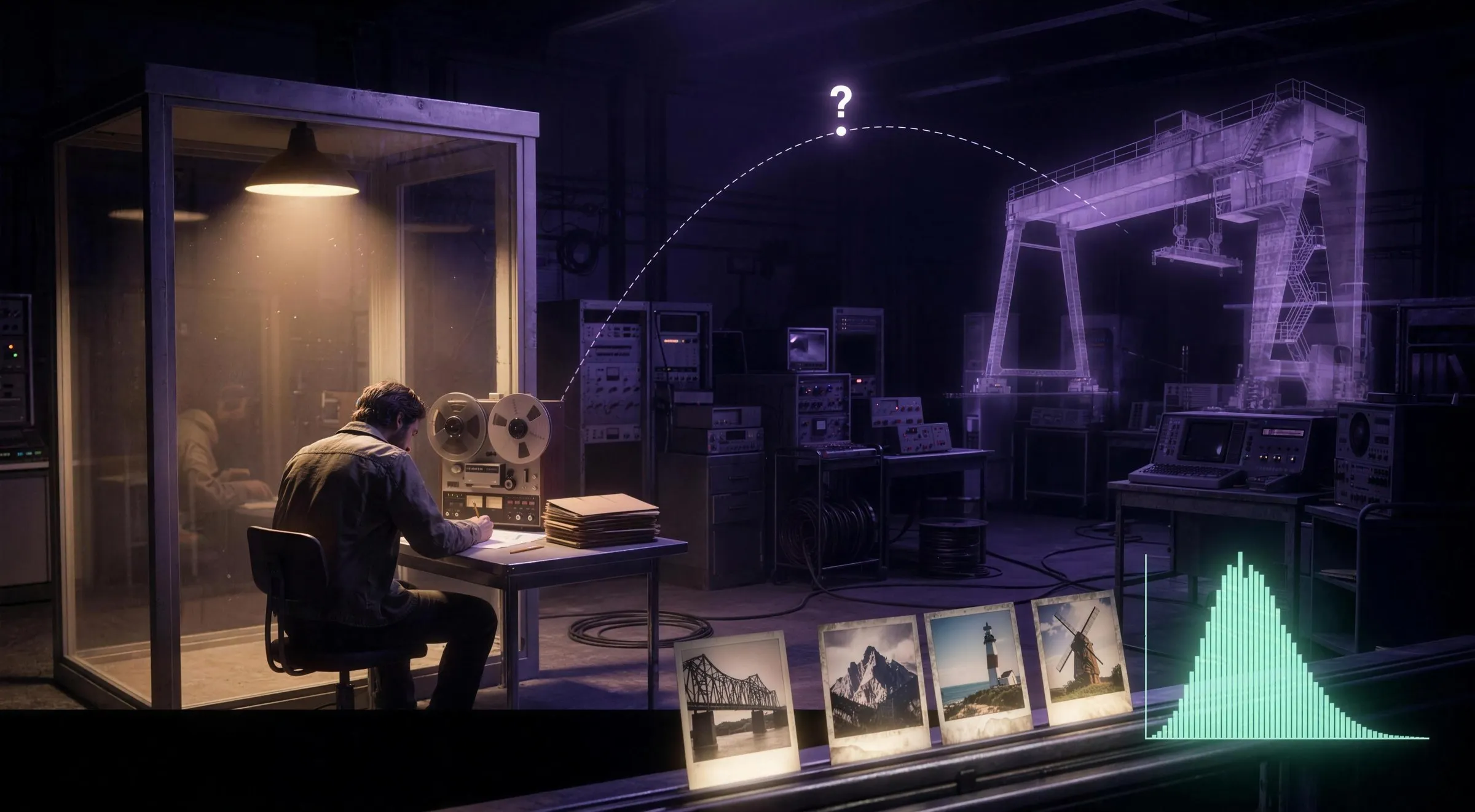
The Protocol view is one remote-viewing trial as a physical machine, on a dark stage under a violet lamp. A randomizer ring spins over a pool of four targets; one card travels, sealed, to the site pedestal; in a translucent booth the viewer's pen fills a sheet; the transcript then flies to the judge's table, where four candidates rise and take their ranks, and a beacon flashes mint for a hit, coral for a miss. Every station wears a label you can click: the booth explains sensory isolation, the randomizer explains why honesty lives there, the judge explains rank-of-4 and why chance is exactly 25% by construction. One line is drawn dashed with a question mark over it: the claim itself. Single trials, you will notice, look identical in every world.
The Chance Machine is the heart of the bench. Every series of trials drops as a glowing ball into a histogram bin, and the pile converges on the binomial bell around the mint 25% line. Two markers stand over the board: manila at 32.2%, the autoganzfeld record, and violet at 33.7%, Utts' effect size 0.2 mapped onto the same axis. Choose your world, pure chance, the claimed rate, or a free dial, and run: at small N the worlds are indistinguishable, and as trials mount, the z readout against the 25% baseline hardens. The whole historical argument is visible as geometry: the claimed margin is one bin wide, and its significance is entirely a function of how many times you sample it.
The Leaky Lab is the counter-argument, built. Two laboratories run side by side in a world with zero psi: the clean one keeps the protocol and its pile sits obediently on the mint line; the leaky one has five switches, each a documented critique mechanism, sensory cues on handled targets, sloppy randomization, a judge who is not quite blind, series stopped while ahead, and failures left in the file drawer. Flip them and watch the coral pile drift onto the manila line: a headline effect, manufactured from procedure alone. The panel is explicit about what this proves and what it does not: leaks can buy the margin; whether they did is exactly what the two 1995 verdicts dispute.
The File view lays the program out card by card. The code-name lineage runs along a timeline, SCANATE through GRILL FLAME and SUN STREAK to STAR GATE. Below it hang the two verdict cards, quoting Utts and Hyman on the same dataset, side by side and at equal size, which is this site's entire editorial stance rendered as layout. Three smaller cards hold the celebrated ops stories at the arm's length the file itself holds them, the customer's verdict that closed the program, and the archive: about twenty million dollars, six code names, 89,000 pages, public since 2017. Click any card to read more.
Why it's here
On this site's culture shelf sits a review of Stranger Things: a show that weaves MKUltra, sensory-deprivation tanks and a psychic child into small-town horror. That review carries three tags: MKUltra, remote viewing, Stargate. This instrument opens the most computable of the three. Project Stargate is the real file that fiction loves to cite: the government really paid, the experiments really ran for twenty-three years, and the archive really went public in 2017. And its lasting legacy is not any single viewing; it is a statistical argument, in which two respected scholars read one dataset and signed opposite conclusions.
It is also this station's first instrument to touch the government-programs half of the archive, and its first instrument of pure statistics. There is a deeper reason to pick it: the side-by-side Utts and Hyman conclusions in the 1995 AIR review are the real-world prototype of this site's neutral-curation stance. This site's method is to summarise, attribute and leave the verdict to the reader; that review is what the method looks like inside a federal document. So this bench does not adjudicate remote viewing. It builds the 25% baseline as a machine you can crank, draws the claimed 32% as a line you can weigh with your own eyes, turns the critique literature's flaws into five switches you can flip, and hangs the two verdicts side by side, quoted.
How it works
One protocol and one distribution run the whole bench, and the panel tags every number as measured, reported, modelled or read.
hit = rank 1 of 4 ⇒ p₀ = 25% · series: X ~ Binomial(n, p) · z = (X − Np₀)/√(Np₀q₀) · claimed: 32.2% (106/329) · ES 0.2 ⇒ 33.7%
The baseline is arithmetic. The judge must rank exactly four candidates, so a first-place match by pure guessing is exactly one in four. Nothing about remote viewing needs to be believed or doubted to accept this number; it is the construction of the experiment. Every z the bench prints is measured against it.
The worlds are explicit. A world is nothing but a true hit probability: 25% for pure chance, 32.2% for the claimed autoganzfeld rate played back as if true, or any rate you set on the dial. The bench's point is epistemic: the dial is invisible from inside the data. All anyone ever sees is the pile, and the game is inferring the dial from it.
The statistics are live, not scripted. Trials are real Bernoulli draws; histograms accumulate real runs; z = (X − Np₀)/√(Np₀q₀) and the one-sided p are recomputed from the actual tallies as you watch. Occasionally a pure-chance run will clear three sigma in front of you. The bench does not prevent this; it is the honest price of sampling, and the verdict line will tell you what you just saw.
The leaks are mechanisms, not slanders. Each switch implements a critique that exists in print: cues and randomization from Hyman's 1985 appraisal and the 1986 joint communiqué, judging concentration from his 1995 review, optional stopping and the file drawer from the general methodological literature. Their magnitudes here are illustrative round numbers, tagged MODELLED, because the historical sizes are exactly what nobody can measure anymore.
And the verdicts are quoted, not summarised. The two AIR conclusions appear as written, at equal visual weight, with their agreements preserved: both signatories accepted that the departures were too large for statistical flukes. Where they part, on whether that establishes psychic functioning, the bench stops with them.
The baseline is arithmetic, the claimed margins are quoted from their publications, the machinery is live probability you can audit, the leak sizes are disclosed illustrations, and the verdicts are two real signatures on one real document. What this bench refuses to do is add a third signature. The program's legacy is a perfect specimen of the hardest question in any anomaly file: not "are the numbers strange" but "what earned the strangeness". Twenty-three years bought seven extra hits per hundred and two readings of them. Both readings are here, running.
The dials that decide the case
Three worlds and five leak switches, each a published position, not a mood.
- Chance, 25%. The null world. Run it long and the pile becomes the binomial bell around the mint line: the shape of pure luck, including the outlier sessions that would each make a headline alone. This is the default, because the default should be the null.
- Claimed, 32.2%. The autoganzfeld record, 106 hits in 329 sessions, played back as if it were the truth of the world. The pile shifts right by barely one bin, and z climbs anyway as N grows: the whole Utts argument in one animation.
- The free dial. Set any true rate from 15 to 45 percent and discover how many trials separate "invisible" from "undeniable". The dial nobody in the real story could see is the one you get to hold.
- The five leaks. Sensory cues, sloppy randomization, an unblind judge, optional stopping, the file drawer. Individually worth a few points each; together they carry a zero-psi lab to the claimed line. The switches demonstrate capability, and the panel is explicit that capability is not history.
- Series length. Eight to sixty trials per filed series. Shorter series make wilder piles and better outlier anecdotes; longer series tame them. A quiet lesson in why anecdote and aggregate disagree so reliably.
The readings, as they stand
Five claims about the program, with who argues each and where it lands. One is settled and closed the program; three are live and share the statistics; one is a reading the record never paid for.
| As intelligence, it was useless: close the program argued by the AIR programme review (Mumford, Rose & Goslin, 1995); the CIA | LEADING | The one verdict nobody managed to dispute. The users of the product told the reviewers the reports were vague, ambiguous, and never used alone to guide an operation. The CIA accepted the recommendation and closed the program in 1995. Note its limits: it is a verdict on usefulness, not on whether anything anomalous occurred. |
| The statistical effect is real: "far beyond what is expected by chance" argued by Jessica Utts (AIR 1995); Radin; May and the SAIC continuity | OPEN | The strongest pro reading, made by a professional statistician on the program's own data: small margins, large N, consistency across labs, effect sizes near 0.2 for the experienced viewers. Her recommendation was further research. The chance machine view is her argument, runnable. |
| The numbers are real, the conclusion is not warranted argued by Ray Hyman (AIR 1995) | OPEN | The co-reviewer's counter-reading, and the site's reason this case is here: he conceded the departures were too large for statistical flukes, agreed real effects were occurring, and then refused the final step, citing one lab, few viewers, concentrated judging, reused targets and no independent replication. The leaky lab view is his ledger, runnable. |
| The effect fails replication argued by Milton & Wiseman, Psychological Bulletin (1999); the subsequent ganzfeld argument | OPEN | The post-mortem decade: a meta-analysis of thirty new ganzfeld studies found no significant effect, answered in turn by Bem, Palmer & Broughton with a standardness analysis that restored it. The dispute moved from the lab to the meta-analysis and stayed there. Both directions are cited in the sources. |
| The ops legends prove it worked argued by the memoir literature: McMoneagle, Smith, Targ; the documentary retellings | READING | Unpaid on the record as written. The crane and the Typhoon are genuine archive stories, but each survives as after-action retelling, the AIR review found the operational record far weaker than its best anecdotes, and no tasking ever relied on remote viewing alone. The legends card in the File view holds them at arm's length, which is where the file itself holds them. |
Try this
- Watch one full trial without touching anything. The randomizer picks, the viewer sketches, the transcript flies, the judge ranks, the beacon flashes. Then ask yourself the only question that matters at this scale: was that a psychic world or a chance world? You cannot know. That impossibility is the reason the rest of the bench exists.
- Run 200 series of pure chance. In the Chance Machine, chance world, hit the burst button and read the pile: sessions at 36% and 40% are sitting there, earned by nobody. Any one of them, alone, is a convincing story. The pile is the antidote to the story.
- Switch to the claimed world and find the difference. Same machine, 32.2%. The pile moves one bin to the right. Stand back and honestly ask whether your eye could tell these two piles apart. Then watch the z readout, which can.
- Let sigma do its slow work. Stay in the claimed world at MAX speed. z passes 3, then 5; the one-sided p acquires exponents. Nothing about the margin changed, only N. That is Utts' entire case, and it is not wrong: at face value, chance is dead. The question that survives is the face value.
- Buy the margin with procedure. In the Leaky Lab, turn on cues and the unblind judge, then add the file drawer. Watch the coral pile reach 32% in a world containing zero psi, and watch the drawer counter count what was never filed. This is Hyman's ledger as a physical object.
- End in the File and read both cards aloud. Utts first, then Hyman, or the other way around. Notice they agree on the arithmetic and part on one sentence. Every anomaly file on this station eventually reaches this exact fork; this is the case where the fork got two federal signatures.
Accuracy
The honest line between what is measured, what the record reports, what is modelled here, and what is a reading:
| Feature | Tier | What that means |
|---|---|---|
| The 25% baseline | T1 Measured | A hit is the blind judge ranking the true target first among four candidates, so chance is exactly one in four by construction. This is arithmetic, not a survey result, and it is the one number in the whole file with no error bar. |
| The binomial machinery | T1 Measured | Series of n Bernoulli trials, histograms converging on Binomial(n, p), z = (X − Np₀)/√(Np₀q₀) against p₀ = 0.25, one-sided p from the normal tail. Every z and p the bench prints is computed live from its own runs, and you can check it by hand. |
| The claimed margins | T2 Reported | The CLAIMED world plays back 32.2%: the autoganzfeld record of 106 hits in 329 sessions (Bem & Honorton 1994). The second marker is Utts' effect size of about 0.2 for the experienced SRI/SAIC viewers (AIR 1995). Both are quoted as published; neither is this site's estimate. |
| The ES-to-hit-rate mapping | T2 Modelled | Utts reported an effect size, not a rank-4 hit rate. The bench maps ES 0.2 to 33.7% via p = p₀ + ES·√(p₀q₀) so it can live on the same axis, and tags that mapping as a modelling choice wherever it appears. |
| The leaky lab's switches | T2 Modelled | Sensory cues, sloppy randomization, an unblind judge, optional stopping and the file drawer are all documented mechanisms from the published critiques (Hyman 1985 and 1995, the joint communiqué, Milton & Wiseman 1999, the file-drawer literature). Their sizes here, a few percentage points each, are illustrative round numbers chosen to show direction, and the panel says so. |
| The trial theatre | T2 Modelled | The protocol view draws the viewer's sketch after the outcome is decided, which reverses the real order of events for the sake of the show; real transcripts were pages of fragments, not one pictogram. The dashed question mark over the channel is an editorial mark, not apparatus. |
| The two verdicts and the customer's finding | T2 Reported | Utts: "well established... far beyond what is expected by chance." Hyman: departures "too large and consistent to attribute to statistical flukes... does not warrant the conclusion." The programme half of the AIR review: reports vague and ambiguous, never used alone to guide an operation. All three are quoted from the 1995 documents. |
| The operational legends | T3 Reading | Price's Semipalatinsk crane, McMoneagle's Typhoon, the Iran hostage sessions. Each survives as after-action retellings of varying quality, celebrated in the memoir literature and deflated in the reviews. The bench keeps them in one card, tagged as what they are. |
| What the margin was | T3 Reading | Psi, or procedure: the two readings that split the 1995 review still split the literature. The instrument prices both, demonstrates that leaks can manufacture the margin, quotes those who conclude they did and those who conclude they did not, and buys neither. |
In one line: the 25% baseline and the binomial machinery are arithmetic you can audit; the claimed margins, 32.2% autoganzfeld and effect size 0.2, are quoted from their publications and tagged as reported; the leak switches implement documented critique mechanisms at illustrative sizes and are tagged as modelled, as is the trial theatre that draws the sketch after the verdict; the operational legends are retellings and are shelved as readings; and the two 1995 verdicts are quoted verbatim, at equal weight, because two qualified reviewers read one dataset and signed opposite conclusions, which is precisely why this case belongs on this station. Run the machine and decide for yourself.
Sources
- Utts, J. "An Assessment of the Evidence for Psychic Functioning" (AIR, 1995). The pro verdict, quoted verbatim: "well established... far beyond what is expected by chance"; the ES ≈ 0.2 figures for the experienced viewers.
- Hyman, R. "Evaluation of the Program on Anomalous Mental Phenomena" (AIR, 1995). The counter verdict, quoted verbatim, plus the ledger this bench builds its leaky lab from: one lab, few viewers, concentrated judging, no independent replication.
- Mumford, M., Rose, A. & Goslin, D. "An Evaluation of Remote Viewing: Research and Applications" (American Institutes for Research, 29 Sept 1995). The programme review: vague, ambiguous, never used alone; the recommendation to terminate.
- Bem, D. & Honorton, C. "Does Psi Exist? Replicable Evidence for an Anomalous Process of Information Transfer", Psychological Bulletin 115:1 (1994). The autoganzfeld: 106 hits in 329 sessions, 32.2%, the bench's CLAIMED world.
- Hyman, R. "The Ganzfeld Psi Experiment: A Critical Appraisal", Journal of Parapsychology 49 (1985), and Hyman & Honorton, "A Joint Communiqué" (1986). The randomization and cue critiques, and the protocol standards they produced.
- Milton, J. & Wiseman, R. "Does Psi Exist? Lack of Replication of an Anomalous Process of Information Transfer", Psychological Bulletin 125:4 (1999); and Bem, Palmer & Broughton's 2001 reply. The replication fight after the program closed.
- Targ, R. & Puthoff, H. "Information transmission under conditions of sensory shielding", Nature 251 (1974). Where the SRI work went public; the paper the whole lineage cites.
- Puthoff, H. "CIA-Initiated Remote Viewing at Stanford Research Institute", Journal of Scientific Exploration 10:1 (1996). The founder's history: SCANATE, Price, the early coordinates work.
- The Star Gate collection, CIA FOIA reading room (released January 2017, ~89,000 pages): session transcripts, tasking memos, programme reviews, the code-name lineage.
- Smith, P. H. Reading the Enemy's Mind (2005), and McMoneagle, J. Memoirs of a Psychic Spy (2002/2006). The inside retellings of Fort Meade, the Typhoon claim, the Iran hostage sessions, read here as memoir.
- Signals from the Periphery: the Culture 13 review of Stranger Things, and the wiki cluster on the Stargate program, remote viewing, the AIR review, and the named viewers and cases.
Run the protocol. Chance earns 25 either way; the argument is about seven hits per hundred.
Open the interactiveCompiled July 2026