Quantum Eraser
Tag which slit a photon took and the double-slit fringes die. Erase the tag and they come back, but only when you sort the hits by the eraser’s two channels. The whole screen is always flat. And the choice can wait until after the photon has landed.
 Open the interactive ▸
 What you're looking at
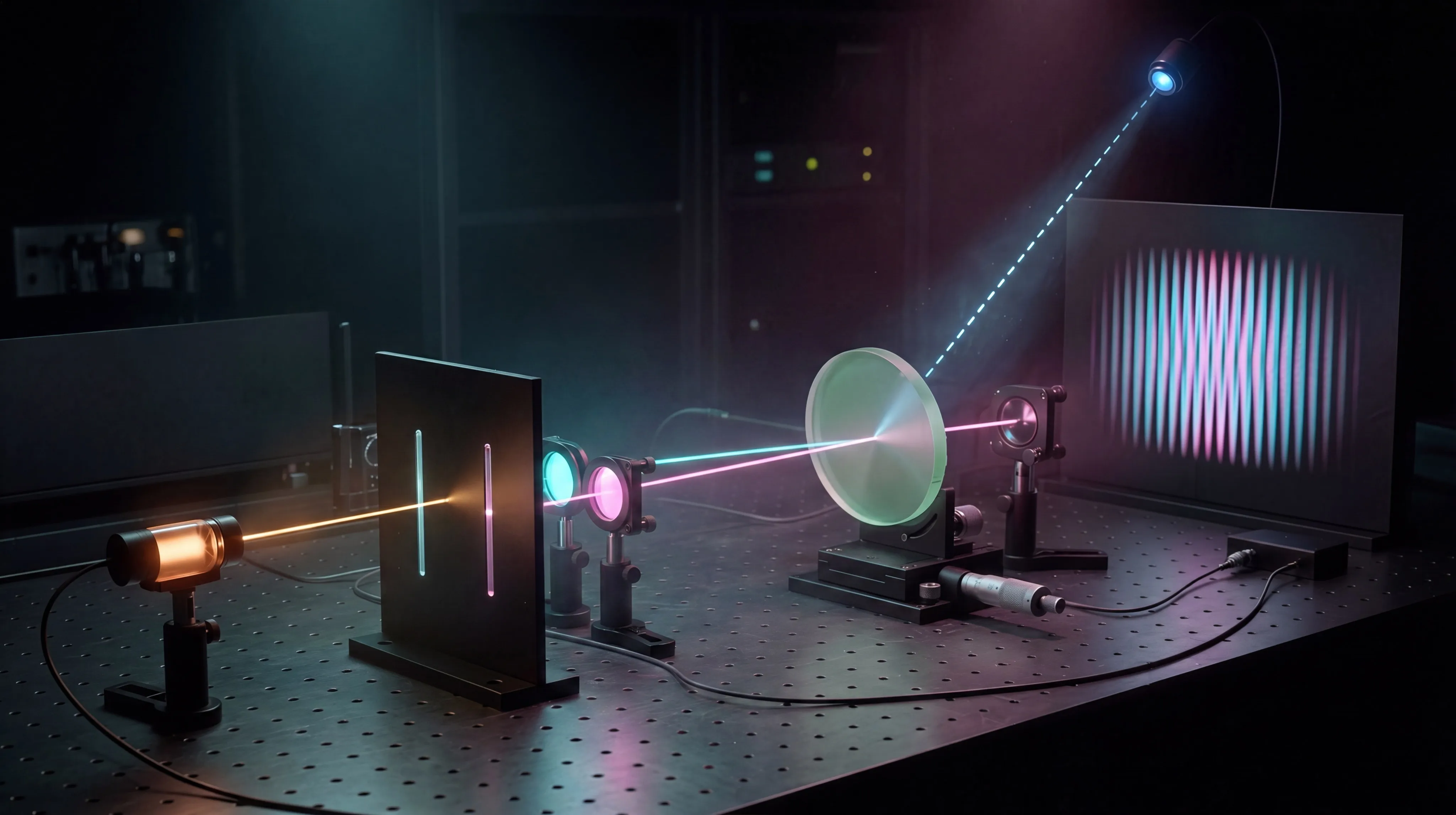
Two panels, one experiment. Along the top, a not-to-scale schematic: a source on the left, a barrier with two slits, and a screen on the right. Below is that screen seen face-on, filling in dot by dot as photons arrive. It is the Double-Slit apparatus with two parts added: a which-path marker just behind the slits, and a 45° eraser in front of the screen.
There are three configurations on the bench, and two ways to read the screen. ① Open: no marker, and the dots stack into bright fringes, a wave through both slits. ② Mark the path: put an H polarizer behind one slit and a V behind the other, and the fringes die, though no one has looked. ③ Erase: slide the diagonal analyzer in. Now the View switch is the whole point: on the combined screen, every photon counted together, the pattern stays flat; switch to the sorted ± channels and the same hits split by the analyzer’s two outputs, one channel a fringe, the other its exact anti-fringe.
The two colours are the eraser’s + and − channels. Watch what they do: separately, each is striped; added together, they fill each other’s gaps and the screen is featureless again. You can turn the marker and eraser on and off yourself, drag the analyzer angle φ from 0° to 45°, switch between the combined and sorted views, and turn on the delayed choice, where the erase decision rides a distant idler and can be made after the photon is already recorded.
Why it's here
The Double-Slit shows that looking erases the wave. The obvious next question is the one this experiment asks: if knowing the path kills the fringes, can un-knowing it, erasing the which-path record after the fact, bring them back? The honest answer is stranger and quieter than the headlines. Yes, and no.
It belongs with the site’s other quantum instruments (Entanglement, Tunnelling, Uncertainty) because it is where the double-slit’s "only mystery" is most often mis-sold. The quantum eraser is real, confirmed, and routinely dressed up as retrocausation, choices in the present rewriting the past. The interactive is built to show exactly why that reading is wrong while keeping every genuinely strange thing about it. Nothing here needs a mind, a consciousness, or a message sent backward in time.
How it works
Start from the far-field double-slit intensity: env(y)·[1 + cos δ], the single-slit envelope times the two-slit interference, with phase δ = 2πd·sinθ/λ. That is configuration ①, full fringes.
The marker puts orthogonal polarizations behind the slits, H on one, V on the other. The photon’s path is now written into a degree of freedom that could be read, so the two paths no longer share a state that can interfere. The pattern collapses to a plain env(y). Crucially, this happens whether or not anyone measures the polarization: distinguishability, not observation, is what matters.
The eraser is a polarizer (analyzer) set at angle φ in front of the screen, with two outputs, call them + and −. Projecting the H/V tags onto that common basis gives P±(y) ∝ env(y)·[1 ± sin(2φ)·cos δ]. At φ = 45° the two channels are a full fringe and a full anti-fringe; at φ = 0 the analyzer just re-reads the path and both channels go flat. The sorted visibility is V = |sin 2φ|.
Now the point the demonstrations are built around: P₊ + P₋ = 2·env(y). The combined screen, every photon regardless of channel, is always flat once the path was tagged. The fringes exist only inside the correlation between where a photon landed and which channel it went to. That is why the delayed choice is harmless: you can decide whether to erase after the signal photon is detected, because you are not changing its landing spot, you are choosing how to sort a list you will read later. No record on the screen alone ever shows a fringe, so nothing has been signalled and nothing has been undone.
The formulas, the flat total, the V = sin2φ trade and the complementarity bound are the exact, established physics. What the simulation stylises is the staging: a single photon source stands in for entangled signal/idler pairs, the ± channels stand in for coincidence counting, and the apparatus is a legible cartoon. None of that changes the verdict the experiment has returned since 1982: erasing reveals a hidden fringe, it does not rewrite the past.
Three configurations, two views
- ① Open: no marker, both paths indistinguishable. Full interference, the ordinary double-slit. Fringes.
- ② Mark the path: H behind one slit, V behind the other. The path is knowable, so the wave cannot interfere with itself. Flat, no one looked.
- ③ Erase: a 45° analyzer erases the tag. Still flat, so long as you count every photon together.
- View: combined → sorted ±: the same hits, split by the analyzer’s + and − outputs. Fringe and anti-fringe, summing back to flat.
Accuracy
The honest line between what is exact and what is staged for display:
| Feature | Tier | What that means |
|---|---|---|
| Marked pattern is flat: tagging the path (H/V behind the slits) destroys the fringes | T1 Established | A which-path marker need never be read to kill interference; making the path knowable is enough. Confirmed in every marker realisation (Walborn 2002; Dürr–Nonn–Rempe 1998). |
| Erased subsets: P±(y) ∝ env·[1 ± sin(2φ)·cos δ] | T1 Established | A diagonal analyzer at angle φ projects the H/V tags onto a common basis. The two output channels carry a fringe and an anti-fringe, exactly out of step. |
| The combined screen is ALWAYS flat: P₊ + P₋ = 2·env | T1 Established | This is the anti-mystery. Erasing restores nothing you can see in the raw counts; the total never interferes once a path was tagged. Only the sorted subsets do. |
| Sorted-fringe visibility V = |sin 2φ|; complementarity V² + D² ≤ 1 | T1 Established | φ = 0 reads the path (V = 0, full which-path); φ = 45° fully erases it (V = 1). The trade is the Englert (1996) bound, made continuous by the slider. |
| Delayed choice: erase-or-not can be decided after the signal is detected | T1 Established | Demonstrated with entangled pairs and a distant, sometimes causally-disconnected idler (Kim 2000; Ma–Zeilinger 2013). The result is identical to the non-delayed case. |
| What "erasure" means about reality; whether the past is "changed" | T2 Theoretical | It is not. No information travels back; the sorting only reveals a correlation already fixed in the joint record. But what the wavefunction is remains interpretation-dependent, as on the Double-Slit page. |
| One photon source; a single clean analyzer angle φ | T3 Stylised | A lab eraser uses entangled signal/idler pairs and coincidence counting between two detectors; here the ± channels stand in for that partition. The physics of the pattern is faithful. |
| Real-scale figures (fringe spacing Δy = λL/d), beam speed, slit sizes | T3 Stylised | Geometry is order-of-magnitude honest from λ = 632.8 nm; the slit widths are drawn to human scale and the dots accumulate far faster than any single-photon source. |
| The apparatus cartoon, the marker ticks, the rotating eraser bar | T4 Illustrative | A schematic, not to scale: the top strip shows source → tagged slits → analyzer → screen so the parts are legible. Faithful to the logic, not the optical layout. |
In one line: the marked pattern going flat, the P±(y) fringe/anti-fringe split, the always-flat total, V = sin2φ and the delayed choice are exact, established physics; only the single-photon staging, the ± channels standing in for coincidence counting, and the apparatus cartoon are simplified so you can watch what the equations say. What none of it means is a message sent to the past.
Sources
- Scully, M. O., & Drühl, K. (1982). Quantum Eraser: A Proposed Photon Correlation Experiment Concerning Observation and "Delayed Choice" in Quantum Mechanics. Phys. Rev. A 25, 2208. The original proposal.
- Englert, B.-G. (1996). Fringe Visibility and Which-Way Information: An Inequality. Phys. Rev. Lett. 77, 2154. The V² + D² ≤ 1 bound the eraser rides.
- Dürr, S., Nonn, T., & Rempe, G. (1998). Origin of Quantum-Mechanical Complementarity Probed by a "Which-Way" Experiment in an Atom Interferometer. Nature 395, 33. Marking without momentum kick still kills fringes.
- Kim, Y.-H., Yu, R., Kulik, S. P., Shih, Y., & Scully, M. O. (2000). Delayed "Choice" Quantum Eraser. Phys. Rev. Lett. 84, 1. The canonical entangled-photon realisation with coincidence counting.
- Walborn, S. P., Terra Cunha, M. O., Pádua, S., & Monken, C. H. (2002). Double-Slit Quantum Eraser. Phys. Rev. A 65, 033818. Quarter-wave plates tag the paths; a polarizer erases. The layout closest to this sim.
- Jacques, V., et al. (2007). Experimental Realization of Wheeler’s Delayed-Choice Gedanken Experiment. Science 315, 966. Single photons, the choice made after entry.
- Ma, X.-S., et al. (2013). Quantum Erasure with Causally Disconnected Choice. PNAS 110, 1221. The erase decision spacelike-separated from the detection.
Erasing reveals a hidden fringe. It does not rewrite the past.
Open the interactiveCompiled July 2026