The Rendlesham Light
In the last week of December 1980, American security police walked out of RAF Woodbridge's East Gate, into a dark pine plantation, after lights. Twice. What came back was Britain's most famous UFO case: a landed craft touched by hand, landing marks, radiation, a red winking eye that dripped light, beams from the sky. This bench does what should have been done that January: it runs the numbers, all of which survive. The claimed site sits 8.56 kilometres due west of the third-brightest lighthouse in England, whose five-million-candela flash swept past that forest edge every five seconds, at eye height, because Rendlesham Forest stands higher than the coast. The bearing matches within a night compass's error; the tape's own calls beat at five seconds; the airmen's handwritten statements from night one say the word lighthouse themselves; the fireball that opened the case is in the British Astronomical Association's log; the radiation readings never reached the first graduation of an unsuitable meter that read the same half a mile away; and the star-like objects Halt tracked for hours stand, computed, exactly where Sirius, Vega and Deneb stood. And yet: one airman has never withdrawn his craft, another was disabled by that duty formally enough for his government to pay for it, and the official file has a hole the MoD itself called huge. The bench prices the light. It cannot price the men. Two verdicts, equal size.
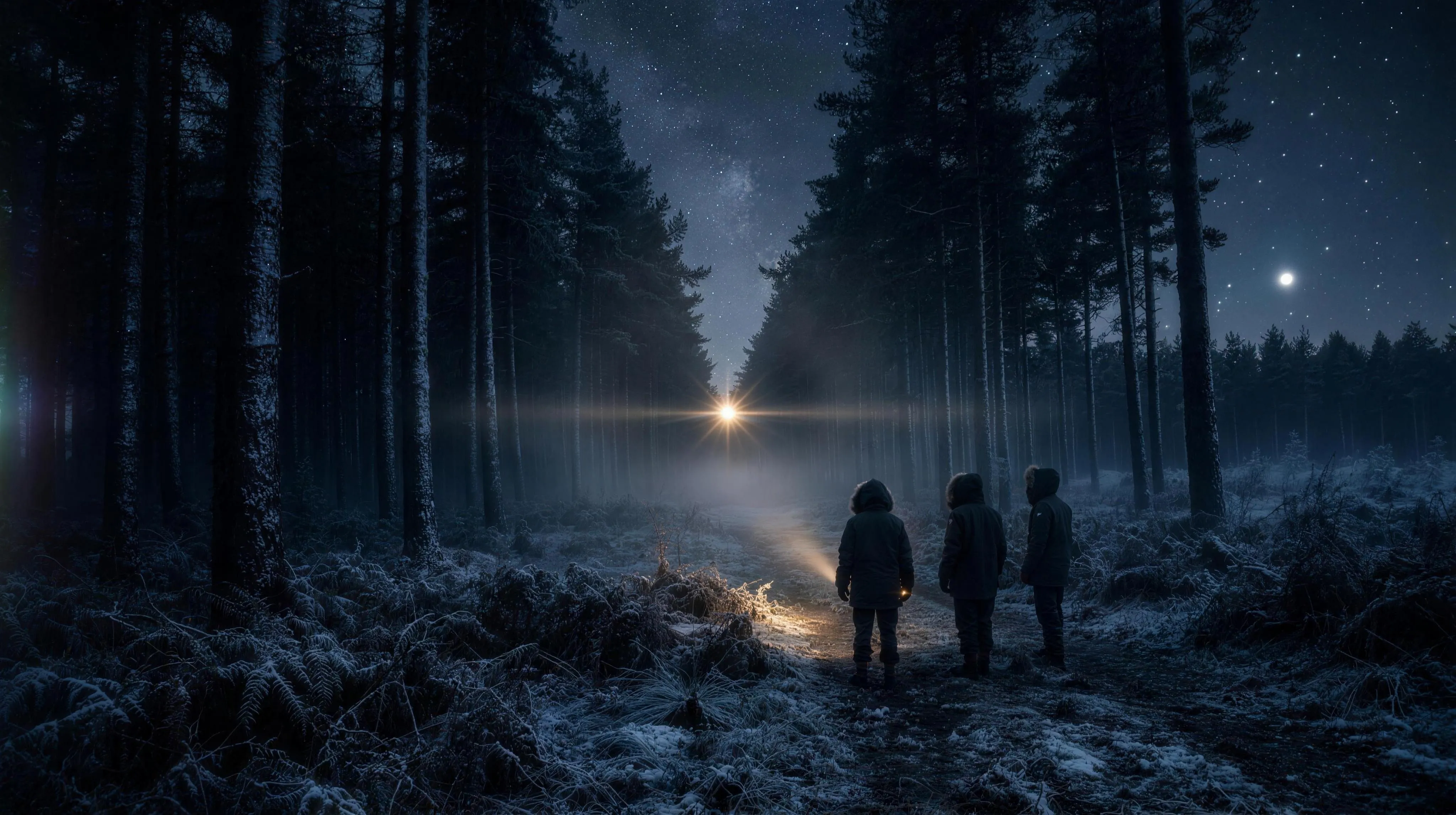 Open the interactive ▸
 What you're looking at
The Forest view is 3D and first person because the subject is a sightline: an eye at 1.75 m over a 17.5 m forest floor, a 19 m ridge at 3.5 km, and a 28 m lantern at 8.56 km, all within two metres of one straight line. One scene unit is one metre; +x runs along the true 093.7° bearing to the light. Walk the record's own mile from East Gate past the claimed landing site to Halt's turnaround; the flash winks between the trunks, keeps pace with you, dies behind the ridge if you stand low, and returns every five seconds when you stop. Overhead, the stars and the 61%-lit waning moon are computed for that exact night. Two switches carry the whole argument: fell the forest, and switch the lighthouse off.
The Tape view is three exhibits. The five-second beat: the three-panel optic's clock drawn against the tape's own "There it is again... there it is", one timed interval, labelled as one. Halt's tape: fifteen entries from "just minor clicks" to the 04:00 sign-off, each with its verbatim quote, each wearing its sceptical annotation when you flip the toggle. And night one: Cosmos 749, the 02:50 fireball, the walk, and the statements in the airmen's own hands.
The Counter view puts the radiation on the instrument that read it: the AN/PDR-27's real lowest range, 0 to 0.5 mR/h, first major graduation at 0.1. The tape's cluster, its one spike, the memo's figure, and the background all pin onto the face; the log strip below converts everything to dose rate; and the control card carries the reading nobody quotes, the same four or five clicks half a mile away.
The Sky view is the Belgian Wave's machinery pointed at Suffolk: the computed sky over the site, hour by hour, with Halt's three reported objects drawn as dashed boxes at his own words and times, beside the stars that stood there. Sirius at 10.6° when he said ten; Vega and Deneb at nine and eight when he said about ten, north; Sirius at 5.4° southwest at 04:00, over the base that lay southwest.
The File view is the case on ten cards, from the fireball to the 2000 file gap, and two verdicts at equal size: every measured number points east; an explanation is not an experience.
Why it's here
The casework line arrives at Britain's most famous case. This station's wiki entries have carried Rendlesham in both languages from the start, but never put its most checkable half on a bench: this is one of the rare cases where nearly every number survives on paper. The lighthouse's coordinates, candlepower and flash period sit in Trinity House's own list; that night's fireball sits in the British Astronomical Association's newsletter; the radiation readings are spoken line by line onto a tape, and the meter's ranges are printed in an ordnance manual; the airmen's statements are handwritten. An enigma built entirely of checkable numbers is exactly what this station is for.
It also picks up old threads. INST-54, the Belgian Wave, built this station's machinery for how low bright stars become colour-changing unidentified lights; this bench reuses it verbatim on the Suffolk sky of 28 December 1980. INST-41, Fata Morgana, covered what horizon light does to the eye; and INST-30, Washington 1952, is this bench's sister in method: take a world-famous case, hand its hardest exhibit to arithmetic, and see what survives. There is a human thread too: John Burroughs' medical file and disability award already hang in this station's wiki network, by way of Elizondo and McCain.
How it works
Five exact shelves and zero fitted constants run everything. The panel tags every number exact, modelled, reported or reading.
d, θ = haversine(site, light) · drop = d²/2·(7/6 R⊕) · E = I/d²·e^(−3.912 d/V) · m = −2.5 log₁₀(E/2.54×10⁻⁶) · az/el = f(GMST, α, δ)
The geodesy, exactly. Distance and bearing from published coordinates in closed form: 8.559 km at 093.7° true, 099° magnetic in 1980. The team called 110 to 120 on a lensatic compass at night; an eleven-degree error on an intermittent light is unremarkable, and the tape never once mentions the lighthouse it was pointed at.
The sightline, exactly. Both the ridge and the lantern drop by d²/2R under standard refraction. The beam clears the Gedgrave ridge by 1.6 m through one gap between two tree stands, and stands 2.2 arcminutes above the observer's horizontal: at eye height, visually on the ground. Stand a few metres lower and the ridge takes it; the readout prints the clearance live as you walk.
The photometry, exactly. Illuminance is I/d² times Koschmieder extinction, whose 3.912 is ln(1/0.02) by the definition of meteorological visibility, and magnitude follows from the standard zero point. Five million candela lands at magnitude -9.3 on a clear night: 1,300 Siriuses from a point source into dark-adapted eyes. After the 2000 refit the lamp fell to 13% of that, which is one reason the legend outlived the light.
The clock, exactly. Three panels, one revolution per 15 seconds, 24 degrees per second: one flash every 5.0 seconds past a fixed observer, exactly as Trinity House's 1981 list prints it.
The counter, exactly. Conversions at 1 mR = 8.77 µGy air kerma; the comparator is the UK's outdoor external background (terrestrial gamma plus cosmic, 0.7 mSv/yr), because radon and internal dose are invisible to a survey meter and comparing against the full 2.6 mSv/yr would flatter the case in the other direction. Both honest edges are printed: the memo figure really is eleven times the outdoor background, and the meter genuinely cannot measure that difference.
What is deliberately not computed. No verdict on Penniston's experience, no medical reading of Burroughs' record, no probability for the case as a whole. Where the record is silent or human, the bench carries a label instead of a guess.
The geodesy, the sightline, the photometry, the five-second clock, the radiation conversions and the star positions are exact and auditable; the forest staging, the terrain between spot heights and the Shipwash flash are labelled models; the chronology, the tape, the statements, the readings, the surveys and the denials are reported as documented; and what the nights became in the men's lives is a reading, for which the bench hangs two verdicts at equal size and adds no third.
The dials that decide what happens
A walk, a visibility dial, two switches, a tape clock, a meter, and an hour: between them they hold the whole public argument about Rendlesham.
- The walk, with Run. East Gate to Halt's turnaround along the record's own distances, at a night walking pace, time-lapsed. The strip's marks are the gate, the track, the site, the forest edge, the farm and the turn.
- The visibility dial. Koschmieder extinction over 8.56 km: from magnitude -10.2 on the clearest nights to -7.4 in haze, a hundredfold swing in delivered light. It is the difference between the 1980 reports and the unimpressed pilgrims of later years, and it is physics, not mood.
- The lighthouse switch. The counterfactual nobody could run in 1980: Orfordness dark. Everything else stays: moon, stars, farm, the faint offshore flasher. What disappears is the case.
- The forest switch. Fell the trees and the mystery inverts: from open ground the flash is obviously a distant coastal light. The trees are not scenery here; they are the instrument of the illusion.
- The tape clock. 01:00 to 04:10, with the eight spoken timestamps starred. The sceptical-annotations toggle dresses each entry in its terrestrial reading, from muntjac deer to intensifier bloom.
- The meter and the hour. Slide the reading across the real dial face and watch it against the first graduation; slide the sky clock and watch Halt's dashed boxes light up beside Sirius, Vega and Deneb at his own stated times.
The claims, as they stand
Six claims that orbit Rendlesham, from the lighthouse identification to the state of the men, with who made each and where it lands once the arithmetic is done.
| The lights were the Orfordness lighthouse, a logged fireball, and bright scintillating stars made by Ridpath (building on Klass and forester Thurkettle), and, for night one, the airmen's own written statements | BEST SUPPORTED | Best supported, at every measured point: bearing within compass error, elevation at eye level, period at five seconds, brightness at -9, the fireball logged by the BAA minutes before the first sighting, and Sirius, Vega and Deneb standing where Halt pointed at the altitudes he spoke. Burroughs' and Cabansag's statements say the word themselves: a lighthouse. |
| A structured craft landed, was inspected at close quarters, and left symbols to copy made by Jim Penniston, in accounts that grew from the mid-1990s on | DID NOT SURVIVE | Did not survive the record. The contemporaneous statements, including his own and Chandler's radio log, have him no closer than about 50 metres to receding lights; his notebook page is dated the wrong day at an impossible hour; his landing site has moved twice; Burroughs, yards away, denies the notebook scene. Nothing on any tape or paper from 1980-81 contains a craft. |
| The site was measurably radioactive made by the Halt memo (0.1 mR); Nick Pope ("significantly higher than background") | DID NOT SURVIVE | Did not survive the instrument. Every taped reading sits below the first major graduation of an unsuitable meter's lowest range; the memo's 0.1 appears nowhere on the tape; the same clicks were recorded half a mile away; three re-surveys found nothing, ever; and Pope's own consulted expert conceded the doubt in writing in 1998. The honest residue is real but unmeasurable with that meter. |
| The ground marks and tree damage were physical traces of a landing made by the Halt memo; the case literature | DID NOT SURVIVE | Did not survive daylight. A police constable found marks "of no depth", possibly animal; the forester identified months-old rabbit diggings and his own trade's axe blazes with resin bubbled in; Halt's own tape concedes "it may be old"; the released photographs show shallow disturbances in pine litter. |
| Something in those nights genuinely marked the men who were there made by Burroughs' medical record and disability award; Halt's forty years of consistency; Penniston's persistence | CONTESTED | Contested, and left open. The VA granted Burroughs full disability for that duty after his files were pried open by a senator's office; Halt has never recanted; Conrad, watching the same sky, saw nothing. The bench prices the light and cannot price the men, and says so. |
| Britain's best-documented case was adequately investigated made by the MoD position (no defence significance) | READING | Did not survive its own file. The MoD never investigated the radiation (one handwritten memo), never interviewed the airmen, and in 2000 found a gap it called "huge" where the defence-intelligence papers should have been. Whatever one believes about the lights, the investigation itself is the thinnest exhibit in the case. |
Try this
- Stand at the site and just wait. Five seconds. Again. The flash sits at eye height between the trunks, looking a couple of hundred yards away. You now know more about what those men saw than most of what has been written about them.
- Press Walk east and don't touch anything. The light winks out behind trunks, jumps between gaps, holds pace with you like it is retreating. A tree gap at 30 m crosses your view 285 times faster than the light does. That is the entire chase, both nights.
- Drop the visibility to 8 km. The flash collapses to a dull distant blink. This is the bench's answer to "but the airmen would have recognised a lighthouse": on most nights it looks like one. That night was clear.
- In the Tape's beat exhibit, count with it. "There it is again"... five seconds... "there it is". Then open Halt's tape and flip the sceptical annotations on, and read the 03:15 entry against the computed sky.
- On the Counter, slide the reading to 0.1. The needle just touches the first major graduation: the memo's number, at the bottom of the lowest scale. Then read the control card: the same clicks, half a mile away.
- In the Sky, drag the hour from 03:00 to 04:30. Halt's southern object sinks from ten degrees to five, exactly on Sirius's rail, and ends over the base because the base was southwest. His objects kept his schedule because the sky did.
- Switch the lighthouse off. Look at what remains, and then read the File's two verdicts in order. They do not fight, and the second one is not a consolation prize.
Accuracy
The honest line between what is exact, what is modelled here, what the record reports, and what is a reading:
| Feature | Tier | What that means |
|---|---|---|
| The sightline | T1 Exact | Published coordinates and spot heights, standard 7/6-Earth refraction, closed form: the site-to-lighthouse line is 8.56 km at 099° magnetic, clears the 19 m Gedgrave ridge by 1.6 m, and puts the beam 2.2 arcminutes above a standing eye. A light at eye height, on the ground, between the trees, that a few yards of walking can extinguish: that is not a metaphor, it is the arithmetic. |
| The photometry | T2 Modelled | Five million candela (Trinity House, the 1980 fit) through inverse square and Koschmieder extinction: magnitude -9.3 at the dialled 20 km clear-night visibility, about 1,300 Siriuses from a single point, one twentieth of full moonlight. The formulas are exact; the visibility is a dial, spanning hazy to very clear and moving the answer a hundredfold, which also explains every underwhelmed later visitor. |
| The five-second clock | T1 Exact | A three-panel optic turning once per 15 s gives one flash every 5.0 s. The tape's own "There it is again... there it is" spans 5 seconds. It is one timed interval, and the bench labels it as one; the recording is public and re-timeable. |
| The sky that night | T1 Exact | GMST and the catalogue, machine-checked: Sirius at 10.6° in the south-southwest at 03:15 against Halt's "object, 10 degrees, south"; Vega 9.1° and Deneb 8.1° low in the north at 03:05 against his "two objects, about ten degrees, north"; Sirius sunk to 5.4° SW by 04:00 against "over Woodbridge base, five to ten degrees". The waning 61% moon is computed from a truncated series and labelled approximate. |
| The counter's arithmetic | T1 Exact | Unit conversions exact (1 mR = 8.77 µGy air kerma); the tape peak of 0.07 mR/h is 14% of the lowest range's full scale, below the first major graduation, about 7.7× the UK outdoor external background, and identical to the readings half a mile away. The verdict on the instrument is its manufacturer's, via NRPB, 1997. |
| The forest staging | T2 Modelled | Tree placement, the farm buildings, the path line, the terrain between the published spot heights, the winking of the flash between trunks, and the Shipwash flash (its 1980 character is unconfirmed) are staging around the published anchors, and the instrument prints that split on its face. |
| The record, whole | T3 Reported | The three-night chronology, the witness statements, all 18 minutes of Halt's tape as transcribed with his help, the memo with its wrong dates and wrong units, Thurkettle's findings, the police log, the Watton radar nils, Conrad's statement, the re-surveys, the 2000 file gap, and Burroughs' disability. Carried as documented, with the disagreements left visible. |
In one line: the geodesy, the ridge clearance, the beam's 2-arcminute elevation, the five-second clock, the radiation conversions and the positions of Sirius, Vega, Deneb and the moon are EXACT and machine-checked, with no fitted constant anywhere; the forest, the farm, the path, the -9 magnitude's visibility term and the Shipwash flash are MODELLED and labelled; the chronology, the tape, the handwritten statements, the readings, the police log, the surveys and the file gap are REPORTED as documented; and what those nights became in the lives of Burroughs, Penniston and Halt is a READING, for which this bench hangs two verdicts at equal size and adds no third. Walk the mile, wait five seconds, and decide.
Sources
- Ian Ridpath's Rendlesham casebook (ianridpath.com/ufo): the primary sceptical dossier, including the Halt tape transcript compiled with Col Halt's own help, the annotated line-of-sight and Notch analysis, the lighthouse engineering data obtained from Trinity House, the witness statements, the police file, and the radiation correspondence. Research pass 2026-08-07; the site is HTTP-only.
- The Halt memorandum, "Unexplained Lights", RAF/CD to MoD, 13 January 1981: two paragraphs, written from memory a fortnight after the events, with both dates displaced by one day and dose units where rates were meant.
- The Halt tape: 18 min 12 s of micro-cassette recorded during the night of 27-28 December 1980, publicly available; the five-second "There it is again... there it is" interval first noted by Philip J. Klass; Brian Dunning's overlaid re-timing at skeptoid.com.
- The witness statements of Burroughs, Cabansag, Chandler, Buran and Penniston, collected by Halt in January 1981 and surfaced by James Easton in 1997: night one tracked to "a beacon light... coming from a lighthouse" in the airmen's own hands.
- Trinity House, list of lighthouses (March 1981) and Engineer-in-Chief's department data: Orfordness W.FL 5.0, 5,000,000 cd in December 1980 (3 kW filament lamp), focal plane 28 m, 3-panel optic at one revolution per 15 s; the notched landward shield. Decommissioned 2013, demolished 2020.
- British Astronomical Association, Meteor Section Newsletter no. 4 (February 1981): the exceptionally brilliant fireball of 02:50 UT, 26 December 1980, over southern England; and Journal of the BAA vol. 91 (1981) on the Cosmos 749 rocket re-entry at 21:07 on 25 December.
- The AN/PDR-27 survey meter: ORAU Museum of Radiation and Radioactivity collection notes (four ranges, lowest 0-0.5 mR/h, GM tubes, obsolescent by 1975); Tim Printy, SUNlite vol. 2 no. 6 (2010), an ex-USN operator's analysis of the tape's radiation phase, the open beta window and soil potassium-40.
- The 1997 NRPB correspondence (via Prof. Frank Close, for LWT's Strange But True? Live): the manufacturers' statement that 0.1 mR/h is the bottom of the lowest range and "of little or no significance", confirmed in writing by Michael Clark, NRPB, 7 July 1997; and Giles Cowling (DERA) to Ridpath, 21 August 1998, qualifying the "ten times background" figure he had given Nick Pope.
- Suffolk Constabulary file on the incident, FOI release January 2005: PC Cresswell's marks "of no depth... could have been made by an animal", and the command-log outcome entry, "Only lights visible this area was from Orford lighthouse."
- Vince Thurkettle, forester: BBC Breakfast Time interview (7 October 1983) and Ridpath's Guardian article (5 January 1985): the rabbit diggings, the axe blazes with resin, the parallax of a light seen through a moving tree line, and his own minutes of being fooled by the beam.
- UKHSA, Ionising Radiation Exposure of the UK Population (2025 review): the 2.6 mSv/yr total and its components, from which the 0.7 mSv/yr external (terrestrial gamma + cosmic) comparator used here is taken; radon and internal dose are excluded on purpose because a survey meter cannot see them.
- Sky arithmetic: GMST per the IAU 1982 expression; the J2000 bright-star catalogue; a truncated Meeus lunar series (labelled approximate); positions cross-checked against an independently precessed Hipparcos ephemeris. All constants are solved and checked in scripts/rendlesham-tune.mjs, which is re-runnable and prints every number the instrument is allowed to carry. This bench fits no constant anywhere.
- Cross-referenced instruments on this site: INST-54, the Belgian Wave, whose computed-sky machinery this bench reuses; INST-41, Fata Morgana, for horizon optics; INST-30, Washington 1952, for the sister method; and the station's wiki entries on the incident, the forest and John Burroughs.
Walk the mile. Count the five seconds. Read the meter. Check the sky. Then decide what the forest saw, and what it left in the men.
Open the interactiveCompiled August 2026