The Belgian Wave
In the small hours of 31 March 1990, two Belgian F-16s spent over an hour chasing something that two ground radars confirmed, six lock-ons recorded, and nobody ever saw. The fire-control tapes printed numbers that made the wave famous: 150 to 970 knots in seconds, thousands of feet of altitude in a blink, readings the literature still quotes as 40 g. This bench does what should have been done to those numbers on the morning of 31 March: it runs the arithmetic. A real object flying the tape is supersonic at ground level over one of Europe's densest plains, and owes it a sonic-boom carpet kilometres wide; the night logged no boom, no wake, no wreckage, and an altitude channel that also printed readings below the ground. The Air Force's own study later handed the night to atmospheric angels, ground mirrors and one lock aimed at the wingman, and the wave's own physicist accepted most of it. What the arithmetic cannot touch is the other half of the file: thirteen gendarmes at eight locations opening the wave four months earlier, some 540 inquiries never explained, and an attribution list where every entry has died on the record. The bench computes what can be computed, and hangs two verdicts at equal size: a lock is not a sighting, and a hoax is not a wave.
 Open the interactive ▸
 What you're looking at
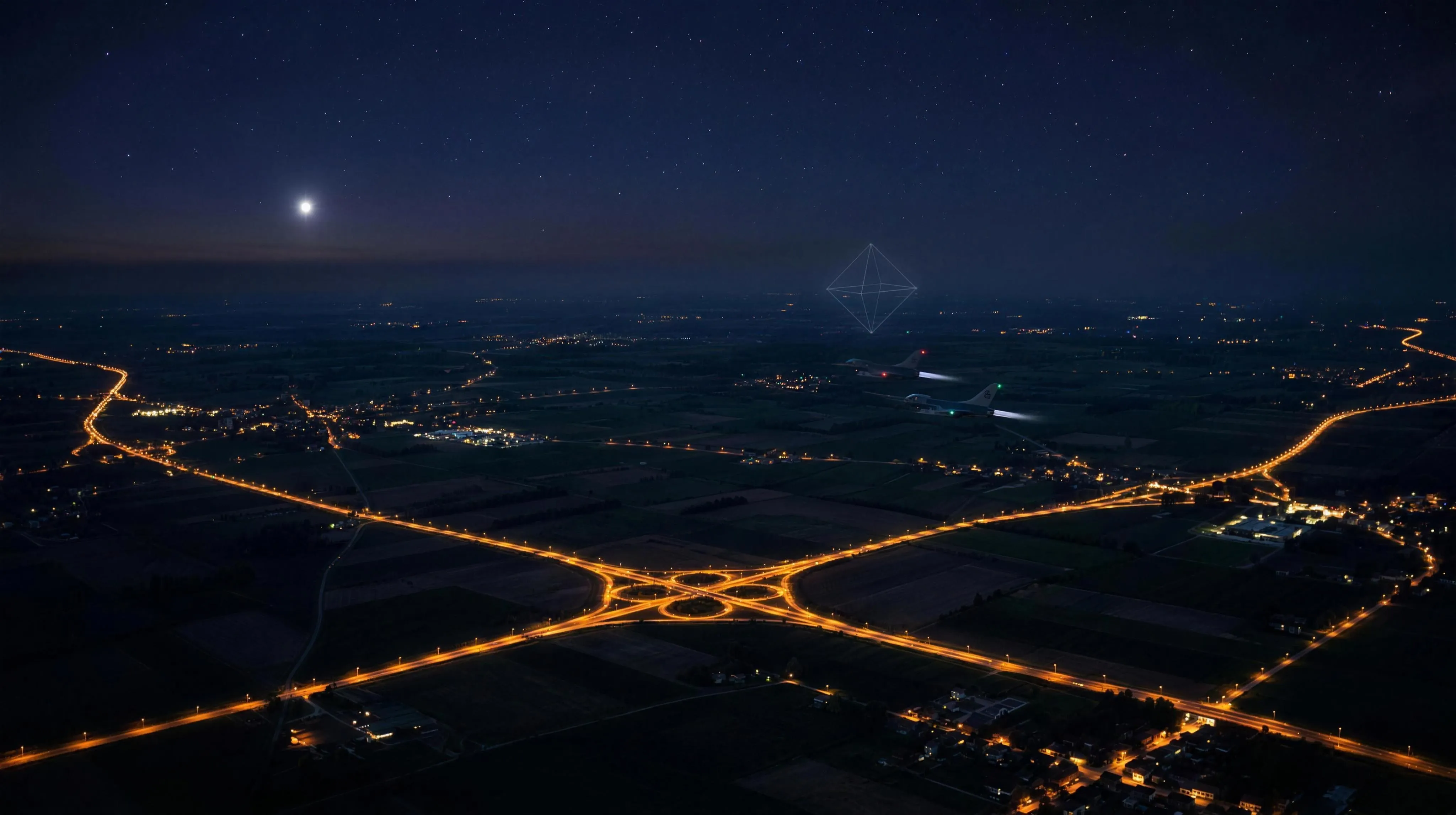
The Night view is 3D because the subject is an engagement in space: two fighters two nautical miles apart, a ghost that jumps thousands of metres between radar sweeps, and the geometry of one radar finding the other. One scene unit is one metre: the pair flies its racetrack over a plain glowing with Belgium's lit motorway net, the star field overhead is computed for that exact night, and the ghost is drawn as a wireframe on purpose, because it is a radar track and not a thing anyone saw. Press Run and the 23:00 to 01:10 clock plays in a minute: the first attempt, the 00:13 jump, the wingman lock, the last lock, the quiet.
The Tape view is the recorded record, drawn as recorded: the 00:13 lock's speed and altitude channels with their published points, the 22.5-second lock that flew straight and then 'evaded', and the thirteen lock durations from 45.9 seconds down to one tenth. The dashed zero line matters: some altitude readings fall below it, and no craft flies under Belgium. Toggle the sceptical annotations and each episode wears its artifact reading.
The Court view is three shelves of closed-form arithmetic on the tape's own numbers, with no fitted constant anywhere: the Mach test and the boom carpet nobody heard, the jump priced in g and gigawatts with the step time as a dial instead of a secret, and the vertical channel read as motion, a supersonic dive over towns in silence.
The Sky view rebuilds the star field over Ramillies for that night, hour by hour, exactly: the sceptics' whole identification set, Sirius flashing colours low in the south-west, Jupiter at magnitude -2.1 sinking slowly toward the horizon, each object's dotted arc showing its stately all-night drift. What stood where the lights were reported is a computation; whether a given witness watched a given star stays a reading, and the bench says so.
The Ledger view is the wave on nine cards: Eupen and its thirteen gendarmes, the counts, the night, the tape, the Air Force's own analysis, the ground reports and the 143 letters, the press conference, the confessed photograph, and the stealth denial. It closes on two verdicts at equal size: the tape, and the wave.
Why it's here
This bench was called into existence by the casework line itself. The File view of INST-52, the Stealth Bench, carries a Belgium card that kills the black triangles' most convenient attribution on the spot: the United States denied, on the record, flying over Belgium, and a faceted penetrator cannot do the low, slow, silent hover the reports describe. With the attribution dead, the real question is exposed: does the radar evidence that made this wave stand up on the world's evening news survive arithmetic. This station's wiki entry gives the wave one paragraph; this instrument puts its hardest night on the table whole.
It also picks up two older threads. INST-30, Washington 1952, taught how a radar sees things that are not there inside a temperature inversion; Belgium's night had a documented inversion at 3,000 ft, the same machine running again under a different flag. And INST-53, the Shootdown Bench, is this instrument's sister: the same F-16s, the same lock-ons, except that in 2023 the missiles actually flew, while Belgium in 1990 never produced anything to shoot at. Read side by side, the phrase "confirmed on radar" weighs what it honestly weighs.
How it works
Three exact shelves and zero fitted constants run everything. The panel tags every number exact, modelled, reported or reading.
M = v / √(γRT(h)) · w = 2h·√(M²−1) · a = Δv/Δt · P = m·a·v · az/el = f(GMST(JD), α, δ, φ, λ)
The atmosphere, exactly. The International Standard Atmosphere gives temperature, and with it the local speed of sound, in closed form at any altitude on the dial. Every recorded speed becomes a Mach number the reader can check, at altitude and at the ground, and the ground number is the one no refraction profile can argue with.
The boom, geometrically. A supersonic aircraft drags a Mach cone whose ground intersection is the boom carpet, width 2h√(M²−1) in still air. At the tape's 970 knots and 5,000 ft that is about 3.4 km of carpet laid along every supersonic kilometre of track, across Walloon Brabant, at midnight. The silence of that night is carried as reported, and it is the court's loudest exhibit.
The jump, priced. The tapes' public record gives endpoints, not step times, so the bench puts the step time on a dial and computes dv/dt live: 2 s reads 21.5 g, 1.1 s reads the cited 40 g. P = mav prices the top of the step for any dialled mass; a false echo, gate transfer or interference product pays none of it.
The sky, solved. GMST from the IAU 1982 expression, verified in the tune script against the canonical J2000 anchors; the bright-star catalogue rotated to alt-az over Ramillies; Jupiter from Standish mean elements, verified to stand in Gemini at magnitude -2.1 that night. The scintillation that turns low bright stars into colour-changing lights is animated over exact positions.
The chase, staged honestly. The reported structure is replayed: two ships 2 NM apart, nine attempts, six locks, three simultaneous, one of them the wingman. The coordinates are invented staging, because the real tracks were never published, and the instrument prints that split on its face.
What is deliberately not computed. No propagation solution for the angels (INST-30 holds that machinery), no claimed identification of any witness's light, no verdict on the wave's unexplained residue. Where the record is silent or contested, the bench carries a label instead of a guess.
The Mach numbers, the boom geometry, the jump kinematics and the star positions are exact and auditable; the chase staging, the tape interpolation and the scintillation are labelled models; the chronology, the tape's numbers, the studies, the counts, the confession and the denials are reported as documented; and what the wave's surviving testimony amounts to is a reading, for which the bench hangs two verdicts at equal size and adds no third.
The dials that decide what happens
A timeline, a dt dial, a mass, a speed, an altitude and an hour: between them they hold the whole public argument about the Belgian wave's hardest night.
- The timeline, with Run. The 23:00 to 01:10 clock compressed to a minute, with the record's fixed moments marked: 00:07 first attempt, 00:13 the jump, 00:29 the wingman lock, 00:40 the last lock. Scrub anywhere.
- The dt dial. The single most argued-about number of the wave, 40 g, is not on the tape: it is a reading of the step time. This bench refuses to type a dt in secret. Slide it and watch the g follow, exactly.
- Speed and altitude. The court's Mach test, fed the tape's own band, 150 to 1,010 knots, 11,000 ft down to the deck. Above roughly 660 knots at low level the ground-Mach test starts owing Wallonia a boom.
- The mass. P = mav needs one, so it is a dial, not an assumption: any real mass pays gigawatts at the top of the step; an artifact pays nothing. That asymmetry is the whole shelf.
- The hour. 21:00 to 04:00 CEST over Ramillies. The witness set rises, scintillates and sinks west on rails the tune script verifies; the dotted arcs are what 'it moved slowly all night' looks like when stars do it.
- The sceptical annotations. Off, the bench shows the tape as the 1990 press conference showed it. On, each episode wears the artifact reading the later analyses gave it: gate transfers, angels, mirrors, the wingman.
The claims, as they stand
Six claims that orbit the Belgian wave, from the Air Force's own study to the reading that circled the world, with who made each and where it lands once the arithmetic is done.
| The lock-ons were artifacts: angels in an inversion, ground mirrors, gate transfers, and at least one wingman lock made by the Air Force's own EW study (Gilmard-Salmon 1992), later Meessen in large part, Paquay, Abrassart | BEST SUPPORTED | Best supported, and unusually so: both sides of the argument converge on it. The BAF study attributes the returns to that night's documented inversion, identifies the 00:29-00:31 lock as the wingman locking the lead, and reads the below-zero altitudes as mirrors; SOBEPS's own physicist accepted much of this by 1998. The court view shows the recorded numbers refute themselves as kinematics. |
| The tape recorded a craft with extraordinary performance made by the wave literature, from the 1990 press coverage on | DID NOT SURVIVE | Did not survive the arithmetic. Ground-level supersonic speeds with no boom over dense country, 20-to-40 g steps with no wake or wreckage, an altitude channel that also prints readings below the ground, and a tenth-of-a-second lock. Every extreme the reading needs doubles as a standard radar artifact signature. |
| The wave was secret American aircraft made by the stealth attribution, 1990 onward | DID NOT SURVIVE | Did not survive the record or the physics. A declassified DIA memo records the US confirming no stealth aircraft operated over the Ardennes, Minister Delcroix repeated the assurance in 1993, and INST-52's own bench shows a faceted penetrator cannot hover silently at walking pace, which is what the strongest reports describe. |
| The 30-31 March ground lights were scintillating stars and Jupiter made by the sceptical identification (Printy and others), computed on this bench | CONTESTED | Contested, and left as a reading. The computed sky puts the whole identification set exactly in the reported quadrant, at the reported pace, scintillating in colour low in a turbulent clear sky; and not one report was phoned in during the chase, the night's 143 arriving by mail over two weeks. What no computation can do is put a particular star in a particular witness's eye. |
| The wave as a whole was a psychosocial event made by Hallet 1992, Magain and Remy 1993, Abrassart | CONTESTED | Contested. It explains the wave's growth curve, the media coupling and the mail-in pattern; it sits awkwardly against the opening night, when thirteen gendarmes at eight locations reported the same object geometry before any headline existed. The record supports a mixture without fixing its proportions. |
| The triangles were extraordinary craft made by the reading the wave carried around the world | READING | A reading, and it stays one. With the photo confessed, the tape dissolved and the stealth story denied, no physical exhibit survives; what survives is a mass of sincere, structured testimony, some 540 SOBEPS inquiries never explained, and an air force that says, on the record, it could not identify the phenomena. This station closes neither door. |
Try this
- Press Run and watch the whole night once. Note what never happens: the pilots never see anything. Six locks, nine attempts, zero visuals. That asymmetry is the entire case, and the bench draws the ghost as a wireframe to keep it in view.
- At the 00:13 lock, watch the streak. The track crosses kilometres between sweeps, dives at the ground, and prints readings below it. Then open the Tape view and find the same seconds as a stepped line on paper.
- In the Court, slide dt from 2.0 s down to 1.1 s. The g readout walks from 21.5 to 40: both famous numbers, one pair of endpoints, and the dial is the only difference. Nothing about the wave is a cleaner lesson in how a headline number gets made.
- Slide the speed to 660 kt and watch the ground Mach cross 1. Everything the tape records above that line owes Belgium a boom. The tape spends its most famous seconds well above that line, and the night stayed silent.
- In the Sky, drag the hour from 23:00 to 03:00. The whole witness set sinks slowly west, scintillating, exactly the slow stately drift the ground reports describe. Then remember not one call came in during the chase, and 143 letters came after the headlines.
- Toggle the sceptical annotations during the wingman phase. The Air Force's own study concluded one triumphant lock was pointed at the lead F-16. Watch the cone swing between the jets and decide how much of the rest of the tape you would now bet on.
- End on the Ledger's two verdicts. They do not fight. The tape refutes itself; the wave's testimony stands unexplained and unattributed. Holding both at once is what this file actually supports, and it is rarer than either alone.
Accuracy
The honest line between what is exact, what is modelled here, what the record reports, and what is a reading:
| Feature | Tier | What that means |
|---|---|---|
| The atmosphere and the Mach test | T1 Exact | The International Standard Atmosphere and the speed of sound in closed form at any dialled altitude. The recorded 970 knots is Mach 1.49 at 5,000 ft and Mach 1.47 at the ground, so no refraction profile keeps the boom off the map: the still-air carpet is about 3.4 km wide, laid along every supersonic kilometre. The night logged no boom anywhere. |
| The jump as kinematics | T1 Exact | dv/dt on the tape's own endpoints, with the step time as a dial instead of a hidden assumption: 150 to 970 knots is 21.5 g read over 2 s and the literature's 40 g read over about 1.1 s. P = mav prices the top of the step at about a gigawatt for a 5-tonne craft. The altitude channel read the same way is a supersonic vertical dive. |
| The sky over Ramillies that night | T1 Exact | GMST (verified against the canonical J2000 anchors), the J2000 bright-star catalogue transformed to alt-az for 50.65° N 4.92° E, and Jupiter from Standish mean Keplerian elements: the sceptics' whole identification set, Sirius to Capella, drawn where it actually stood, hour by hour, with Jupiter at magnitude -2.1 sinking slowly west. |
| The chase staging and the tape traces | T2 Modelled | The mission's real tracks were never published, so the 3D racetrack, the pair's coordinates and the ghost's positions are staging around the reported structure (nine attempts, six locks, one wingman lock, 2 NM spacing). The stepped lines between the tape's published data points are drawn, and say so. |
| The scintillation | T2 Modelled | The colour-flashing of low bright stars is animated, not solved from a turbulence model. The effect itself is textbook astronomy and the reason bright setting stars generate colour-changing-light reports; its physics is real, its animation here is staging. |
| The record, whole | T3 Reported | The Eupen night and its thirteen gendarmes, the wave counts (SOBEPS ~2,000, COB 1,282), the full chronology of 30-31 March, every number on the tape, the Gilmard-Salmon findings, Meessen's analyses and his one retained trace, the 143 mailed reports, the press conference, the Petit-Rechain confession, and the stealth denials. Carried as documented, with the disagreements left visible. |
In one line: the ISA atmosphere, every Mach number, the boom-carpet geometry, the jump's dv/dt and P = mav, and the star field over Ramillies are EXACT and machine-checked, with no fitted constant anywhere; the chase staging, the tape interpolation and the scintillation are MODELLED and labelled; the chronology, the tape's numbers, the Gilmard-Salmon findings, Meessen's analyses, the 143 letters, the confession and the denials are REPORTED as documented; and what two thousand sincere reports amount to once the exhibits fall is a READING, for which this bench hangs two verdicts at equal size and adds no third. Fly the night, dial the dt yourself, and decide.
Sources
- The Belgian Air Force summary report on the night of 30-31 March 1990 (English translation at ufologie.patrickgross.org): the chronology from the 23:00 gendarmerie call to the 01:10 recovery, nine interception attempts and six lock-ons at 5-8 NM, recorded speeds 150 to 1,010 kt, the 3,000 ft temperature inversion, and the exclusion of balloons, microlights, RPVs, aircraft and laser projections.
- Maj. Gen. (ret.) Wilfried De Brouwer's chapter in Leslie Kean, UFOs: Generals, Pilots and Government Officials Go On the Record (2010): the Eupen chronology and the thirteen gendarmes at eight locations, the 00:13 lock (150 to 970 kt, 9,000 to 5,000 to 11,000 ft), the pilots' names, the wave counts (over 2,000 reports, ~540 unexplained), the DIA memo quote and the 1993 Delcroix letter.
- The Gilmard-Salmon electronic-warfare analysis (Belgian Air Force, 1992), as summarised in the public record: anomalous-propagation angels in the inversion, the 00:29-00:31 lock identified as the wingman locking the lead, and below-zero altitude readings as ground mirror images.
- Auguste Meessen, "Analyse approfondie des mystérieux enregistrements radar des F-16", Inforespace (December 1998), and his Bertem ground-radar study: acceptance of the angel hypothesis for many contacts, two-radar interference proposed as a mechanism for the extreme Doppler speeds, some 180 hours of ground tape analysed, and the one trace he retained as unexplained.
- Tim Printy, "Belgium 1990: A case for radar-visual UFOs?" (astronomyufo.com): the tabulated lock durations (45.9 s down to 0.1 s), the winds-aloft and drift analysis, and the star identifications for the night's ground reports (Sirius, Procyon, Rigel, Betelgeuse, Jupiter, Castor, Pollux, Aldebaran, Capella).
- Jean-Michel Abrassart (2019) on the simultaneous locks as mutual locks with Bragg scattering for the remainder, carried on this bench as the sceptical extension of the BAF finding; Marc Hallet, La Vague OVNI Belge (1992); Pierre Magain and Marc Remy, Physicalia Magazine 15(4), 1993 (bibliographic record).
- The COBEPS statistics paper (Franck Boitte): the independent COB catalogue of 1,282 notifications and 2,531 witnesses across 1989-1993, and the wave historiography after 2011.
- The Petit-Rechain confession: Patrick Maréchal on RTL-TVI, 26 July 2011 (VRT News coverage), a painted polystyrene triangle with corner lamps suspended on threads; the preceding two decades of optical analyses (Louange, Acheroy, Marion); and COBEPS's 27 July 2011 response that one faked photograph does not downgrade the wave.
- The stealth denials: the declassified DIA memo "Belgium and the UFO Issue" recording the USAF's confirmation that no stealth aircraft operated in the Ardennes area, and Defence Minister Leo Delcroix's 1993 letter; contemporary reporting on the wave and the 11 July 1990 Evere press conference.
- Radar hardware: the Westinghouse AN/APG-66 pulse-Doppler radar of the Belgian F-16As (IEEE, "F-16 Pulse Doppler Radar (AN/APG-66) Performance", 1983; radartutorial.eu): medium-PRF downlook, 64-point FFT filter bank, CFAR thresholding, single-target-track gates, the artifact modes (gate capture and transfer, multipath, mutual interference, anomalous propagation) that the sceptical readings invoke.
- Physics: the International Standard Atmosphere; Mach and sonic-boom carpet geometry (any gas-dynamics text); GMST per the IAU 1982 expression (Meeus, Astronomical Algorithms); the J2000 bright-star catalogue; Standish mean Keplerian elements for Jupiter. All constants are solved and checked in scripts/belgian-wave-tune.mjs, which is re-runnable and prints every number the instrument is allowed to carry. This bench fits no constant anywhere.
- Cross-referenced instruments on this site: INST-52, the Stealth Bench, whose Belgium card sent us here; INST-30, Washington 1952, for what an inversion does to a radar picture; INST-53, the Shootdown Bench, for the same fighters with live missiles; and the station's wiki entry on the Belgian wave.
Fly the night. Read the tape. Check the sky. Then decide what a lock-on confirms, and what a wave leaves behind.
Open the interactiveCompiled August 2026