The Silent Hover Bench
Stand on the lawn and look up. The book says (p. 134) the triangle was 'about 300 feet in length' and '60 to a few hundred feet above him', and 'It made no sound.'; his son was camping outside in a tent (p. 133), and the yard has 'a grassy area 75 yards from the house, leading to a wooded tree line' (p. 134), read here as the lawn's length to the trees. No source gives a mass, so the bench computes one: the B-2's weight per square metre of wing, 151.8 kg/m², on a 300 ft triangle, 549.7 t. Held 60 ft up by moving air, that puts 49.3 m/s on the lawn, Category 2 on the Saffir-Simpson scale, 1,489 newtons on every square metre of the tent's wall, and takes at least 133.0 MW; at the acoustic efficiency read from a measured BV-234 flyover, 3.05 × 10⁻⁵, the witness hears 122.9 dB, and for the hover to fall to the EPA's 70 dB the efficiency would be 1.6 × 10⁻¹⁰. The lightest rung on the ladder, the Zeppelin NT's gross 10.7 t, still puts 6.9 m/s on the grass, force 4, 'Raises dust and loose paper', and 97.2 dB at the witness. Niagara's five hours (p. 124) at Max Fabre's 1,000 ft are 674,301 kWh at the floor of 134.9 MW: 196.9 t of turboshaft fuel, 35.8 % of the craft, or 2,697 t of lithium-ion battery. Held up by helium instead there is no wind and no rotor noise, and the craft is 493,454 m³ of gas, a slab 136.3 m thick over the planform the witness drew as flat. The bench prices the sentences and rules on none of them.
Keep the signal
The station is free. No ads, no tracking cookies. If the files are worth your time, following is the support.
 Open the interactive ▸
What you're looking at
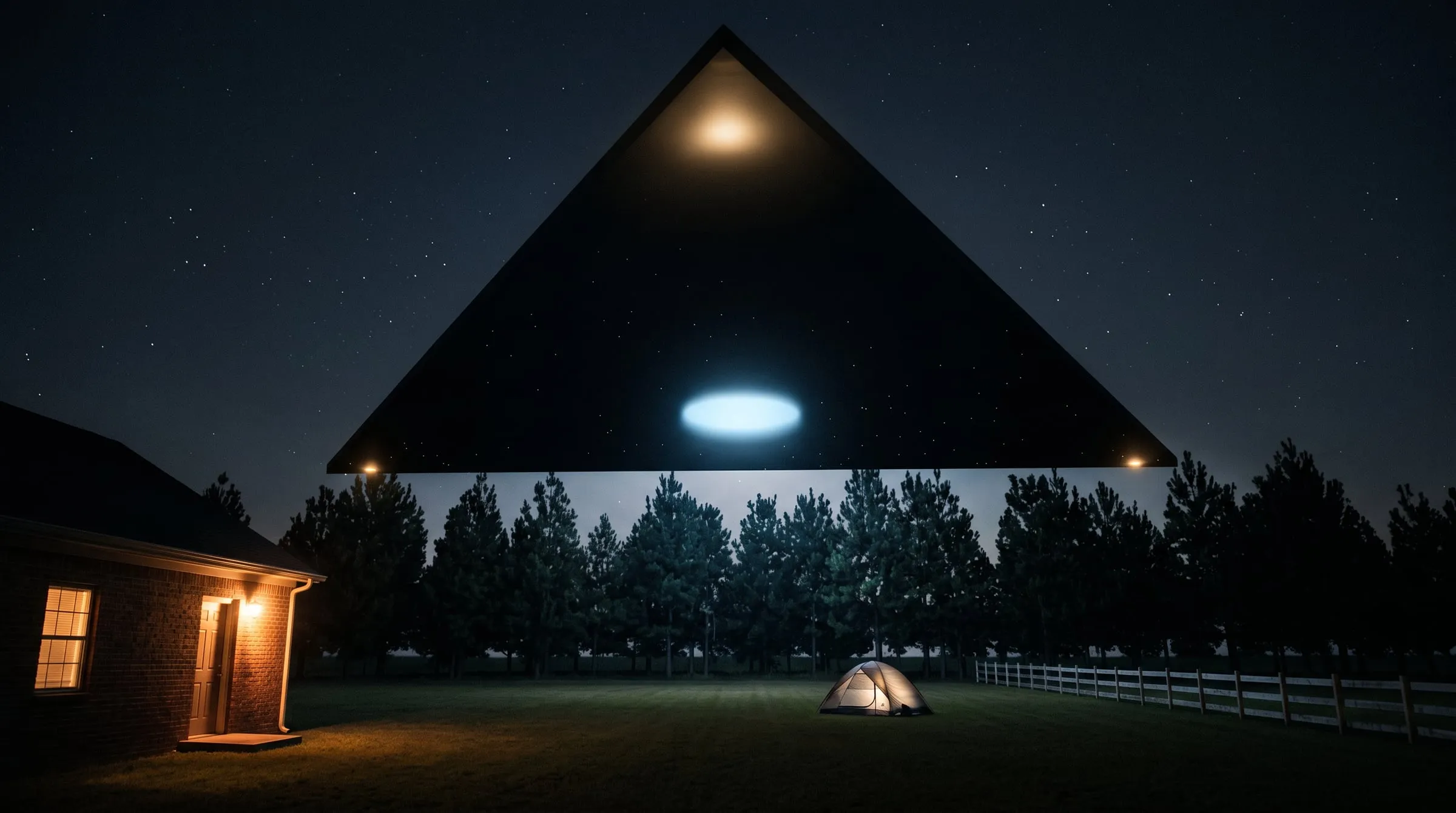
The Yard is the north Georgia backyard in 3D at 11:45 p.m. The corner of the house, the grassy area and the wooded tree line are the book's; the lit window, the porch light, the fence and the tent's place on the grass are staging. Over it stands the full Moon of the text's night, sixteen minutes from full by the USNO's table, placed by the site's Meeus series at 28° above the horizon in the south-southeast, within the 27° to 29° it stood at over north Georgia's latitude band at that hour; the slab throws its shadow across the lawn, while the pine tops and the ground beyond are moonlit under a dimmed star dome. Overhead hangs the triangle at the dialled side and height, pitch black, a yellowish light at each corner, a large bluish-white light at the centre of its underside and faint speckles on the belly. A switch draws the wake, the air the model moves, falling from the underside and spreading across the lawn at the model's speeds while the grass, the tent and the pine tops lean by the Beaufort band (the lean is illustrative). Four cameras: the lawn, the street, the side and the plan; chips for the craft, the height, the wind under it, the power and the sound at the witness.
The Downwash is the ground wind against the mass, both logarithmic, for the dialled planform and fan fraction: the Beaufort forces as strips with their land descriptions, the Saffir-Simpson categories as dashed lines, the aircraft near the span as dots, the rotorcraft that exist as diamonds at their own disk loadings, and the dialled point; a second strip solves each band back into the mass that puts it on the lawn. The Sound is a level ladder in decibels: the sound-pressure table's rungs from leaf rustle to a chainsaw, the measured helicopters at their own distances (a BV-234 flyover, a K-MAX, an Mi-8 contour), the hover's level at the witness and the efficiency the dialled ambient asks for, with the hover's level against distance from the craft beside it.
The Hours sets the dialled hours of hover, as fuel and as battery, against the craft's own mass at the floor power, with the book's hours as ticks, each with its page. The Gas spreads the helium or hydrogen that would float the dialled mass as a slab over the triangle's planform, drawn to one scale beside the Zeppelin NT and the Hindenburg. The File holds the book's sentences from both chapters on cards with their pages, the outside pages beside them, what the bench does not model, and two cards at equal size: what the record says, and what the arithmetic gives.
Why it is here
The book is already on this site: the Culture 01 source note on Future Visions summarises Lacatski's account as a whole, and INST-73 The Radiation Dose prices the Georgia chapter's beam and the dose its medical course implies. That chapter has a sentence before the beam, and this bench takes it: a triangle 'about 300 feet in length', '60 to a few hundred feet above him', and 'It made no sound.' (p. 134). What it adds is the hover itself: a thing that size held still over a lawn. The book puts the size, the height and the sentence on sound in its Georgia chapter (chapter 15) and the hours in its Niagara chapter (chapter 12), where Brody Cox's object was 'hovering silently in the same position for five hours' (p. 124) and the chapter gives no size in feet or metres. The bench keeps the two cases apart: Georgia is the 3D stage and the default dials; Niagara is two presets that change the height and the hours, keeping the Georgia side only because its own chapter offers none, and the File says so.
So the instrument asks one question of each sentence: what would holding that up cost? Held up by moving air, momentum theory gives the wind under it, read on the Beaufort and Saffir-Simpson scales; the ideal power, the floor any rotor or fan exceeds; the sound that power makes at the witness, for an acoustic efficiency anchored on a measured helicopter; and the fuel or battery for the hours. Held up by gas, it gives the volume of helium or hydrogen and how thick a slab that makes over the planform. No source gives the craft's mass, so the mass is a dial whose rungs are real aircraft near the span. The prices sit beside the sentences, with their pages; the bench does not say what the craft was, and it does not say the witnesses were right or wrong. On the casework line it sits beside INST-54 The Belgian Wave, which prices an F-16 chase and no hover, and among the same book's other benches, INST-91 The Submerged Egg Buoyancy Bench and INST-82 The Skinwalker Spectrum.
How it works
Everything on the bench is arithmetic on the book's figures and on published tables: momentum theory, the standard atmosphere, the wind scales, the aircraft and rotorcraft tables, the sound-power relations, the engines' fuel use, lithium-ion's specific energy and the lifting gases. The side, the height, the mass, the fan fraction, the acoustic efficiency, the ambient, the hours, the battery, the engine and the gas are dials. The script that ships with the site re-derives every displayed figure from the constants before the build is allowed to pass.
v_i = √(T/2ρA) · w = 2v_i · ½ρw² = T/A · P_i = T v_i · L_W = 10 log(ηP_i/10⁻¹²) · L_p = L_W − 10 log(2πr²) · E = P_i t · V = M/Δρ
The hover. The craft is an equilateral triangle of side L, the book's 'about 300 feet' read as the side: 91.4 m, a planform of 3,621 m². Its lift surface is an actuator disk of area A f_a, with f_a the share of the underside that moves air; 1, the whole belly, is the kindest case. For a hover out of ground effect the thrust is T = M g, with g = 9.80665 m/s²; the disk pushes air at v_i = √(T/2ρA), and the fully contracted wake below it moves at w = 2v_i; its dynamic pressure ½ρw² is the disk loading T/A in pascals; the ideal (induced) power P_i = T v_i is the least any rotor or fan can spend, and a real one spends more. The air's density comes from the standard atmosphere's lapse formula, 1.225 kg/m³ at sea level, at the dialled height. w is read against the lower bounds of the Beaufort forces and the Saffir-Simpson categories, and each band is solved back into the mass that puts it on the lawn, M = ½ρw²A/g. The default mass is the B-2's weight, 72,575 kg on the USAF fact sheet, over its 478 m² of wing, 151.8 kg/m², on this planform: 549.7 t. The rotorcraft run through the same formula at the disk-loading table's own figures.
The sound. The acoustic power is W_a = η P_i, η the fraction of the power radiated as sound, as Sree (2015) defines it. No page found states a helicopter's η, so the default is derived from a measured level: the FAA's 1984 BV-234 flyover, 87 to 89 dBA at 492 ft (150 m) as the Forest Service reports it, read back over a hemisphere and set against the CH-47D's ideal hover power from the disk-loading table, 2.92 MW, gives 2.4 × 10⁻⁵ to 3.8 × 10⁻⁵, and the dial's default is 3.05 × 10⁻⁵. The sound power level is L_W = 10 log₁₀(W_a/10⁻¹² W); the witness stands on the ground, a reflecting plane, so the level there is L_p = L_W − 10 log₁₀(2πr²), r the height. The ambient rungs are the sound-pressure table's rows without a citation flag, from light leaf rustling at 10 dB to a two-stroke chainsaw at 110; the default is the EPA's 70 dB maximum, the one row that names sleep disturbance among its effects, and the leaves' 10 dB is printed beside every result. The bench prints the η at which the hover's level at the witness falls to the dialled ambient.
The hours and the gas. The energy for the dialled hours is E = P_i t at the floor power. Fuel is E times a turboshaft's specific fuel consumption: the T64's 0.48 lb per horsepower-hour, 0.292 kg per kWh of shaft work (the CH-53E's engine family), or the T406's 0.426, 0.259 kg (the MV-22B's engine); Jet A-1's 43.15 MJ/kg is the check, 12.6 MJ of fuel for each kWh of work. A battery is E over lithium-ion's 100 to 250 Wh/kg. Both are printed against the craft's own mass. The gas volume is V = M over the net lift the Lifting gas page states, 1.114 kg/m³ for helium and 1.202 for hydrogen at sea level and 0 °C; its mean thickness over the planform is V/A; it is drawn beside the Zeppelin NT (75.00 m, 8,255 m³) and the Hindenburg (245 m, 200,000 m³).
Where it takes liberties. No ground-effect credit is taken: near the ground it lowers the induced power by a modest factor and leaves the air still to be moved. The ground is taken to see the far-wake mean w: under the Georgia heights the wake has not spread, while at Niagara's 1,000 ft and more a real jet spreads and slows, so there the figure is an upper bound. No figure of merit is taken, because no page found states a full-scale one cleanly: the power is the floor, and the sound and energy budgets run on it. Heights are taken from sea level, because no page gives either site's elevation; the air is still, as the Niagara chapter's 'minimal wind' allows; the gas tables sit at 0 °C and the hover's air at 15 °C. The yard, the house, the tent and the stars are staging: the book names no town in north Georgia, so the stars are not placed by sidereal time for a coordinate the record does not give. The Moon is computed: the site's Meeus series puts it 27° to 29° above the horizon in the south-southeast across the band 33.5° to 35° N, 83° to 85.5° W at 03:45 UT, and the Yard draws it at 28°. The yard's orientation is staging, so where the slab's shadow fell on the real yard is not claimed, only that a slab that size at that height threw one, about 34 m north-north-west of its footprint.
Nothing is fitted to the sources: they give the bench a size, a height, a sentence on sound and a number of hours, and the tables give it the air, the scales, the aircraft, the engines, the batteries and the gases. The choices are the dials, and every figure on this page is the bench's own readout at the preset it names.
The dials that decide the result
Four presets from the book and the free dials. Each preset sets the height from a sentence with its page; the Niagara presets set the hours too. The mass, the fan fraction and the efficiency stay at their defaults until you move them.
- Georgia, 60 ft. The default: the book's 300 ft side at its lower height, 549.7 t, the whole underside as the disk, η 3.05 × 10⁻⁵, the EPA's 70 dB around. The lawn sees 49.3 m/s (95.9 kt), Category 2, 1,489 Pa; the floor power is 133.0 MW; the witness 18.3 m below hears 122.9 dB, and the hover falls to 70 dB only at η 1.6 × 10⁻¹⁰, 5.3 orders of magnitude below the dial.
- Georgia, a few hundred. The book gives 'a few hundred' no number, so the high preset takes 300 ft, the craft's own length: 49.5 m/s, Category 2, 133.5 MW, 108.9 dB at the witness, η 3.9 × 10⁻⁹ for 70 dB.
- Niagara, Fabre. Max Fabre's 'approximately 1000 ft' (p. 122) and Cox's five hours (p. 124), on the Georgia side: 50.0 m/s, Category 3, an upper bound at that height; 134.9 MW; 98.5 dB at the witness, η 4.3 × 10⁻⁸ for 70 dB. The five hours are 674,301 kWh: 196.9 t of fuel at the T64's rate (174.7 t at the T406's), 35.8 % of the craft, or 2,697 t of battery at 250 Wh/kg (6,743 t at 100), 491 %.
- Niagara, 1 February. The 5,000 ft and the 'approximately one hour' of p. 121; p. 120 gives the same evening six hours, which the Hours view ticks. 53.1 m/s, Category 3, 143.2 MW, 84.8 dB at the witness; the hour is 143,165 kWh, 41.8 t of fuel or 572.7 t of battery.
- The dials. Side 100 to 600 ft; height 30 to 10,000 ft and mass 1 to 1,000 t, both logarithmic, the mass with its rungs from the Zeppelin NT's gross 10.7 t to the An-225's maximum takeoff 640.0 t; fan fraction 0.05 to 1 (at 0.25 the default puts 98.7 m/s on the lawn and needs 266.0 MW, at 0.1, 156.1 m/s and 420.6 MW); η 1 × 10⁻⁷ to 2.7 × 10⁻², the top being Sree's open-rotor figure, a different machine at cruise; ambient 10 to 110 dB; hours 0.25 to 6; battery 100 to 250 Wh/kg; the T64 or the T406; helium or hydrogen. In the Yard, the wake switch, its visual rate and the four cameras.
The claims, as they stand
The book's sentences and the outside pages, one by one, and what the bench does with each.
| 'Jones estimated that the large triangular craft, which was 60 to a few hundred feet above him, was about 300 feet in length. It made no sound.' stated by Jones, as the book reports him, p. 134 | REPORTED | The size is read as the side of an equilateral triangle, 91.4 m, a planform of 3,621 m²; the height is the dial's Georgia range, 60 ft by default and 300 ft on the high preset. The sentence on sound is what the Sound view prices: at the default the witness hears 122.9 dB unless η falls to 1.6 × 10⁻¹⁰. |
| 'a large triangular aircraft, with lights at each apex, moving silently almost directly above him. The craft had a yellowish light at each point and a large bluish-white light in the middle.' stated by Jones, as the book reports him, p. 133 | REPORTED | Drawn on the Yard: three yellowish corner lights and one bluish-white centre light on a black underside. Their brightness is staging; the book gives none. |
| 'He could see stars on the bottom of the object, as if someone had tried to camouflage the craft.' stated by Jones, as the book reports him, p. 134 | REPORTED | Drawn as faint speckles on the belly. The stars over the yard are staging: the book names no town, so they are not placed for a night and a place. |
| '(The yard has a grassy area 75 yards from the house, leading to a wooded tree line.)' His son 'was camping outside' with a neighbour's child 'in a tent.' stated by the book, pp. 133 to 134 | REPORTED | Read here as the lawn’s length, from the house to the pines. The book does not place the tent; the Yard’s tent on the grass is staging. At the default the tent’s wall would take 1,489 newtons on each square metre; the 2015 outwash paper lists toppled canvas tents among a hover’s effects. |
| 'Date of Event: September 12, 2009' in the chapter's header; 'At 11:45 p.m. on Friday, May 8, 2009' in its text. stated by the book, p. 133 | REPORTED | Both printed as the book’s own, as The Radiation Dose (INST-73) prints them for the same chapter; nothing is computed from either date. |
| Full Moon 9 May 2009 04:01 UT; Last Quarter 12 September 2009 02:16 UT stated by the U.S. Naval Observatory, phases of the Moon | TABULATED | Carried as tabulated beside the book, which says nothing of the Moon. The text’s hour, 11:45 p.m. on 8 May read as Eastern Daylight Time (the book gives no zone), is 03:45 UT on 9 May, sixteen minutes before the full Moon; the header’s 12 September at the same hour is a day past the last quarter. By the site’s Meeus series the Moon then stood about 27° to 29° above the horizon in the south-southeast across north Georgia’s latitude band; the Yard draws it at 28°. The yard’s orientation is staging, so where the slab’s shadow fell on the real yard is not claimed. |
| 'Due to HIPAA concerns, BAASS has concealed the identity of Jones and the BAASS contract physician.' stated by the book, p. 138 | REPORTED | Carried once, on the File; the bench calls the witness Jones, as the book does. |
| 'It was reported that the altitude ranged from 500 to over 10,000 feet above ground level, with durations of up to five hours.' stated by the book, p. 119, of some twenty-five reports over Niagara Falls | REPORTED | The height dial reaches 10,000 ft; the Niagara presets take Fabre’s 1,000 ft and the 5,000 ft of 1 February. At those heights a real jet spreads and slows before it reaches the ground, so the ground wind there is an upper bound. |
| 'The object was reported to be hovering silently in the same position for five hours. Cox recorded the object for one minute and thirteen seconds.' stated by the book, p. 124, of Brody Cox, 9 October 2009 | REPORTED | The hours of the Niagara presets. At Fabre’s 1,000 ft the floor power is 134.9 MW, and five hours are 674,301 kWh: 196.9 t of turboshaft fuel, 35.8 % of the craft, or 2,697 t of battery at 250 Wh/kg, 491 %. |
| 'hovering approximately 1000 ft above ground level' stated by Max Fabre, as the book reports him, p. 122 | REPORTED | The height of the Niagara preset: 50.0 m/s on the ground, Category 3, as an upper bound; 98.5 dB at the witness; η 4.3 × 10⁻⁸ for the EPA’s 70 dB. |
| 'had been observed again over the exact location for six hours' (p. 120) and, the same evening, 'observed for approximately one hour, with an altitude of 5,000 feet above ground level' (p. 121) stated by the book, of 1 February 2010 | REPORTED | The clash is the book’s own and both are printed. The preset carries p. 121’s hour at 5,000 ft: 143.2 MW, 143,165 kWh, 41.8 t of fuel; the Hours view ticks the six hours too. |
| 'Many consistent statements describe a large triangular craft hovering silently, with ground skylights reflecting off it.' Others: 'two cylinders joined at one end, resembling a boomerang or a chevron'; 'The object is described as cylindrical.' stated by the book, pp. 119 and 123 | REPORTED | The chapter gives the shape three ways and no size. The bench prices a triangle, the shape the video of 23 January 2010 and many consistent statements give, on the Georgia side; the 3D stage stays Georgia’s. |
| 'Witness statements indicated that the weather was consistently cold, with cloudy skies, rain showers, minimal wind, and sporadic snow flurries on the dates of each incident.' stated by the book, p. 122 | REPORTED | The bench takes still air, so holding station costs nothing beyond the hover itself. |
| 'at least one hundred people on the streets looking up and pointing at the object on those evenings' stated by Tom Brillo and Joe Milani, as the book reports them, p. 124 | REPORTED | Carried on the File as the book has it, on the streets (p. 124); nothing is computed from it. |
| 'Two were egg-shaped, and two were round.' It 'looked like a black rod'. The object 'could create its own cloud cover to conceal itself'. stated by the book, pp. 133, 134 and 120 | REPORTED | Not priced here: the four smaller objects, the triangle’s turn onto its end, the cloud, the bluish light that would shine back, and the spotlight, the beam and the medical course, which The Radiation Dose prices. |
| 'The downwash produced by the newer HL aircraft variants will have as much wind force as a category 1 or 2 hurricane.' stated by RAND DB-472, Gordon et al. (2005) | TABULATED | Carried as tabulated. Its p. 39 chart of rotor downwash, calculated mean velocity at maximum VTOL gross weight, reads, on the page image, the MV-22 near 83 kt, the Mi-26 near 65 and the CH-53A about 58. Beside it, the bench’s far-wake mean on the disk-loading table’s figures gives the MV-22B 45.6 m/s (88.6 kt), the Mi-26 33.7 m/s (65.5 kt) and the CH-47D 26.3 m/s (51.1 kt). The triangle at the default: 49.3 m/s. |
| Outwash 'as high as 95, 100 and 90 kts, respectively' for the CH-53E, MV-22 and CH-47D; 'toppling canvas tents pitched near the hover' stated by Ramasamy, Potsdam and Yamauchi (2015), AHS 71st Annual Forum | TABULATED | Measured peaks of the ground jet, higher than the far-wake mean the bench computes; carried as the record, not fitted to. |
| The BV-234, the civil CH-47, in a 1984 flyover: 87 to 89 dBA at 492 feet (150 m) stated by the FAA, as the USDA Forest Service reports it | TABULATED | Where the efficiency’s default comes from: read back over a hemisphere and set against the CH-47D’s 2.92 MW of ideal hover power, η 2.4 × 10⁻⁵ to 3.8 × 10⁻⁵, the dial at 3.05 × 10⁻⁵. A flyover is not a hover: an order-of-magnitude anchor, named as such. |
| 'Low disc loading rotorcraft may indeed represent the quietest present-generation aircraft with VTOL capability' stated by Marte and Kurtz (1970), JPL TR 32-1462 | TABULATED | The quietest VTOL class the review names is the low disc loading one; the triangle at the default carries 151.8 kg/m², above every rotorcraft in the disk-loading table, the MV-22B’s 129.63 included. |
| The Zeppelin NT: 8,255 m³ of envelope, 10,690 kg gross; helium lifts 1.114 kg/m³ stated by the Zeppelin NT and Lifting gas pages | EXACT | The arithmetic gives the envelope 9.20 t of lift against its 10,690 kg gross; both are printed, neither explained. The same lift floats the default 549.7 t on 493,454 m³ of helium, 59.8 envelopes, a slab 136.3 m thick. |
| What the bench amounts to stated by this bench | READING | Two cases, one book. The size, the height and the sentence on sound are Georgia’s; the hours are Niagara’s. Every price on the bench is the record’s figures times a choice of mass, disk and efficiency, or a choice of gas. The bench prints the prices beside the sentences and rules on none of them. |
Try this
- Stand on the lawn. The Yard opens on the lawn camera under the triangle at 60 ft: read the chips, then switch the wake on (Space) and watch the air the model moves come down at 24.7 m/s and cross the lawn, the tent and the pine tops leaning. Switch it off and the yard is still; the book reports 'It made no sound' (p. 134) and says nothing of wind.
- Walk the ladder. On the Downwash, slide the mass down to the Zeppelin NT's 10.7 t and read 6.9 m/s, force 4; up to the B-2's own weight, 72.6 t, a force 8 gale at 17.9 m/s; back to the default's 49.3 m/s, above the MV-22B's diamond at 45.6 m/s. Then halve the fan fraction and watch the point climb by √2.
- Price the sentence on sound. On the Sound, read 122.9 dB at the witness against the EPA's 70 dB, and the η that would bring the hover down to it, 1.6 × 10⁻¹⁰; set the ambient to the leaves' 10 dB and it falls to 1.6 × 10⁻¹⁶. Load 'Georgia, a few hundred' and read 108.9 dB at 300 ft.
- Go to Niagara. Load 'Niagara, Fabre' and open the Hours: five hours at 134.9 MW are 196.9 t of fuel at the T64's rate and 2,697 t of battery at 250 Wh/kg. Switch to the T406 (174.7 t), drop the battery to 100 Wh/kg (6,743 t), and click the ticks for the book's hours with their pages.
- Float it. On the Gas, the default needs 493,454 m³ of helium, a slab 136.3 m thick, 2.47 Hindenburgs; switch to hydrogen for 457,328 m³ and 126.3 m, then slide the mass to the Zeppelin NT's gross: 9,596 m³ of helium, 2.7 m.
- Finish in the File. The book's sentences with their pages, the two clashes it carries, what the bench does not model, and the two cards at equal size: what the record says, and what the arithmetic gives.
Accuracy
The honest line between what is reported, what is tabulated, what is arithmetic on them, what is a choice, and what is a reading:
| Feature | Status | What that means |
|---|---|---|
| The book | Reported | Lacatski, Future Visions (RTMA, 2026): chapter 15 (PMPA #6, the Georgia black triangle), pp. 133 to 138, for the size, the height, 'It made no sound.', the lights, the stars on the belly, the yard and the tent, the header's date against the text's and the concealed identity; chapter 12 (PMPA #3, Niagara Falls, Ontario), pp. 119 to 125, for the altitudes and durations, Cox's five hours, Fabre's height, the 1 February clash, the weather, the crowds and the shape given three ways. Each quoted as printed, with its page. |
| The outside figures | Tabulated | The standard atmosphere; the Beaufort table's bands and land column; the National Hurricane Center's Saffir-Simpson bands; the B-2, C-5M, 747-8I, A380 and An-225 weights and the B-2's wing area; the disk-loading table's rotorcraft; RAND's downwash text and chart; the 2015 outwash paper's measured peaks; the sound-power relations, the sound-pressure table and the measured helicopter levels; the T64 and T406 fuel use, Jet A-1 and lithium-ion; the lifting gases, the Zeppelin NT and the Hindenburg; the U.S. Naval Observatory's phases of the Moon. |
| The arithmetic | Exact | Momentum theory (v_i, w, the disk loading in pascals, P_i); the bands solved into masses; the default mass from the B-2’s weight per square metre of wing; the efficiency read back from the BV-234 level; L_W and the hemisphere; the efficiency each ambient asks for; E = P t with its fuel and battery; the gas volume and its thickness. Checked in the tune against the constants and the job’s own table of figures. |
| The dials, and what is staged | Modelled | The mass, the fan fraction and η: no source gives them. No figure of merit, so the power is the floor; no ground-effect credit; the far-wake mean as the ground wind; heights from sea level; still air. The yard, the house, the tent, the fence, the stars, the yard’s orientation and the lean of grass and trees are staging, the lean illustrative. The beam, the four smaller objects, the turn into a rod, the cloud cover and the Niagara shapes other than a triangle are not modelled. |
| What it amounts to | Reading | What the witnesses saw, and what the distance between their sentences and the arithmetic means, is a reading, and the bench leaves it with you. |
In one line: Every sentence of the book is quoted as printed with its page; the tables are the published ones, each named; the mass, the fan fraction and the efficiency are named as choices and the power as the floor; and what the craft was is left with the reader, where the bench leaves everything about both cases.
Sources
- Lacatski, J. T. (2026). Inside the U.S. Government Covert UFO Program: Future Visions. RTMA. Chapter 12 (PMPA #3, Niagara Falls, Ontario), pp. 119 to 125: the dates and hours, the altitudes from 500 to over 10,000 feet, the twenty-five reports, the video of 23 January 2010, the six hours and the one hour of 1 February 2010, the weather, Max Fabre, Officer Hale, Tommy Hile, Leo Renaud, Brody Cox’s five hours, Carter Moore, Tom Brillo and Joe Milani. Chapter 15 (PMPA #6, the Georgia black triangle), pp. 133 to 138: the date and the hour, the lights, the size, the height and the sentence on sound, the stars on the belly, the yard and the tent, the concealed identity. The site’s Culture 01 source note on the book.
- Wikipedia, read 9 October 2026: "Disk loading" (the momentum-theory relations and the table of rotorcraft gross weight, disk area and disk loading) and "Momentum theory"; "International Standard Atmosphere" (1.225 kg/m³ at sea level) and "Density of air" (the lapse formula, g = 9.80665 m/s²); "Beaufort scale" (the force bands and the land column, with the page’s own caveat on the scale).
- National Hurricane Center (NOAA), "Saffir-Simpson Hurricane Wind Scale", read 9 October 2026: the categories’ lower bounds in mph.
- U.S. Air Force, "B-2 Spirit" fact sheet, Wayback Machine snapshot of 24 September 2026: the weight, 72,575 kg, and the maximum takeoff weight. Wikipedia, read 9 October 2026, the specifications of the Northrop B-2 Spirit (the wing area, 478 m²), the Boeing 747-8, the Airbus A380, the Antonov An-225 Mriya and the Lockheed C-5 Galaxy (the C-5M).
- Wikipedia, read 9 October 2026: "Zeppelin NT" (75.00 m, 8,255 m³, 10,690 kg gross), "LZ 129 Hindenburg" (245 m, 200,000 m³), "Helium" and "Lifting gas" (1.114 kg/m³ for helium and 1.202 for hydrogen, at sea level and 0 °C).
- Gordon et al. (2005). Assessment of Navy Heavy-Lift Aircraft Options. RAND DB-472: the downwash text ("as much wind force as a category 1 or 2 hurricane") and the p. 39 chart of rotor downwash, calculated mean velocity at maximum VTOL gross weight (graph courtesy of Dr Michael Scully, US Army AMCOM), read on the page image.
- Ramasamy, Potsdam and Yamauchi (2015). Measurements to Understand the Flow Mechanisms Contributing to Tandem-Rotor Outwash. AHS 71st Annual Forum: the measured outwash peaks of the CH-53E, MV-22 and CH-47D, and the toppled canvas tents.
- Federal Aviation Administration, Aeronautical Information Manual, chapter 7, section 4: rotor outwash "to a distance approximately three times the diameter of the rotor".
- USDA Forest Service, helicopter sound measurement results, read 9 October 2026, reporting the FAA’s 1984 test of the BV-234 (87 to 89 dBA in a flyover at 492 feet, 150 m), the K-MAX’s 118 dBA at 50 feet (Piper 2007) and the Mi-8’s 90 dBA contour at 50 m (Messinger and Tajnos 2006).
- Wikipedia, read 9 October 2026: "Sound power" (the reference 10⁻¹² W and the relation over a reflecting plane) and "Sound pressure" (the table of levels: light leaf rustling, a passenger car at 30 km/h, the EPA’s identified maximum, television, a vacuum cleaner, a two-stroke chainsaw).
- Sree (2015). NASA/CR-2015-218845: the acoustic efficiency as the ratio of radiated acoustic power to input power, and an open-rotor model’s "below about 2.7 percent", the top of the η dial.
- Marte, J. E. and Kurtz, D. W. (1970). A Review of Aerodynamic Noise From Propellers, Rotors, and Lift Fans. JPL TR 32-1462 (NASA CR-107568): the sentence on low disc loading rotorcraft as the quietest VTOL aircraft of their generation.
- Wikipedia, read 9 October 2026: "Jet fuel" (Jet A-1, 43.15 MJ/kg), "General Electric T64" (0.48 lb per horsepower-hour), "Rolls-Royce T406" (0.426 lb/shp/hr) and "Lithium-ion battery" (100 to 250 Wh/kg).
- U.S. Naval Observatory, Astronomical Applications API, phases of the Moon, read 10 October 2026: Full Moon 9 May 2009 04:01 UT; Last Quarter 12 September 2009 02:16 UT. The Moon’s place at 03:45 UT on 9 May 2009 is placed by the site’s Meeus series for 33.5° to 35° N, 83° to 85.5° W: about 27° to 29° above the horizon, azimuth 152° to 154°.
- On this site: INST-73 The Radiation Dose (the same chapter’s beam), INST-54 The Belgian Wave, INST-91 The Submerged Egg Buoyancy Bench and INST-82 The Skinwalker Spectrum (the same book’s other benches); the Culture 01 source note on Future Visions.