The Orbs Launching Orbs Bench
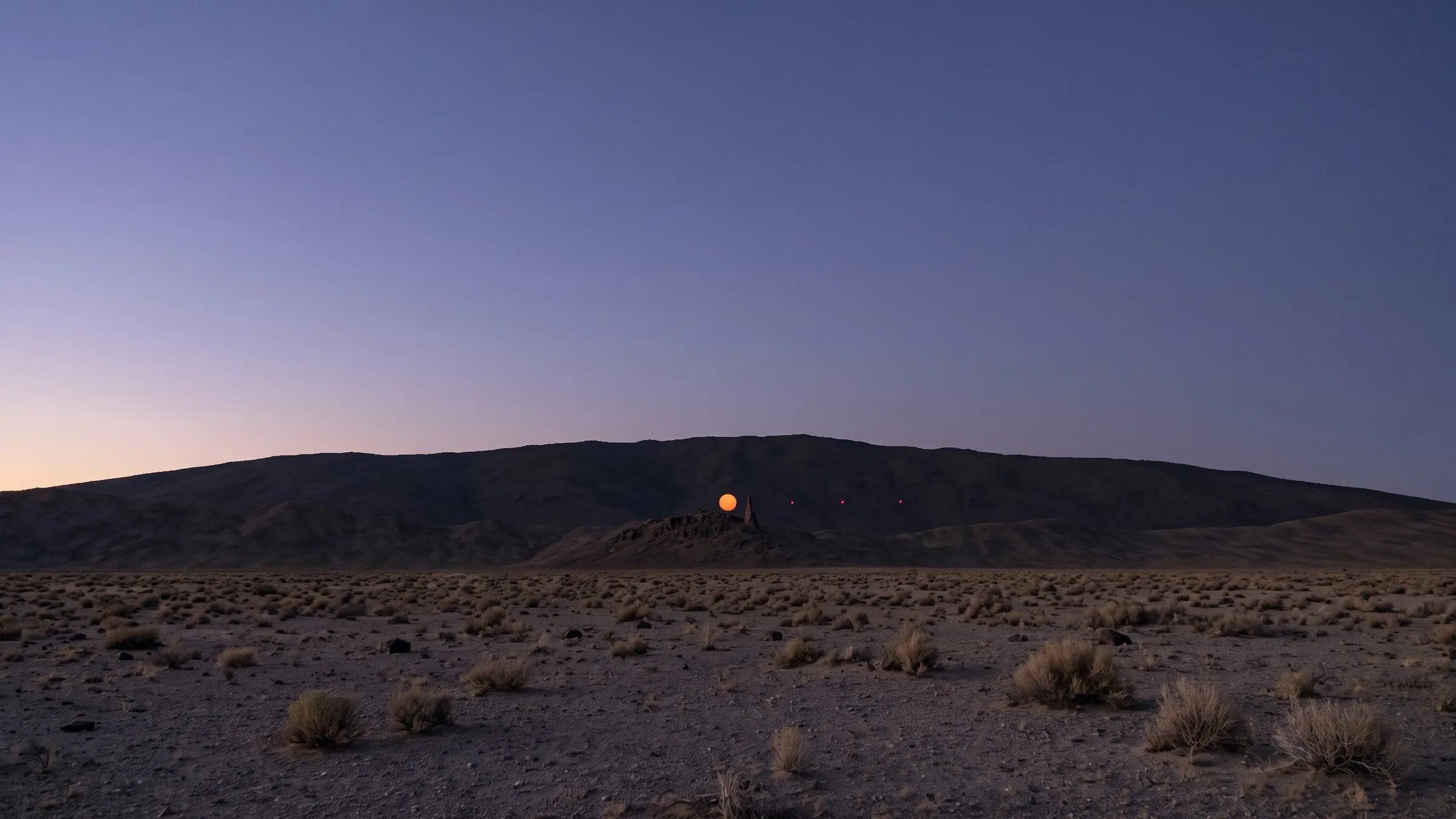
Stand at dusk where the agents stood and look at the ridge. The deck says two of them, USPER5 and USPER6, watched a glowing orange orb at 'approximately 500-600 meters,' by their estimate, and that 'it appeared to be similar in size to a “small helicopter cockpit.”' (p. 2); its footnotes give AARO's assessment, '~1050 meters away from the observers' and 'between 12-18 meters in diameter'. Witness 1 writes 'I would have guessed the circle to be 20 feet or more in diameter.' (D079 p. 1). An object's angle is its size over its range, so the two pairs can be set side by side: the witnesses' 20 ft at 500 to 600 m fills 0.699° to 0.582° of sky, AARO's 12 to 18 m at ~1,050 m fills 0.655° to 0.982°, and they meet at about 0.65 to 0.70°, one angle read with two rulers. The Moon's mean disc is 0.5179°, so AARO's pair is 1.26 to 1.90 Moons. Witness 1 writes that on a later day a range finder put the hillside 'at about 1100 meters' (D079 p. 1), where the same 20 ft is 0.318°. AARO's analysis update prints 'approximately 60 percent' and 'the remaining 40 percent' and leaves two sentences open, and the bench prices both: a red orb 'remaining stationary for several hours' against the LUU-2 illumination flare's specified 240 to 300 s at 2.5 m/s, which at 1,050 m crosses 0.136° a second and falls 600 to 750 m over its burn; and the silence, against 68.4 dB of spreading to 1,050 m, after which a source of 100 dB sound power arrives at 31.6 dB on a desert night measured at 15.0 dBA. The bench prints the record's sentences beside the arithmetic and rules on none of them.
Keep the signal
The station is free. No ads, no tracking cookies. If the files are worth your time, following is the support.
 Open the interactive ▸
The record
The deck is the four-section Department of War briefing slide deck that PURSUE Release 01 published at war.gov/ufo on 8 May 2026, read on this site by Release 01 Briefing 2. Its sections, one a page, carry their own headings: “Orbs Launching Orbs”, “Large, Fiery Orb”, “Dark Kite” and “Transparent Kite”. The first gives 'Time of Day: Dusk (on two separate days)' and says 'Three teams of two federal law enforcement special agents each (USPER1 through USPER6) independently describe seeing orange “orbs” in the sky emit/launch smaller red “orbs” in groups of two to four, with three being the general consensus.' It adds 'This is stated to have occurred at least five times.' and 'The orange orb was only visible for one or two seconds.' (p. 1), and says what it cannot tell: 'it is not known whether there was a single orange “mother” orb that released the groups of red orbs or whether there were multiple orange orbs at play.' The second says 'Two federal law enforcement special agents (USPER5 and USPER6) witness a glowing orange orb at a distance of “approximately 500-600 meters,”* where it was perched close to a rock pinnacle.' and 'The sighting lasted “about a minute.”' (p. 2), and its two footnotes carry AARO's measurements. The two kites, on pp. 3 and 4, are on the File and in no figure. Apart from AARO's two footnotes, the deck's distances, sizes and times are the agents' own figures, not instrument readings.
Release 03 opened the file wider, and Release 03 Briefing 3, the expanded case file, reads it. AARO's case analysis update, DOW-UAP-D077, dated 05 June 2026, says 'As of June 2026, the case remains unresolved.' (§1, p. 1) and 'Over a period of two days in October 2023, six federal law enforcement special agents reported observing “orbs launching other orbs,” near a sensitive national security site in the western United States at approximately dusk.' (§2, p. 1). It calls the repeating pattern the phenomena's most distinctive reported feature, 'a luminous orange “mother orb”' producing smaller red ones 'multiple times over a period of several hours', and says 'Reporters described the orange “mother orbs” as appearing for one to two seconds, releasing a cluster of two to four red “orbs,” and subsequently disappearing.' Its §4 sets out the hypotheses AARO ran, each with the document's own label. The notional map, DOW-UAP-D078, calls itself 'a notional representation of four incidents reportedly involving unidentified anomalous phenomena (UAP) in the western United States, as seen from above' and puts the fiery orb 'at an approximate distance of 1,000 yards'. The five narratives, DoW-UAP-D079 to D083, dated 02 June 2026, are the witnesses' own accounts, labelled Witness 1 to Witness 5. The release's ten renderings, FBI-UAP-D014 to D023, generated in 2023, and the narratives' own images are illustrations made after the fact; of the images in D080, Witness 2 writes that they are 'not to exact scale' and were 'generated two and a half years after the events' (D080 p. 5). The bench takes no geometry from any of them.
The record disagrees with itself in two places, and the File prints both sides at one size. The span: the deck says 'over a two-day period' (p. 1), and so do D077 and the narratives' summaries (§1), where the map's caption says 'over a period of several days in October 2023'. The footage: D077 §3.a says 'The reporting agents did not collect video footage, photographic imagery, or other technical data during the incident.' (p. 2), where Witness 2 writes 'The video footage captures some of it, but more valuable is the audio of our reactions.' (D080 p. 4) of the third incident, the object on the road, and Witness 5 'we set up a camera in hopes to catch photos if anything returned to sight' (D083 p. 2). The bench draws no conclusion from either.
One angle, two rulers
The record gives one object two pairs of figures. The deck puts the fiery orb at 'approximately 500-600 meters,' by the witnesses' estimate and 'similar in size to a “small helicopter cockpit.”', a size with no number; its footnotes give AARO's assessment, '~1050 meters away from the observers' and 'between 12-18 meters in diameter' (p. 2). Witness 1 gives the number the deck leaves out: 'I would have guessed the circle to be 20 feet or more in diameter.' (D079 p. 1). The same page carries a third range, 'initially I guessed it was 500 to 600 meters away, though another later day I was able to use a range finder to put the distance to the hillside at about 1100 meters. The ball appeared close to the hill face.', and the map's caption a fourth, 'at an approximate distance of 1,000 yards', beside 'Distances are not to scale.'
An object of diameter D at range d fills θ = 2 arctan(D / 2d) of sky, whatever it is. The witnesses' 20 ft, 6.096 m, is 0.699° (12.2 mrad) at 500 m and 0.582° (10.2 mrad) at 600 m. AARO's 12, 15 and 18 m at ~1,050 m are 0.655°, 0.818° and 0.982° (11.4, 14.3 and 17.1 mrad). The two pairs meet at about 0.65 to 0.70° of sky: one angle, read with two rulers. The 20 ft is a floor, 'or more', and the bench draws it as one. Carried out to 1,050 m, the witnesses' angle belongs to an object 10.7 to 12.8 m across; brought in to 500 and 600 m, the angle of AARO's middle 15 m belongs to one 7.14 and 8.57 m across, and at the range finder's 1,100 m to one 15.7 m across. The ratios are arithmetic, not a ruling: 1,050 against 500 is 2.10 and against 600 is 1.75; the range finder's 1,100 against 1,050 is 1.05. The same 20 ft at the range finder's 1,100 m to the hillside is 0.318° (5.5 mrad), 0.45 of the angle at 500 m. At the map's 1,000 yards, 914.4 m exactly, AARO's angle belongs to an orb 13.1 m across, and the caption says its distances are not to scale.
The Moon's mean disc, from NASA's fact sheet, is 0.5179° across, so AARO's pair is 1.26 to 1.90 Moons and the witnesses' 1.35 to 1.12. The deck's cockpit is a dial on the bench, 1 to 3 m wide, 1.5 m by default and labelled modelled: 1.5 m at 500 to 600 m is 0.172° to 0.143°, and it would fill the dialled 0.818° at 105 m. The bench prints both pairs as the record prints them and draws the line of one angle that each implies; it does not say which ruler is right.
What the bench does
The bench's views are the Dusk, the Ledger, the Flare, the Silence and the File, and its presets set the dials from the record: AARO's pair, the witnesses at 500 m and at 600 m, the range finder, the map, the Sequence, the LUU-2, the M206 and the silence.
The Dusk is the witness's eye in 3D, staged from the record's words. The orange orb is drawn at its angular size against a hill face just over the near crest's summit, with the rock pinnacle beside it: Witness 1 writes 'The ball appeared close to the hill face.' (D079 p. 1), Witness 5 writes it 'seemed to be hovering with zero resistance or movement, or to be suspended just over a distinctive peak in the ridge line' (D083 p. 1), and the deck puts the orb 'perched close to a rock pinnacle' (p. 2). The sky sits at a dialled sun depression, 4° below the horizon by default, inside civil twilight, which the U.S. Naval Observatory ends when the Sun's centre is 6° below; the record gives the hour in words, not the Sun: 'just before 7 pm' (D079 p. 1), 'roughly dusk with a clear sky' (D081 p. 1), 'just after sunset (7PM)' (D082 p. 1), 'at 1858' (D083 p. 1). The dial runs from 0° to 12° below, the end of nautical twilight. The ridge, the pinnacle, the floor, the sky's colours and the stars are staging; the orb and the two reading aids beside it, the Moon ghost (the Moon's mean disc) and the cockpit ghost (the dialled cockpit width at the witnesses' 500 m), are drawn at their angular sizes. The witness camera looks along the sightline; the side and plan cameras show the witness, the orb, the near crest and the pinnacle from beside and from above. Chips give the angle in degrees, milliradians and Moons, the size that keeps it at the witnesses' range, the cockpit, the Moon and the Sun.
The Dusk's Sequence plays the record's pattern with the record's own numbers: the 'mother' orb at 'approximately 45 degrees (halfway between the horizon and directly overhead)' (D081 p. 1) for the deck's 'one or two seconds' (p. 1) or for the 'about 10 seconds' of what Witness 5 calls 'a large red orb' (D083 p. 2), releasing two to four red orbs, three by default, each 'approximately 1/15 the size of the orb-like light' (D080 p. 1): 1.00 m across at the default 15 m, 0.8 to 1.2 m across AARO's 12 to 18 m, 0.4 m at the witnesses' 20 ft. They move off along a horizontal line at one of Witness 3's two rates: the orange orb's 'approximately 20 degrees in the sky in about three to five seconds' (D081 p. 1), 4 to 6.7°/s, or the four red lights' 'in about five to ten seconds covering roughly 90 degrees across the sky' (D081 p. 2), 9 to 18°/s. The record never gives the red orbs' range, so the range is the Sequence's one modelled dial, labelled so on the view: at its default 1,050 m the slower end of the orange orb's rate, 4°/s, is 73.3 m/s.
The Ledger is the range-size plane, both axes logarithmic, 100 m to 5 km by 0.3 to 50 m: the band of AARO's angle, the witnesses' box with an arrow up from its 20 ft floor, the cockpit width, the range finder's 1,100 m and the map's 914.4 m as lines with their words, and the Moon's angle; a line of one angle is straight on it, and the pointer reads the angle anywhere. The Flare sets a specification's fall and burn at the dialled range on one time axis with the record's durations, with a magnitude ladder beside it. The Silence is a level ladder in decibels with the source at the witness, the dialled ambient and the source the night allows. The File holds the record on cards, document by document: the deck's sections, D077 with its hypotheses at one size, the map's caption, the narratives, the images' caveat, the two places the record disagrees with itself, the Release 02 case kept apart, what the bench does not model and the two readings. The story walks through them in the record's order, from the heading to the reading.
Not priced here: what the orbs were; the kites, which stay on the File; the renderings, as geometry; triangulation, since the map is notional and the deck gives no baselines; radar and ADS-B coverage, for which the record gives no data; the ground scrapes Witness 5 writes of (D083 p. 4); and the heights Witness 4 prints without a unit, '1-2k' among them, in any unit.
The Moon for scale
NASA's Moon Fact Sheet (NSSDCA, last updated 11 January 2024) gives the figures the bench takes for scale. From its volumetric mean radius, 1737.4 km, and its semimajor axis, 384,400 km, the mean disc is 2 arctan(1737.4 / 384,400), 0.5179°; the sheet's own apparent diameter at opposition, 1896 seconds of arc at 378,000 km, is 0.527°, and the Ledger prints both. Across the sheet's range of distances, 357,000 to 407,000 km, the disc runs from 0.558° to 0.489°. Against the mean disc, AARO's 12 to 18 m at ~1,050 m is 1.26 to 1.90 Moons and the Dusk's default 15 m is 1.58; the witnesses' 20 ft at 500 to 600 m is 1.35 to 1.12. The sheet's full Moon, apparent visual magnitude −12.74 at opposition, is a rung on the Flare's ladder. The Dusk draws the Moon's disc beside the orb as a ghost, a reading aid that a switch turns off: the record does not mention the Moon.
A flare's minute
D077's §4.c, headed 'Military Aircraft Dispensing Flares (Partially Plausible)', names two kinds of flare and carries the agents' own sentence; the Flare prints the three at one size, as the document does:
- 'However, the visual and behavioral characteristics of the specific types of flares carried by the military aircraft operating in the area differ from those of standard illumination flares.' (§4.c.i, p. 3)
- 'In at least one case, the agents’ report of a red “orb” remaining stationary for several hours is physically incompatible with the burn-time and descent rate of any known military flare.' (§4.c.ii, p. 3)
- 'The agents, who are professionally familiar with the visual characteristics of military flares, stated that the phenomena did not exhibit those characteristics.' (§4.c.i, p. 3)
D077 names 'infrared countermeasure flares' and 'standard illumination flares', so the Flare carries one specification of each, with its document. The LUU-2 illumination flare (GlobalSecurity.org's LUU-2 pages; Magellan Aerospace, 15 March 2019): 'Burn Time: 240 sec/300 sec', 'Descent Rate: 8.3 ft/sec (2.5 m/sec)', 'Light Output: 1,800,000 candlepower, 1,600,000 candlepower'. The M206 infrared countermeasure flare (MIL-F-63107C(AR), 6 January 1986): 'Decoy intensity requirement is 1480 watts/steradian.' (§3.5.3.1), 'Each sample shall reach decoy intensity within .14 seconds and shall remain at or above this intensity for an additional 2.3 seconds.' (§3.5.3.1.1), and 'the average duration at or above this intensity shall not be less than 2.7 seconds' (§3.5.3.1.2). Both are reported as their documents print them.
At the dialled range the bench's arithmetic is exact. At 1,050 m the LUU-2's 2.5 m/s crosses the line of sight at 2.38 mrad/s, 0.136°/s; over the 240 to 300 s burn it drops 600 to 750 m, 29.7° to 35.5° below the release point seen from 1,050 m; released 300 m above a ridgeline, a modelled height, it is below the ridge after 120 s. Each M206 sample reaches decoy intensity within 0.14 s and holds it for 2.3 s more, 2.44 s in all; the average time at or above it is at least 2.7 s. The Flare's time axis is logarithmic and carries them together: the M206's 2.7 s, the LUU-2's 240 to 300 s, the record's own durations with their pages, from the 'mother' orb's 'one or two seconds' and the fiery orb's 'about a minute' to Witness 2's 'From approximately 1930 hours until approximately 2300 hours', 3.5 h, and Witness 4's 'within a 2-3 hour span, nonstop', and D077's 'several hours', which the axis brackets with no figure because D077 gives none.
On the magnitude ladder the LUU-2's two candlepower figures, taken as candela as Collins English Dictionary defines the unit, read −14.7 and −14.6 at 1,050 m (Wikipedia's 0.981 candela to the candlepower moves neither at one decimal), beside the full Moon's −12.74 and the planets' mean magnitudes from Venus's −4.14 to Saturn's +0.46: the band for Witness 2's 'not dissimilar to that of a luminescent planet observed in the night sky but grew slowly brighter' (D080 p. 1), printed with no planet picked. The M206 is specified in watts per steradian in its own band and gets no visual magnitude. The bench prices D077's sentences against the specifications and stops there.
The silence
The record's statements on the orbs' sound, each with its page, as the Silence view prints them: the deck, 'Witnesses stated that the object did not emit any noticeable sound.' (p. 2); AARO's analysis update, 'The reporters also described the phenomena as “silent.”' (§2, p. 1); Witness 1, 'There was no particular sound heard with it.' (D079 p. 1); Witness 2, 'There were no acoustics, interreference or physiological effects experienced during the incident.' (D080 pp. 2, 3 and 4); Witness 3, 'I do not recall any sound associated with what I saw.' (D081 p. 1) and 'Again, I don't recall there being any sound associated with any of this.' (D081 p. 2); Witness 4, 'No other lights were seen, nor did I hear any mechanical buzzing or anything like an aircraft at this time and kept driving.' (D082 p. 1). And AARO's own open sentence: 'Due to a lack of instrument-measured distance data, AARO cannot determine whether the phenomena’s reported silence corresponds to an inherent characteristic or to acoustic attenuation.' (§3.b, p. 2)
Over the ground, a reflecting plane, a source of sound power level L_W arrives at the witness at L_p = L_W − 10 log₁₀(2πd²), the hemisphere INST-99 uses: at 1,050 m the spreading takes 68.4 dB, where a free-field sphere would take 71.4 dB. The record gives no source level, so L_W is a dial, 100 dB by default, and at 1,050 m that source arrives at 31.6 dB. The default ambient is a measured desert night, the National Park Service's 2008 report for Great Sand Dunes, a night L50 of 15.0 dBA in salty shrubland, set by AARO's 'typical levels of light pollution for the area' (§4.f.ii, p. 4) and Witness 1's 'All seemed quiet and it was pretty remote.' (D079 p. 1). Against it the night allows a source at 1,050 m of L_W 83.4 dB. The National Park Service's 2017 Grand Canyon desert nights, 15.3 to 38.4 dB, are printed as the spread, and INST-99's measured helicopters, carried to 1,050 m by the same hemisphere, sit on the ladder for scale: a BV-234 flyover at 70.1 to 72.1 dB, a K-MAX at 81.2 dB and an Mi-8 contour at 63.6 dB; the bench does not say the source was one.
Air absorption is a switch, off by default. ISO 9613-2:1996's Table 2 gives, for air at 20 °C and 70 % humidity, 0.3 to 22.9 dB/km from 125 Hz to 4 kHz and 5.0 dB/km at 1 kHz; A_atm = αd / 1 000 is 5.25 dB at 1,050 m, so with it on the 100 dB source arrives at 26.3 dB and the night allows 88.7 dB. It is Part 2's octave-band table, and its row is the table's air, not the desert's.
Evidence
The record's sentences, the specifications and the tables, one row each, with the kind of claim each is and what the bench does with it.
| 'Three teams of two federal law enforcement special agents each (USPER1 through USPER6) independently describe seeing orange “orbs” in the sky emit/launch smaller red “orbs” in groups of two to four, with three being the general consensus.' 'This is stated to have occurred at least five times.' stated by the deck, p. 1 | REPORTED | The Sequence releases two to four red orbs, three by default; the count and the five times stay the deck's, with their page. |
| 'The orange orb was only visible for one or two seconds.' stated by the deck, p. 1; AARO's analysis update, §2, p. 1 | REPORTED | The Sequence's default visible time; D077 §2 gives the same, 'appearing for one to two seconds'. Both sit on the Flare's time axis with the record's other durations. |
| 'Two federal law enforcement special agents (USPER5 and USPER6) witness a glowing orange orb at a distance of “approximately 500-600 meters,”* where it was perched close to a rock pinnacle.' 'Size was difficult to determine, but it appeared to be similar in size to a “small helicopter cockpit.”**' stated by the deck, p. 2 | REPORTED | The witnesses' range, their estimate. The cockpit has no number in the record; on the bench it is a modelled width, 1 to 3 m, 1.5 m by default: 0.172° to 0.143° at 500 to 600 m. |
| '* Measurements later gathered by AARO assess the object to have been ~1050 meters away from the observers.' '** Measurements later gathered by AARO assess the object to have been between 12-18 meters in diameter.' stated by the deck's footnotes, p. 2 | REPORTED | AARO's assessment, its “~” kept: 0.655° to 0.982°, 11.4 to 17.1 mrad, 1.26 to 1.90 Moons. The Dusk's default is the middle, 15 m at 1,050 m, 0.818°. |
| 'initially I guessed it was 500 to 600 meters away, though another later day I was able to use a range finder to put the distance to the hillside at about 1100 meters. The ball appeared close to the hill face.' 'I would have guessed the circle to be 20 feet or more in diameter.' stated by Witness 1, D079 p. 1 | REPORTED | The witnesses' pair, 20 ft at 500 to 600 m: 0.699° to 0.582°; the 20 ft is a floor and is drawn as one. At the range finder's 1,100 m to the hillside the same 20 ft is 0.318°. The Dusk sets the orb against the hill face. |
| 'Agents reported observing a large “fiery orb” projected against a ridgeline at an approximate distance of 1,000 yards.' 'Distances are not to scale.' stated by the map's caption, D078 | REPORTED | 914.4 m on the Ledger, where AARO's angle belongs to an orb 13.1 m across. Nothing else is taken from the map, which calls itself notional. |
| 'approximately 35-45 degrees above the northern/northeastern horizon' 'The red lights were approximately 1/15 the size of the orb-like light.' 'not dissimilar to that of a luminescent planet observed in the night sky but grew slowly brighter' stated by Witness 2, D080 p. 1 | REPORTED | The Dusk looks north-east; the red orbs are 1/15 of the orange orb, 0.8 to 1.2 m across AARO's 12 to 18 m; the planet is a band on the Flare's ladder, −4.14 to +0.46, with no planet picked. |
| 'In terms of speed, I'd estimate the orb moved approximately 20 degrees in the sky in about three to five seconds.' 'Their speed was difficult to gauge but I'd say they moved from right to left in my vision in about five to ten seconds covering roughly 90 degrees across the sky.' stated by Witness 3, D081 pp. 1 and 2 | REPORTED | The Sequence's two rates, 4 to 6.7°/s and 9 to 18°/s. The record gives no range for them, so their speed in metres a second rides on a modelled dial. |
| 'Approximately 40 percent of the reported phenomena lack a plausible explanation after first stage analysis and thus remain unresolved.' 'approximately 60 percent' 'the remaining 40 percent' stated by AARO's analysis update, D077 §4 to §4.c.ii, pp. 2 and 3 | REPORTED | Printed as D077 prints them, at one size, with its hypothesis headings and labels on the File. The bench adds no percentage of its own. |
| 'In at least one case, the agents’ report of a red “orb” remaining stationary for several hours is physically incompatible with the burn-time and descent rate of any known military flare.' stated by AARO's analysis update, D077 §4.c.ii, p. 3 | REPORTED | Priced on the Flare: the LUU-2's 240 to 300 s at 2.5 m/s, on one axis with D077's 'several hours'. No ruling. |
| 'Due to a lack of instrument-measured distance data, AARO cannot determine whether the phenomena’s reported silence corresponds to an inherent characteristic or to acoustic attenuation.' stated by AARO's analysis update, D077 §3.b, p. 2 | REPORTED | Priced on the Silence: 68.4 dB of spreading at 1,050 m; a 100 dB source arrives at 31.6 dB against a 15.0 dBA night, which allows 83.4 dB. |
| The record's statements on the orbs' sound, among them 'There was no particular sound heard with it.' (Witness 1) and 'nor did I hear any mechanical buzzing or anything like an aircraft' (Witness 4) stated by the deck, p. 2; D077 §2, p. 1; D079 p. 1; D080 pp. 2, 3 and 4; D081 pp. 1 and 2; D082 p. 1 | REPORTED | Printed on the Silence with their pages; the bench adds none. |
| 'Burn Time: 240 sec/300 sec' 'Descent Rate: 8.3 ft/sec (2.5 m/sec)' 'Light Output: 1,800,000 candlepower, 1,600,000 candlepower' stated by GlobalSecurity.org, LUU-2 specifications and overview; Magellan Aerospace, 15 March 2019 | REPORTED | A specification, reported as its document prints it. The fall, the drop and the magnitude are the bench's arithmetic on it. |
| 'Decoy intensity requirement is 1480 watts/steradian.' 'the average duration at or above this intensity shall not be less than 2.7 seconds' stated by MIL-F-63107C(AR), 6 January 1986, §3.5.3.1 and §3.5.3.1.2, p. 4 | REPORTED | On the time axis at 2.7 s; its watts per steradian stay in its own band and never become a visual magnitude. |
| NASA's Moon Fact Sheet: volumetric mean radius 1737.4 km, semimajor axis 384,400 km, apparent diameter 1896 seconds of arc at 378,000 km, apparent visual magnitude −12.74 stated by NASA Goddard Space Flight Center, NSSDCA, last updated 11 January 2024 | TABULATED | The mean disc, 0.5179°, for the Moon ghost and the Ledger's line; the full Moon on the ladder. |
| Civil twilight ends when the Sun's centre is 6° below the horizon, nautical 12°, astronomical 18°; sunset is a zenith distance of 90.8333° stated by the U.S. Naval Observatory's definitions; NOAA's glossary gives the same depressions | TABULATED | The Sun dial's marks; its modelled default, 4° below, sits inside civil twilight. |
| ISO 9613-2:1996 Table 2, at 20 °C and 70 %: 0.3, 1.1, 2.8, 5.0, 9.0 and 22.9 dB/km in the octave bands from 125 Hz to 4 kHz stated by ISO, Part 2's octave-band table | TABULATED | The absorption switch, off by default: 5.25 dB at 1,050 m at 1 kHz, the table's air, not the desert's. |
| The planets' mean magnitudes, Venus −4.14 to Saturn +0.46; E0 = 2.08 × 10⁻⁶ lx at magnitude 0 stated by INST-95's table (Wikipedia, “Apparent magnitude” and “Lux”, read 2 October 2026) | TABULATED | The planet band, and m = −2.5 log₁₀(I / d² E0) for the ladder. |
| The sound-pressure table's rows, from light leaf rustling at 10 dB to a two-stroke chainsaw at 110 dB stated by INST-99's rungs (Wikipedia, “Sound pressure”, read 9 October 2026) | TABULATED | The Silence's ambient ladder, beside this bench's own desert night. |
| Great Sand Dunes, 2008: night L50 15.0 dBA, natural 14.7; Grand Canyon, 2017: desert nights 15.3 to 38.4 dB stated by the National Park Service's acoustic monitoring reports | MEASURED | The default ambient and its spread. |
| A BV-234 flyover, 87 to 89 dBA at 150 m (FAA 1984); a K-MAX, 118 dBA at 50 ft (Piper 2007); an Mi-8 contour, 90 dBA at 50 m (Messinger and Tajnos 2006) stated by INST-99's anchors, as the USDA Forest Service reports them | MEASURED | Carried to 1,050 m by the hemisphere: 70.1 to 72.1, 81.2 and 63.6 dB, rungs for scale. |
| θ = 2 arctan(D / 2d); the size that keeps θ at d, 2d tan(θ / 2); the ratios; the Moon's mean disc stated by this bench | EXACT | 0.699° and 0.582°; 0.655° to 0.982°; 0.318°; 7.14 and 8.57 m, 15.7 m, 13.1 m; 2.10, 1.75 and 1.05; 0.5179°. |
| L_p = L_W − 10 log₁₀(2πd²); A_atm = αd / 1 000 stated by this bench | EXACT | 68.4 dB at 1,050 m, 71.4 dB for a sphere; 31.6 dB at the witness for 100 dB; 83.4 dB allowed by the night; 5.25 dB of air if on. |
| v/d, v t and h/v for a specification's fall; m = −2.5 log₁₀(I / d² E0) stated by this bench | EXACT | 2.38 mrad/s, 600 to 750 m, 120 s; −14.7 and −14.6 at 1,050 m. |
| The cockpit width, 1 to 3 m (1.5); the Sun, 0 to 12° below the horizon (4); the red orbs' range (1,050 m); the release height above the ridgeline (300 m); L_W (100 dB); the ridge, the pinnacle, the floor and the stars stated by this bench | MODELLED | Dials and staging, each named on the view: the record gives none of them a number. |
| Which ruler: the witnesses' 20 ft at 500 to 600 m, or AARO's 12 to 18 m at ~1,050 m, for the one angle both give stated by the reader | READING | The bench prints both and does not say. |
| What the orbs were stated by the reader | READING | The question this bench leaves to you. |
Two readings
As the File ends, at equal size:
WHAT THE RECORD SAYS · REPORTED
the agents' dusks: orange orbs releasing red ones
The record describes, in the witnesses' words and in AARO's, a repeating pattern over 'a period of two days in October 2023' (D077 §2): an orange orb 'only visible for one or two seconds' (deck p. 1) releasing 'smaller red “orbs” in groups of two to four' (deck p. 1), 'at least five times'; the red ones in 'a horizontal formation' (D080 p. 1), one of them 'remaining stationary above a ridgeline for several hours' (D077 §2), and nothing heard. One section gives a range and a size twice: the witnesses' 'approximately 500-600 meters' and 'small helicopter cockpit', and AARO's '~1050 meters' and 'between 12-18 meters in diameter'. The bench repeats the sentences with their pages and adds no adjective. It does not say what was in the sky.
WHAT THE ARITHMETIC GIVES · EXACT
one angle, 0.65 to 0.70° of sky
An object's angular size is its diameter over its range: 2 arctan(D / 2d). The witnesses' 20 ft at 500 to 600 m is 0.699° to 0.582°; AARO's 12 to 18 m at ~1,050 m is 0.655° to 0.982°. They meet at 0.65 to 0.70°: the same angle read with two rulers. The range finder's 1,100 m with the same 20 ft gives 0.318°, about half. D077's two open sentences, priced: the LUU-2's specified 240 to 300 s at 2.5 m/s against 'several hours'; a source of 100 dB sound power at 31.6 dB at ~1,050 m, against a desert night of 15.0 dBA, which allows 83.4 dB. These are what the record's own figures give; none of it says what the orbs were. The reading is yours.
On this site
The case is on this site already. Release 01 Briefing 2 reads the deck, Release 03 Briefing 3 reads AARO's update, the map and the narratives, and the wiki keeps a node on the Western US Event. The briefings record what the documents say; this bench does not retell the case, it prices the record's figures. A separate case shares the region and much of the language: ODNI-UAP-D001, published in PURSUE Release 02 and read by Release 02 Briefing 2, a serving senior U.S. intelligence official's account of glowing orbs seen from a helicopter in and near a sensitive U.S. military facility in late 2025. The briefings keep the two apart, and so does this bench: it prices only the event of October 2023.
On the casework line it sits beside benches of the same shape. INST-90 The Tremonton Film Rangefinder multiplies a film's angles by an assumed distance, the one number nobody measured; INST-86 The Westall Two-Channel Bench runs sight lines from three witness groups at known places and reads an object's angle in Moons; INST-95 The Lubbock Thirty Degrees a Second Bench holds the magnitude ladder the Flare reads, and INST-99 The Silent Hover Bench the sound ladder, the measured helicopters and the hemisphere the Silence reads, both now in modules this bench shares with them.
The documents and the tables
- “Orbs Launching Orbs”, the Western US Event briefing slide deck, U.S. Department of War, PURSUE Release 01, war.gov/ufo, published 8 May 2026: pp. 1 to 4, the four sections and the two footnotes.
- DOW-UAP-D077, AARO Case Analysis Update, “Western U.S. Event ‘Orbs Launching Orbs’”, dated 05 June 2026, PURSUE Release 03: §1 to §5, pp. 1 to 4.
- DOW-UAP-D078, the notional map of the Western US Event, PURSUE Release 03: the caption, Incident 2 and the note.
- DoW-UAP-D079 to DoW-UAP-D083, Narratives 1 to 5 (Witness 1 to Witness 5), dated 02 June 2026, PURSUE Release 03: D079 p. 1, D080 pp. 1 to 5, D081 pp. 1 and 2, D082 pp. 1 and 2, D083 pp. 1, 2 and 4.
- FBI-UAP-D014 to FBI-UAP-D023, the digital renderings of incidents 1-1 to 2-7, generated 2023, PURSUE Release 03: carried as illustrations, never as geometry.
- NASA Goddard Space Flight Center, NSSDCA, “Moon Fact Sheet” (Dr David R. Williams), last updated 11 January 2024, read 25 October 2026: the radii, the semimajor axis, the range of distances, the mean values at opposition.
- GlobalSecurity.org, “LUU-2 Flare” and its specifications page, read 25 October 2026; Magellan Aerospace, press release of 15 March 2019: the burn time, the descent rate, the light output.
- MIL-F-63107C(AR), Military Specification, “Flare, Aircraft Countermeasure: M206”, 6 January 1986, pp. 4 and 5: §3.5.2 to §3.5.3.2.1, the ejection velocity, the decoy and high intensities and their times.
- ISO 9613-2:1996, “Acoustics, Attenuation of sound during propagation outdoors, Part 2: General method of calculation”, Table 2 and §7.2, p. 9, as reproduced in South Dakota PUC docket EL19-003, exhibit KM-9, read 25 October 2026.
- U.S. Naval Observatory, “Rise, Set, and Twilight Definitions” (Internet Archive capture of 12 October 2026); NOAA Global Monitoring Laboratory, “Solar Calculator Glossary”; read 25 October 2026.
- National Park Service, “Great Sand Dunes National Park and Preserve Acoustic Monitoring Report” (Emma Lynch, October 2008), Table 1, and “Grand Canyon National Park Acoustic monitoring report: 2017” (Jacob Job, February 2020), Table 3; read 25 October 2026.
- Collins English Dictionary, through Dictionary.com, “candlepower”, and Wikipedia, “Candlepower”, read 25 October 2026: candlepower taken as candela, the 0.981 printed beside it.
- The shared tables, with their own sources in the benches that first read them: INST-99’s sound-pressure rungs and helicopter anchors (Wikipedia, “Sound pressure” and “Sound power”, read 9 October 2026; the USDA Forest Service’s helicopter sound measurements, reporting FAA 1984, Piper 2007 and Messinger and Tajnos 2006), and INST-95’s magnitudes (Wikipedia, “Lux”, “Apparent magnitude” and “Candela”, read 2 October 2026).
- On this site: Release 01 Briefing 2 and Release 03 Briefing 3 (the Western US Event); the wiki node on the Western US Event; INST-90 The Tremonton Film Rangefinder, INST-86 The Westall Two-Channel Bench, INST-95 The Lubbock Thirty Degrees a Second Bench, INST-99 The Silent Hover Bench.