The Claims Bench
Standing claims wired up and tested: the pattern is real, the mechanism is the question.
LIVE  The Thermoptic Camouflage Bench OSHII 1995 · THE SUIT, PRICED · INST-88 The Major's thermoptic camouflage in the opening drop and the canal fight of Oshii's Ghost in the Shell (1995): it shows its background, ripples when she moves, is found out by water at once, and its name says it defeats thermal imagers too. This bench prices the device as drawn in three currencies. The Band prices the passive cloak: light routed round a 0.45 m body travels at least (π/2 − 1)·D further and a wave packet cannot go round faster than light in a passive medium, so the band a body can hold at 550 nm is 0.12 pm, a laser line, one part in three million of daylight; turned round, daylight can hide a virus, a sodium lamp a coin, a laser a building, and the sum rule permits what the clock forbids. The Seam prices the display cloak the film draws: Tachi's 2003 optical camouflage is right for one eye, a second eye a metre aside with the wall 1.5 m behind sees the background jump 19 cm, 68 times what the eye resolves; one frame of latency at a walk lags 23 mm, a third of a metre a frame in the fall; rain at 10 mm/h hits the body 208 times a second and six splashes at once draw the outline. The Heat prices 100 W with nowhere to go: +1.5 K an hour if stored, 81 minutes to +2 K; 2 kg of ice for 2 h 42 min at rest and 27 minutes running; breath at 8 W bright at 4.3 µm, a bare sole's print above the noise for 26 minutes. The Suit puts all of it in a night alley: three suits, four lights, a white-hot imager, rain. Two readings hang at equal size. LIVE
 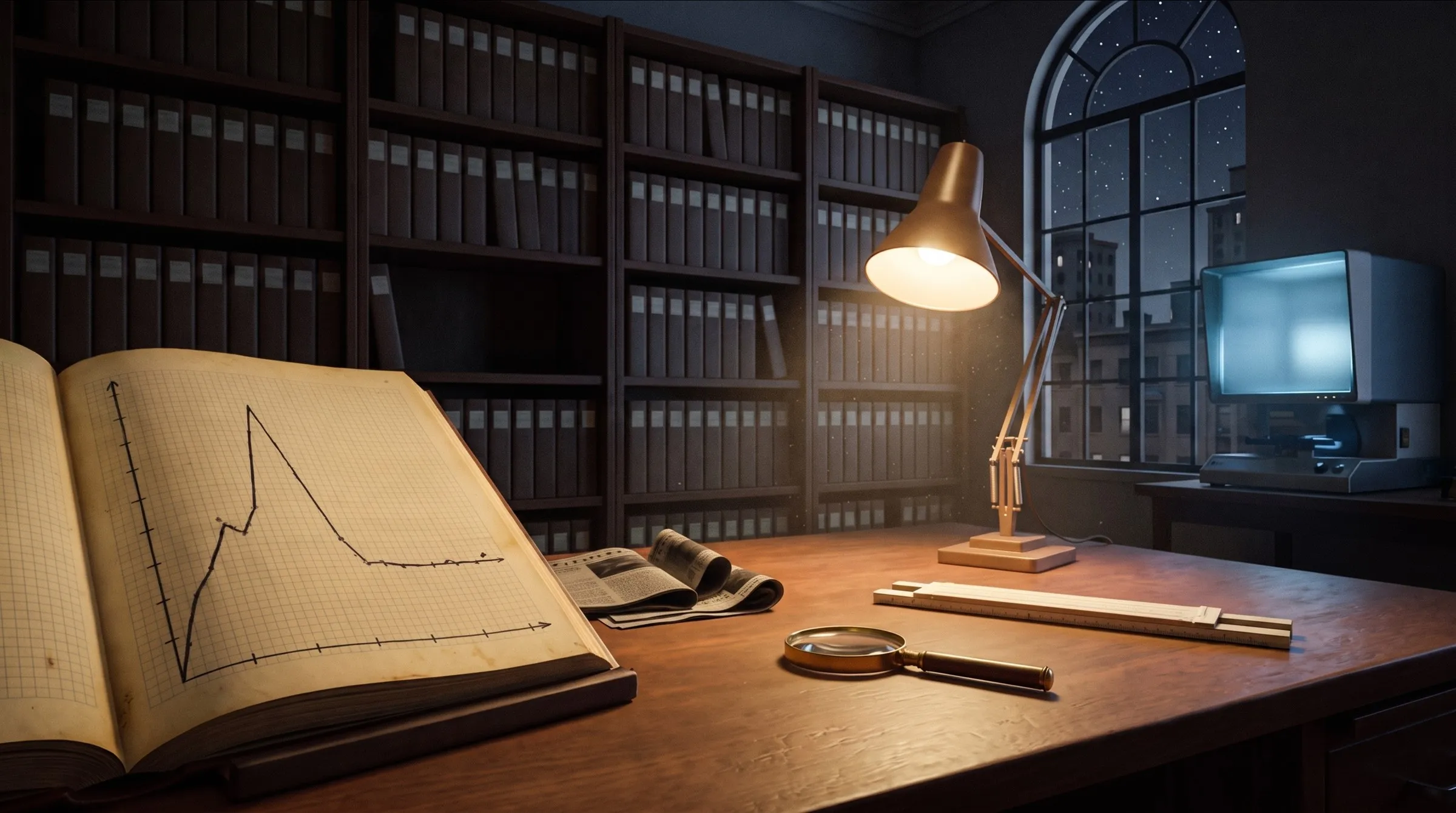 The Vanishing Literature COOK 2002 · A SILENCE, PRICED · INST-81 In 1956, named aerospace executives talked about cancelling gravity in print; by 1960, in Cook's words, "it was as if none of them had ever even thought of it." The Hunt for Zero Point reads that silence as classification. The sixth statistics bench lays the silence itself on the table: all thirty documented items of the 1952-1961 electrogravitics conversation, one square per document, drawn as dated. The curve rearranges the legend: the peak is 1955, not 1956 (11 items against 4); 73.9% of the 1954-56 corpus is one London newsletter whose stream stopped before the famous year began, and the celebrated 1956 report's evidence appendix is fifteen clippings of that same newsletter; the ONR's electric-wind verdict predates the boom's first front page by 38 months; the decay's cause of death was in a trade-journal headline by 1961; and Brown's patents published openly through the whole silence, to 1970. The Controls run nuclear aircraft, ramjet and variable sweep as the null, then hang the two confirmed secrecy signatures: fission dips 37% through its documented publication stop and explodes ×5.4 at the reveal, stealth steps ×10 from literal zero; confirmed secrecy ends in an explosion, and this curve, 68 years on, has none. The Scope gives one year, 1958, three answers: the conversation died, antigravity set its 1950s book-corpus peak, and electrogravitics touched zero while saving its true peak for 2008. Two verdicts at equal size. LIVE
 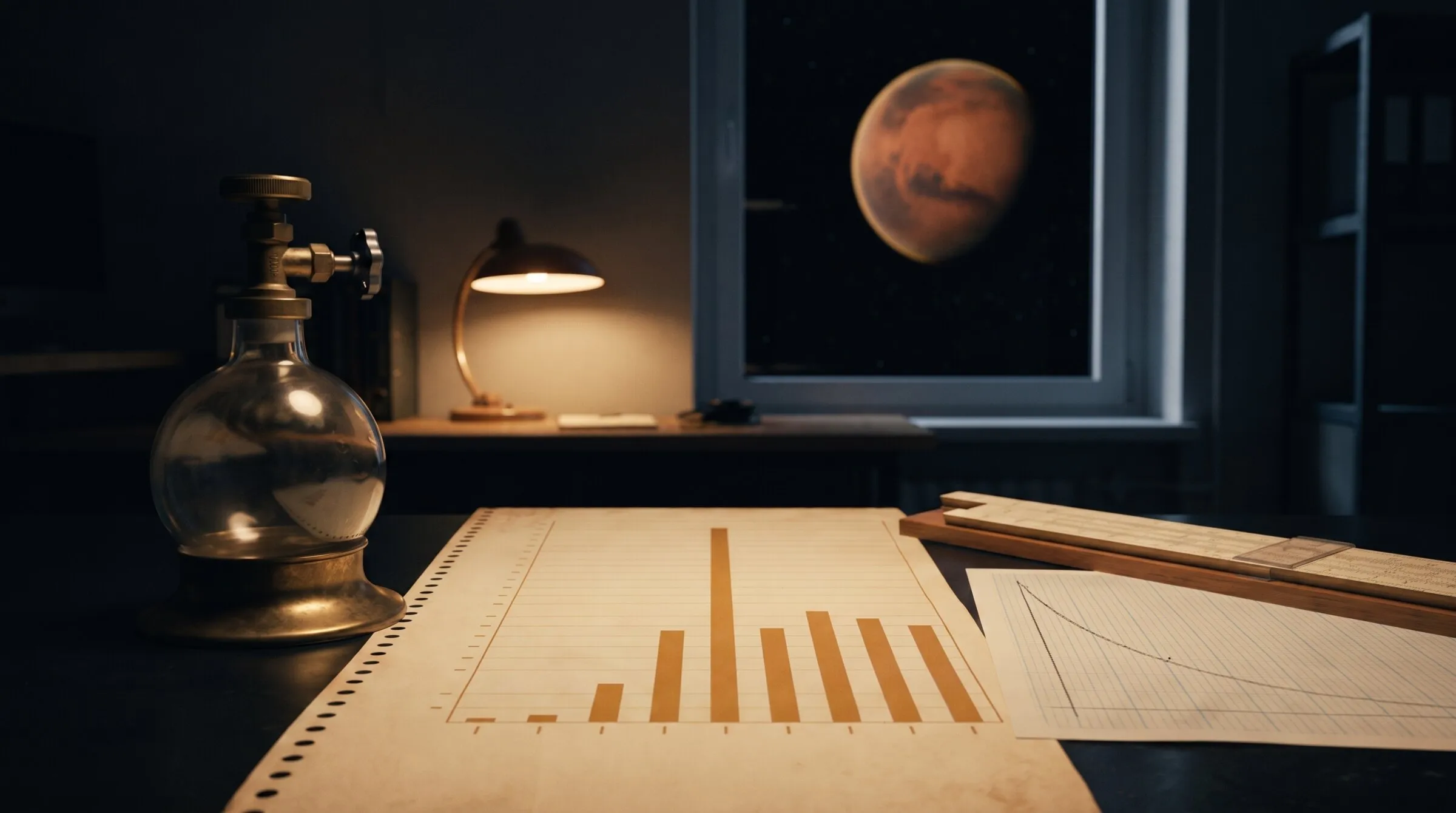 The Xenon Ledger JORJANI 2021 · THE RATIO, PRICED · INST-78 Chapter 5 of Closer Encounters (2021) says somebody nuked Mars: the Martian air's xenon-129 ratio 'matched, point for point' a thermonuclear test signature, thorium and potassium were 'skewed', two ground zeros at Cydonia and Utopia, 250 million years ago. This bench prices that one ratio, Curiosity's ¹²⁹Xe/¹³²Xe of 2.522 against Earth's 0.983, two ways. The Spectrum builds the recipe: the cited paper's own '70% nuclear testing xenon' drives the ratio to 0.58, the wrong way, while pushing ¹³⁴Xe and ¹³⁶Xe up 2.4×; the solar wind fractionated 3.7% per amu plus the decay of ¹²⁹I fits the other bars with one factor. The Price does the arithmetic: fission xenon caps at 0.36 because mass 129 is born as iodine; even pretending fission made only ¹²⁹, the bill is a hundred times the energy needed to blow Mars's whole atmosphere away. The Clock runs ¹²⁹I: the book's 250 million years is 16 half-lives, and ALH84001 carried today's ratio at 4.16 Ga; argon, nitrogen and water carry the same escape. The Globe draws the two ground zeros on the real Mars (the paper's second coordinate is on the wrong hemisphere), the three landers, a 500 km gamma-ray pixel and the blast rings. The numbers are sourced, the quotes are paginated, and two verdicts hang at equal size. LIVE
 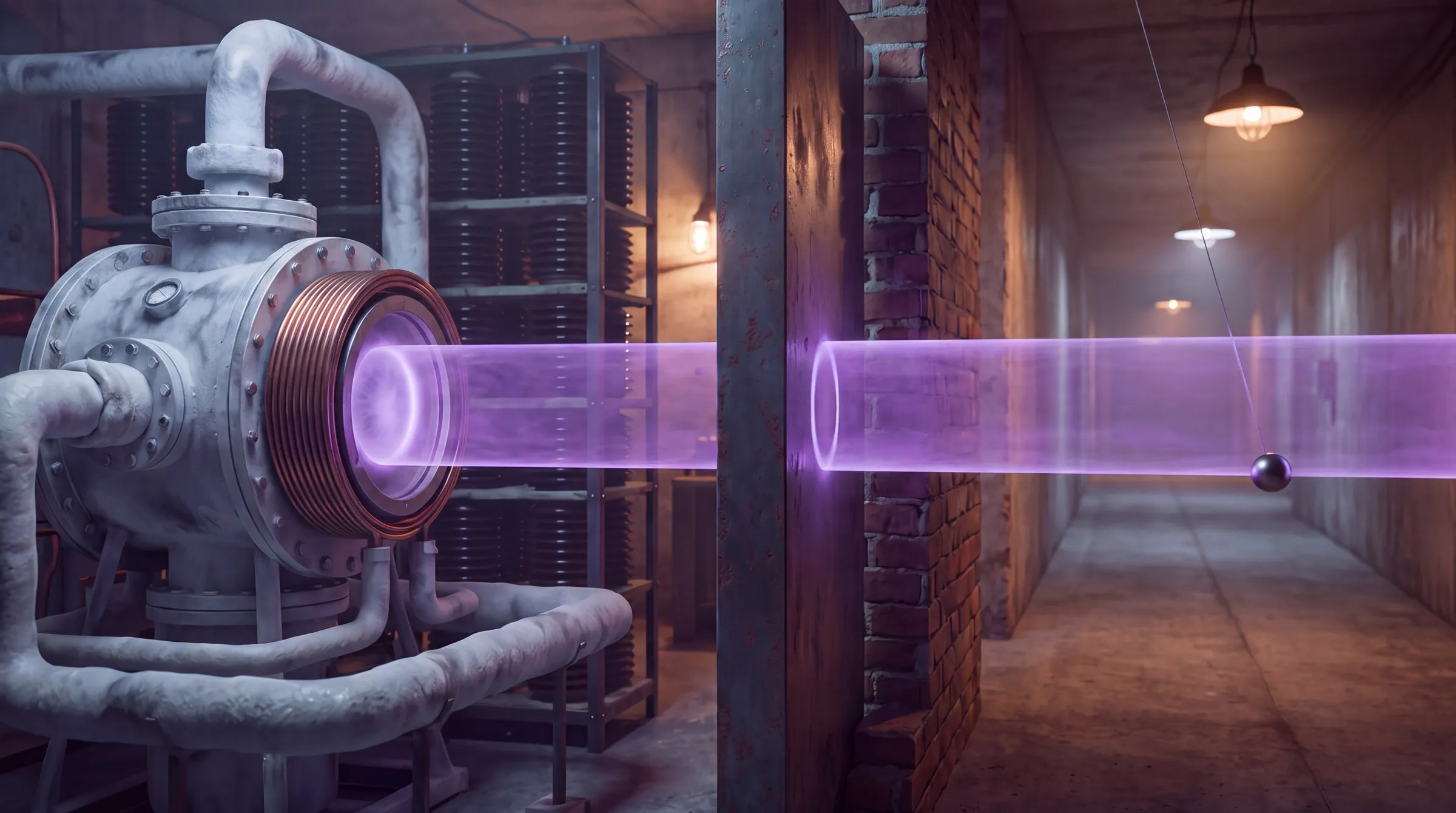 The Podkletnov Impulse LAVIOLETTE 2008 · THE IMPULSE, PRICED · INST-76 Chapter 6 of Secrets of Antigravity Propulsion (2008) says a 10 cm YBCO superconducting disc fired at two million volts sends a gravitational shock wave through a Faraday cage, 2.5 cm of steel and a 30 cm brick wall to push an 18.5 gram pendulum bob 14 centimetres sideways at 150 metres, with no recoil, at sixty-four times the speed of light. This bench builds the range to scale in metres and prices the sentence item by item. The Lab is the corridor in three dimensions, with the two stations the 2001 paper actually used and the book's single stack on a switch. The Ledger turns the swing into one impulse of 9.23 millinewton-seconds and lays out the divisor: 509 g divided by the discharge the papers measured, 509,000 g divided by the 100 nanoseconds the book substitutes, which is the laser sensor's rise time. The Wall runs two bills side by side: skin depth prices 25 mm of steel at 1,988 decibels while the brick costs a thousandth of one, and the equal-push column puts 19.6 kilograms on the path for Newton to hand 9.81 newton-seconds back. Diffraction sets the ceiling under a 10 cm spot at every range, 67 micrometres at 150 m and 50 nanometres at 200 km. The Timing rebuilds the 63 nanoseconds over 1,211 metres. Fourteen cards, two readings at equal size. The numbers are sourced, the quotes are paginated, and the reading is yours. LIVE
 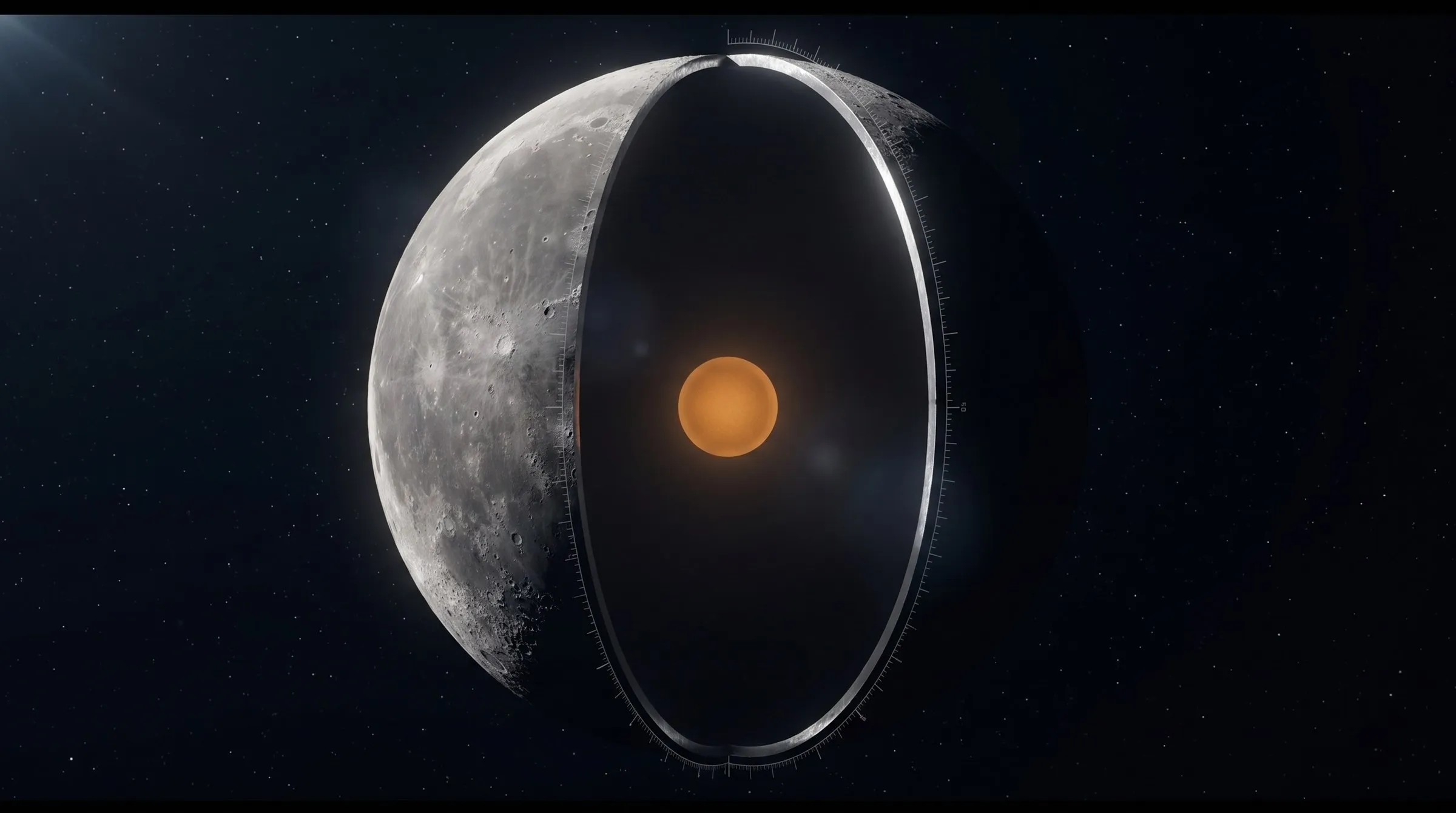 The Hollow Moon JORJANI 2021 · THE SHELL, WEIGHED · INST-75 Chapter 5 of Closer Encounters (2021) says the Moon 'is an artificial satellite, which is mostly hollow', argued from the ringing after the Apollo impacts, a twenty-mile metal shell around a tiny core, the Moon's motion and gravity field, and the 400:1 eclipse ratio. This bench gives each kind of number its own instrument. The Shell cuts the Moon open: the book's shell must carry the measured mass, so its armour must be 2.3 times the density of osmium and its moment of inertia reads 0.64, where laser ranging and GRAIL measure 0.3931, below a solid sphere, mass toward the centre. The Bell times the ringing: the seven-minute rise is scattering in a fractured, dry crust, where a struck shell peaks at once; the hour-long and three-hour tails are a Q of 3,000-5,000, dryness, and the same Apollo rock rings at Q 60 in air and 3,300 outgassed. The Core lines up the rocky bodies' core fractions: the Moon's 1-2% is the giant impact's prediction, cited by the book as its refutation. The Eclipse puts 400:1 into a recession of 3.8 cm a year: total and annular both for 1.6 billion years, today 78% of the way through. The File hangs the unit-dependent circumference coincidence (100.1% in kilometres, 62% in miles) and the book's own subtraction, off by 229 miles. The numbers are sourced, the quotes are paginated, and two verdicts hang at equal size. LIVE
 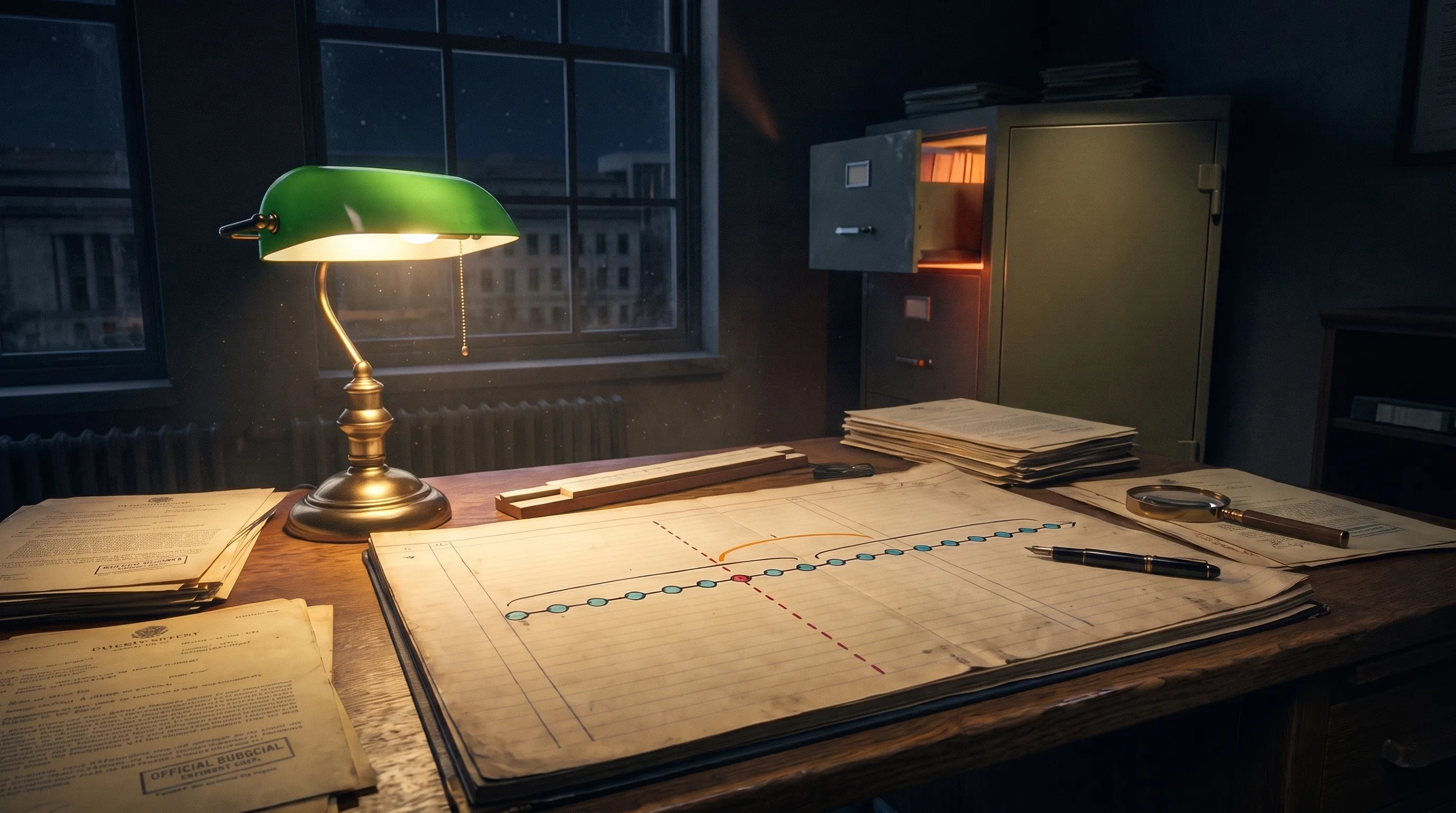 The Corso Ledger CORSO 1997 · THE HARVEST, DATED · INST-74 The central claim of The Day After Roswell (1997), priced as printed: Corso's account of heading the Foreign Technology desk in 1961-62 and farming the Roswell debris out to industry, growing the transistor, the integrated circuit, fibre optics, the laser, night vision and Kevlar. This bench pairs the book's own fourteen-item harvest list (pp. 125-126) with each row's documented invention chain and runs it against two clocks. Clock one is the crash: every chain crosses July 8, 1947 going backwards, the laser to 1917, the transistor to 1926, fibre optics to 1841, night vision in combat on Okinawa 27 months early; to out-run every anchor the crash line must be dragged past 1841. Clock two is the desk: DA Form 66 grants 393 days as staff officer and 91 in charge against the book's opening 'two incredible years'; of eleven priced termini, three predate the desk, one reaches orbit nine days into his tenure, seven come after he left. The File hangs the grep's seven silences (Kilby 0, Noyce 0, Kwolek 0, Kao 0), the ruby laser placed at Columbia four times, the book's own microwave and Seesaw dates, Kohler's thirty-year fibre forecast that lands, and the control experiment: Ufimtsev's stealth mathematics, openly published in 1962, translated by the real Foreign Technology Division in 1971, flying as Have Blue in 1977, receipts at every step. The numbers are sourced, the quotes are paginated, and two verdicts hang at equal size. LIVE
 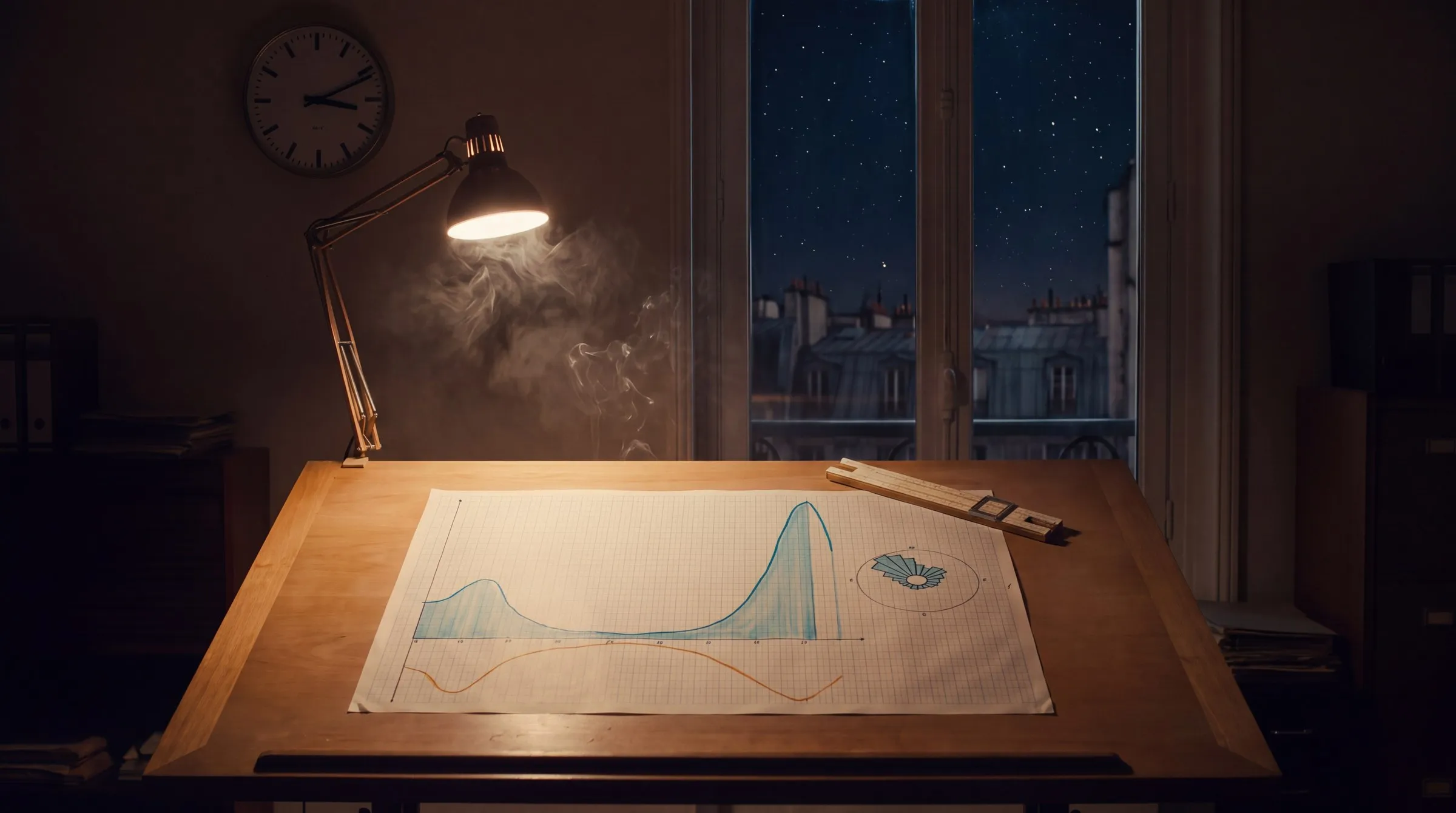 The Law of the Times POHER-VALLEE 1975 · WITNESS CLOCK · INST-69 The most famous clock in the close-encounter literature was published in 1975: Poher and Vallée's hourly distribution of type-I reports, peaking about 9 p.m., dipping at 1 a.m., bumping at 3 a.m., later christened the law of the times. The paper then divided reports by the 'percentage of the working population not at home' and concluded true activity peaks at 3 a.m., that witnesses see one close approach in fourteen, and that 2,000 reports imply 28,000 manifestations. This bench digitises the hand-drawn figure pixel by pixel (the trace sums to 2,090 against the stated 2,000, the digitisation's certificate) and hangs it on one axis with 64,627 modern NUFORC US reports: the same 21h peak fifty years apart, the evening law replicating verbatim, and the 3 a.m. bump existing only in 1975. The Witness view reproduces the whole law from two public tables with nothing fitted: awake alone r = 0.00, awake × dark r = 0.88; darkness carries it, and the paper never modelled darkness. The Correction reruns the division live: a 2.0% night floor reproduces Figure 9's plotted 5,900 peak exactly, 2.5% the stated 'about 14 to 1'; drag the floor across the pen's width and the ×14 swings ×18.7 to ×12.7; swap in the published awake table and it falls to ×5.0; modern data gives ×3.6 with the modern divisor and ×13.0 with the 1975 one. July 4th's 1,206 reports and Hendry's IFO clock hang in the File. Two verdicts at equal size. LIVE
 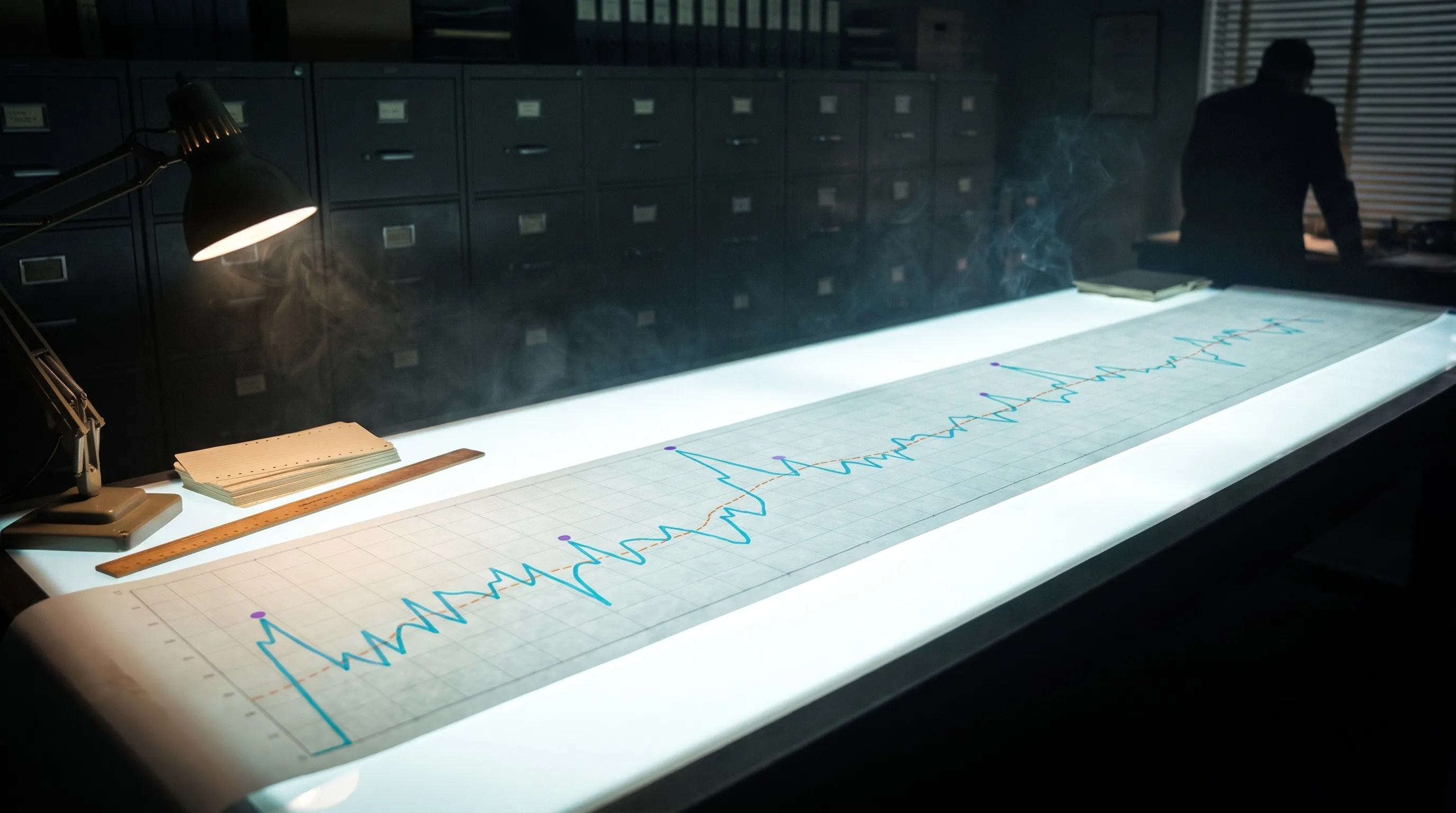 The Wave Schedule BLUE BOOK WAVES · FIGURE 3 · INST-68 The most famous graph in the UFO literature is a question: Vallée's Figure 3 of 1975, a detrended monthly index of the waves, 1947-1962, captioned 'Is this a schedule of reinforcement?' His catalogue was private and the figure cannot be recomputed; the public record carrying the same waves can: the Blue Book monthly file, 12,618 reports over 23 years. This bench puts every load-bearing word on a dial. The Index removes the trend in front of you and a threshold defines the waves: six at the defaults, spaced 32, 28, 49, 15, 34 months; turn to 2σ and the five-year clock of the 1950s literature really appears, 60 and 64 months, and one button extending the record to 1969 lands the next wave 93 months late and shatters it. The Spectrum makes the null hypothesis a switch: against white noise the 32, 24 and 21-month periods all clear; against red noise carrying the series' own memory, nothing beyond a year survives but the 12.0-month season, July 78 to January 30. The Schedule sets six waves against Skinner's three laboratory schedules: CV 0.39, CI [0.08, 0.60], covering clock and variable schedule at once, so six waves identify nothing. The Mars epoch, Sputnik month and the nine self-disagreeing years hang in the File. Two verdicts at equal size. LIVE
 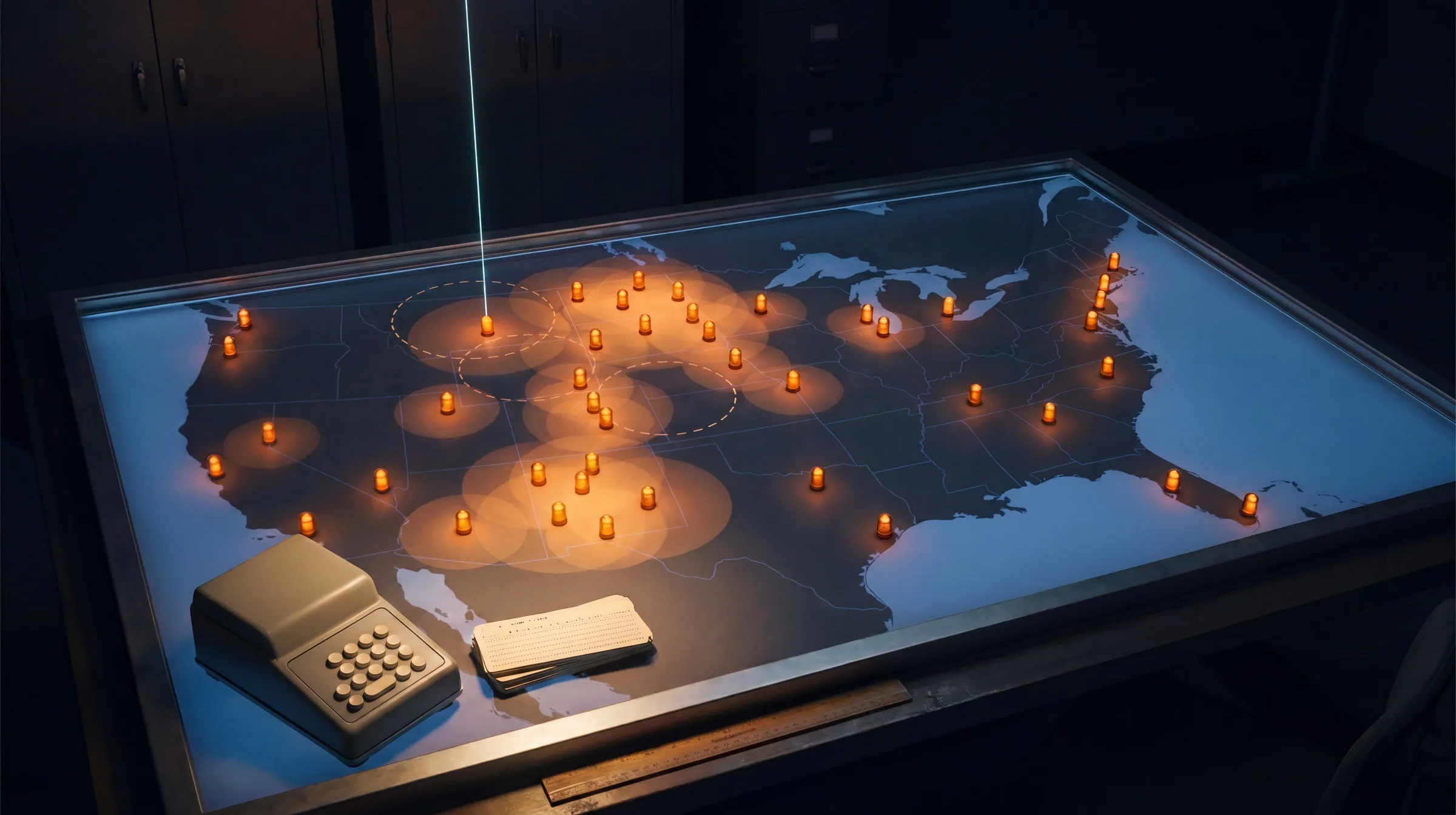 The Nuclear Lure THE NUCLEAR CORRELATION · 1945-2026 · INST-60 'UAP prefer nuclear sites' is the oldest pattern claim in the subject, and in 2026 Farah pushed it to deliberate nuclear bait. This bench prices the checkable part. The Map lays the mid-60s nuclear complex over the lower 48 in six layers, missile fields at documented areas, with the 1960 census underneath: a fifth of the population within 50 miles, half within 100, so 'near a nuclear site' starts a fifth true by accident. The Clock pairs Blue Book's 12,618 yearly reports with the NV-209 test counts: reports fall through 1958's 77 tests, rise through the zero-test moratorium, and fall again through 1962's 96; r = 0.19 at permutation p = 0.39, and the only one of fourteen dial settings to clear 5% is the acausal one where reports lead. The Mill computes 1,469 'near a nuke, during nuclear activity' double coincidences from chance alone. The File prices Echo Flight's ten missiles, the 1975 NORAD logs and the Farah claim card by card. Two verdicts at equal size: the correlation is cheap; the residue is not statistical. LIVE
 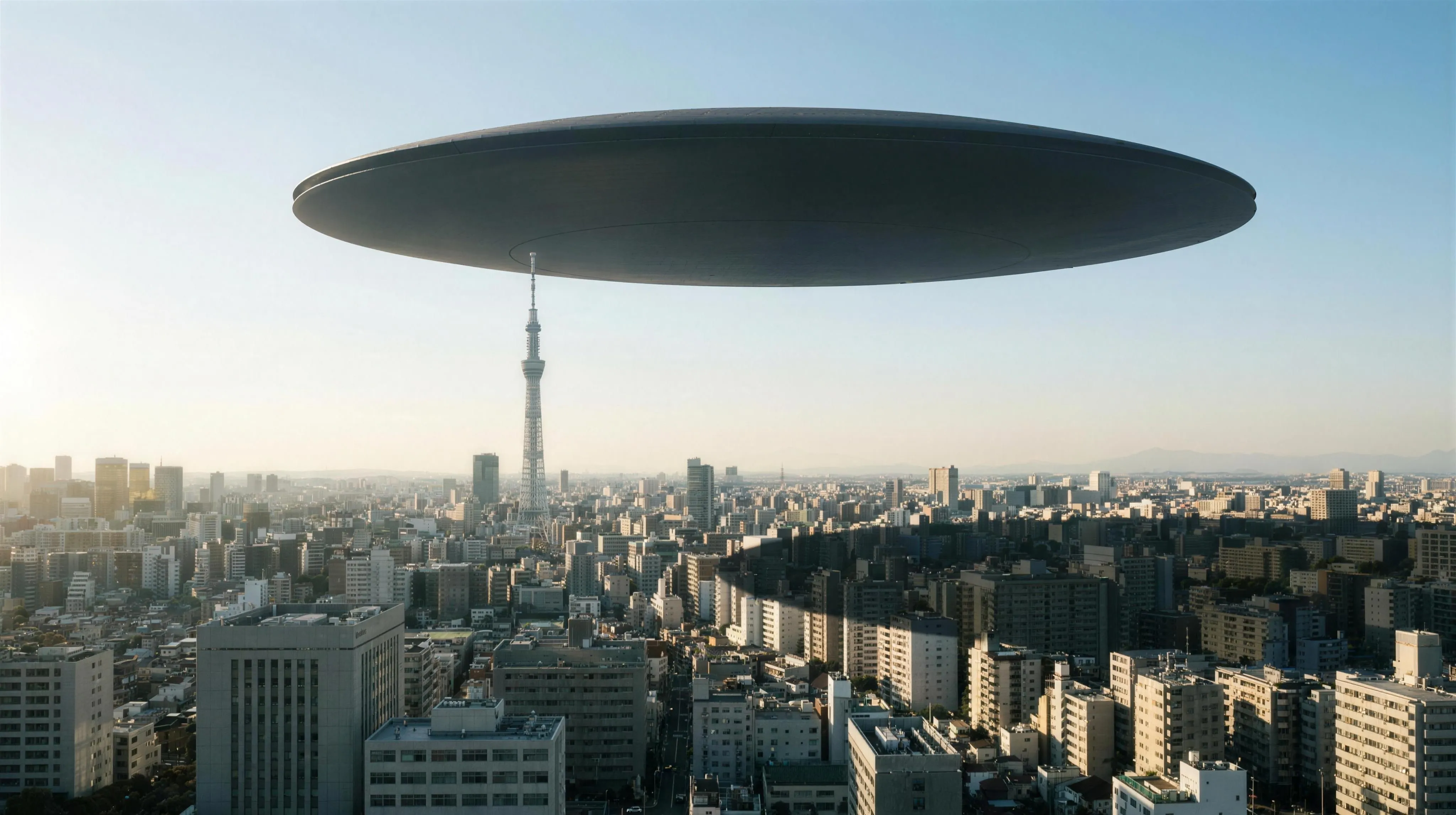 The Mothership Ledger DEDEDEDE · INST-59 Fiction's favourite picture, priced: a kilometre-scale ship parked quietly over a city, for years. The mass is the dial nobody measured, and three independent ledgers re-price it live: the Gravimeter runs the uniform-disk formula against published instrument floors; the Lift bill prices the hover three ways, 71 m/s and 700 GW to pay in air, buoyancy free but capped at about one aircraft carrier, the field clause handing the bill to bedrock; and the Shadow ledger prices the one thing no clause can waive, a nine-metre fringe and 785 MW of deleted noon sunlight. The Overhead view stages it all under a Preetham sky driven by the same spherical trig as the shadow. Two verdicts at equal size: nothing kilometre-sized hovers for free, and fiction pays no bills, which was always its licence. LIVE
 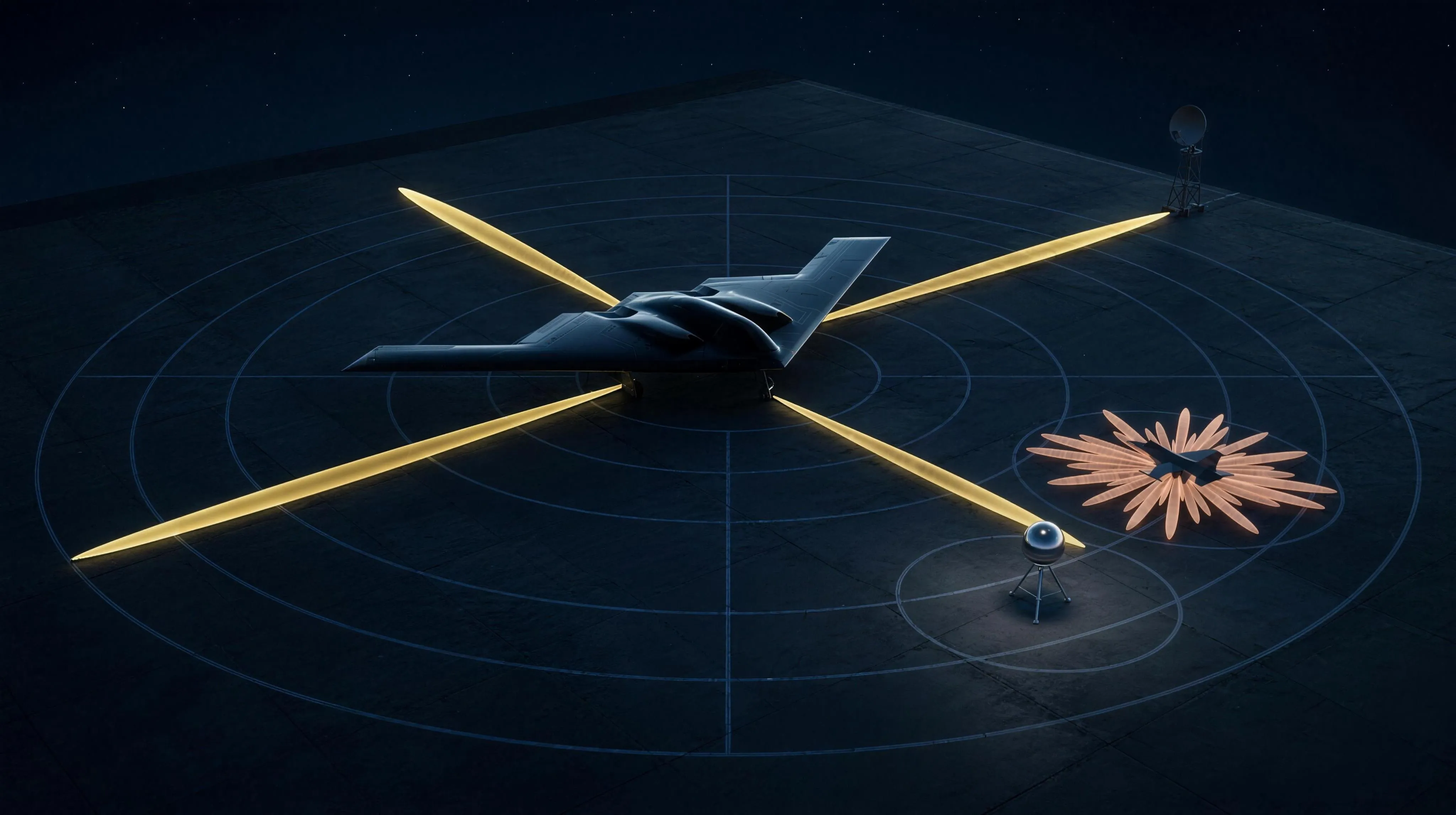 The Stealth Bench UFIMTSEV 1962 · INST-52 The B-2 exists because of three pieces of computable physics, and the same three pieces write its limits; this bench computes both sides. The Range view is 3D: a flying wing, a baseline fighter and a calibration sphere at true metre scale on a radar range, with the beam drawn at the selected band's true wavelength, so VHF arrives as two-metre swells and X band as a fine ripple; walk the radar around the ring and catch the four spikes that planform alignment allows. The Rose view draws the whole rotation at once: four narrow petals on a circle of silence, about 0.5% of azimuths above the 1 m² line at X band, against roughly 10% for the fighter under the same solver, with a median return 25 dB louder. The Bands view is two exact curves: the full Mie series for the conducting sphere, lifting to 3.65 times the optical value near ka = 1, which is the entire case for VHF counter-stealth radar, and a Salisbury screen tuned at 10 GHz that hands back 91% of the power one decade below. The Ladder view prices the radar equation's fourth-root law: the radar that sees 100 m² at 400 km sees 0.0001 m² only at 13 km, so a million times quieter buys about thirty times closer. The File runs from a paper published openly in Moscow in 1962 to an F-117 in a Serbian field in 1999 with a VHF radar in the kill chain, by way of the black triangles, the Belgian wave, and the 1992 charged-edge report some read as antigravity. Two verdicts close at equal size: the geometry delivers, and the limits hold. LIVE
 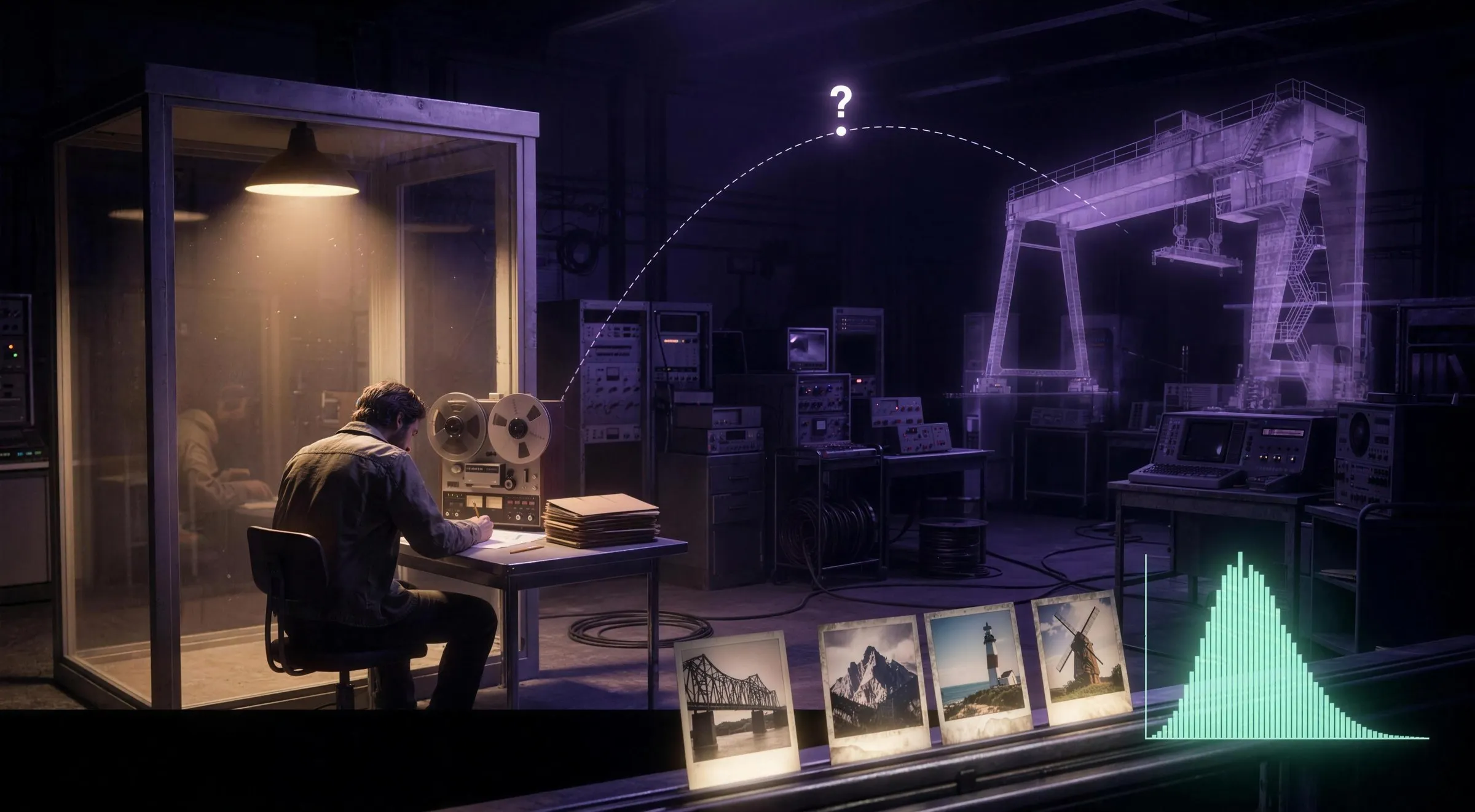 Project Stargate STARGATE · 1972-95 · INST-37 The U.S. government's 1972-1995 remote-viewing program, rebuilt as a statistics bench. Twenty-three years, about $20 million, six code names, and the entire empirical residue is one sliver: an effect size near 0.2 from the program's own experienced viewers, and a 32.2% hit rate from a 1994 ganzfeld series run outside it, where chance earns exactly 25%. The Protocol view takes one trial apart as a machine: the sealed booth, the four-candidate pool, the randomiser, the blind judge, and the claim under test drawn as a dashed question mark. The Chance Machine drops series into a live histogram: watch pure luck build its bell, then lay the autoganzfeld's 32.2% and Utts' effect size 0.2 over it and watch z grow with the square root of N. The Leaky Lab runs a clean and a leaky zero-psi laboratory side by side, with five switches from the published critiques that can drift the coral pile onto the claimed line. The File sets out the 1995 AIR review, where Utts and Hyman read one dataset and signed opposite verdicts. The baseline is arithmetic, the claims are sourced, and the reading is yours. LIVE
 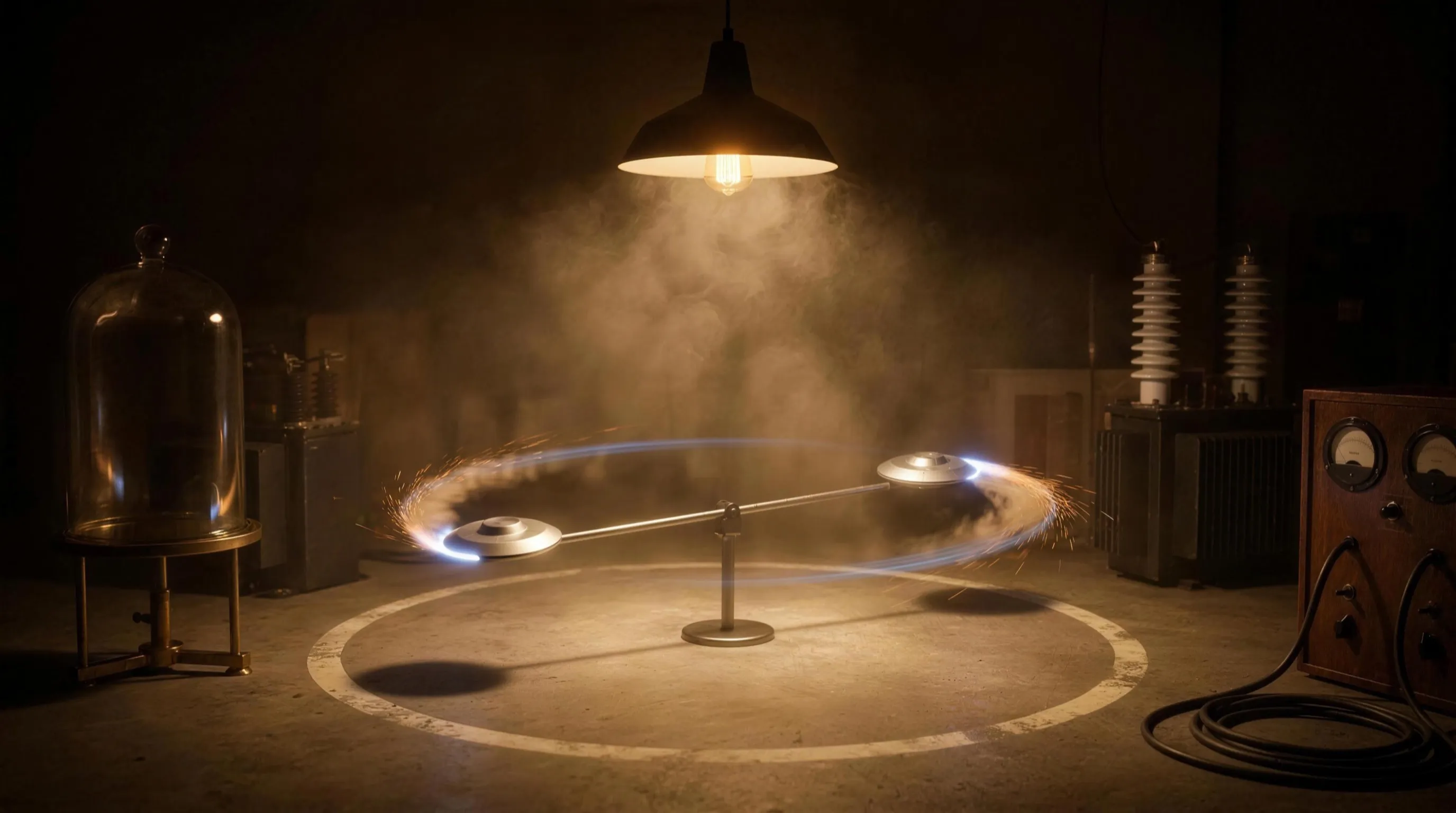 Electrogravitics BIEFELD-BROWN · INST-32 Charge an asymmetric capacitor to tens of kilovolts and it moves toward its positive side. Nobody disputes that; the dispute is why. The sceptic says ion wind: charged air thrown backward, useless in space. Thomas Townsend Brown, and the 2008 book built on him, say charge couples to gravity. This instrument computes both readings from the same dials and hands you the decisive one: pump the chamber from one atmosphere down past a billionth of one, where ions cannot exist. The Bench flies Brown's 1950 tethered discs; the Jar rebuilds the Paris vacuum chamber and the discharge that spun the rotor until they feared it would shatter the bell jar; the Craft stages the seventy-foot aero-marine proposal of 1960 that was never built; the Curve lays out the Navy's 1952 data; the Ledger prices both readings row by row, with the author's own chapter 12 nulls as the counter-bill. Every constant in the electrogravitic branch is the book's own. One arithmetic error is corrected on screen. LIVE
 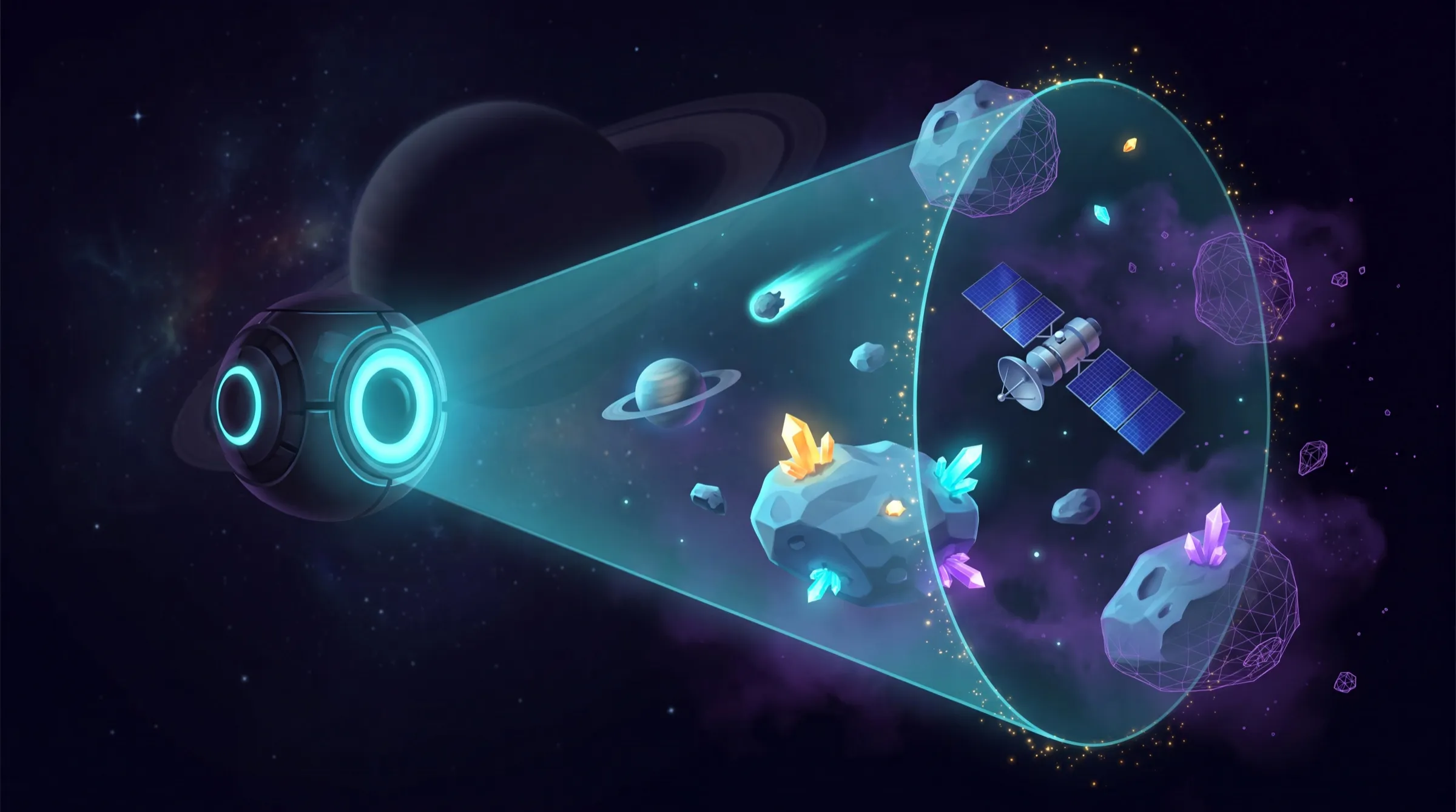 The Rendering Engine FRUSTUM · INST-17 A game engine's oldest trick, built honest: a drifting interstellar field of crystal asteroids, satellites, comets and deep-space probes that renders only inside the observer's view frustum and decays to probability fog beyond it. Whip the view and try to catch the world loading, break the engine to see the glitch nature never shows, and read the live table that tags every rung of Virk's game-to-quantum analogy as ENGINE, PHYSICS or READING. LIVE
 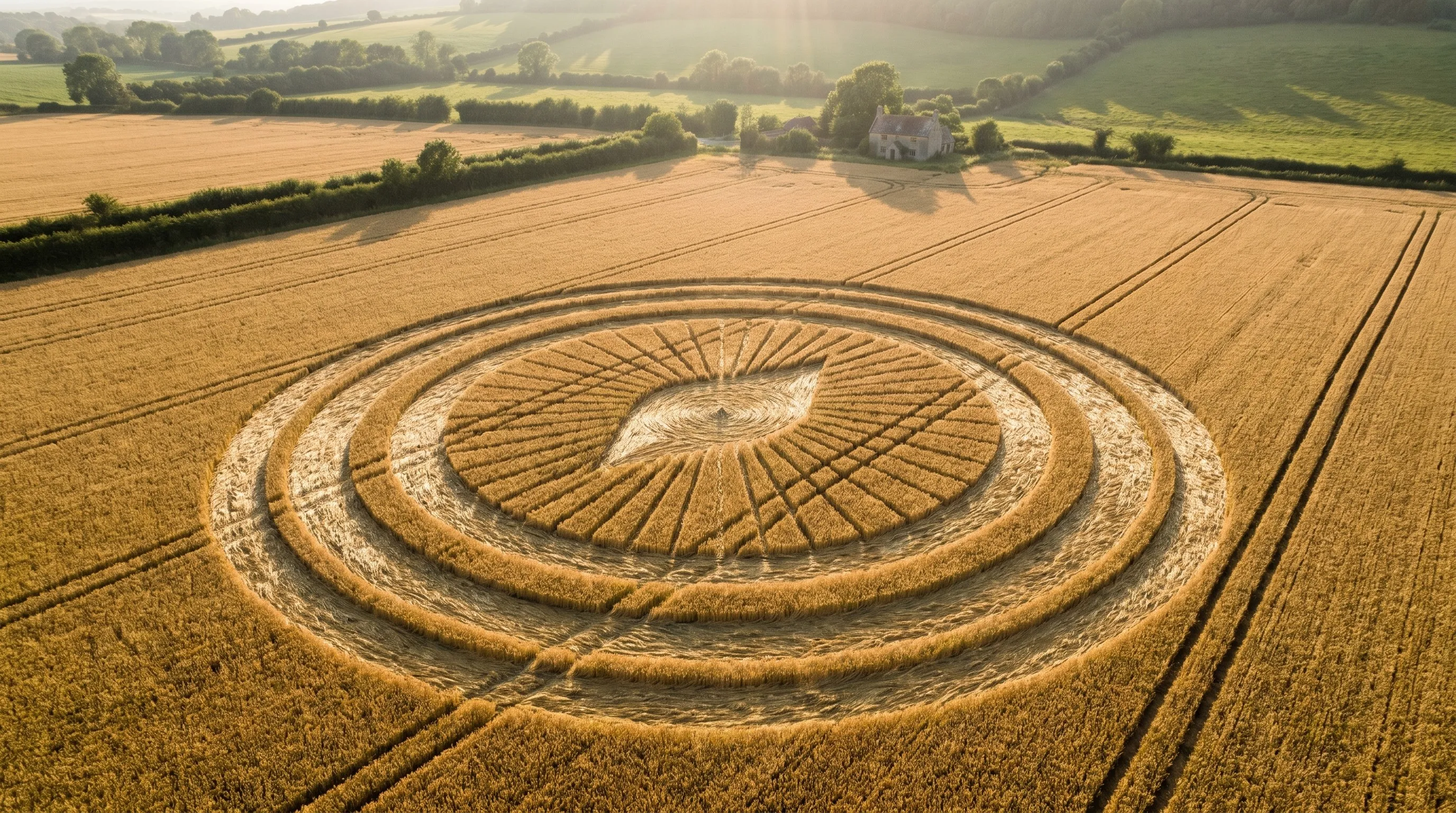 Crop Circles FIELD · INST-04 A wheat field you can stamp real formations into, the stalks laying over in physical swirls. The patterns are real; the cause is where the periphery begins.
The Thermoptic Camouflage Bench OSHII 1995 · THE SUIT, PRICED · INST-88 The Major's thermoptic camouflage in the opening drop and the canal fight of Oshii's Ghost in the Shell (1995): it shows its background, ripples when she moves, is found out by water at once, and its name says it defeats thermal imagers too. This bench prices the device as drawn in three currencies. The Band prices the passive cloak: light routed round a 0.45 m body travels at least (π/2 − 1)·D further and a wave packet cannot go round faster than light in a passive medium, so the band a body can hold at 550 nm is 0.12 pm, a laser line, one part in three million of daylight; turned round, daylight can hide a virus, a sodium lamp a coin, a laser a building, and the sum rule permits what the clock forbids. The Seam prices the display cloak the film draws: Tachi's 2003 optical camouflage is right for one eye, a second eye a metre aside with the wall 1.5 m behind sees the background jump 19 cm, 68 times what the eye resolves; one frame of latency at a walk lags 23 mm, a third of a metre a frame in the fall; rain at 10 mm/h hits the body 208 times a second and six splashes at once draw the outline. The Heat prices 100 W with nowhere to go: +1.5 K an hour if stored, 81 minutes to +2 K; 2 kg of ice for 2 h 42 min at rest and 27 minutes running; breath at 8 W bright at 4.3 µm, a bare sole's print above the noise for 26 minutes. The Suit puts all of it in a night alley: three suits, four lights, a white-hot imager, rain. Two readings hang at equal size. LIVE The Vanishing Literature COOK 2002 · A SILENCE, PRICED · INST-81 In 1956, named aerospace executives talked about cancelling gravity in print; by 1960, in Cook's words, "it was as if none of them had ever even thought of it." The Hunt for Zero Point reads that silence as classification. The sixth statistics bench lays the silence itself on the table: all thirty documented items of the 1952-1961 electrogravitics conversation, one square per document, drawn as dated. The curve rearranges the legend: the peak is 1955, not 1956 (11 items against 4); 73.9% of the 1954-56 corpus is one London newsletter whose stream stopped before the famous year began, and the celebrated 1956 report's evidence appendix is fifteen clippings of that same newsletter; the ONR's electric-wind verdict predates the boom's first front page by 38 months; the decay's cause of death was in a trade-journal headline by 1961; and Brown's patents published openly through the whole silence, to 1970. The Controls run nuclear aircraft, ramjet and variable sweep as the null, then hang the two confirmed secrecy signatures: fission dips 37% through its documented publication stop and explodes ×5.4 at the reveal, stealth steps ×10 from literal zero; confirmed secrecy ends in an explosion, and this curve, 68 years on, has none. The Scope gives one year, 1958, three answers: the conversation died, antigravity set its 1950s book-corpus peak, and electrogravitics touched zero while saving its true peak for 2008. Two verdicts at equal size. LIVE The Xenon Ledger JORJANI 2021 · THE RATIO, PRICED · INST-78 Chapter 5 of Closer Encounters (2021) says somebody nuked Mars: the Martian air's xenon-129 ratio 'matched, point for point' a thermonuclear test signature, thorium and potassium were 'skewed', two ground zeros at Cydonia and Utopia, 250 million years ago. This bench prices that one ratio, Curiosity's ¹²⁹Xe/¹³²Xe of 2.522 against Earth's 0.983, two ways. The Spectrum builds the recipe: the cited paper's own '70% nuclear testing xenon' drives the ratio to 0.58, the wrong way, while pushing ¹³⁴Xe and ¹³⁶Xe up 2.4×; the solar wind fractionated 3.7% per amu plus the decay of ¹²⁹I fits the other bars with one factor. The Price does the arithmetic: fission xenon caps at 0.36 because mass 129 is born as iodine; even pretending fission made only ¹²⁹, the bill is a hundred times the energy needed to blow Mars's whole atmosphere away. The Clock runs ¹²⁹I: the book's 250 million years is 16 half-lives, and ALH84001 carried today's ratio at 4.16 Ga; argon, nitrogen and water carry the same escape. The Globe draws the two ground zeros on the real Mars (the paper's second coordinate is on the wrong hemisphere), the three landers, a 500 km gamma-ray pixel and the blast rings. The numbers are sourced, the quotes are paginated, and two verdicts hang at equal size. LIVE The Podkletnov Impulse LAVIOLETTE 2008 · THE IMPULSE, PRICED · INST-76 Chapter 6 of Secrets of Antigravity Propulsion (2008) says a 10 cm YBCO superconducting disc fired at two million volts sends a gravitational shock wave through a Faraday cage, 2.5 cm of steel and a 30 cm brick wall to push an 18.5 gram pendulum bob 14 centimetres sideways at 150 metres, with no recoil, at sixty-four times the speed of light. This bench builds the range to scale in metres and prices the sentence item by item. The Lab is the corridor in three dimensions, with the two stations the 2001 paper actually used and the book's single stack on a switch. The Ledger turns the swing into one impulse of 9.23 millinewton-seconds and lays out the divisor: 509 g divided by the discharge the papers measured, 509,000 g divided by the 100 nanoseconds the book substitutes, which is the laser sensor's rise time. The Wall runs two bills side by side: skin depth prices 25 mm of steel at 1,988 decibels while the brick costs a thousandth of one, and the equal-push column puts 19.6 kilograms on the path for Newton to hand 9.81 newton-seconds back. Diffraction sets the ceiling under a 10 cm spot at every range, 67 micrometres at 150 m and 50 nanometres at 200 km. The Timing rebuilds the 63 nanoseconds over 1,211 metres. Fourteen cards, two readings at equal size. The numbers are sourced, the quotes are paginated, and the reading is yours. LIVE The Hollow Moon JORJANI 2021 · THE SHELL, WEIGHED · INST-75 Chapter 5 of Closer Encounters (2021) says the Moon 'is an artificial satellite, which is mostly hollow', argued from the ringing after the Apollo impacts, a twenty-mile metal shell around a tiny core, the Moon's motion and gravity field, and the 400:1 eclipse ratio. This bench gives each kind of number its own instrument. The Shell cuts the Moon open: the book's shell must carry the measured mass, so its armour must be 2.3 times the density of osmium and its moment of inertia reads 0.64, where laser ranging and GRAIL measure 0.3931, below a solid sphere, mass toward the centre. The Bell times the ringing: the seven-minute rise is scattering in a fractured, dry crust, where a struck shell peaks at once; the hour-long and three-hour tails are a Q of 3,000-5,000, dryness, and the same Apollo rock rings at Q 60 in air and 3,300 outgassed. The Core lines up the rocky bodies' core fractions: the Moon's 1-2% is the giant impact's prediction, cited by the book as its refutation. The Eclipse puts 400:1 into a recession of 3.8 cm a year: total and annular both for 1.6 billion years, today 78% of the way through. The File hangs the unit-dependent circumference coincidence (100.1% in kilometres, 62% in miles) and the book's own subtraction, off by 229 miles. The numbers are sourced, the quotes are paginated, and two verdicts hang at equal size. LIVE The Corso Ledger CORSO 1997 · THE HARVEST, DATED · INST-74 The central claim of The Day After Roswell (1997), priced as printed: Corso's account of heading the Foreign Technology desk in 1961-62 and farming the Roswell debris out to industry, growing the transistor, the integrated circuit, fibre optics, the laser, night vision and Kevlar. This bench pairs the book's own fourteen-item harvest list (pp. 125-126) with each row's documented invention chain and runs it against two clocks. Clock one is the crash: every chain crosses July 8, 1947 going backwards, the laser to 1917, the transistor to 1926, fibre optics to 1841, night vision in combat on Okinawa 27 months early; to out-run every anchor the crash line must be dragged past 1841. Clock two is the desk: DA Form 66 grants 393 days as staff officer and 91 in charge against the book's opening 'two incredible years'; of eleven priced termini, three predate the desk, one reaches orbit nine days into his tenure, seven come after he left. The File hangs the grep's seven silences (Kilby 0, Noyce 0, Kwolek 0, Kao 0), the ruby laser placed at Columbia four times, the book's own microwave and Seesaw dates, Kohler's thirty-year fibre forecast that lands, and the control experiment: Ufimtsev's stealth mathematics, openly published in 1962, translated by the real Foreign Technology Division in 1971, flying as Have Blue in 1977, receipts at every step. The numbers are sourced, the quotes are paginated, and two verdicts hang at equal size. LIVE The Law of the Times POHER-VALLEE 1975 · WITNESS CLOCK · INST-69 The most famous clock in the close-encounter literature was published in 1975: Poher and Vallée's hourly distribution of type-I reports, peaking about 9 p.m., dipping at 1 a.m., bumping at 3 a.m., later christened the law of the times. The paper then divided reports by the 'percentage of the working population not at home' and concluded true activity peaks at 3 a.m., that witnesses see one close approach in fourteen, and that 2,000 reports imply 28,000 manifestations. This bench digitises the hand-drawn figure pixel by pixel (the trace sums to 2,090 against the stated 2,000, the digitisation's certificate) and hangs it on one axis with 64,627 modern NUFORC US reports: the same 21h peak fifty years apart, the evening law replicating verbatim, and the 3 a.m. bump existing only in 1975. The Witness view reproduces the whole law from two public tables with nothing fitted: awake alone r = 0.00, awake × dark r = 0.88; darkness carries it, and the paper never modelled darkness. The Correction reruns the division live: a 2.0% night floor reproduces Figure 9's plotted 5,900 peak exactly, 2.5% the stated 'about 14 to 1'; drag the floor across the pen's width and the ×14 swings ×18.7 to ×12.7; swap in the published awake table and it falls to ×5.0; modern data gives ×3.6 with the modern divisor and ×13.0 with the 1975 one. July 4th's 1,206 reports and Hendry's IFO clock hang in the File. Two verdicts at equal size. LIVE The Wave Schedule BLUE BOOK WAVES · FIGURE 3 · INST-68 The most famous graph in the UFO literature is a question: Vallée's Figure 3 of 1975, a detrended monthly index of the waves, 1947-1962, captioned 'Is this a schedule of reinforcement?' His catalogue was private and the figure cannot be recomputed; the public record carrying the same waves can: the Blue Book monthly file, 12,618 reports over 23 years. This bench puts every load-bearing word on a dial. The Index removes the trend in front of you and a threshold defines the waves: six at the defaults, spaced 32, 28, 49, 15, 34 months; turn to 2σ and the five-year clock of the 1950s literature really appears, 60 and 64 months, and one button extending the record to 1969 lands the next wave 93 months late and shatters it. The Spectrum makes the null hypothesis a switch: against white noise the 32, 24 and 21-month periods all clear; against red noise carrying the series' own memory, nothing beyond a year survives but the 12.0-month season, July 78 to January 30. The Schedule sets six waves against Skinner's three laboratory schedules: CV 0.39, CI [0.08, 0.60], covering clock and variable schedule at once, so six waves identify nothing. The Mars epoch, Sputnik month and the nine self-disagreeing years hang in the File. Two verdicts at equal size. LIVE The Nuclear Lure THE NUCLEAR CORRELATION · 1945-2026 · INST-60 'UAP prefer nuclear sites' is the oldest pattern claim in the subject, and in 2026 Farah pushed it to deliberate nuclear bait. This bench prices the checkable part. The Map lays the mid-60s nuclear complex over the lower 48 in six layers, missile fields at documented areas, with the 1960 census underneath: a fifth of the population within 50 miles, half within 100, so 'near a nuclear site' starts a fifth true by accident. The Clock pairs Blue Book's 12,618 yearly reports with the NV-209 test counts: reports fall through 1958's 77 tests, rise through the zero-test moratorium, and fall again through 1962's 96; r = 0.19 at permutation p = 0.39, and the only one of fourteen dial settings to clear 5% is the acausal one where reports lead. The Mill computes 1,469 'near a nuke, during nuclear activity' double coincidences from chance alone. The File prices Echo Flight's ten missiles, the 1975 NORAD logs and the Farah claim card by card. Two verdicts at equal size: the correlation is cheap; the residue is not statistical. LIVE The Mothership Ledger DEDEDEDE · INST-59 Fiction's favourite picture, priced: a kilometre-scale ship parked quietly over a city, for years. The mass is the dial nobody measured, and three independent ledgers re-price it live: the Gravimeter runs the uniform-disk formula against published instrument floors; the Lift bill prices the hover three ways, 71 m/s and 700 GW to pay in air, buoyancy free but capped at about one aircraft carrier, the field clause handing the bill to bedrock; and the Shadow ledger prices the one thing no clause can waive, a nine-metre fringe and 785 MW of deleted noon sunlight. The Overhead view stages it all under a Preetham sky driven by the same spherical trig as the shadow. Two verdicts at equal size: nothing kilometre-sized hovers for free, and fiction pays no bills, which was always its licence. LIVE The Stealth Bench UFIMTSEV 1962 · INST-52 The B-2 exists because of three pieces of computable physics, and the same three pieces write its limits; this bench computes both sides. The Range view is 3D: a flying wing, a baseline fighter and a calibration sphere at true metre scale on a radar range, with the beam drawn at the selected band's true wavelength, so VHF arrives as two-metre swells and X band as a fine ripple; walk the radar around the ring and catch the four spikes that planform alignment allows. The Rose view draws the whole rotation at once: four narrow petals on a circle of silence, about 0.5% of azimuths above the 1 m² line at X band, against roughly 10% for the fighter under the same solver, with a median return 25 dB louder. The Bands view is two exact curves: the full Mie series for the conducting sphere, lifting to 3.65 times the optical value near ka = 1, which is the entire case for VHF counter-stealth radar, and a Salisbury screen tuned at 10 GHz that hands back 91% of the power one decade below. The Ladder view prices the radar equation's fourth-root law: the radar that sees 100 m² at 400 km sees 0.0001 m² only at 13 km, so a million times quieter buys about thirty times closer. The File runs from a paper published openly in Moscow in 1962 to an F-117 in a Serbian field in 1999 with a VHF radar in the kill chain, by way of the black triangles, the Belgian wave, and the 1992 charged-edge report some read as antigravity. Two verdicts close at equal size: the geometry delivers, and the limits hold. LIVE Project Stargate STARGATE · 1972-95 · INST-37 The U.S. government's 1972-1995 remote-viewing program, rebuilt as a statistics bench. Twenty-three years, about $20 million, six code names, and the entire empirical residue is one sliver: an effect size near 0.2 from the program's own experienced viewers, and a 32.2% hit rate from a 1994 ganzfeld series run outside it, where chance earns exactly 25%. The Protocol view takes one trial apart as a machine: the sealed booth, the four-candidate pool, the randomiser, the blind judge, and the claim under test drawn as a dashed question mark. The Chance Machine drops series into a live histogram: watch pure luck build its bell, then lay the autoganzfeld's 32.2% and Utts' effect size 0.2 over it and watch z grow with the square root of N. The Leaky Lab runs a clean and a leaky zero-psi laboratory side by side, with five switches from the published critiques that can drift the coral pile onto the claimed line. The File sets out the 1995 AIR review, where Utts and Hyman read one dataset and signed opposite verdicts. The baseline is arithmetic, the claims are sourced, and the reading is yours. LIVE Electrogravitics BIEFELD-BROWN · INST-32 Charge an asymmetric capacitor to tens of kilovolts and it moves toward its positive side. Nobody disputes that; the dispute is why. The sceptic says ion wind: charged air thrown backward, useless in space. Thomas Townsend Brown, and the 2008 book built on him, say charge couples to gravity. This instrument computes both readings from the same dials and hands you the decisive one: pump the chamber from one atmosphere down past a billionth of one, where ions cannot exist. The Bench flies Brown's 1950 tethered discs; the Jar rebuilds the Paris vacuum chamber and the discharge that spun the rotor until they feared it would shatter the bell jar; the Craft stages the seventy-foot aero-marine proposal of 1960 that was never built; the Curve lays out the Navy's 1952 data; the Ledger prices both readings row by row, with the author's own chapter 12 nulls as the counter-bill. Every constant in the electrogravitic branch is the book's own. One arithmetic error is corrected on screen. LIVE The Rendering Engine FRUSTUM · INST-17 A game engine's oldest trick, built honest: a drifting interstellar field of crystal asteroids, satellites, comets and deep-space probes that renders only inside the observer's view frustum and decays to probability fog beyond it. Whip the view and try to catch the world loading, break the engine to see the glitch nature never shows, and read the live table that tags every rung of Virk's game-to-quantum analogy as ENGINE, PHYSICS or READING. LIVE Crop Circles FIELD · INST-04 A wheat field you can stamp real formations into, the stalks laying over in physical swirls. The patterns are real; the cause is where the periphery begins.