Deep Time
Claims written into ice, stone and star charts, weighed against what the record can actually carry.
LIVE 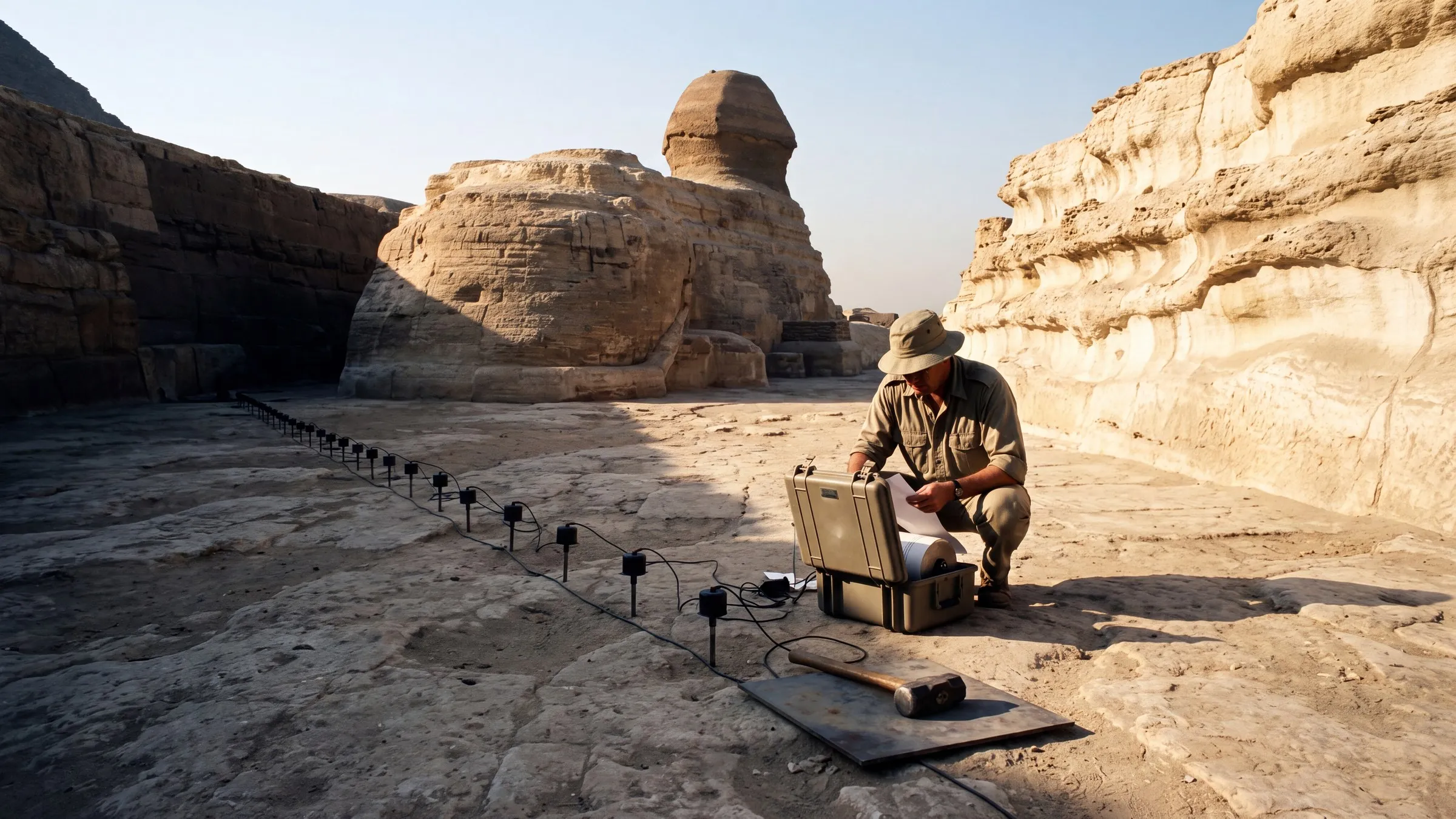 The Sphinx Erosion Bench SCHOCH 1992 · A RATIO, THREE DIALS · INST-87 In April 1991 Schoch and Dobecki laid four seismic refraction lines on the floor of the Sphinx Enclosure: 1.8 to 2.5 m of weathered rock under the floor on the north, south and east, and only 1 to 1.2 m behind the rump. Origins of the Sphinx turns that ratio into a year: linear, with Khafre's 2500 BCE as the rump floor's baseline, 7000 to 5000 BCE in 1992; 1.0 against 2.7 m, circa 10,000 BCE in 2016. This bench takes the conversion apart. The Ditch draws the statue, the two-tiered west wall, the four lines and a window into the rock under each where they were measured, then drapes the weathering front under the whole floor: shallow behind, deep everywhere else. The Clock puts the three assumptions the book states and never dials on sliders, the baseline year, the rate law's exponent, the climate multiplier before the baseline: 7000 BCE linear, 16,000 BCE at √t, 4500 BCE if the rate follows the rain, and Reader's Early Dynastic needs the pre-baseline rate 23 times the later one. The Rain lays a stepped Holocene rainfall proxy over the exposure windows and prices Reader's runoff: 30 hectares of plateau send 1.7 m of water a year over the walls until Khufu's quarries cut it. The other reading is on the bench too: one campaign needs the rump rock twice as hard, and its refraction velocities are the lowest of the four lines. Two readings hang at equal size. LIVE
 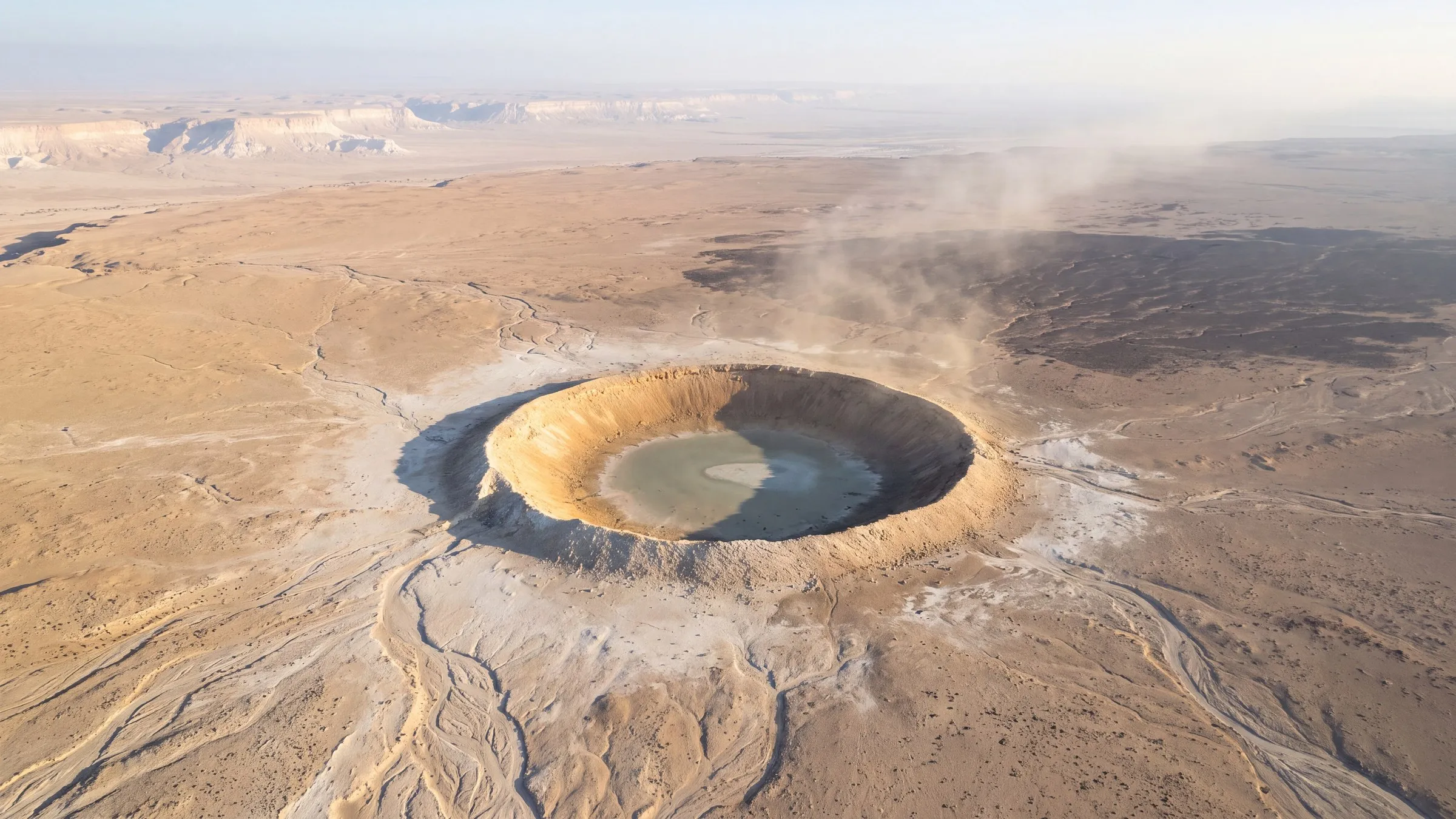 The Sinai Fallout Ledger SITCHIN 1985 · ONE BLOW, PRICED · INST-85 Chapter 14 of Sitchin's The Wars of Gods and Men: in 2024 B.C. the spaceport in the central Sinai was obliterated 'with one nuclear blow', leaving a scar 'so vast that its features can be seen only from the skies', a plain of blackened rock, an Evil Wind that took a day to cross Sumer, and Dead Sea springs radioactive to this day. This bench runs the chain the book never ran. The Scar turns the book's own adjective into a dial: a 10-km crater read in the most generous mode, buried at optimum depth, is 5.2 gigatons, 103 Tsar Bombas, twelve times every atmospheric test ever fired; even the floor of 'vast', 2 km, is 24 Mt, larger than Castle Bravo. The Wind uses Bravo's dose ladder, measured on people: Bravo itself set off in the Sinai puts 2.4 rad on Ur, a chest CT, and emptying Ur takes 1.9 Gt of fission, a yield whose crater agrees with the scar on gigatons. The Residue puts every isotope 4,049 years on: caesium-137 gone 10⁴¹ times over, plutonium-239 89% intact at 2.7 MBq per square metre, 53,000 times background, at a weapons-grade ratio; 10¹⁵ plutonium atoms per kilogram of Greenland ice at the 2024 BC layer, +11,000‰ of carbon-14 in that year's tree rings, and IntCal20 shows no step, while every soil profile in the hemisphere carries only the Cold War's plutonium. The numbers are sourced, the quotes are paginated, and two verdicts hang at equal size. LIVE
 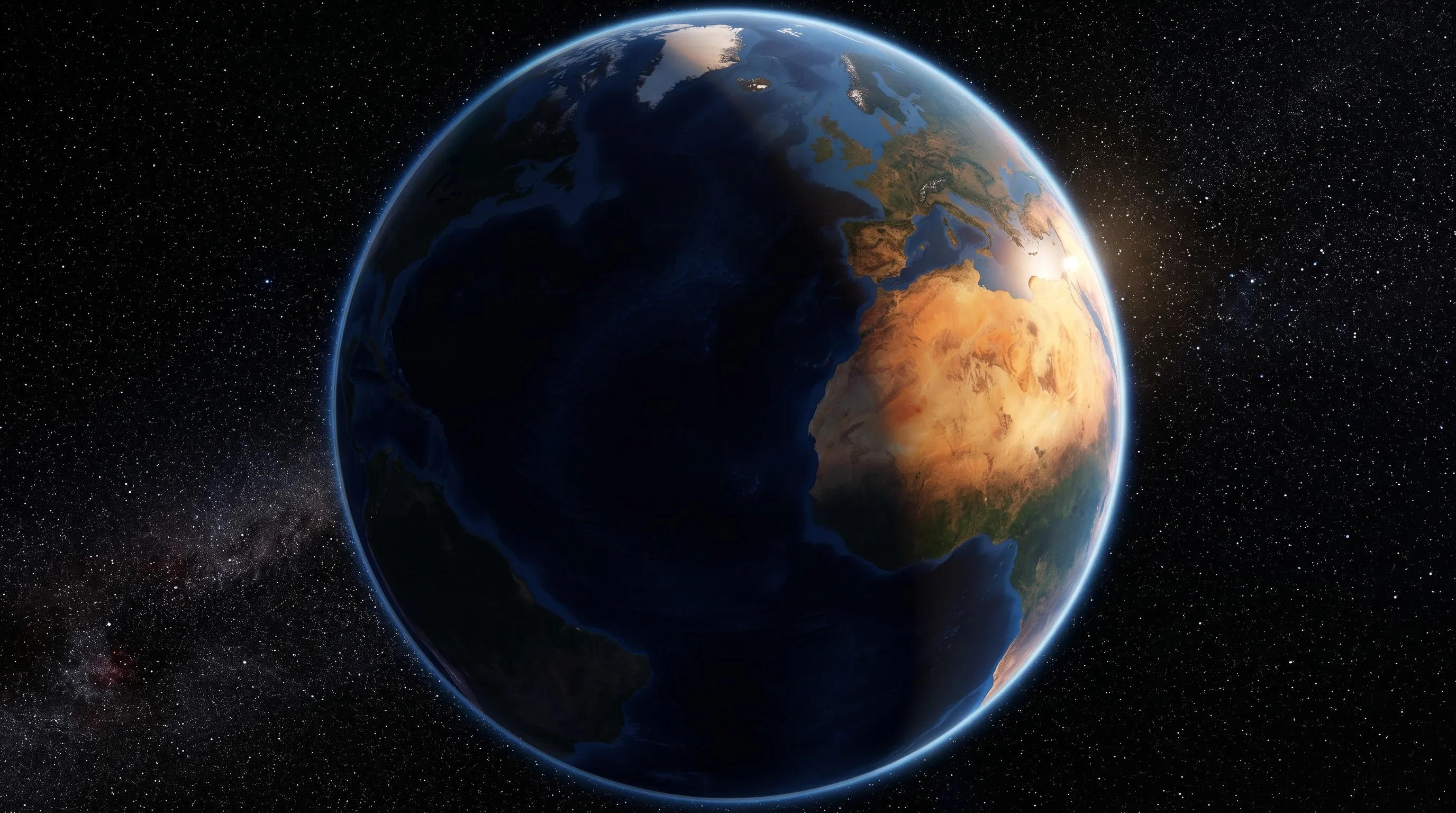 The Long Day at Gibeon SITCHIN 1990 · THE LETTER, PRICED · INST-84 Sitchin's letter to the New York Times, March 17, 1990: Joshua's sun stood still at Gibeon 'rising but not setting for a whole day'; 'at about that same time, circa 1400 B.C.' the sun failed to rise for a whole day at Teotihuacan and for 20 hours in the Andes; and since 'a day that does not end and a night that does not end are the same phenomenon in opposite parts of the world', Jericho's re-dating 'would also confirm' Joshua. This bench freezes the sentence onto the sphere. The Terminator stops the sun: at a noon freeze Teotihuacan's clock really does read 03:04 and Cusco's 04:51, and the pairing holds; but the entire night hemisphere, 50% of the planet, could supply a 'corroborating' long-night tale, the window stays open at every season, and the point 'opposite' actually names is open South Pacific more than 7,500 km from either witness. The Calendar lines up every dated pillar: the one laboratory date (Jericho radiocarbon, 1995) misses by ~150 years, the named city is 1,300 years late, and both American tales are written three millennia downstream, one of them saying in its own text that the sun rose and then would not move. The Ledger prices the stop: 2.1 × 10²⁹ joules out and back, heat enough to boil the oceans off 58 times, against a real brake a trillion times too weak. The numbers are sourced, the quotes are paginated, and two verdicts hang at equal size. LIVE
 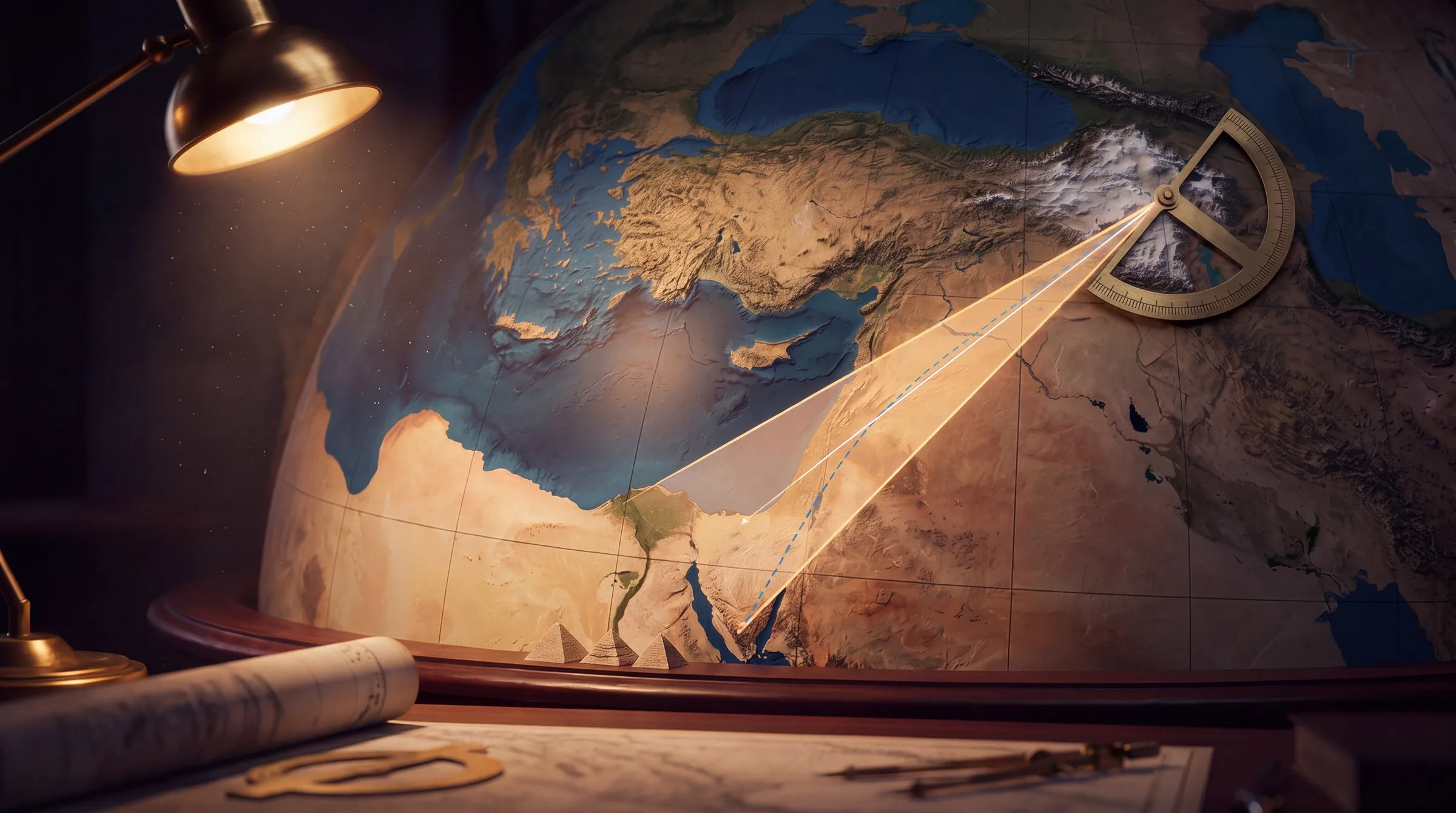 The Landing Corridor SITCHIN 1980 · THE CORRIDOR, MEASURED · INST-77 Sitchin's landing corridor has its point on Ararat's twin peaks, one edge on the two great pyramids of Giza, the other on twin peaks in the Sinai, and 'the flight path within this corridor was then inclined at a precise 45 degrees to the equator'. This bench puts the wedge on the Earth. The Corridor draws every line the book draws as a WGS84 geodesic with a true 45° rhumb line beside it, and protractors on the ground read the angle to the parallel along the way: Ararat to Giza reads 37.9° at Ararat and 45.5° at Giza, one line. The Angles measure each line six ways, geodesic at its start, middle and end, rhumb, flat map, Lambert sheet: six numbers against one 'precise'. The Sheet redraws the book's diagram and tests it with its own anchors: the bisector passes 10 km from Jerusalem, the Giza edge 13 km from Baalbek and 540 m from Heliopolis, the book's equidistances hold to a percent, its 'accurate 45 degree right angle' is 46.2°, Sippar sits 4 km off Ararat's meridian, and Viracocha's line runs straight to 217 m over 450 km at 42°. The Lottery joins 52 Near-East summits and sites pairwise: 33 of 1,297 lines sit within ±1° of 45°, where uniform chance predicts 29; allow any measuring rule and it is 120. The Andes run second. The numbers are sourced, the quotes are paginated, and two verdicts hang at equal size. LIVE
 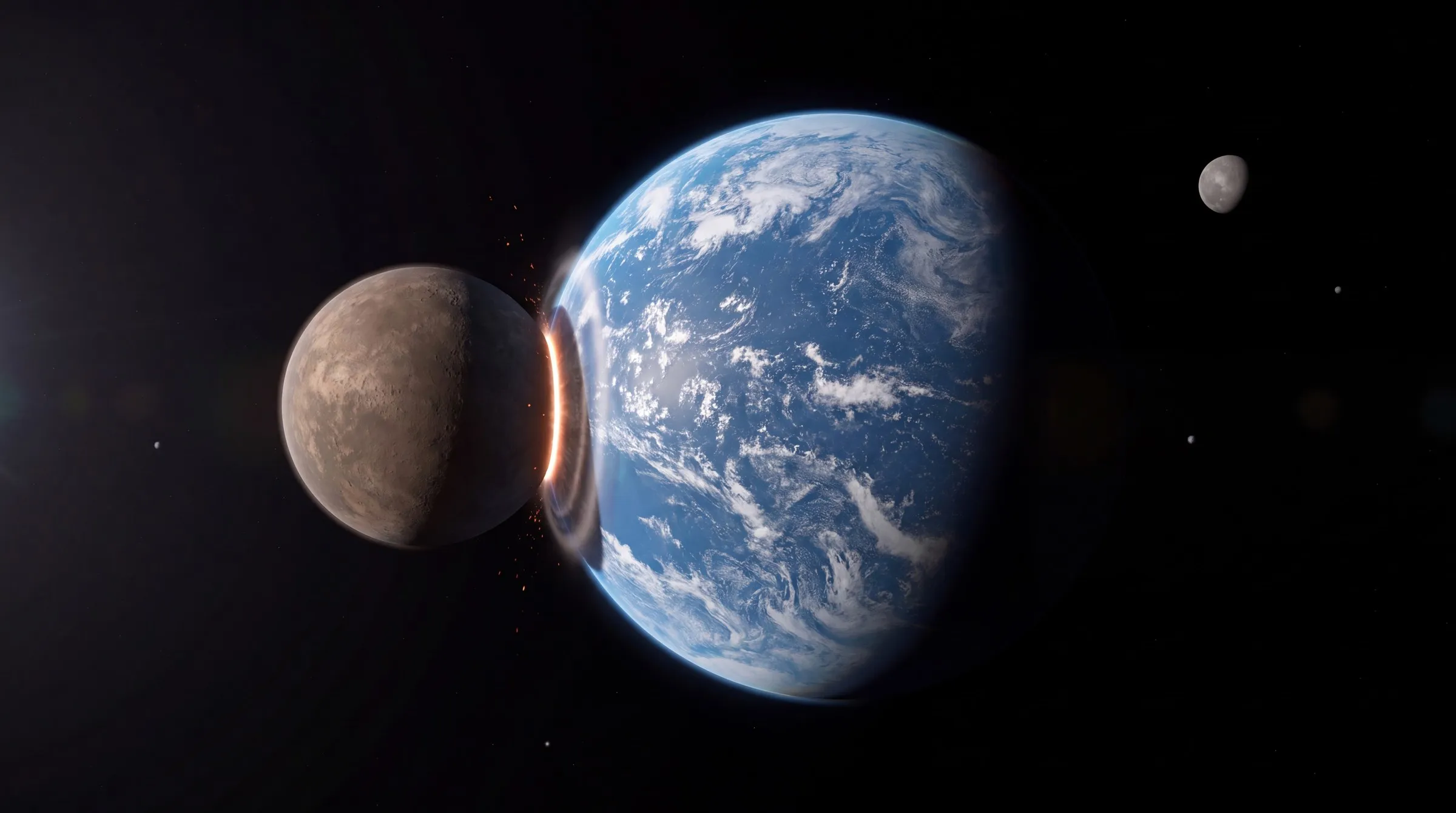 The Tiamat Collision SITCHIN 1976 · THE CELESTIAL BATTLE, PRICED · INST-72 Sitchin's Celestial Battle: Marduk's satellites strike Tiamat, the watery planet beyond Mars, 'as a mussel, he split her into two parts' (p. 113), the North Wind carries the upper half to 'a new orbit nearer the Sun' as Earth, Kingu is pulled along as the Moon, the lower half is hammered into the asteroid belt. The book gives the sequence and no number. This bench supplies the arithmetic: a two-Earth-mass Tiamat needs 4.9 km/s to reach 1 AU in one blow, a two-Mars satellite at 43 km/s by momentum; the disruption scaling says that blow leaves a third to three quarters of her in one piece, the order of 'two parts'. The Battle is 3D: her orbit, Nibiru's retrograde ellipse, the hit, the remnant's ellipse returning to the point of impact, the lower half shearing into a ring by Kepler alone; zoom in for the bodies at true scale. The Halves stands every mass on one ruler: the belt is 1/2,500 of the lower half, and the book itself calls the debris insufficient. The Move finds the 6.2 km/s that would round the orbit must be paid at 1 AU, where Nibiru never is. The Moon maps Kingu's leash beside three rulers: oxygen, core, age. Two verdicts at equal size. LIVE
 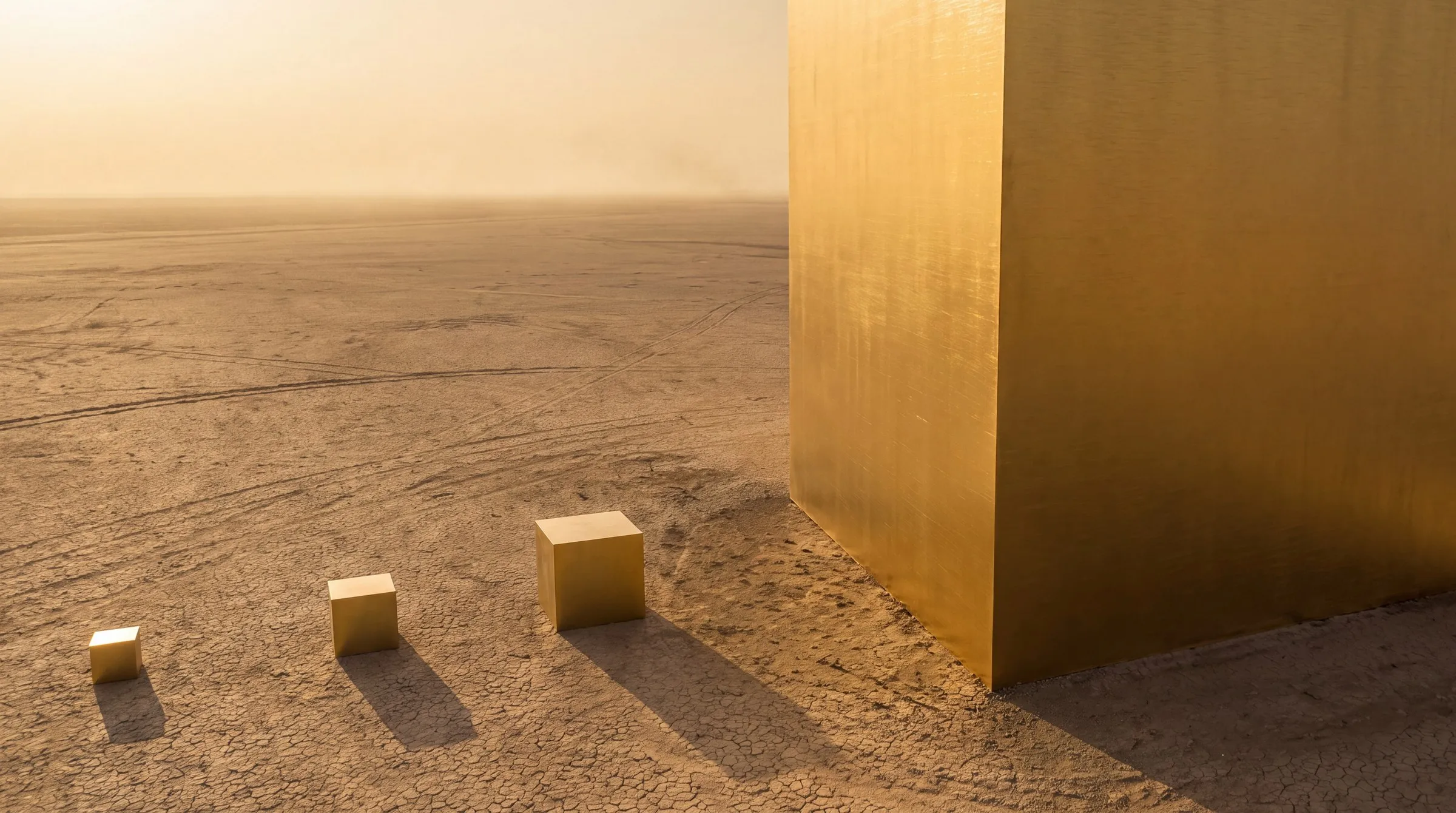 The Gold Shield SITCHIN 1976 · THE GOLD SHIELD, PRICED · INST-71 Sitchin's Anunnaki came to Earth for gold, 'in order to create, on their own planet, a shield of suspended gold particles with which to protect their dwindling atmosphere' (p. 72). The books state the motive five times and the quantity never. This bench supplies the arithmetic: Mie theory on gold's measured optical constants puts the cheapest sunshade at a radius near 70 nm and about one gram of gold per square metre per unit optical depth, two and a half times Pinatubo's sulfate; over Nibiru at the size INST-70 read from the same book, 6.4 billion tonnes, thirty thousand times all the gold ever mined, a quarter of the gold in the continental crust. The Veil is 3D: the planet under a gold haze drawn at the dialled optical depth, and six gold cubes at true scale on the surface, from the 22 m cube of everything humanity has mined to the 16 km cube of one delivery. The Fall prices how long the layer stays up, Stokes with the slip correction: months, faster with coagulation. The Schedule takes the book's own cadence, one delivery per 3,600-year orbit, and finds the shield on duty one part in twelve thousand of the time and a delivery that would hold it at over two thousand crusts of gold. Two verdicts at equal size. LIVE
 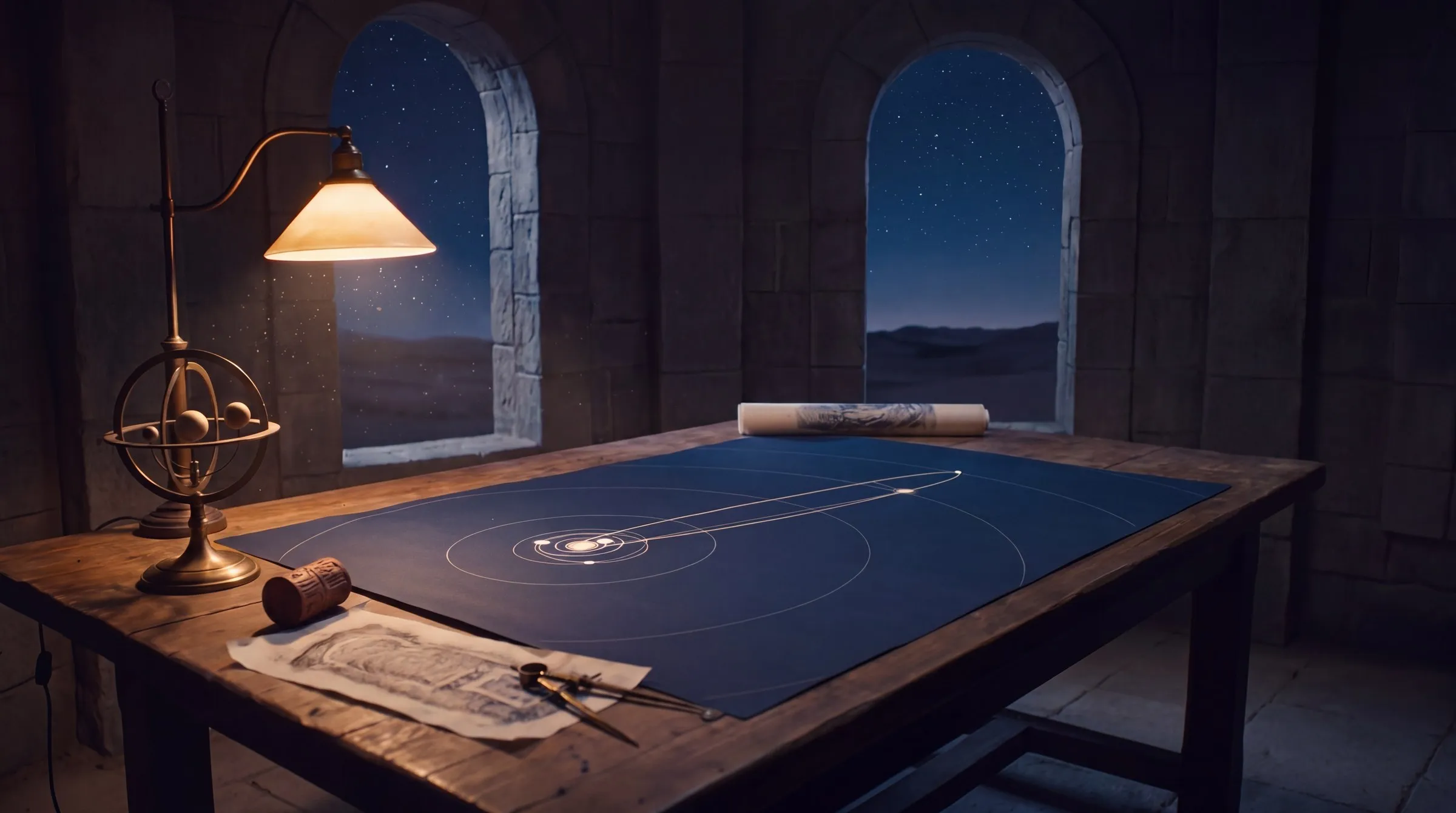 Nibiru SITCHIN 1976 · THE 3,600-YEAR ORBIT · INST-70 Sitchin's Twelfth Planet has one orbital number, 3,600 years; an inclination 'almost identical to Halley's'; a perihelion 'between Mars and Jupiter'; a size 'three or four times Earth'; and no mass. This bench builds the orbit those words describe (a = 235 AU, e = 0.9885, aphelion 467 AU, retrograde) and runs it through the real solar system with every planet massive. The inner planets barely notice: at two AU a 12.7-Earth-mass body moves Earth's eccentricity by 8×10⁻⁷ a passage. Nibiru's own period notices: Jupiter and Saturn move it by hundreds of years every passage, no close encounter needed and no dependence on mass, and the orbit's median life is 171 passages, not four billion years. Today, at the book's size, the body is never fainter than V 20.0 at any phase of the orbit, two magnitudes brighter than the Pan-STARRS Planet Nine search reached; near perihelion it is a new naked-eye wanderer for about fifteen years, which the bench does not dispute. The belt is 3% of the Moon, not half a planet; moving Earth costs 11 km/s; the Deluge nudge is two millionths of the Moon's tide; and the book's own three dates run on 3,500. Two verdicts at equal size. LIVE
 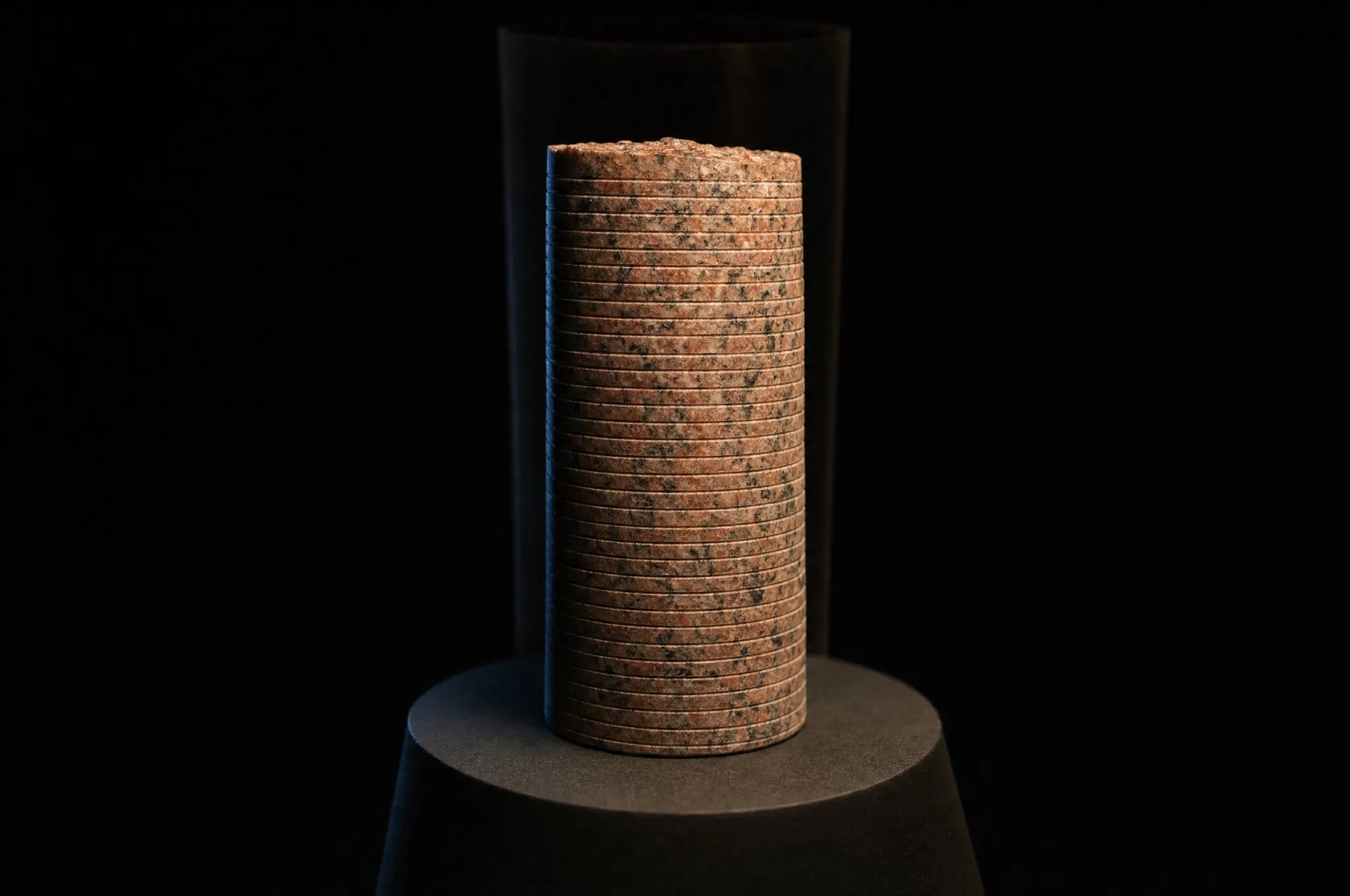 The Core No. 7 Feed-Rate Bench PETRIE CORE NO. 7 · UC16036 · INST-67 A granite drill core Petrie carried out of Giza in 1881 has spent twenty-eight years holding up a planetary machine: read its groove as a 0.1 inch per revolution feed mark, divide by a diamond drill's feed, print '500 times', and an ultrasonic machine-tool industry follows. This bench does the arithmetic the book skipped: the division is actually 450; the ratio compares feeds while ignoring speeds, and as a real rate Petrie's reading at a 60 rpm hand bow means nine metres of granite per hour, thirty times a diamond rig; and everyone who has measured the grooves, Dunn included, finds the same 1-2 mm spacing, differing only in the reading: one start, two starts, or, per the 1983 SEM and the 2020 full panorama, broken crystal-following rings that carry no feed at all. The Core view draws all four readings onto the 3D stone, switchable live; the Feed and Rate ledgers put readings and measured machines on one axis: Stocks's measured copper-and-sand rate is 3 millimetres per hour. Two verdicts at equal size. LIVE
 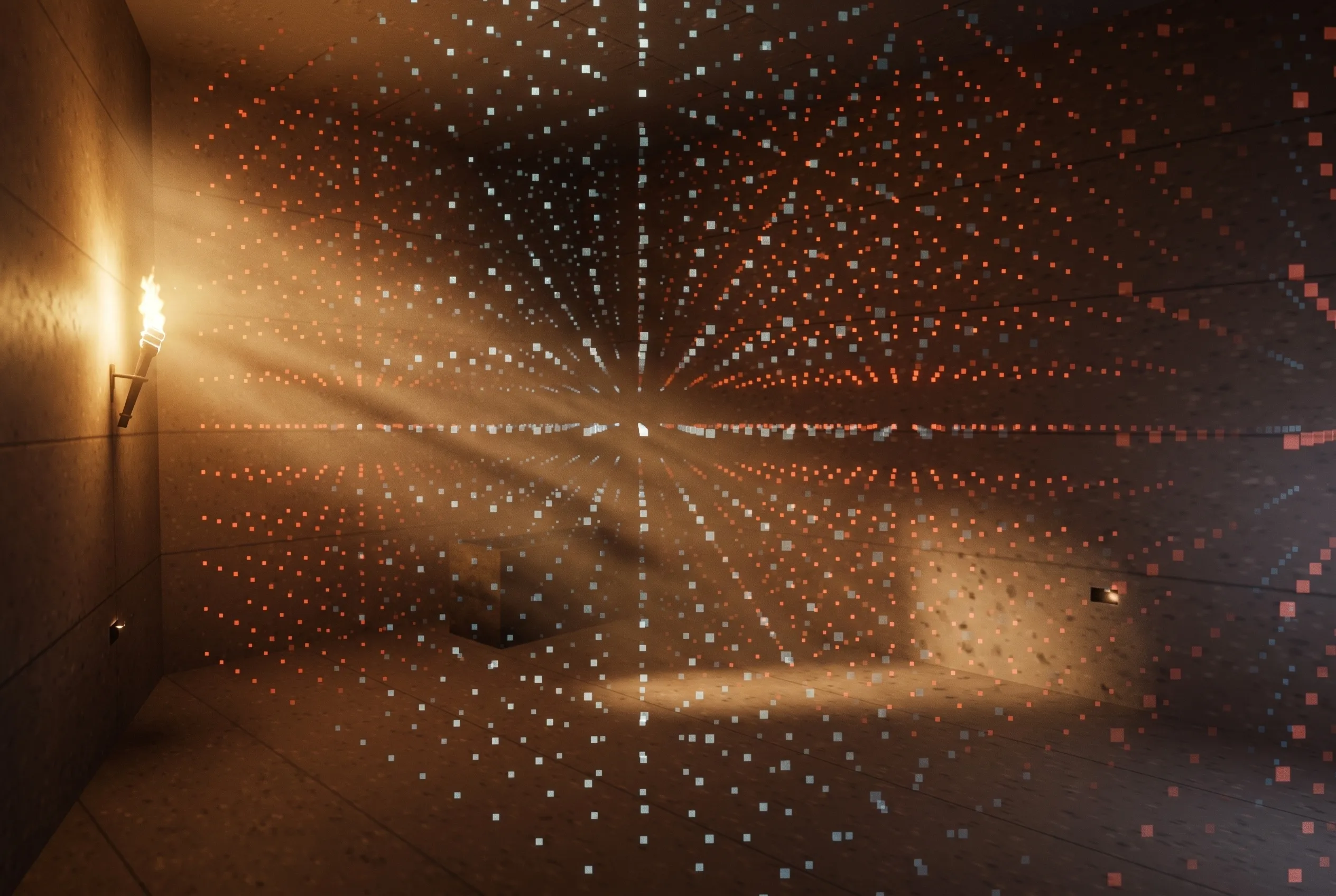 The King's Chamber Resonance Bench KING'S CHAMBER · GIZA · INST-66 A granite room surveyed to hundredths of an inch, and a 1998 book that made it the power centre of a planetary machine: an F sharp chord, a hydrogen-line waveguide, a coupled oscillator drawing power from the Earth. All three numbers are computable and the book computes none. This bench does, with zero fitted constants: the Chamber view rebuilds the room in 3D with the selected standing wave breathing as a live pressure field, nodal planes on request; the Mode Ledger computes all 89 resonances below 120 Hz and maps them to the scale, the fundamental landing at 16.38 Hz, exactly the broadcast's '16 Hz', except it is a C0, not an F sharp, and all twelve pitch classes are hit within a quarter tone, so the chord is post-hoc; the Waveguide bench runs Dunn's 8.4 by 4.8 inch section through the standard formulas, five modes at the hydrogen line because the single-mode limit is set by the 4.8 inch height and not the width, where the real WR-650 is single-moded, and Gantenbrink measured the shaft proper near-square; the Energy Budget performs the arithmetic the book never faced, all channels at one hundred percent capture still three orders of magnitude short of one ultrasonic drill. Two verdicts at equal size. LIVE
 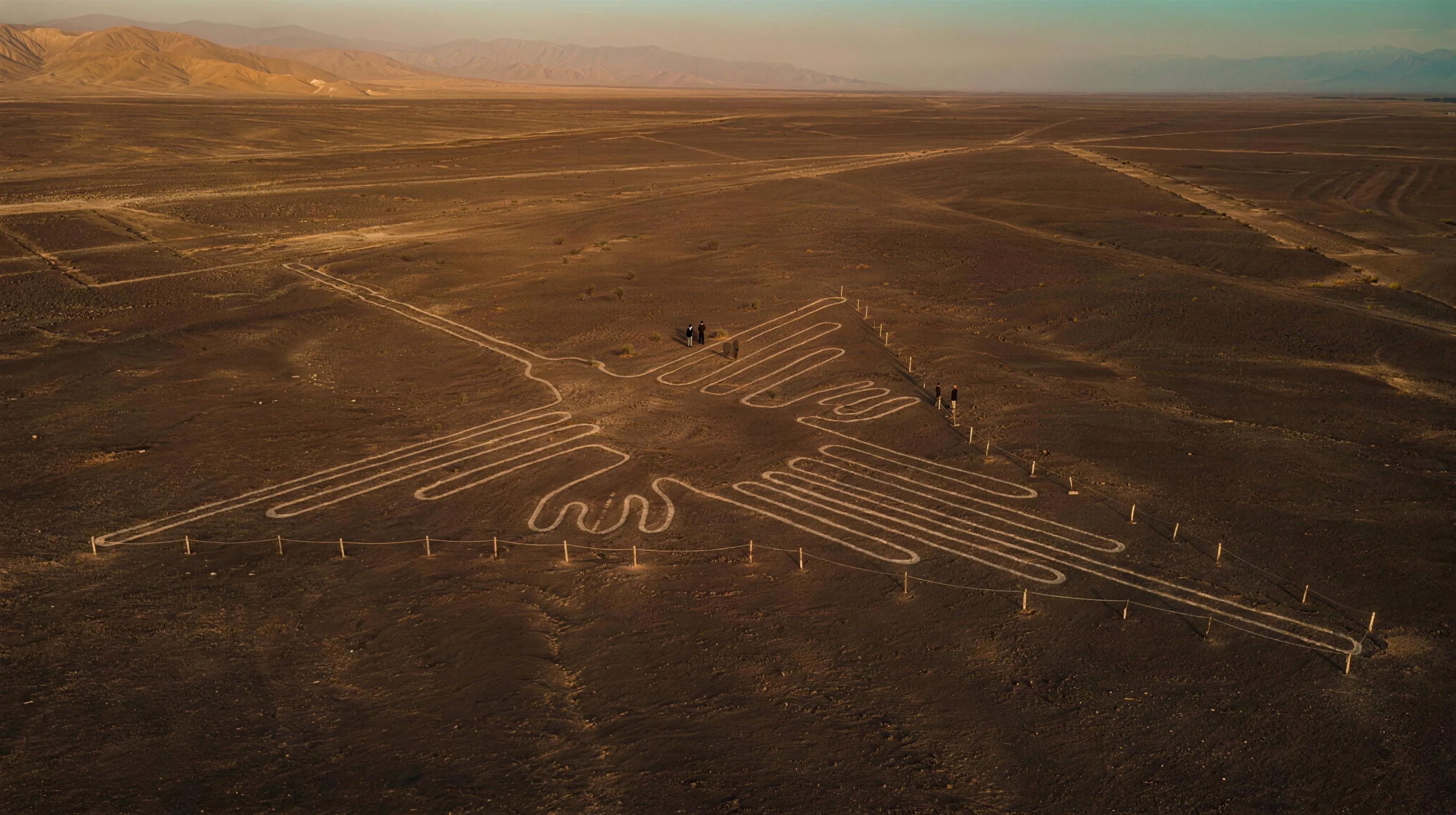 The Nazca Construction Bench NAZCA PAMPA · 500 BC–AD 500 · INST-58 The pampa's lines and figures as a construction-arithmetic problem. The Plot view drives the stakes live: centre-line coordinates whose errors refuse to add (RMS = σ at any size), the peg-to-peg chain random-walking to a σ√N closure gap, and the kilometre straightaways held to under two metres by a 1-arcminute naked eye. The Ground view is 3D: from a 1.6 m standing eye through Reiche's ladder, the 13 m Mirador, the bordering rises and the after-check Cessna, with foreshortening read live. The Labour view prices every job at the measured 1984 clearing rate: the hummingbird at a dozen person-days, the whole pampa at ~257 person-days a year across the drawing centuries, and Nickell's 1982 crew of six staking a full-size condor in nine hours. The File view lays out the claims: the runway that began as a joke, Hawkins' 39 hits against 37 free from chance, and the water-and-pathways reading that leads the archaeology. Two verdicts at equal size: the construction never needs the air; why they drew stays open. LIVE
 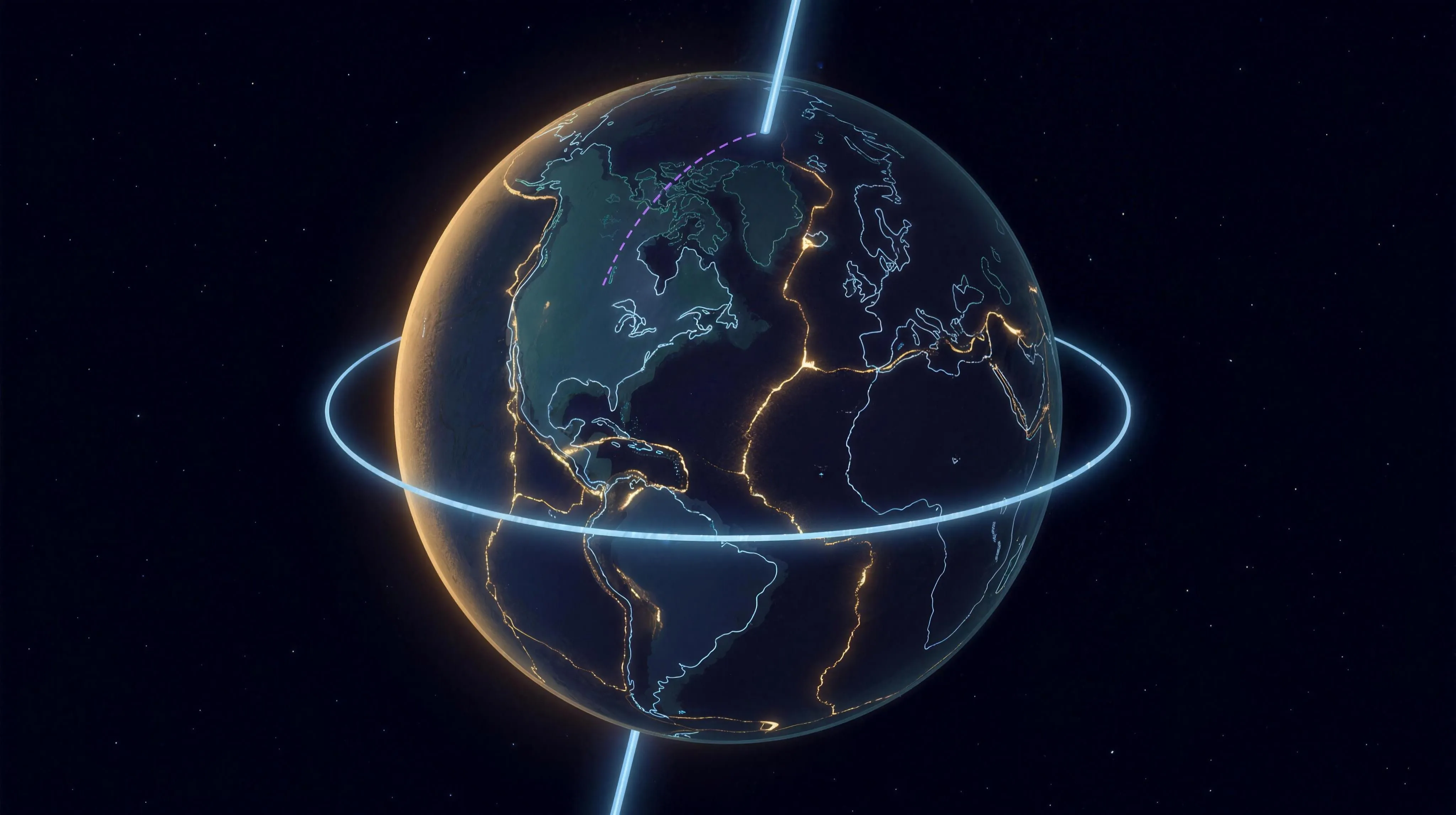 Earth's Shifting Crust CRUST DISPLACEMENT · 1958 · INST-57 Charles Hapgood's 1958 hypothesis, with Einstein's foreword, on which Hancock staked a civilisation in 1995: the whole crust can slide 30 degrees in a few thousand years. This instrument runs it at face value. The Globe view replays the claimed slide on a real-coastline Earth: geography moves, the rotation axis and climate rings stay put, Hudson Bay exits the polar circle as Antarctica enters it, and a misfit heat-map prices the rotated shell against the equatorial bulge per pixel, closed form, up to 10.7 km. The Engine view runs the book's own ice-cap motor to the end: the off-axis centrifugal thrust supplies about 900 pascals at its kindest, the pressure of a hand resting on a table, while sliding at the claimed speed demands about 1.4 GPa, a gap of 1.5 million; run forward, the engine buys 0.43 mm a year, pricing the claimed 30 degrees at 7.7 billion years, longer than the age of the Earth. The Records view sets the claim on the rate ladder: every measured motion of the solid Earth reads centimetres per year, the Greenland cores count layer by layer through the claimed dates without a seam, and the Antarctic ice is continuously layered for over 800,000 years. The File walks 1958 to 2015: Einstein's foreword names the only doubtful assumption itself, the author withdraws his own engine in 1970, Hancock switches to the Younger Dryas impact in 2015, and the measured pole drifts toward Hudson Bay today at ten centimetres a year, the claimed direction at about one seven-thousandth of the claimed rate. Two verdicts at equal size; the reading is yours. LIVE
 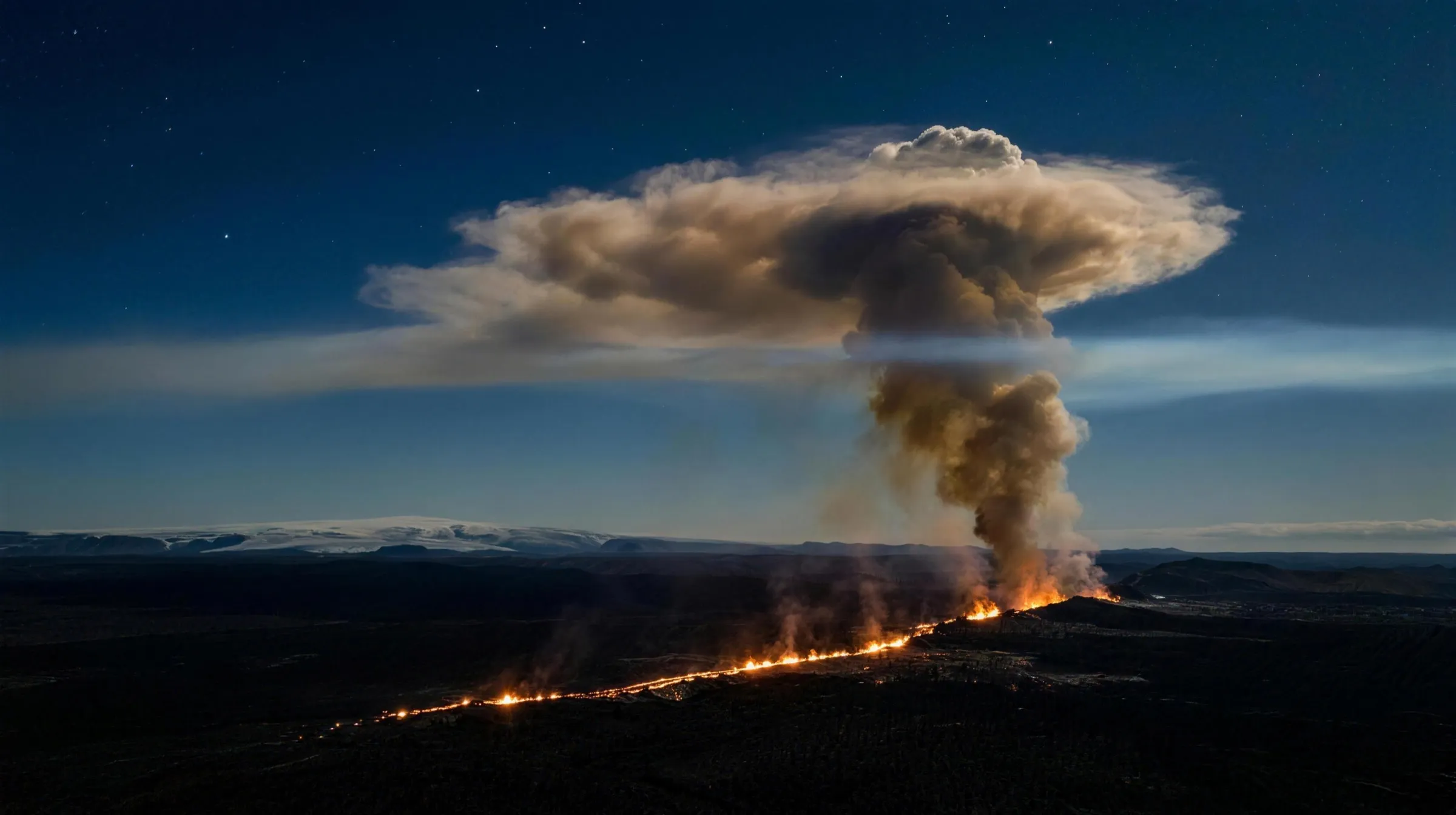 The Osmium Fingerprint FISSURE VS IMPACT · INST-48 INST-46 closed on one undisputed measurement: a platinum spike in Greenland ice that rose a hundredfold over fourteen years, cause unknown. This sequel tries the remaining suspect with the same rigour the impact got: a crack in the ground in Iceland. The Fissure view builds the whole machine at true scale, one unit per kilometre: the famous curtain of fire is a few hundred metres of base, the convective column above it plays against a 9 km subpolar tropopause, about 500 m³/s of column feed clears it, and the three-week channel to Summit, 1,247 km away, is not a model, because Laki demonstrated it in 1783 and Hekla repeated it in 1991, writing a platinum peak into a snow pit at the exact GISP2 site; the control case, Holuhraun, released eleven megatons of SO₂, never topped 4 km, and delivered nothing. The Mixing Bench runs Sun 2020 as a machine: meteorite and mantle are degenerate in the osmium isotope, both near 0.13, but the chondrite fraction that supplies the osmium must deliver iridium at CI proportions, 250 times the measurement, while volcanic gas condensate takes the osmium alone, and the deepest sample at 0.12 sits below anything a chondrite mixture can reach. The Record draws both published tables to the last row: five horizons in four thousand years where an impact predicts one, the 152-154 cm gap shaded rather than smoothed, the disagreeing same-depth replicates in both camps' tables joined in red, and beneath it Abbott 2021's eight bipolar sulfate events, V8 at twice Okmok twenty-five years before the onset, with the platinum spike forty-eight years after it, too late to be anyone's trigger. The File runs 2013 to 2026 in nine cards and two verdicts at equal size: a fingerprint without a culprit, a sheet without a crater. The numbers are sourced, the anchors are re-runnable, and the reading is yours. LIVE
 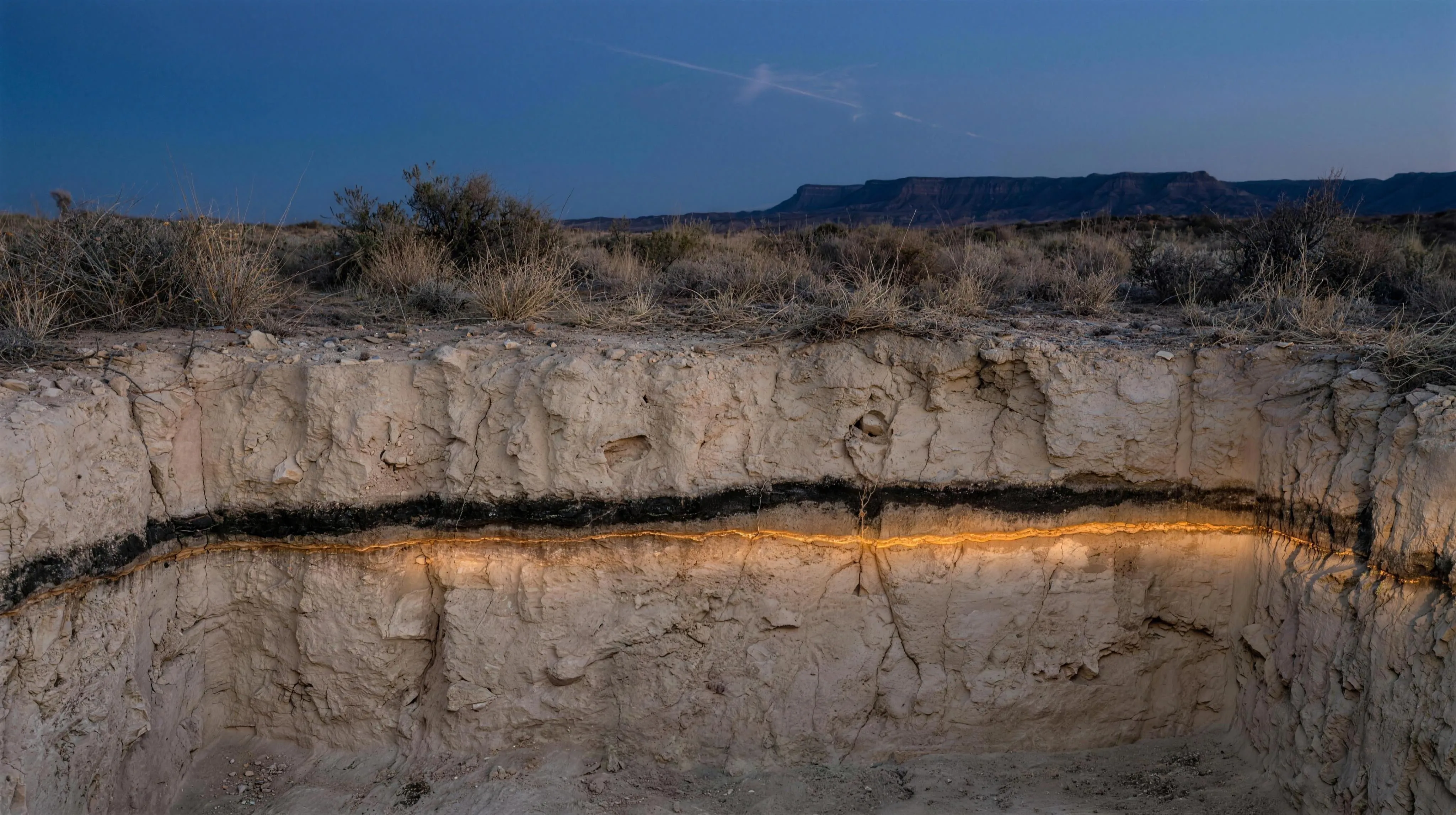 The Younger Dryas Impact Ledger YOUNGER DRYAS · 12.9 KA · INST-46 In 2007, twenty-six authors proposed in PNAS that an impact 12,900 years ago ended the Clovis culture, killed thirty-five genera of megafauna, and tipped the planet into a twelve-hundred-year cold snap. This instrument does not summarise that argument; it runs it. The Layer view puts seventeen sites on one axis: under the proponents' own Bayesian model fifteen of fifteen touch the claimed boundary and the layer looks synchronous across four continents, while switching to ages measured directly on the layer leaves five of eleven, with Lommel's charcoal five hundred years too old and Gainey, which supplied the highest microspherule count ever published, having its carbon spherules dated to about two centuries ago. The Impactor view computes five requirements that must hold at once, all from Collins/Melosh/Marcus 2005: delivering the measured 82.2 ppt platinum spike takes a kilometre of iron, a kilometre of iron leaves a twenty-kilometre crater, shrinking it until the crater could hide drops the platinum by four orders of magnitude, and growing it until it could burn a continent makes it a once-in-thirteen-million-year event. The fifth cannot be bought at any size, because aerosols clear the stratosphere within fifteen years and the stadial lasted 1,193. The Ledger gives all fifteen lines of evidence: the ones that were not reproduced, the ones that turned out not to be unique, the ones refuted, and the two retracted in February 2026. The platinum spike is real and nobody disputes the measurement, and the paper reporting it says in its own words that no such crater has been found, and its lead author now co-authors the refutation. The numbers are sourced, the arithmetic is auditable, and the reading is yours. LIVE
 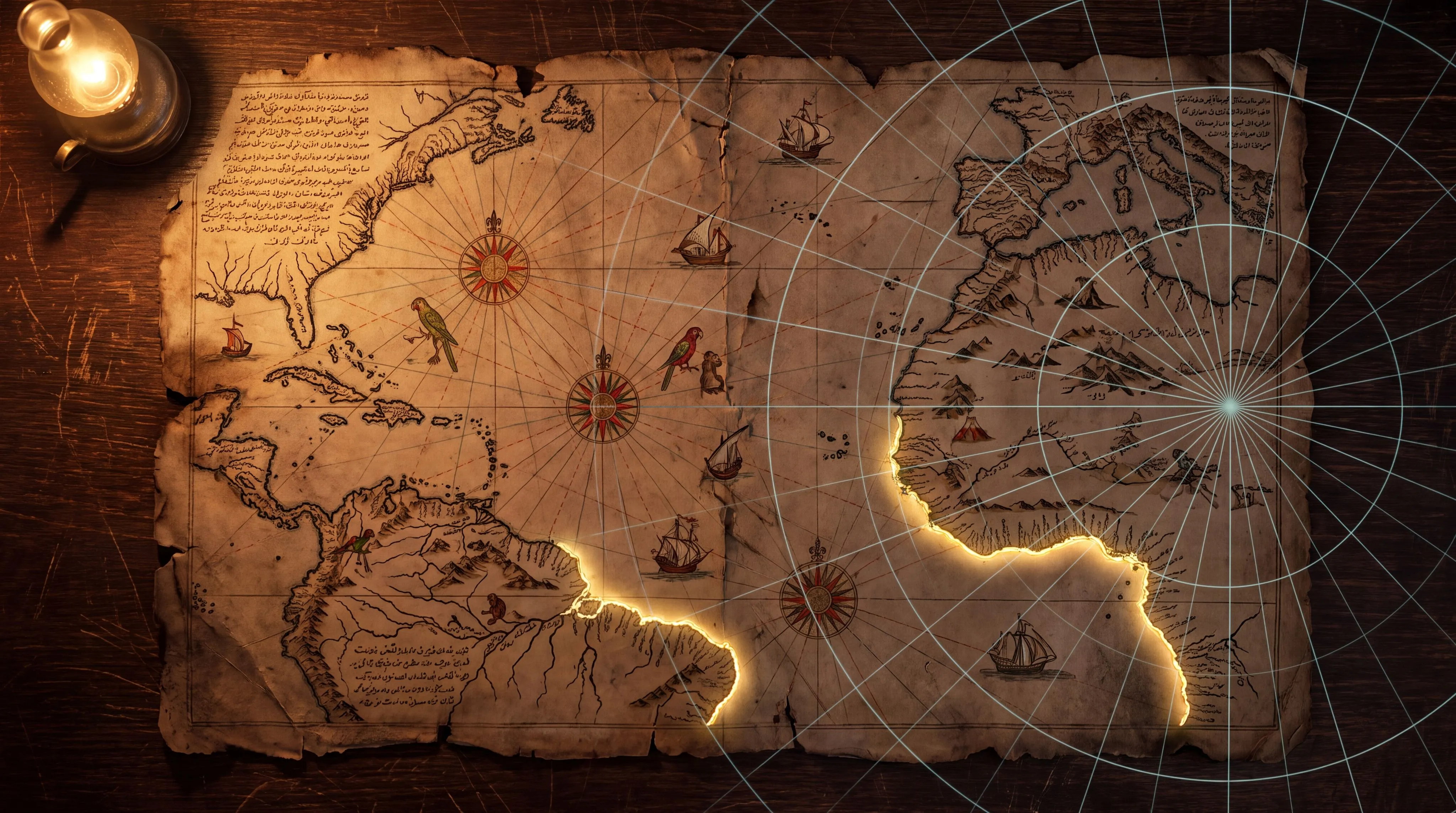 The Piri Reis Map PIRI REIS · 1513 · INST-39 The 1513 Ottoman chart rebuilt as a cartography bench. The Chart view redraws the gazelle-skin fragment with every disputed feature clickable: the Amazon drawn twice, roughly 900 miles of missing coast, the Caribbean drawn to Columbus's cosmography, the southern land annotated with heat and big snakes. The Projection view honestly builds the azimuthal equidistant machine Hapgood claimed, its centre free to stand at Cairo or anywhere: distance and bearing from the centre are exact by construction, and Queen Maud Land falls 11,400 km out in a smeared arc that quarrels with the snug coast the parchment draws against South America. The Southern Land view hands the coast to least squares with three candidates fitted live, subglacial bedrock, the modern ice edge and a Patagonia bent east, RMS printed, the Drake Passage's 800 km gap drawn alongside. The File view lays out 1513 to 2000: Mallery's broadcast, the Ohlmeyer letter, and the Hapgood and McIntosh verdict cards at equal size. The geometry is arithmetic, the claims are sourced, and the reading is yours. LIVE
 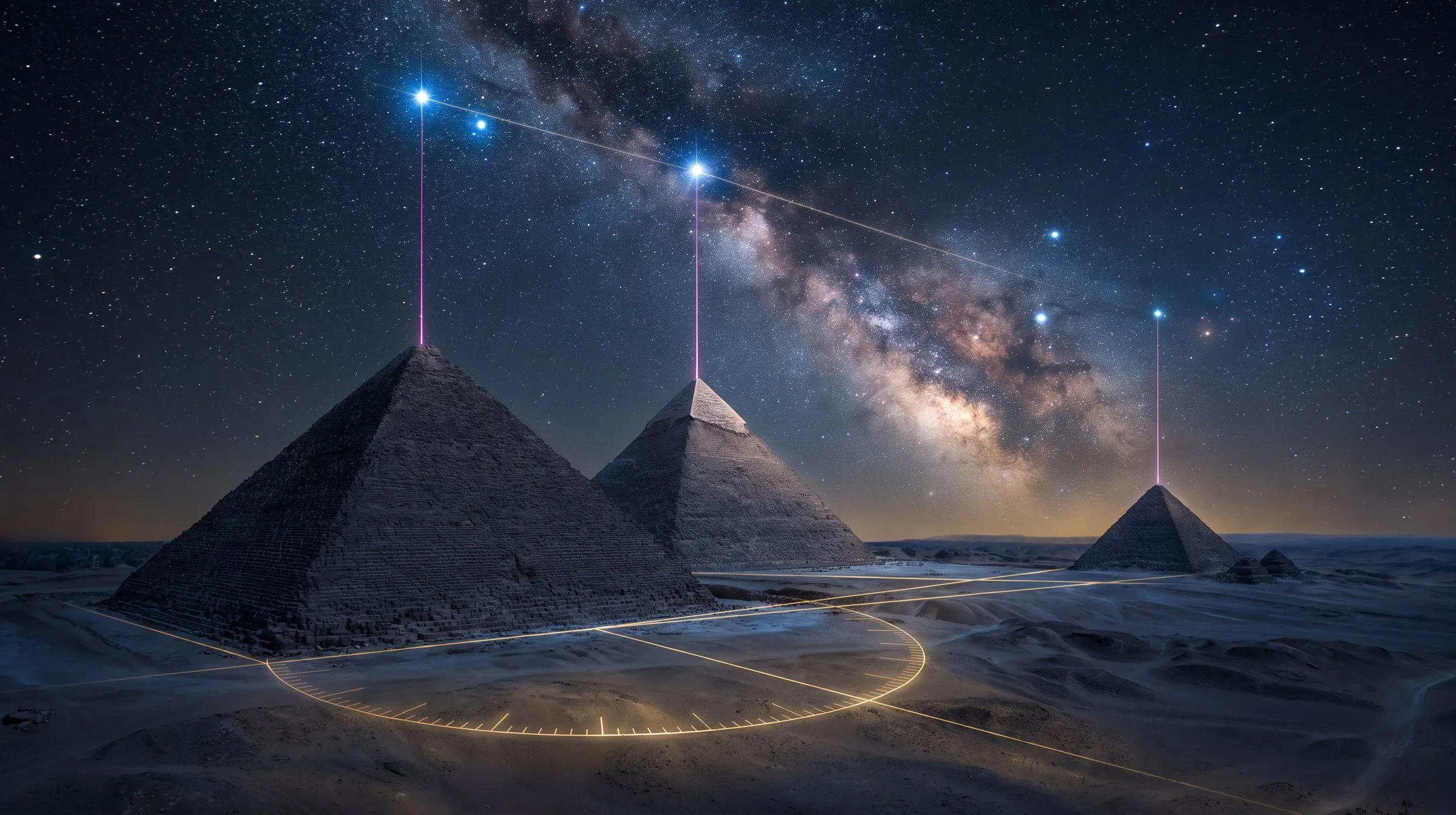 Precession & the Orion Correlation GIZA · PRECESSION · INST-35 Earth's axis rides a 23.4° cone once every 25,772 years, and the whole sky slides against the horizon on that clock, which nobody can wind back or fake. Bauval's famous claim makes that clock its hinge: the three pyramids of Giza map Orion's Belt as it stood at the trough of 10,450 BC. This instrument builds the clock and lets every party make their case on it. The Sky view is a planetarium at Giza with an epoch dial thirteen millennia deep each way; the Match view sets Petrie's survey against the Belt of any epoch, with Krupp's upside-down objection and Fairall's protractor each wired to a switch; the Clock view draws the axis cone and the trough curve that stays within 15 arcminutes of its bottom for about a thousand years; the Shafts view lets the Great Pyramid's four measured shafts date themselves, clustering at about 2,500 BC. The precession is measured, the claim and the objections are quoted from their sources, and the reading is yours.
The Sphinx Erosion Bench SCHOCH 1992 · A RATIO, THREE DIALS · INST-87 In April 1991 Schoch and Dobecki laid four seismic refraction lines on the floor of the Sphinx Enclosure: 1.8 to 2.5 m of weathered rock under the floor on the north, south and east, and only 1 to 1.2 m behind the rump. Origins of the Sphinx turns that ratio into a year: linear, with Khafre's 2500 BCE as the rump floor's baseline, 7000 to 5000 BCE in 1992; 1.0 against 2.7 m, circa 10,000 BCE in 2016. This bench takes the conversion apart. The Ditch draws the statue, the two-tiered west wall, the four lines and a window into the rock under each where they were measured, then drapes the weathering front under the whole floor: shallow behind, deep everywhere else. The Clock puts the three assumptions the book states and never dials on sliders, the baseline year, the rate law's exponent, the climate multiplier before the baseline: 7000 BCE linear, 16,000 BCE at √t, 4500 BCE if the rate follows the rain, and Reader's Early Dynastic needs the pre-baseline rate 23 times the later one. The Rain lays a stepped Holocene rainfall proxy over the exposure windows and prices Reader's runoff: 30 hectares of plateau send 1.7 m of water a year over the walls until Khufu's quarries cut it. The other reading is on the bench too: one campaign needs the rump rock twice as hard, and its refraction velocities are the lowest of the four lines. Two readings hang at equal size. LIVE The Sinai Fallout Ledger SITCHIN 1985 · ONE BLOW, PRICED · INST-85 Chapter 14 of Sitchin's The Wars of Gods and Men: in 2024 B.C. the spaceport in the central Sinai was obliterated 'with one nuclear blow', leaving a scar 'so vast that its features can be seen only from the skies', a plain of blackened rock, an Evil Wind that took a day to cross Sumer, and Dead Sea springs radioactive to this day. This bench runs the chain the book never ran. The Scar turns the book's own adjective into a dial: a 10-km crater read in the most generous mode, buried at optimum depth, is 5.2 gigatons, 103 Tsar Bombas, twelve times every atmospheric test ever fired; even the floor of 'vast', 2 km, is 24 Mt, larger than Castle Bravo. The Wind uses Bravo's dose ladder, measured on people: Bravo itself set off in the Sinai puts 2.4 rad on Ur, a chest CT, and emptying Ur takes 1.9 Gt of fission, a yield whose crater agrees with the scar on gigatons. The Residue puts every isotope 4,049 years on: caesium-137 gone 10⁴¹ times over, plutonium-239 89% intact at 2.7 MBq per square metre, 53,000 times background, at a weapons-grade ratio; 10¹⁵ plutonium atoms per kilogram of Greenland ice at the 2024 BC layer, +11,000‰ of carbon-14 in that year's tree rings, and IntCal20 shows no step, while every soil profile in the hemisphere carries only the Cold War's plutonium. The numbers are sourced, the quotes are paginated, and two verdicts hang at equal size. LIVE The Long Day at Gibeon SITCHIN 1990 · THE LETTER, PRICED · INST-84 Sitchin's letter to the New York Times, March 17, 1990: Joshua's sun stood still at Gibeon 'rising but not setting for a whole day'; 'at about that same time, circa 1400 B.C.' the sun failed to rise for a whole day at Teotihuacan and for 20 hours in the Andes; and since 'a day that does not end and a night that does not end are the same phenomenon in opposite parts of the world', Jericho's re-dating 'would also confirm' Joshua. This bench freezes the sentence onto the sphere. The Terminator stops the sun: at a noon freeze Teotihuacan's clock really does read 03:04 and Cusco's 04:51, and the pairing holds; but the entire night hemisphere, 50% of the planet, could supply a 'corroborating' long-night tale, the window stays open at every season, and the point 'opposite' actually names is open South Pacific more than 7,500 km from either witness. The Calendar lines up every dated pillar: the one laboratory date (Jericho radiocarbon, 1995) misses by ~150 years, the named city is 1,300 years late, and both American tales are written three millennia downstream, one of them saying in its own text that the sun rose and then would not move. The Ledger prices the stop: 2.1 × 10²⁹ joules out and back, heat enough to boil the oceans off 58 times, against a real brake a trillion times too weak. The numbers are sourced, the quotes are paginated, and two verdicts hang at equal size. LIVE The Landing Corridor SITCHIN 1980 · THE CORRIDOR, MEASURED · INST-77 Sitchin's landing corridor has its point on Ararat's twin peaks, one edge on the two great pyramids of Giza, the other on twin peaks in the Sinai, and 'the flight path within this corridor was then inclined at a precise 45 degrees to the equator'. This bench puts the wedge on the Earth. The Corridor draws every line the book draws as a WGS84 geodesic with a true 45° rhumb line beside it, and protractors on the ground read the angle to the parallel along the way: Ararat to Giza reads 37.9° at Ararat and 45.5° at Giza, one line. The Angles measure each line six ways, geodesic at its start, middle and end, rhumb, flat map, Lambert sheet: six numbers against one 'precise'. The Sheet redraws the book's diagram and tests it with its own anchors: the bisector passes 10 km from Jerusalem, the Giza edge 13 km from Baalbek and 540 m from Heliopolis, the book's equidistances hold to a percent, its 'accurate 45 degree right angle' is 46.2°, Sippar sits 4 km off Ararat's meridian, and Viracocha's line runs straight to 217 m over 450 km at 42°. The Lottery joins 52 Near-East summits and sites pairwise: 33 of 1,297 lines sit within ±1° of 45°, where uniform chance predicts 29; allow any measuring rule and it is 120. The Andes run second. The numbers are sourced, the quotes are paginated, and two verdicts hang at equal size. LIVE The Tiamat Collision SITCHIN 1976 · THE CELESTIAL BATTLE, PRICED · INST-72 Sitchin's Celestial Battle: Marduk's satellites strike Tiamat, the watery planet beyond Mars, 'as a mussel, he split her into two parts' (p. 113), the North Wind carries the upper half to 'a new orbit nearer the Sun' as Earth, Kingu is pulled along as the Moon, the lower half is hammered into the asteroid belt. The book gives the sequence and no number. This bench supplies the arithmetic: a two-Earth-mass Tiamat needs 4.9 km/s to reach 1 AU in one blow, a two-Mars satellite at 43 km/s by momentum; the disruption scaling says that blow leaves a third to three quarters of her in one piece, the order of 'two parts'. The Battle is 3D: her orbit, Nibiru's retrograde ellipse, the hit, the remnant's ellipse returning to the point of impact, the lower half shearing into a ring by Kepler alone; zoom in for the bodies at true scale. The Halves stands every mass on one ruler: the belt is 1/2,500 of the lower half, and the book itself calls the debris insufficient. The Move finds the 6.2 km/s that would round the orbit must be paid at 1 AU, where Nibiru never is. The Moon maps Kingu's leash beside three rulers: oxygen, core, age. Two verdicts at equal size. LIVE The Gold Shield SITCHIN 1976 · THE GOLD SHIELD, PRICED · INST-71 Sitchin's Anunnaki came to Earth for gold, 'in order to create, on their own planet, a shield of suspended gold particles with which to protect their dwindling atmosphere' (p. 72). The books state the motive five times and the quantity never. This bench supplies the arithmetic: Mie theory on gold's measured optical constants puts the cheapest sunshade at a radius near 70 nm and about one gram of gold per square metre per unit optical depth, two and a half times Pinatubo's sulfate; over Nibiru at the size INST-70 read from the same book, 6.4 billion tonnes, thirty thousand times all the gold ever mined, a quarter of the gold in the continental crust. The Veil is 3D: the planet under a gold haze drawn at the dialled optical depth, and six gold cubes at true scale on the surface, from the 22 m cube of everything humanity has mined to the 16 km cube of one delivery. The Fall prices how long the layer stays up, Stokes with the slip correction: months, faster with coagulation. The Schedule takes the book's own cadence, one delivery per 3,600-year orbit, and finds the shield on duty one part in twelve thousand of the time and a delivery that would hold it at over two thousand crusts of gold. Two verdicts at equal size. LIVE Nibiru SITCHIN 1976 · THE 3,600-YEAR ORBIT · INST-70 Sitchin's Twelfth Planet has one orbital number, 3,600 years; an inclination 'almost identical to Halley's'; a perihelion 'between Mars and Jupiter'; a size 'three or four times Earth'; and no mass. This bench builds the orbit those words describe (a = 235 AU, e = 0.9885, aphelion 467 AU, retrograde) and runs it through the real solar system with every planet massive. The inner planets barely notice: at two AU a 12.7-Earth-mass body moves Earth's eccentricity by 8×10⁻⁷ a passage. Nibiru's own period notices: Jupiter and Saturn move it by hundreds of years every passage, no close encounter needed and no dependence on mass, and the orbit's median life is 171 passages, not four billion years. Today, at the book's size, the body is never fainter than V 20.0 at any phase of the orbit, two magnitudes brighter than the Pan-STARRS Planet Nine search reached; near perihelion it is a new naked-eye wanderer for about fifteen years, which the bench does not dispute. The belt is 3% of the Moon, not half a planet; moving Earth costs 11 km/s; the Deluge nudge is two millionths of the Moon's tide; and the book's own three dates run on 3,500. Two verdicts at equal size. LIVE The Core No. 7 Feed-Rate Bench PETRIE CORE NO. 7 · UC16036 · INST-67 A granite drill core Petrie carried out of Giza in 1881 has spent twenty-eight years holding up a planetary machine: read its groove as a 0.1 inch per revolution feed mark, divide by a diamond drill's feed, print '500 times', and an ultrasonic machine-tool industry follows. This bench does the arithmetic the book skipped: the division is actually 450; the ratio compares feeds while ignoring speeds, and as a real rate Petrie's reading at a 60 rpm hand bow means nine metres of granite per hour, thirty times a diamond rig; and everyone who has measured the grooves, Dunn included, finds the same 1-2 mm spacing, differing only in the reading: one start, two starts, or, per the 1983 SEM and the 2020 full panorama, broken crystal-following rings that carry no feed at all. The Core view draws all four readings onto the 3D stone, switchable live; the Feed and Rate ledgers put readings and measured machines on one axis: Stocks's measured copper-and-sand rate is 3 millimetres per hour. Two verdicts at equal size. LIVE The King's Chamber Resonance Bench KING'S CHAMBER · GIZA · INST-66 A granite room surveyed to hundredths of an inch, and a 1998 book that made it the power centre of a planetary machine: an F sharp chord, a hydrogen-line waveguide, a coupled oscillator drawing power from the Earth. All three numbers are computable and the book computes none. This bench does, with zero fitted constants: the Chamber view rebuilds the room in 3D with the selected standing wave breathing as a live pressure field, nodal planes on request; the Mode Ledger computes all 89 resonances below 120 Hz and maps them to the scale, the fundamental landing at 16.38 Hz, exactly the broadcast's '16 Hz', except it is a C0, not an F sharp, and all twelve pitch classes are hit within a quarter tone, so the chord is post-hoc; the Waveguide bench runs Dunn's 8.4 by 4.8 inch section through the standard formulas, five modes at the hydrogen line because the single-mode limit is set by the 4.8 inch height and not the width, where the real WR-650 is single-moded, and Gantenbrink measured the shaft proper near-square; the Energy Budget performs the arithmetic the book never faced, all channels at one hundred percent capture still three orders of magnitude short of one ultrasonic drill. Two verdicts at equal size. LIVE The Nazca Construction Bench NAZCA PAMPA · 500 BC–AD 500 · INST-58 The pampa's lines and figures as a construction-arithmetic problem. The Plot view drives the stakes live: centre-line coordinates whose errors refuse to add (RMS = σ at any size), the peg-to-peg chain random-walking to a σ√N closure gap, and the kilometre straightaways held to under two metres by a 1-arcminute naked eye. The Ground view is 3D: from a 1.6 m standing eye through Reiche's ladder, the 13 m Mirador, the bordering rises and the after-check Cessna, with foreshortening read live. The Labour view prices every job at the measured 1984 clearing rate: the hummingbird at a dozen person-days, the whole pampa at ~257 person-days a year across the drawing centuries, and Nickell's 1982 crew of six staking a full-size condor in nine hours. The File view lays out the claims: the runway that began as a joke, Hawkins' 39 hits against 37 free from chance, and the water-and-pathways reading that leads the archaeology. Two verdicts at equal size: the construction never needs the air; why they drew stays open. LIVE Earth's Shifting Crust CRUST DISPLACEMENT · 1958 · INST-57 Charles Hapgood's 1958 hypothesis, with Einstein's foreword, on which Hancock staked a civilisation in 1995: the whole crust can slide 30 degrees in a few thousand years. This instrument runs it at face value. The Globe view replays the claimed slide on a real-coastline Earth: geography moves, the rotation axis and climate rings stay put, Hudson Bay exits the polar circle as Antarctica enters it, and a misfit heat-map prices the rotated shell against the equatorial bulge per pixel, closed form, up to 10.7 km. The Engine view runs the book's own ice-cap motor to the end: the off-axis centrifugal thrust supplies about 900 pascals at its kindest, the pressure of a hand resting on a table, while sliding at the claimed speed demands about 1.4 GPa, a gap of 1.5 million; run forward, the engine buys 0.43 mm a year, pricing the claimed 30 degrees at 7.7 billion years, longer than the age of the Earth. The Records view sets the claim on the rate ladder: every measured motion of the solid Earth reads centimetres per year, the Greenland cores count layer by layer through the claimed dates without a seam, and the Antarctic ice is continuously layered for over 800,000 years. The File walks 1958 to 2015: Einstein's foreword names the only doubtful assumption itself, the author withdraws his own engine in 1970, Hancock switches to the Younger Dryas impact in 2015, and the measured pole drifts toward Hudson Bay today at ten centimetres a year, the claimed direction at about one seven-thousandth of the claimed rate. Two verdicts at equal size; the reading is yours. LIVE The Osmium Fingerprint FISSURE VS IMPACT · INST-48 INST-46 closed on one undisputed measurement: a platinum spike in Greenland ice that rose a hundredfold over fourteen years, cause unknown. This sequel tries the remaining suspect with the same rigour the impact got: a crack in the ground in Iceland. The Fissure view builds the whole machine at true scale, one unit per kilometre: the famous curtain of fire is a few hundred metres of base, the convective column above it plays against a 9 km subpolar tropopause, about 500 m³/s of column feed clears it, and the three-week channel to Summit, 1,247 km away, is not a model, because Laki demonstrated it in 1783 and Hekla repeated it in 1991, writing a platinum peak into a snow pit at the exact GISP2 site; the control case, Holuhraun, released eleven megatons of SO₂, never topped 4 km, and delivered nothing. The Mixing Bench runs Sun 2020 as a machine: meteorite and mantle are degenerate in the osmium isotope, both near 0.13, but the chondrite fraction that supplies the osmium must deliver iridium at CI proportions, 250 times the measurement, while volcanic gas condensate takes the osmium alone, and the deepest sample at 0.12 sits below anything a chondrite mixture can reach. The Record draws both published tables to the last row: five horizons in four thousand years where an impact predicts one, the 152-154 cm gap shaded rather than smoothed, the disagreeing same-depth replicates in both camps' tables joined in red, and beneath it Abbott 2021's eight bipolar sulfate events, V8 at twice Okmok twenty-five years before the onset, with the platinum spike forty-eight years after it, too late to be anyone's trigger. The File runs 2013 to 2026 in nine cards and two verdicts at equal size: a fingerprint without a culprit, a sheet without a crater. The numbers are sourced, the anchors are re-runnable, and the reading is yours. LIVE The Younger Dryas Impact Ledger YOUNGER DRYAS · 12.9 KA · INST-46 In 2007, twenty-six authors proposed in PNAS that an impact 12,900 years ago ended the Clovis culture, killed thirty-five genera of megafauna, and tipped the planet into a twelve-hundred-year cold snap. This instrument does not summarise that argument; it runs it. The Layer view puts seventeen sites on one axis: under the proponents' own Bayesian model fifteen of fifteen touch the claimed boundary and the layer looks synchronous across four continents, while switching to ages measured directly on the layer leaves five of eleven, with Lommel's charcoal five hundred years too old and Gainey, which supplied the highest microspherule count ever published, having its carbon spherules dated to about two centuries ago. The Impactor view computes five requirements that must hold at once, all from Collins/Melosh/Marcus 2005: delivering the measured 82.2 ppt platinum spike takes a kilometre of iron, a kilometre of iron leaves a twenty-kilometre crater, shrinking it until the crater could hide drops the platinum by four orders of magnitude, and growing it until it could burn a continent makes it a once-in-thirteen-million-year event. The fifth cannot be bought at any size, because aerosols clear the stratosphere within fifteen years and the stadial lasted 1,193. The Ledger gives all fifteen lines of evidence: the ones that were not reproduced, the ones that turned out not to be unique, the ones refuted, and the two retracted in February 2026. The platinum spike is real and nobody disputes the measurement, and the paper reporting it says in its own words that no such crater has been found, and its lead author now co-authors the refutation. The numbers are sourced, the arithmetic is auditable, and the reading is yours. LIVE The Piri Reis Map PIRI REIS · 1513 · INST-39 The 1513 Ottoman chart rebuilt as a cartography bench. The Chart view redraws the gazelle-skin fragment with every disputed feature clickable: the Amazon drawn twice, roughly 900 miles of missing coast, the Caribbean drawn to Columbus's cosmography, the southern land annotated with heat and big snakes. The Projection view honestly builds the azimuthal equidistant machine Hapgood claimed, its centre free to stand at Cairo or anywhere: distance and bearing from the centre are exact by construction, and Queen Maud Land falls 11,400 km out in a smeared arc that quarrels with the snug coast the parchment draws against South America. The Southern Land view hands the coast to least squares with three candidates fitted live, subglacial bedrock, the modern ice edge and a Patagonia bent east, RMS printed, the Drake Passage's 800 km gap drawn alongside. The File view lays out 1513 to 2000: Mallery's broadcast, the Ohlmeyer letter, and the Hapgood and McIntosh verdict cards at equal size. The geometry is arithmetic, the claims are sourced, and the reading is yours. LIVE Precession & the Orion Correlation GIZA · PRECESSION · INST-35 Earth's axis rides a 23.4° cone once every 25,772 years, and the whole sky slides against the horizon on that clock, which nobody can wind back or fake. Bauval's famous claim makes that clock its hinge: the three pyramids of Giza map Orion's Belt as it stood at the trough of 10,450 BC. This instrument builds the clock and lets every party make their case on it. The Sky view is a planetarium at Giza with an epoch dial thirteen millennia deep each way; the Match view sets Petrie's survey against the Belt of any epoch, with Krupp's upside-down objection and Fairall's protractor each wired to a switch; the Clock view draws the axis cone and the trough curve that stays within 15 arcminutes of its bottom for about a thousand years; the Shafts view lets the Great Pyramid's four measured shafts date themselves, clustering at about 2,500 BC. The precession is measured, the claim and the objections are quoted from their sources, and the reading is yours.