The Sphinx Erosion Bench
A ratio is a measurement. A year is the ratio times three things the book states and never moves: a baseline borrowed from Khafre, a rate law that is linear in its arithmetic and nonlinear in its argument, and a dry-climate rate run back unchanged into the wet Holocene. Move them and the same four lines give 4500, 7000, 10,000 or 16,000 BCE. Leave them and the flank floor is older than the rump floor, and the rump rock is the softer. Walk the ditch, read the ratio, turn the dials, and price the rain.
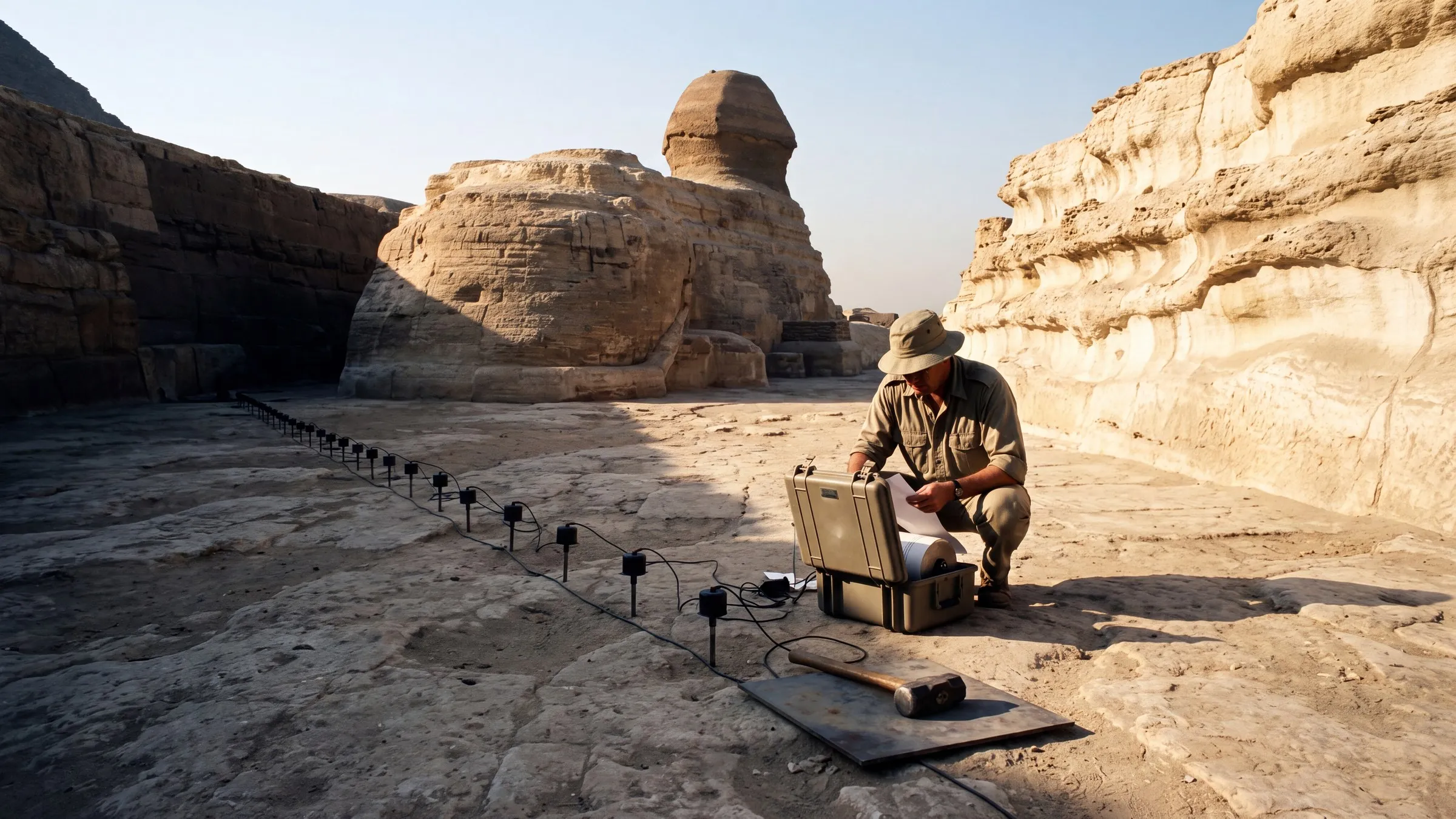 Open the interactive ▸
 What you're looking at
The Ditch is the Sphinx Enclosure in three dimensions: the floor at its level, the statue at 73 by 19 by 20 m, the two-tiered western wall, the temple three metres lower to the east, and the four refraction lines where the survey laid them, S1 along the north flank, S2 along the south, S3 behind the rump, S4 in front of the paws. Under each line a cutaway window into the rock shows the weathered layer at the printed depths, amber over the sound limestone's blue; a toggle drapes the same front under the whole floor by interpolation, so the shape reads at a glance, a metre behind and two everywhere else. Six cameras, a label for every line with its two velocities, and a chip that carries the ratio and the year the dials currently make of it.
The Clock is the conversion taken apart. Two columns show the rump floor and the flank floor at the dial's depths with their printed ranges bracketed and their velocities beneath; three numbered steps show the baseline, the law and the climate turning the ratio into extra effective years and then into calendar years; a timeline from 12,500 BCE to today carries the baseline pin, the flank-floor pin, the bracket the printed ranges allow at the current law, and the company the dates keep: Khufu and Khafre, Reader's Early Dynastic, the two Schoch dates, the humid phase and the sub-pluvial, the end of the Younger Dryas, Göbekli Tepe, the Age of Leo. A mode switch turns the same view to the one-campaign reading and prints what it needs.
The Rain lays a stepped Holocene rainfall proxy over the two exposure windows and sums what each floor received; a dial lets the weathering rate follow the rain to any power and solves the window self-consistently. Below it, Reader's runoff: a plan of the ditch with the plateau's catchment as a wedge, the quarries as a block, the flow over the walls priced in cubic metres a year before and after Khufu cut it, and a ledger. The File runs twelve cards, the survey, the depths, the ratio, the baseline, the two conversions, the law, the climate, the other reading, the runoff, the undrilled core, the company the dates keep, then two verdicts at equal size.
Why it's here
This site's signed review of Origins of the Sphinx ends on a number it wanted on a bench: "the one this book supplies the parts for and no one has yet built: four velocities, four depths, one ratio, and the assumptions that turn a ratio into a year, set out so that a reader can move the baseline and the rate and watch the date move with them." This is that bench. The 1991 survey is the only instrumented measurement in the whole dispute: Schoch and the geophysicist Thomas Dobecki laid four refraction lines on the floor of the enclosure and found two layers under every one, weathered limestone over sound limestone, 1.8 to 2.5 m deep on the north, south and east and only 1 to 1.2 m behind the rump. "These results were completely unexpected" (ch. 2). The book's reading is a floor cut in two campaigns, flanks and front first, the rump left in the bedrock until the Old Kingdom. Then it turns the ratio into a year: linear, with "circa 2500 BCE, at the latest" as the rump floor's baseline, 7000 to 5000 BCE in 1992; 1.0 against 2.7 m, "circa 10,000 BCE (or even a bit earlier)" in 2016, with the remark that since the rate is nonlinear "it must be still older".
It is here because this is a sentence that can be computed, and the book computed only half of it. The ratio is a measurement; the year is the ratio times three assumptions the book states and never dials: the year the rump floor was first exposed, borrowed from the Khafre chronology under attack; the shape of the rate law, linear in the book's arithmetic and nonlinear in its argument; and whether the rate before the baseline was the rate after it, which the book, having calibrated on 4,500 hyperarid years, runs back unchanged into the wet Holocene it says in chapter seven cut the walls. The bench reproduces the book's numbers from the book's inputs first, then puts the three assumptions on sliders. The same ratio gives 7000 BCE linear, 16,000 BCE at √t, and 4500 BCE if the rate follows a rainfall proxy; Reader's Early Dynastic needs the pre-baseline rate 23 times the later one. The other reading is on the bench too, one campaign with depths that differ because the rock does, which needs the rump rock twice as resistant when the rump line's velocities are the lowest of the four. After the Orion Correlation bench this is the second instrument priced against the same book, on the Giza deep-time line with the Younger Dryas ledger and Core No. 7; the water-erosion hypothesis itself, the rain profile on the walls, is not on this bench, which computes only the floor.
How it works
Everything on the bench is arithmetic on four printed depths and a rate law with three named parameters. The book's own 1992 and 2016 sums are reproduced from the book's inputs before any dial moves, and the script that ships with the site re-derives every displayed number before the build passes.
d = k·τⁿ · τ_E/τ_W = (d_E/d_W)^(1/n) · Δτ = τ_W·((d_E/d_W)^(1/n) − 1) · Δt = Δτ / c · c = c_dial · ⟨(R/R̄)^p⟩_window
The ratio. Flank depth over rump depth, 2.2 / 1.1 = 2.00 at the defaults; 1.5 to 2.5 across the printed ranges (1.8/1.2 to 2.5/1.0); 2.7 in the 2016 revision. The rump floor's exposure since the baseline is τ_W, 4,525 years from 2500 BCE.
The law. Depth grows as τⁿ. At n = 1 twice the depth is twice the time; at n = ½, the diffusion law Colman and Pierce give as the likely upper bound, twice the depth is four times the time. The flanks' extra effective time is τ_W·(ratio^(1/n) − 1): 4,525 years linear, 13,575 at √t.
The climate. If the rock weathered c times faster before the baseline than the mean since, the extra calendar time is Δτ / c. The dial runs 0.5 to 30; the rain dial multiplies it by the mean of (rain / post-baseline mean)^p over the window, taken from a stepped proxy (40 mm/yr before 8800 BCE, the humid-phase level from 8500 to 5300, the sub-pluvial level to 2350, 25 today) and solved by iteration because the window depends on the rate. At the defaults with p = 1 the window closes at 4560 BCE and the rain ratio equals the depth ratio.
The other reading. One campaign at the baseline puts equal τ on every side, so k_E / k_W = d_E / d_W at any exponent: the rump rock must resist twice as well. The bench prints that requirement beside the survey's own velocities, S3's 2,502 m/s against S1's 3,205. Reader's runoff is catchment × coefficient × the proxy's rain over the pre-cut window, 95 % intercepted after Khufu's quarry year, and is spread over the drawn enclosure floor as metres of water a year.
Nothing is fitted. The only choices are the dials the book never turned and the drawn quantities in the rain view, each declared; the book's own dates come out first, at the book's own settings.
The dials that decide what happens
Two depths, a baseline, an exponent, a climate multiplier and a rain sensitivity on the clock; four levels and a catchment on the rain; six cameras and five overlays in the ditch. Between them they draw every year the book's chapter could mean, and two the book did not.
- Rump and flank depths. 0.8 to 1.5 m and 1.5 to 4.0 m; 1.1 and 2.2 by default, the middle of the printed ranges. The 1992 preset sets 1.2 and 2.5 with a 4,500-year baseline; the 2016 preset sets 1.0 and 2.7.
- Baseline. 3300 to 2000 BCE; 2500 by default, the book's 'at the latest'. It is the year the rump floor was first exposed and the zero of the clock.
- The law. Exponent 0.5 to 1.0 with two buttons, linear (the book's arithmetic) and √t (the book's argument). Nothing else changes, and the year moves from 7025 to 16,075 BCE.
- Climate. 0.5 to 30 times the post-baseline rate on a log dial; 1 by default, the book's silent assumption. Reader's 2700 BCE sits at 22.6.
- Rate follows rain. 0 (off) to 1 (proportional). Turns the rain proxy into a climate multiplier over the window, solved self-consistently.
- The proxy's levels, the catchment, the quarries. Humid-phase rainfall 50 to 400 mm/yr (100 by default), sub-pluvial 25 to 150 (60), catchment 5 to 100 ha (30), runoff coefficient 0.1 to 0.6 (0.35), and a toggle for Khufu's quarries cutting the flow.
- Cameras and overlays. Overview, the rump, the north flank, the paws, under the floor, the temple; the windows, the front under the whole floor, the reading painted on the floor, the lines, the temple, labels.
The claims, as they stand
The measurement, the reading, the two conversions, the three assumptions, the other reading, the runoff and the missing core, with where each lands when the arithmetic is run and the sources are checked.
| A weathered layer 1.8-2.5 m deep on three sides and 1-1.2 m behind the rump proposed by Dobecki & Schoch 1992; the book, ch. 2 | MEASURED | The measurement. Four refraction lines, two layers under each, the depths as printed; the bench draws them where the survey laid them. Reader's reading of the 1992 paper puts S4 near 4 m; the bench keeps the book's 2 to 2.5 and marks the conflict. |
| The floor was cut in two campaigns: flanks and front first, the rump in the Old Kingdom proposed by the book, ch. 2 | CONTESTED | The reading the depths invite, and the two-tiered west wall tells the same story. It needs no rate and no baseline; it says 'older than the rump floor' and nothing about how much. |
| 50 to 100 percent older: 7000 to 5000 BCE proposed by Schoch 1992 (KMT; app. 6) | READING | Linear, on a 4,500-year baseline, from 1.2 against 1.8 and 2.5 m: 4725 to 7350 BCE before rounding. The bench reproduces it from the book's inputs. It assumes a constant rate through the wet Holocene. |
| 2.7 times older: circa 10,000 BCE, and nonlinear means older still proposed by the book, ch. 2 (2016) | READING | From 1.0 against 2.7 m, the shallowest rump reading against the deepest flank reading, part of which the same chapter attributes to a cavity. At √t the same pair gives about 31,000 BCE; the direction is the book's, the size is what it never computed. |
| The rump floor was first exposed circa 2500 BCE proposed by the book, ch. 2 | READING | The hinge. Khafre's date, kept by an argument that rejects Khafre's Sphinx, and called a minimum. Move it to 3000 BCE and the linear flank date is 8025 BCE; to 2000 and it is 6025. |
| The rate before the baseline was the rate after it proposed by the book, implicitly; Harrell 1994 against; Schoch, app. 7, in reply | CONTESTED | Assumed in every conversion. Let the rate follow the rainfall proxy and the flank floor lands at 4560 BCE linear, 5662 with the 2016 pair: older than Khafre by two to three millennia, not eight. Schoch's reply is that wet-dry cycle frequency, not rain volume, drives the weathering. |
| One campaign at Khafre: the depths differ because the rock does proposed by Lehner, Hawass; Harrell 1994; Reader 2002 on the dip | CONTESTED | Needs the rump floor twice as resistant as the flanks. The survey's own velocities point the other way: S3 is the slowest of the four lines in both layers. Reader's alternative, that the depths join along a line parallel to the bedding when S9's lower floor is included, would make the layer structure, not weathering. Unmeasured either way. |
| Runoff from the plateau cut the walls until Khufu's quarries intercepted it proposed by Reader 2001, 2002 | CONTESTED | The plateau drains south-east into the ditch; the quarries opened in Khufu's reign up-slope. On the bench's drawn catchment, 1.7 m of water a year over the walls before the cut and a twentieth after. It bounds the date on one side only; Reader says Early Dynastic. |
| The core that would settle it proposed by Dobecki & Schoch 1992; Harrell 2000; Schoch 2016; AERAGRAM 2024 | UNTESTED | Listed in the 1992 paper, not drilled by 2016, and holes since have gone unpublished. A characterised, dated core on all four sides fixes the baseline, the law and the climate at once. Every dial on this bench stands in for it. |
Try this
- Start in the ditch. Press 'the rump' and read S3's chip: 1 to 1.2 m, 1,039 over 2,502 m/s. Press 'north flank' and read S1's: 1.8 to 2.5 m, 1,285 over 3,205. Then 'under the floor' with the front toggle on, and look at the step.
- Go to the clock. Read the three steps at the defaults: 4,525 years, times two, 7025 BCE. Press the 1992 preset and the 2016 preset and watch the pin land on the book's own numbers.
- Press √t. The flank floor goes to 16,075 BCE with nothing else changed. Press the 2016 preset again and then √t: 30,962 BCE, off the left of the axis.
- Turn the rain dial to 1. The window closes at 4560 BCE, inside the sub-pluvial, and the rain ledger's ratio row reads 2.00 against 2.00. Go to the Rain view and see where the window now sits on the proxy.
- Switch to One campaign. Read what it needs, twice as hard behind the rump, and what the velocities say. Then go back to Staggered and slide the climate dial until the pin reaches Reader's band: 22.6.
- End on the File. The survey, the depths, the ratio, the baseline, 1992, 2016, the law, the climate, the other reading, the runoff, the core, the company, then both verdicts.
Accuracy
The honest line between what is reported, what is measured, what is modelled on them, and what is a reading:
| Feature | Status | What that means |
|---|---|---|
| The four lines, the climate frame, the rind law | Measured | Dobecki & Schoch 1992 as printed in the book's figure 2.32 and chapter 2: S1 1,285/3,205 m/s at 1.8-2.5 m, S2 1,260/3,184 at 1.8-2.5 m, S3 1,039/2,502 at 1-1.2 m, S4 1,426 at 2-2.5 m (3-3.5 in places), S9 1,257/2,881 at 1.2-1.5 m, S10's buried cliff and water table. Kuper & Kröpelin's dates for the humid phase, Hayes's sub-pluvial, Cairo's rainfall today. Colman & Pierce's bounds on the age ratio from a thickness ratio. S4's sound-rock velocity did not survive the printed figure and is shown as missing. |
| The conversion, and the book's own sums | Exact | d = k·τⁿ; τ_E/τ_W = (d_E/d_W)^(1/n); extra effective years Δτ = τ_W·((d_E/d_W)^(1/n) − 1); extra calendar years Δτ / c. The 1992 and 2016 sums reproduced from the book's inputs (4725 to 7350 BCE; 10,125 BCE) before any dial moves. The one-campaign requirement k_E/k_W = d_E/d_W at any exponent. |
| The dials, the proxy, the drawing | Modelled | The baseline year, the exponent, the climate multiplier and the rain sensitivity are dials because the book left them unturned; every finding quoted holds across their range. The rainfall proxy is a stepped stand-in for a record that does not exist at Giza's latitude; the catchment, its coefficient and the quarries' 95 % are drawn; the profile curves are shapes inside the printed ranges and the front under the whole floor is an interpolation; the wall heights and line offsets in the 3D ditch are a diagram's. |
| The book's words and its critics' | Reported | Every quotation is given by chapter and appendix: the baseline sentence, the 1992 and 2016 conversions, the nonlinear remark, Dobecki & Schoch on S3's slower velocities, Harrell's 'has not dug or drilled', Reader's runoff and his dip-line reading of the same data, and Schoch's cycle-frequency reply. One conflict is on record: Reader reads the 1992 paper's S4 as nearly 4 m where the book says 2 to 2.5. |
| What it amounts to | Reading | Whether a real depth ratio with no measured rate, no measured exponent and a borrowed baseline dates the monument to 7000, 10,000 or 4500 BCE, or only to 'before Khafre', is a reading; the bench prints the staggered and the one-campaign readings at the same size and declines to make it for you. |
In one line: Four depths and four velocities are the paper's; the year is arithmetic on a ratio and three assumptions the book names and never dials; the book's own dates are reproduced from the book's own inputs before any slider moves; the rainfall proxy, the catchment and the ditch's walls are drawn and say so. The reading is yours.
Sources
- Robert M. Schoch & Robert Bauval, "Origins of the Sphinx: Celestial Guardian of Pre-Pharaonic Civilization" (Inner Traditions, 2017): chapter 2 "The Sands of Time" (the survey, figs. 2.31-2.36, the 1992 and 2016 conversions, the two-tiered west wall), chapter 7 (the rain-cut profile), appendix 6 (the 1992 KMT paper with its 2016 brackets, the Butzer and Hayes climate quotations), appendix 7 (the replies to Harrell and Reader).
- Thomas L. Dobecki & Robert M. Schoch, "Seismic Investigations in the Vicinity of the Great Sphinx of Giza, Egypt", Geoarchaeology 7(6), 1992, 527-544: the four enclosure lines, S9 and S10, the tomography anomalies; quoted in the book at pp. 535-542 of the paper.
- Robert M. Schoch, "Redating the Great Sphinx of Giza", KMT 3(2), 1992: the linear conversion, 7000 to 5000 BCE.
- James A. Harrell, "The Sphinx Controversy: Another Look at the Geological Evidence", KMT 5(2), 1994: the wet-sand hypothesis, the objection that S3's lower velocities read as more weathered, and the wetter-climate rate objection; Harrell (2000) on the undrilled layer, quoted in appendix 7.
- Colin Reader, "A Geomorphological Study of the Giza Necropolis, with Implications for the Development of the Site", Archaeometry 43(1), 2001, 149-165; "Giza Before the Fourth Dynasty", Journal of the Ancient Chronology Forum 9, 2002, 5-21: the rainfall run-off model, Khufu's quarries as the cut, the Early Dynastic date, and the reading of S1-S4 with S9 as a line parallel to the dip.
- K. Lal Gauri, John J. Sinai & Jayanta K. Bandyopadhyay, "Geologic weathering and its implications on the age of the Sphinx", Geoarchaeology 10(2), 1995, 119-133: arid-climate salt weathering and exhumed karst as the alternative for the walls.
- Steven M. Colman & Kenneth L. Pierce, "Weathering Rinds on Andesitic and Basaltic Stones as a Quaternary Age Indicator, Western United States", USGS Professional Paper 1210, 1981: the thickness ratio as a minimum for the age ratio, its square near the maximum, and the logarithmic fit; the source of the bench's exponent bounds.
- Rudolph Kuper & Stefan Kröpelin, "Climate-Controlled Holocene Occupation in the Sahara: Motor of Africa's Evolution", Science 313, 2006, 803-807: the monsoon into the eastern Sahara at 8500 BCE, up to about 100 mm/yr, retreat after 5300 BCE, drying earlier in the north. Peter B. deMenocal et al., "Abrupt onset and termination of the African Humid Period", Quaternary Science Reviews 19, 2000, 347-361.
- Karl W. Butzer, "Early Hydraulic Civilization in Egypt" (Chicago, 1976) and the 1971 passage on wadi activity and the 2350 BCE onset of aridity; William C. Hayes (1965) on the Neolithic sub-pluvial c. 5000-2350 BCE; both as quoted in appendix 6. Cairo climate normals for the present 25-28 mm/yr.
- Mark Lehner, "The Archaeology of an Image: The Great Sphinx of Giza" (PhD, Yale, 1991) for the statue's dimensions, 73 by 19 by 20 m, and the Member I-III sequence; Rebecca D. Sperber, Dean Goodman, Mark Lehner & Glen Dash, "Where the Water Disappears", AERAGRAM 25(1-2), 2024, 19-23, for the 1980 cores and the unpublished holes in the floor.
- This site: the signed review of Origins of the Sphinx (the attribution chain, the Birch note, the audit); the wiki entries for the 1991 Sphinx Seismic Survey, the Sphinx Water Erosion Hypothesis, Colin Reader and Robert Schoch; the Orion Correlation bench for the Age of Leo; the Younger Dryas ledger for appendix nine's comet.