The Stealth Bench
In 1962 a Moscow journal published a mathematician's method for computing how edges scatter radio waves; his reviewers had judged it militarily worthless. Translated by the US Air Force in 1971 and read at Lockheed in 1974, that paper became the F-117, and when computers caught up with its curved-surface case, the B-2: a 52-metre aircraft whose every scattering edge lies in one of two directions, so that its entire radar signature concentrates into four spikes, each a fraction of a degree wide, at four azimuths chosen on the drawing board. This bench computes that machine honestly in both directions. It derives the four-petal rose from the planform, prices what four orders of magnitude buy under the fourth-root law, and then lets the same physics answer back: the exact Mie curve that lifts every aircraft-sized object back out of the noise at metre wavelengths, the quarter-wave absorber that detunes into paint, the 536 m² mirror underneath, and the one combat loss that followed this arithmetic to the letter. No antigravity appears at any step, which is the point: the station's Culture 11 file reviews the book that needs it to, and this instrument is the reply.
 Open the interactive ▸
 What you're looking at
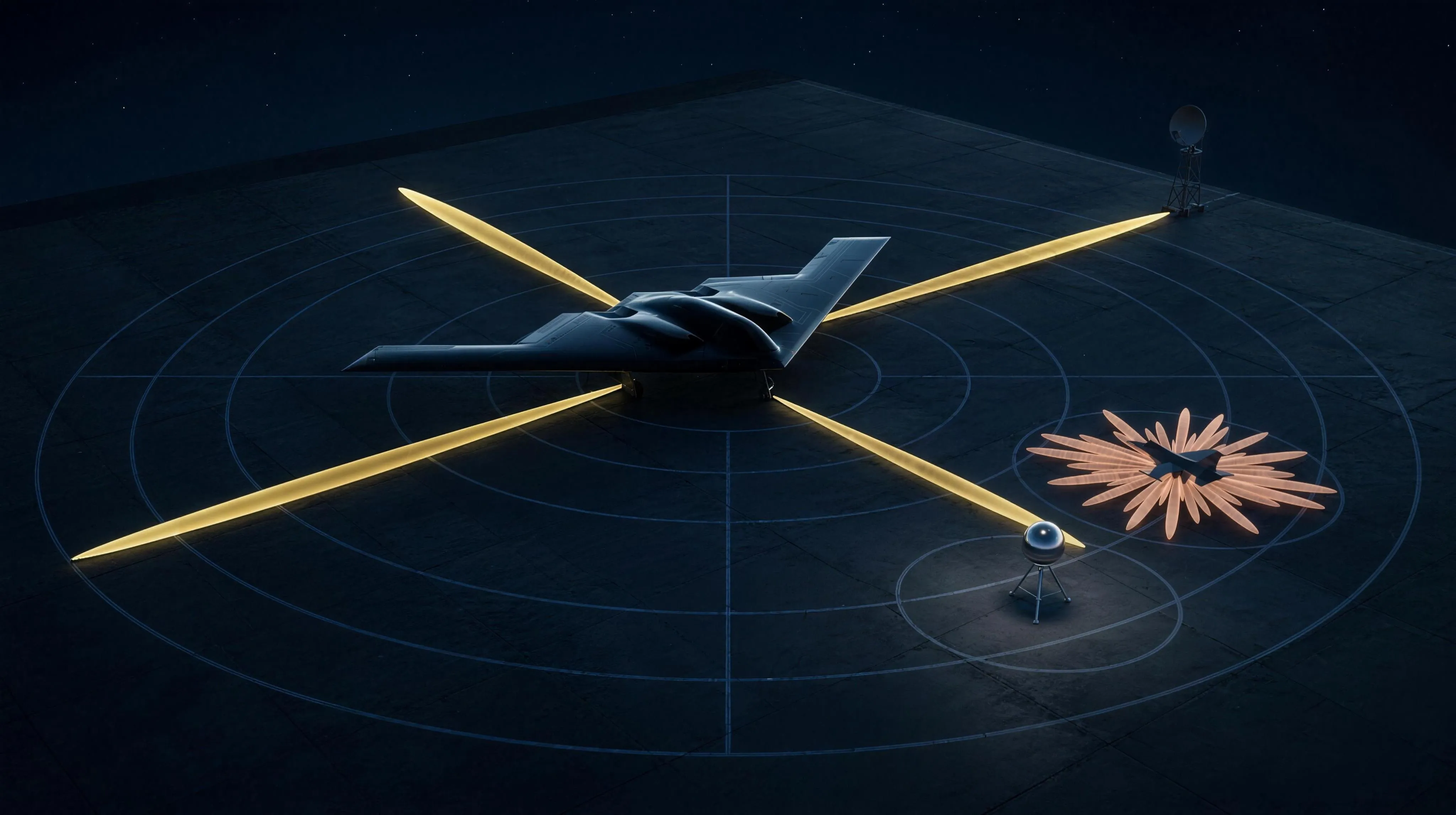
The Range view is 3D because the subject is a shape. A flying wing built from the published planform (52.4 m span, 33° sweep, a trailing-edge W with every segment parallel to a leading edge), a deliberately generic baseline fighter, and a calibration sphere stand at true metre scale on a radar range at night. The radar walks a ring around the target, and its beam is drawn at the true wavelength of the selected band: VHF arrives as two-metre swells, X band as a ripple finer than a hand. The computed azimuth pattern lies on the floor around the aircraft, and the scattering edges wear two colours because they lie in exactly two directions. Drag the radar into a gold petal and watch the readout jump four orders of magnitude.
The Rose view is the whole rotation at once: the monostatic pattern on a polar chart with twenty decibels per ring. The wing is four narrow petals on a circle of silence, about half a percent of azimuths above the 1 m² conventional-target line at X band, with a median return near minus 40 dBsm, quieter than a bird. The fighter, run through the identical solver, has no quiet sector at all. The sphere is a circle, and that boring circle is the calibration standard of the entire discipline.
The Bands view is where the shape stops working, told with two exact curves. The full Mie series for the conducting sphere shows the three regimes: Rayleigh, where small things vanish as f⁴; optical, where geometry rules and stealth was designed; and between them the resonance bump, 3.65 times the optical value at ka ≈ 1.03, where the wave rings the whole object and no facet angle matters. Beside it, the Salisbury screen: exactly silent at its tuned 10 GHz, returning 91% of the power at 1 GHz and 99.8% at 150 MHz. Both curves are the entire case for VHF counter-stealth radar, drawn without approximation.
The Ladder view is the price list. Radar cross-section on the top axis, detection range on the bottom, and the fourth-root law of the radar equation connecting them: the reference radar that sees a bomber-class 100 m² at 400 km sees 1 m² at 126 km and the insect-class end of the B-2's published estimate band at 13 km. Set any cross-section on the dial and read what it buys, and what it fails to buy: ten thousand times quieter for ten times closer, and the next factor of ten unaffordable.
The File view is the paper trail in nine cards: the 1962 paper that leaked by being published, the Hopeless Diamond, seven secret years over Nevada, the B-2 with Jack Northrop's 172-foot span, the black triangles and the Belgian wave the attribution cannot carry, the 1992 charged-edge report and its readings, the metre-wave counter-move, and Vega 31, the only combat loss of a stealth aircraft, with a VHF radar in the kill chain. It closes on two verdicts at equal size: the geometry does everything the equations promise, and the limits hold everywhere the equations say they must.
Why it's here
This instrument was called into existence by the station's own files. The Culture 11 review took apart LaViolette's Secrets of Antigravity Propulsion, and that book's flagship exhibit is the B-2: a March 1992 Aviation Week line about the aircraft electrostatically charging its exhaust and leading edges, read as an operational electrogravitic craft, complete with the closing flourish that "B-2" might better stand for Biefeld-Brown. INST-32, Electrogravitics, has already priced the Brown effect itself. What was missing is the other half: the B-2's stealth requires no exotic mechanism at all, because it is three pieces of physics that can be computed exactly in a browser. This bench puts those three pieces on the table.
It also closes a gap in the casework line: the black triangles. Seven years separate the F-117's first flight from its reveal, the B-2's gestation ran as long, and the record of those years fills with triangles: Hudson Valley, then the Belgian wave. INST-51 has already priced the "secret aircraft become UFO reports" machine for the 1950s; this bench moves the same machine into the 1980s and honestly logs what it cannot carry: the United States denied, on the record, flying over Belgium, and the strongest reports describe the one thing this shape cannot do, a low, slow, silent hover. The geometry holds and the attribution does not, and both sentences are drawn the same size.
How it works
Four exact results and one calibrated term run everything. The panel tags every number exact, measured, modelled, reported or read.
σ_plate = 4πA²/λ² · σ_edge = L²/π · σ_sphere/πa² = |Σ(-1)ⁿ(2n+1)(aₙ−bₙ)|²/x² · R = R₀(σ/σ₀)^¼
Physical optics, with no mesh. The specular return of a flat polygon is an exact closed form: Gordon's method collapses the surface phase integral to a sum over the polygon's edges, so a 500 m² wing facet costs eight edge evaluations and carries zero discretisation error. The tune script checks the plate formula to machine precision and the oblique sinc pattern against brute-force quadrature. Specular scattering is the part shaping controls, so the exact part of the model is exactly the part that matters.
Edges, calibrated once. Physical optics misses what edges re-radiate, which is the correction Ufimtsev's 1962 paper supplied and stealth engineering is built on. This bench carries edges as equivalent line currents with a single coefficient, λ/2π, fixed by requiring the textbook broadside answer σ = L²/π; the sinc-lobe width λ/L then falls out of the line integral by itself. Group every edge into two directions and the four-spike rose is no longer a design claim but a computation.
The sphere, exactly. The resonance argument is too important to trust to an approximation, so it is carried by the one target with an exact answer: the full Mie series, summed live with downward-recurrence Bessel functions, reproducing the Rayleigh limit, the optical limit, and the 3.65× peak at ka ≈ 1.03. When this bench says shape stops working near ka = 1, that sentence has no model in it.
The absorber, exactly. The Salisbury screen is solved by transmission-line theory: a 377 Ω sheet a quarter wave over metal, a shorted stub in parallel with the sheet resistance, reflection zero at the design frequency with no fitting. One decade below, the gap is electrically thin and 91% of the power reflects. Real magnetic absorbers are broader, but the detuning physics is the same, and metre waves would need coatings half a metre thick.
The fourth root, mercilessly. The radar equation's R⁴ means detection range moves as σ^¼. That one exponent is both halves of the story: it is why four orders of magnitude of shaping collapse a 400 km horizon to 13 km, and why the last factor of ten costs as much as the first three combined. The ladder draws it with real reference targets so the axis has a vocabulary.
What is deliberately not computed. Multi-bounce returns: inlet cavities, corner reflectors, surface joins. On a real conventional aircraft they raise the return substantially, so their absence favours the fighter in every comparison, and the wing's computed advantage is an understatement. The instrument prints this on its face rather than in a footnote.
The physical-optics integrals, the Mie series, the Salisbury solution and the fourth-root law are exact and auditable; the edge term is modelled with its single coefficient stated and its calibration printed; the aircraft dimensions, dates and fleet sizes are the published record; the classified RCS is carried as the open estimate band and never as a point; the Vega 31 account and the Belgian wave record are reported as documented; and what the stealth era's secrecy is entitled to explain in the sightings record is a reading, for which the bench hangs two verdicts at equal size and adds no third.
The dials that decide what happens
A shape, a band, two angles and two sliders: between them they hold the entire public argument about stealth, in both directions.
- The target: wing, fighter, sphere. The wing is the exact published planform; the fighter is a generic conventional airframe run through the identical solver; the sphere is the exact answer that calibrates everything. Switching between them is the whole comparison the word stealth implies.
- The band: VHF, L, S, X. One dial that changes no metal and changes everything. X band is where fire-control radars live and where the shaping was engineered; VHF is where metre-scale structure enters resonance and quarter-wave coatings detune. The beam in the Range view is drawn at the true wavelength so the ratio is visible, not asserted.
- Azimuth, 0° to 360°, with Walk the radar. The wing's four spikes live at 33°, 147°, 213° and 327°, each a fraction of a degree wide at X band. Walking the radar is the honest way to meet them: hours of silence, milliseconds of flash.
- Elevation, 0° to 89°. Ground radars live in the first few degrees. Push the dial up and meet the belly: at nadir the flat underside is a 536 m² mirror returning 96 dBsm in a lobe three hundredths of a degree wide. Stealth is a set of chosen aspects, not a property of matter.
- Sphere radius, 0.05 to 3 m. Slides one physical object through three regimes on the exact Mie curve, with the four band dots riding along. A 0.32 m sphere at VHF returns 3.6 times its optical value: the resonance claw-back in one number.
- Your target's σ, 10⁻⁵ to 10³ m². The ladder's dial: set any cross-section and the fourth-root law prices it against a radar that sees 100 m² at 400 km. The published B-2 estimate band sits on the axis for reference, between the insect and the bird.
The claims, as they stand
Six claims that orbit this aircraft, from the drawing board to the fringe, with who made each and where it lands once the arithmetic is done.
| A shape alone can cut radar return by orders of magnitude made by Ufimtsev 1962; Lockheed and Northrop, in aluminium | SETTLED | Settled, and computed here from first principles. Planform alignment concentrates the wing's entire azimuthal response into four spikes near 33°, 147°, 213° and 327°, each a fraction of a degree wide; about 0.5% of azimuths sit above the 1 m² line at X band against 10% for the baseline fighter, and the median return is some 25 dB lower. No exotic mechanism appears at any step. |
| Stealth is bounded by the fourth-root law made by the radar equation, rearranged | SETTLED | Settled. Detection range moves as σ^¼: the reference radar that sees a bomber at 400 km still sees an insect-class 0.0001 m² at 13 km. Ten thousand times quieter buys ten times closer, and the next factor of ten is unaffordable. |
| Low-frequency radar claws the target back made by the Mie curve; every VHF radar designer since | SETTLED | Settled in the sphere's exact physics and demonstrated in combat. Near ka = 1 the return lifts to 3.65 times the optical value and shaping stops controlling it; quarter-wave absorbers detune at the same wavelengths. The one combat loss of a stealth aircraft, Vega 31 in 1999, had a VHF P-18 in the kill chain. |
| The B-2 flies by electrogravitics made by Paul LaViolette, reading Aviation Week of 9 March 1992 | DID NOT SURVIVE | Not required by anything this bench computes, and not settled by the public record. Charge on an airframe has conventional readings (static discharge, boundary-layer and plasma effects, absorber behaviour) that the book does not weigh. INST-32 prices the physics the claim depends on; the reviewed source note is Culture 11. Four orders of magnitude of stealth need no new force. |
| The black triangles were secret aircraft made by the stealth attribution, applied to the 1980s wave reports | CONTESTED | Partly open, and failed where it can be tested. Some fraction of the era's reports were surely real aircraft that officially did not exist. But the Belgian wave fails the attribution on the record: the US denied F-117 flights over Belgium, the two flying B-2s were daylight test aircraft at Edwards, and the reported behaviour, near-stationary, silent, low, is what no air-breathing aircraft of this shape can do. |
| "Stealth" means invisible made by three decades of headlines | DID NOT SURVIVE | Did not survive the arithmetic. The reduction holds in the band it was engineered for, from the aspects it was shaped for: the belly at nadir is a 536 m² mirror returning 96 dBsm in a 0.03° lobe, the spikes flash on every revolution, resonance restores the target at metre waves, and detection range falls only as the fourth root. Radar has no word for invisible; it has bookkeeping. |
Try this
- Press Walk the radar and wait. The readout sits below a bird for most of the circle, then flashes four orders of magnitude as the dish crosses 33°. That is the entire design, felt in real time: hours of silence, milliseconds of spike.
- Toggle the edge highlight and count the colours. Eight scattering edges, two colours, because two directions. Then switch to the fighter and watch the colour discipline collapse: wings, stabs and tail all point somewhere different, and the Rose view shows what that costs.
- Switch the band from X to VHF with the wing selected. The beam in the Range view swells to two-metre waves, and the forward-sector return rises by three orders of magnitude. Same aircraft, same geometry; the only thing that changed is the question's wavelength.
- In the Rose view, read the occupancy strip. Half a percent of the circle above 1 m² for the wing, ten percent for the fighter, and a 25 dB gap between their medians. Stealth as bookkeeping, in two numbers.
- In the Bands view, drag the sphere to 0.32 m. The VHF dot climbs the resonance bump to 3.65× while the X dot stays on the optical shelf. This is the entire counter-stealth industry, expressed as one marker on one exact curve.
- Set the ladder dial to 0.0001 m². The 400 km horizon collapses to 13 km: the purchase. Then read the strip: that took four orders of magnitude, and the next factor of ten in range would take four more. The bill.
- Push elevation to 89°. The belly flash: 96 dBsm, a flashbulb visible from orbit, in a lobe no ground radar loiters in. Then remember that mission planning around known radar fences was always part of the aircraft.
- End on the File, on the Belgium card. The one wave the stealth attribution should explain best, and the record says it cannot: denials on file, two test aircraft in daylight at Edwards, and behaviour no air-breathing aircraft has. The bench leaves it open, which is what the evidence supports.
Accuracy
The honest line between what is exact, what is modelled here, what the record measures, and what is a reading:
| Feature | Tier | What that means |
|---|---|---|
| Physical optics | T1 Exact | Every flat facet's contribution is Gordon's closed-form edge sum: the phase integral over a polygon of any size collapses to a sum over its edges, with no discretisation error. The tune script checks it against the plate formula 4πA²/λ² to machine precision and against brute-force quadrature at oblique incidence. This is the specular part of scattering, which is exactly the part stealth shaping controls. |
| The Mie series | T1 Exact | The perfectly conducting sphere is the one scattering problem with an exact closed answer, which is why calibration spheres hang in every RCS chamber on Earth. The bench sums the series live with downward-recurrence Bessel functions and reproduces the Rayleigh limit 9(ka)⁴, the optical limit, and the 3.65× resonance peak at ka ≈ 1.03. The whole counter-stealth argument rides on that bump, so it is carried by the one curve nobody can argue with. |
| The Salisbury screen | T1 Exact | A 377 Ω resistive sheet a quarter wavelength above metal, solved by transmission-line theory with no approximation: reflection exactly zero at the tuned frequency, 91% of the power returned one decade below, 99.8% at 150 MHz. Real absorbers are broader-band, but they detune by the same physics, and none are a quarter wave deep at metre wavelengths. |
| The fourth-root law | T1 Exact | R = R₀(σ/σ₀)^¼ is algebra on the radar equation. It supplies both halves of the story: four orders of magnitude of RCS reduction collapse a 400 km detection range to 13 km, and the same exponent means the last factor of ten in range costs ten thousand in cross-section. |
| The edge term | T2 Modelled | Straight edges contribute as equivalent line currents with coefficient λ/2π, fixed by requiring the textbook broadside answer σ = L²/π; the sinc lobe shape falls out of the line integral. It is a calibrated stand-in for Ufimtsev's full physical theory of diffraction, and it is what makes the wing's four-spike rose and the fighter's thicket comparable under one solver. |
| The two aircraft | T2 Modelled | The wing's RCS model is the published planform (52.4 m span, 33° sweep, a trailing-edge W with every segment parallel to a leading edge) as two flat polygons and eight edges. The baseline fighter is a deliberately generic conventional airframe: an octagonal-prism fuselage, a vertical tail, three different sweeps, a nose-cavity disc. Multi-bounce returns (inlet cavities, corner reflectors) are not computed, and they would make the fighter worse, so the comparison consistently understates the wing's advantage. |
| The classified number | T3 Reported | The B-2's actual RCS has never been published. The bench carries the open estimate band, 0.0001 to 0.1 m², and never picks a point inside it. The reference targets on the ladder (insect to B-52) are the textbook order-of-magnitude conventions, labelled as such. |
| The triangles and the 1992 report | T3 Reading | What the stealth era's secrecy explains in the sightings record, what it cannot (the Belgian wave, on the record), and whether a one-line report about charged leading edges licenses an antigravity reading (INST-32 prices the physics; nothing in the public record settles the sentence). The bench draws verdicts at equal size and adds no third. |
In one line: the physical-optics facet integrals, the Mie series, the Salisbury screen and the fourth-root law are EXACT and machine-checked; the edge term is MODELLED with its one coefficient calibrated to the textbook L²/π and printed; the B-2's dimensions and dates are MEASURED public record while its actual RCS is REPORTED only as the open estimate band; the Vega 31 loss and the Belgian wave record are REPORTED as documented; and what the stealth era's secrecy explains in the sightings record, and whether one 1992 sentence about charged leading edges licenses an antigravity reading, are READINGS, for which this bench hangs two verdicts at equal size and adds no third. Walk the radar, change the wavelength, and decide for yourself.
Sources
- P. Ya. Ufimtsev, "Method of Edge Waves in the Physical Theory of Diffraction", Sovetskoe Radio, Moscow 1962; translated by the U.S. Air Force Foreign Technology Division, 1971. The origin of the edge-wave corrections to physical optics; this bench's calibrated edge-current term is a simplified descendant, and the story of the translation reaching Lockheed in 1974 (Denys Overholser, under Ben Rich) is told in Rich and Janos, "Skunk Works", 1994.
- W. B. Gordon, "Far-field approximations to the Kirchhoff-Helmholtz representations of scattered fields", IEEE Transactions on Antennas and Propagation, 1975: the exact reduction of the physical-optics integral over a planar polygon to a sum over its edges, used verbatim by this bench and by every facet-based RCS prediction code since.
- G. T. Ruck et al., "Radar Cross Section Handbook", Plenum 1970, for the perfectly conducting sphere series (the Mie solution restricted to backscatter), the Rayleigh limit 9(ka)⁴, the resonance maximum near 3.65 at ka ≈ 1, the flat-plate and straight-edge (L²/π) results, and the textbook reference RCS figures used on the ladder.
- W. W. Salisbury's 1952 patent (filed 1943) for the resistive-sheet absorber, with the standard transmission-line analysis reproduced exactly here: a 377 Ω sheet a quarter wave over metal, null at the design frequency, near-total reflection a decade below.
- Northrop Grumman B-2 public record: 52.4 m (172 ft) span, 21.0 m length, 33° leading-edge sweep, rollout Palmdale 22 November 1988, first flight 17 July 1989, twenty-one aircraft built. The YB-49's identical 172 ft span, and Jack Northrop's April 1980 viewing of the classified design, are carried in Northrop corporate histories and contemporaneous reporting. The B-2's radar cross-section is classified; open estimates spanning 0.0001 to 0.1 m² are carried as a band and never as a point.
- "B-2 exhaust stream electrostatically charged", Aviation Week & Space Technology, 9 March 1992 (sourced to unnamed West Coast scientists), and Paul LaViolette, "Secrets of Antigravity Propulsion", ch. 5, which reads that report as an operational electrogravitic aircraft. Reviewed on this station as Culture 11; the physics of the underlying Biefeld-Brown claim is priced by INST-32.
- The 27 March 1999 loss of F-117 82-0806 ("Vega 31") to the 3rd Battalion, 250th Air Defence Missile Brigade under Zoltán Dani: an S-125 (SA-3) battery whose early warning was a VHF-band P-18, operating with strict emission discipline against routes that had been repeated for several nights. Widely documented in postwar interviews with Dani and pilot Dale Zelko, including their meeting years later.
- The Belgian wave, November 1989 to spring 1990: SOBEPS documentation, the 30-31 March 1990 F-16 scramble, and the U.S. Air Force's formal denial of F-117 operations over Belgium (July 1990 embassy statement). At the time the B-2 fleet consisted of test aircraft flying daylight sorties from Edwards AFB. Related wiki entry on this station: the Belgian wave 1989-90.
- Radar band conventions and the P-18 "Spoon Rest" VHF surveillance radar (~150-170 MHz), predating stealth aircraft entirely; modern VHF AESA descendants (Nebo family and peers) exist because the resonance arithmetic never stopped being true.
- Cross-referenced instruments on this site: INST-32, Electrogravitics, for the Biefeld-Brown bench the 1992 report is usually attached to; INST-51, U-2 & OXCART, for the "secret aircraft become UFO reports" machinery a generation earlier; INST-30 and INST-34 for radar propagation and radar deception, the other two legs of how a scope can lie; and Culture 11, the reviewed source note this instrument answers.
- All constants are solved and checked in scripts/stealth-rcs-tune.mjs, which is re-runnable and prints every value the instrument is allowed to carry: the machine-precision plate checks, the Mie limits and resonance peak, the edge calibration, the Salisbury null, the wing planform closure and its two-direction edge family, the spike azimuths and occupancy fractions, the belly flash, and the fourth-root ladder.
- The 3D aircraft in the Range view: "Lowpoly B2 Spirit bomber" (skfb.ly/pKVRV) by SIpriv, licensed under Creative Commons Attribution 4.0. Modified for this instrument: the detached munitions and bay racks were removed, the legacy specular-glossiness materials were converted losslessly to metallic-roughness, and the model was scaled uniformly to the published 52.4 m span. The model is display only; the scattering solver runs on its own facet-and-edge geometry.
Walk the radar around the shape. Change the wavelength. Then read the file, and decide what a silhouette is entitled to explain.
Open the interactiveCompiled August 2026