The Reflection Bench
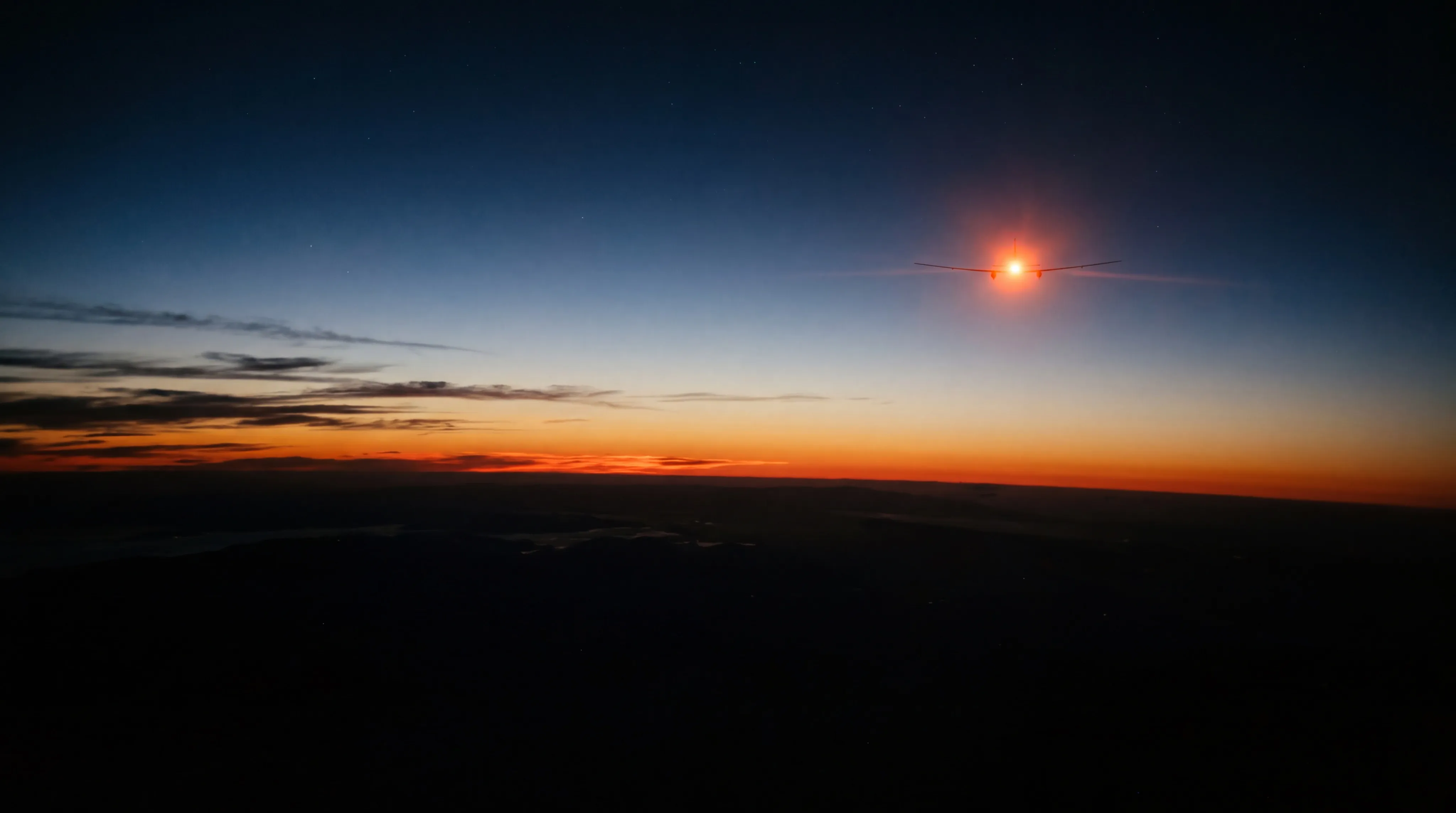
This is the only UFO explanation on the station that the file makes about itself. In a CIA history of two spy planes there is one short section that says: in the early evening the sun had already set for an airliner while a U-2 far above it was still in sunlight, its silver wings caught the sun and looked like a fiery object, and these aircraft accounted for more than one-half of all UFO reports of the late 1950s and most of the 1960s. That is two claims wearing one coat. The first is geometry and can be computed to three decimal places: a horizon dip of 4.68° at 70,000 feet against 2.51° at 20,000, a window of 2.177° that opens twice a day for about eleven minutes at American latitudes, with the refraction term cancelling out of the subtraction entirely. Inside that window a bare metal wing can flare to magnitude -10, and the light it flares in has grazed so much atmosphere that fiery is the correct word and silver is not. The second claim is not physics. It is counting, and the Air Force published the table: 12,618 reports, 8,587 of them inside the window, and more than one-half of that is 4,294 sightings. This instrument runs both, and lets them disagree.
 Open the interactive ▸
 What you're looking at
The Sky view is the moment the document describes, from the seat it puts you in. It is 3D because the subject is a piece of sky: a real 6,371 km Earth sits at the observer's true depth, so the horizon's dip and the curvature are not drawn but fall out, and the twilight above it is the three.js sky shader on an exposure ramp. Two marks hang in it, one at 40,000 ft and one at 70,000, each lit or not lit by the same test the rest of the instrument uses, evaluated at its own position. Run the evening and watch the lower one go out. The dark band rising opposite the sun is the Earth's own shadow, and it is not decoration: its elevation is searched for, per azimuth, with that same test.
The Geometry view is why. A true cross-section, five hundred kilometres wide, with the Earth's curvature drawn and the vertical stretched by a factor the figure prints. The gold line is the last ray of sunlight that clears the planet: above it is day, below it is shadow, and its height at every distance is computed rather than sketched. The dip ladder on the right prices every altitude from the ground to 85,000 ft in the same currency and shows which of them still hold the sun at this moment.
The Glint view is how bright, and for how long. Magnitude against range, on a chart that also carries Venus, Jupiter, Sirius, the full moon and the naked-eye limit, so the instrument never has to say bright. Two channels are drawn: the steady gleam of the whole airframe, and the specular flare off one panel. Between them runs a shaded band that sweeps the one quantity nobody published, surface roughness, across forty times its plausible range. A cross at 780 km marks the Iridium flare the model has to reproduce before it is allowed to describe an aircraft at all.
The Count view is Project Blue Book, 1947 to 1969, drawn whole. The shaded band is the claimed window read as generously as its wording allows, and the gold portion of every bar inside it is what more than one-half demands these aircraft caused. Under the axis runs the paint timeline, fleet by fleet, so you can watch the silver leave the fleet in the middle of the window it is supposed to explain. Event lines mark the U-2's first flight, the first overflight, Sputnik, Levelland, Powers, the A-12's first flight and the day everything went matte black.
The File view is the paper trail in nine cards, from the aircraft that should not have existed to a passage that went around the world in 2014, including the critics by name and the one objection that cuts against this bench's own conclusion. It closes on two verdicts at equal size: the mechanism is real and bigger than stated, and the count was never shown.
Why it's here
The station has already run two official-explanation instruments. INST-30, Washington 1952, hands that summer's radar returns to atmospheric ducting; INST-41, Fata Morgana, takes the same refraction physics into the visible band. This is the third, and it differs from both: those two tested explanations other people proposed for a file, and this one tests the explanation the file proposes for itself. In the briefing "The U-2 and OXCART programs", CIA-UAP-003 gives a mechanism in one section, and gives a share: more than one-half.
It earns its place because that passage stitches together two very different claims, and they deserve to be checked separately. The first is geometry: an aircraft far higher up loses the sun later than one below it. That can be computed exactly, and when you do, it comes out stronger than the document claims. The second is demography: that these aircraft caused more than half the reports of those years. That is not physics, it is counting, and the Air Force published the table. This instrument runs both to the end and lets them answer differently. It also keeps the point that cuts against its own conclusion: the missing tally may genuinely be an artefact of how Blue Book filed things rather than an absence of cases, and that objection is drawn as a card the same size as all the others.
How it works
One formula runs the window, one calibrated model runs the brightness, and the count needs no model at all. The panel tags every number exact, measured, modelled or read.
dip(h) = arccos(R / (R + h)) · Δβ = dip(h₂) − dip(h₁) = 2.177° · m = m☉ − 2.5 log₁₀(F / F☉) · F_glint = ρ_s E A / (d² (Ω☉ + πσ²))
Height buys daylight through one expression. Stand h above a sphere of radius R and your horizon is depressed by arccos(R/(R+h)), so you keep the sun until its true elevation reaches minus that angle. At 20,000 ft the number is 2.505°, at 70,000 ft it is 4.683°, and at 85,000 ft it is 5.158°. Nothing about the aircraft enters: not its speed, not its shape, not its paint. Only how high it is.
The refraction term cancels, so the window is atmosphere-free. Real sunsets carry an allowance of about 0.833° for refraction and the sun's own radius. It is the same allowance at both ends of the subtraction, so it disappears from the difference. That is worth stating plainly, because it means the width of the window, the single most important number in the mechanism, does not depend on the one thing about the sky that is hard to model.
Minutes are latitude, not geometry. The sun descends at a quarter of a degree per minute at the equator and far more slowly toward the poles, so the same 2.177° is 8.7 minutes in Panama, about 11.4 at the latitude of San Francisco, and near half an hour at 60° north in June. Integrated over a year at American latitudes the window is open for roughly 150 hours, about 1.7% of the time, twice every day.
The brightness model has to earn the right to speak. A specular reflection is easy to flatter, so before this bench describes an aircraft it is fed the published area and altitude of an Iridium main mission antenna, 1.9 m² at 780 km, and asked for the flare that thousands of people timed. It returns magnitude -8.3 against a measured -8. Only then is it allowed to say that a bare metal panel at a hundred kilometres reaches -10, brighter than anything in the sky but the sun and the moon.
The one unknown is swept, not fitted. How optically rough the skin was decides how tightly the reflected sunbeam holds together, and nobody published it. So the chart draws the whole plausible range at once, from a quarter of a degree to ten, and the conclusion does not move: every value in that band is brighter than Venus. What the roughness does change is duration, from a few seconds to a minute, which is what makes this mechanism a flash and not a lamp.
The light is red before it arrives. A beam reaching an aircraft near its own sunset has crossed a tangent path through the atmosphere with tens of times the vertical column, and Rayleigh scattering goes as the fourth power of frequency. Across the window the tangent height falls from about 15 km to zero, transmission in the blue falls from 12% to nothing, and the beam loses between half a magnitude and seven. The document says the object looked fiery. That is the physics, not the prose.
The count needs no model. Blue Book's year table is published. The claimed window read generously is 1956 to 1968, which holds 8,587 reports, so more than one-half is 4,294 sightings, about 330 a year for thirteen years. The record's largest year is 1,501 in 1952, three years before the U-2 first flew. There is no step at its introduction. 1959, at the programme's operational height, is a nine-year low. And only about half the window's reports fall in years when any of these aircraft was still bare metal.
The geometry, the lit test, the window in minutes and the annual open fraction are exact and auditable, and the Blue Book table, the airframe dimensions, the paint history and the published flight counts are the record used as it gives them, with the wing-area disagreement printed rather than smoothed. The photometry, the atmospheric reddening, the twilight limiting magnitude and the sky colour are modelled and labelled as such, and the roughness is swept because it was never published. What a mechanism that works is entitled to explain about a population nobody has ever counted is a reading, so the bench hangs two verdicts at equal size and adds no third.
The dials that decide what happens
A depression, a latitude, an altitude, a range and a surface: five sliders, and between them the whole of a claim that has been repeated for a decade without its arithmetic.
- Solar depression, -1° to 12°. The clock, in the unit the physics actually uses. Run the evening and it advances at the true rate for the chosen latitude and date, sped up so a window a dozen minutes wide plays in a dozen seconds. That speed-up is the only thing about the clock that is not real, and the panel says so.
- Latitude, 66° south to 66° north, and four dates. Together these set how many minutes a degree of depression is worth. 25° to 49° covers the contiguous United States, which is where the reports came from. Push to 60° in June and watch the window stretch past half an hour; push further and the sun stops setting at all.
- Observer altitude: ground, 20,000 ft or 40,000 ft. This is the quiet finding. From the ground the whole window sits inside civil twilight, where the steady gleam never clears the sky and only a flare carries. From 20,000 ft the sky is darker and the same object is unmissable. The document names airliner pilots, and the arithmetic says why.
- Range, 10 to 1,000 km, and bearing from the sun. Range sets brightness by the inverse square and angular size linearly; bearing sets the phase angle, and with it how much of the reflection comes your way. Line of sight from 20,000 ft to 70,000 ft reaches about 800 km, so the whole dial is geometrically available.
- Finish: bare, Sea Blue, light grey gloss, Black Velvet. The four things these aircraft actually wore, in the order they wore them. The model's small surprise is that the Air Force's anti-corrosion grey was more visible than the CIA's Sea Blue, because a high diffuse albedo beats a dark specular one.
- Surface roughness, 0.1° to 20°. The one number nobody published, and the one the glint depends on most. Sweep it and watch the conclusion refuse to move.
- US sorties per year, 100 to 10,000. Also never published, so it is a dial rather than a number. Whatever you assume, the readout prices the claim in reports per flight.
The claims, as they stand
Six claims from one paragraph of a CIA history, with who made each and where it lands once the arithmetic is done. Three are settled, one is reported but never reproduced, one does not survive the Air Force's own table, and one is the kind of claim no bench can close.
| A high aircraft stays in sunlight after the one below it does not established by CIA-UAP-003, section "U-2s, UFOs, and Operation BLUE BOOK" | SETTLED | Settled, and computable to three decimals. Horizon dip at 70,000 ft is 4.683°, at 20,000 ft it is 2.505°, and the 2.177° between them is worth about eleven minutes at American latitudes, twice a day, every day of the year. Refraction cancels in the subtraction. Nothing about this claim requires anyone to be trusted. |
| The aircraft looked like a fiery object established by the same section, describing what airliner pilots reported seeing | SETTLED | Settled, and better than the document explains. Light reaching an aircraft near its own sunset crosses a tangent path with tens of times the vertical air column, and Rayleigh scattering removes the blue first. Through the window the beam runs from orange to deep red and loses between half a magnitude and seven. The word in the file is the physically correct one, and the word the file also uses, silver, is not. |
| It was bright enough to be worth reporting established by the mechanism, priced here against a measured calibration | SETTLED | Established for the glint, marginal for the gleam. A specular reflection off a bare metal panel reaches magnitude -10 at a hundred kilometres and stays brighter than Venus across the entire plausible range of surface roughness. The diffuse gleam only reaches about -1, which twilight mostly swallows. So the mechanism delivers flashes of seconds, not a steady lamp, which matches what the file describes and constrains what it can explain. |
| Blue Book checked reports against U-2 flight logs established by CIA-UAP-003, describing Agency Project Staff support | CONTESTED | Reported, and not reproduced. The history says investigators regularly called on the Project Staff in Washington to check sightings against flight logs and that this eliminated the majority of them. The comparisons themselves have never been published, and the footnote points to a classified internal source. Nobody has shown the working, in either direction. |
| These aircraft caused more than one-half of the reports established by CIA historians Pedlow and Welzenbach, as a summary estimate | DID NOT SURVIVE | Did not survive contact with the Air Force's own table. Read generously as 1956 to 1968 the claim needs 4,294 sightings. The largest year in the entire record is 1,501 in 1952, three years before the U-2 first flew; there is no step at its introduction; 1959 was a nine-year low with the programme at its operational height; and only about half the window's reports fall in years when any of these aircraft was still bare metal, so even a perfect score in the silver years reaches one-half and not more. |
| The missing tally is proof there were no cases established by a tempting inference, and not one this bench will make | READING | Open, and the bench declines it. Blue Book filed identified sightings by cause, so an aircraft correlation would have closed as "aircraft" rather than as a separate U-2 category. The absence of a separate tally is therefore expected whether the claim is true or false, and it settles nothing on its own. What can be said is narrower and firmer: the estimate was published without its arithmetic, and the year table does not behave the way the estimate implies. |
Try this
- Press Run the evening and watch the lower mark go out. That is the entire mechanism, happening in real proportions. The high mark keeps burning for minutes afterwards, and then it goes out too, and nothing about either event is mysterious.
- Switch to the Geometry view and read the dip ladder. Every altitude, priced in the same currency. Notice that the first 20,000 ft buys more than the next 50,000, because the gain goes as the square root of height.
- Turn the roughness dial from 0.1° to 20°. The glint runs from magnitude -13 to -4, a spread of nine magnitudes, and never once falls below Venus. The one thing nobody measured turns out not to matter.
- Switch the channel to Gleam and push the range to 200 km. The steady reflection sinks below the sky's own limit. This is why the file's phrase is right about fire and wrong about silver: what carried was a flash, not a shine.
- Set the observer to Ground and compare. The window now sits entirely inside civil twilight, and the gleam never clears it. The mechanism the document describes needs you to be in the air, which is exactly who the document says was reporting.
- Change the finish to Black Velvet. Ten magnitudes vanish. Then remember the date it was adopted, late 1965, and that the claimed window runs three more years after that.
- Go to the Count view and find 1952. 1,501 reports, 303 of them unidentified, the largest year in the record. The U-2 first flew in August 1955. Then find 1959: 390 reports, a nine-year low, with the programme at its operational peak.
- Click the Sputnik line. The largest year inside the window is 1957, and its reports are concentrated in the autumn, alongside two satellite launches and the Levelland cluster. The year has a cause with a date on it, and it is not a reconnaissance aircraft.
- Read the paint strip against the shaded window. The silver leaves the fleet in the middle of the years it is supposed to explain. Even a perfect score in the years that were still bare metal reaches one-half, not more than one-half.
- End on the File view, on the card called The fair point. Blue Book filed identified sightings by cause, so a U-2 correlation would have closed as an aircraft and left no separate tally. That objection is drawn the same size as everything else, because this bench is not here to win.
Accuracy
The honest line between what is exact, what the record measures, what is modelled here, and what is a reading:
| Feature | Tier | What that means |
|---|---|---|
| The window | T1 Exact | Horizon dip is arccos(R/(R+h)) and nothing else. At 20,000 ft it is 2.51°, at 70,000 ft it is 4.68°, and the difference of 2.177° is the extra daylight the high aircraft gets. The refraction and solar-semidiameter allowance is identical at both ends and cancels in the subtraction, so the width of the window is a refraction-free number. Converting it to minutes uses exact spherical astronomy at the chosen latitude and date. |
| Which marks are lit | T1 Exact | Every mark is placed by great-circle geometry at its true altitude and ground range, and the lit test is evaluated at the mark's own position rather than the observer's, because the sun's elevation differs across a hundred kilometres of curved Earth. The Earth's shadow drawn on the anti-solar sky is searched for per azimuth with the same test. |
| Project Blue Book | T1 Measured | The Air Force fact sheet table, drawn whole: 12,618 reports and 701 unidentified across 1947 to 1969, every year at its published value. Nothing is smoothed, binned or interpolated, and the years outside the claimed window are drawn too, because the shape of the record before 1955 is part of the test. |
| The airframes and the paint | T1 Measured | Published dimensions and ceilings for the U-2A and the A-12, and the paint history fleet by fleet: CIA aircraft to Sea Blue ANA 607 in mid-1958, USAF bare metal to 1962 then light grey gloss then black in late 1964, and Black Velvet FS 35042 across everything remaining from late 1965. Wing areas are published; the side and frontal silhouettes are estimated and flagged as such. |
| Brightness | T2 Modelled | Two channels. A diffuse convex body calibrated on the standard diffuse-sphere law, and a specular facet with a Gaussian roughness lobe whose peak is capped by the sun's own angular size. The specular model is checked against a measured Iridium flare before it is used on an aircraft: 1.9 m² at 780 km returns magnitude -8.3 against a measured -8. The roughness itself was never published, so it is swept rather than fitted. |
| The colour and the loss | T2 Modelled | Rayleigh scattering along the beam's tangent path with the standard sqrt(2πR/H) enhancement, in three bands. It supplies both the dimming, which runs from half a magnitude early in the window to seven at the end, and the colour, which is why the reports say fiery and not silver. Ozone's Chappuis band is not modelled and would redden the beam further. |
| The sky | T2 Modelled | The Sky view uses the Preetham analytic model on an exposure ramp. Below about five degrees of depression the shader sun is held just above the horizon and the real depression is carried by exposure instead, because the analytic model has no meaning under the horizon. The twilight limiting magnitude is an empirical stand-in curve rather than a measurement, and the bonus for an observer above most of the air is a rounded estimate. These are the least certain numbers on the instrument and everything gated by them is marked. |
| Whether the share is right | T3 Reading | The bench can compute what more than one-half demands, show that the record has no step at the aircraft's introduction, and show that half the window falls after the silver went away. It cannot prove a negative. Blue Book filed identified sightings by cause, so U-2 correlations would have closed as "aircraft" rather than as a separate category, and the absence of a tally is not by itself a refutation. The bench draws both verdicts at the same size and adds no third. |
In one line: the horizon dip, the sunlit test, the window in minutes and the annual open fraction are EXACT and nothing in them is fitted, with the refraction term cancelling out of the subtraction; Blue Book's year table, the published dimensions and ceilings, the paint history and the flight counts are MEASURED and drawn as published, with the wing-area disagreement printed rather than resolved; the two brightness channels, the atmospheric reddening, the twilight limiting magnitude and the sky colour are MODELLED, and the specular channel is checked against a measured Iridium flare before it may describe an aircraft; the CIA passage and the objections from Friend, Maccabee, Friedman and Hastings are REPORTED as they were made; and whether a mechanism that works explains a share nobody has ever counted is a READING, for which this bench hangs two verdicts at equal size and adds no third. Run the evening, sweep the roughness, and decide for yourself.
Sources
- CIA-UAP-003, "The Central Intelligence Agency and Overhead Reconnaissance: The U-2 and OXCART Programs, 1954-1974", Gregory W. Pedlow and Donald E. Welzenbach, CIA History Staff, released 2013 and carried in PURSUE Release 03, U.S. Department of War, hosted at war.gov/ufo. The instrument is built on its section "U-2s, UFOs, and Operation BLUE BOOK": the altitude comparison between airliners and the U-2, the description of silver wings catching the sun and appearing as a fiery object, the account of Blue Book investigators checking reports against U-2 flight logs through the Agency's Project Staff, and the summary claim that U-2 and later OXCART flights accounted for more than one-half of all UFO reports during the late 1950s and most of the 1960s.
- Signals from the Periphery, Release 03 Briefing 8, "The U-2 and OXCART programs", the site's own summary of that file, including what the passage does not say: no underlying figures, no case-by-case matching, no reproduction of the flight-log comparisons, and a footnote pointing to a classified internal source.
- United States Air Force fact sheet, "Unidentified Flying Objects and Air Force Project Blue Book", for the programme's published totals and the year-by-year table used whole in the Count view: 12,618 reports collected between 1947 and 1969 of which 701 remain unidentified, with the annual figures including 1,501 in 1952, 1,006 in 1957, 390 in 1959, 1,112 in 1966 and 375 in 1968.
- Lockheed U-2 reference data for the U-2A/C: wingspan 80 ft 2 in, length 49 ft 7 in, height 13 ft, operational ceiling over 70,000 ft, and wing area published as 600 sq ft in the variant tables and as 565 sq ft elsewhere. The 6% disagreement is worth 0.06 magnitudes and is carried openly rather than resolved. First flight 1 August 1955; first Soviet overflight 4 July 1956; twenty-four overflights of the Soviet Union to 1 May 1960.
- Lockheed A-12 reference data: wingspan 55 ft 7 in, length 101 ft 7 in, wing area 1,795 sq ft, service ceiling 85,000 ft or higher, first flight 26 April 1962, thirteen aircraft built, about 2,850 test flights essentially all from Groom Lake, and twenty-nine Black Shield operational missions flown from Kadena over North Vietnam, North Korea and Laos between 31 May 1967 and 8 May 1968.
- Dragon Lady History, "Black or blue? The true colours of the U-2", for the paint timeline the Count view draws as a strip: polished natural metal or grey in the early period, CIA adoption of Sea Blue (ANA 607) in mid-1958, USAF aircraft unpainted until 1962 and then light grey gloss for corrosion protection, a hurried repaint to black in late 1964 for operations over North Vietnam, and the matte "Black Velvet" coating (FS 35042, with ferrous particles) applied across all remaining CIA and USAF aircraft in late 1965.
- The objections, as they were made: Lt Col Robert Friend, chief of Project Blue Book from 1958, quoted in 1997 as saying the programme did not notice any appreciable increase in public UFO reports following the implementation of the U-2 programme; Bruce Maccabee's comparison of report counts ten months before and ten months after the first U-2 flights, finding no statistically significant difference; and the rejections of the share by Stanton Friedman and by Robert Hastings, who argued a speck at 60,000 ft cannot account for reports of objects that manoeuvred and hovered near the ground.
- Iridium flare photometry, used here purely as a calibration: the first-generation Iridium satellites carried three flat main mission antennas of about 1.9 m² which produced predictable specular flares peaking near magnitude -8 from an orbital altitude near 780 km. The specular model on this bench returns -8.3 for those published values, and that agreement is the licence for every aircraft magnitude it reports.
- Standard astronomical and atmospheric reduction: the low-precision solar position algorithm (mean longitude, mean anomaly, ecliptic longitude and obliquity) accurate to better than 0.01 degrees, used in local apparent solar time; the 0.833 degree refraction plus solar semidiameter allowance conventional for sunset; the Rayleigh vertical optical depth of 0.0973 at 550 nm with a lambda^-4 wavelength dependence and a 7.6 km effective scale height; and the sqrt(2 pi R / H) tangent-path enhancement.
- The 1957 context the Count view marks on its axis: Sputnik 1 launched 4 October 1957 and Sputnik 2 on 3 November; the Levelland cluster of 2 and 3 November 1957, in which the Levelland police department received fifteen reports in a night including vehicle electrical failures, closed by Blue Book as ball lightning with no storm activity on record for that night.
- Cross-referenced instruments on this site: INST-30, Washington 1952, for the radar half of the largest year in the record; INST-41, Fata Morgana, for the same refraction physics in the optical band; INST-43, Project Mogul, for the other "it was ours all along" file; and INST-27 and INST-28 for the altitudes this bench borrows when it needs a reported number rather than a computed one.
- All constants are solved and checked in scripts/u2-tune.mjs, which is re-runnable and prints every value the instrument is allowed to carry, including the calibration check against the Iridium flare and the two Blue Book totals.
Run the evening. Watch the lower aircraft go out. Then count the years, and decide what a paragraph without its arithmetic is allowed to explain.
Open the interactiveCompiled August 2026