Technosignature Spectroscopy
When a planet crosses its star, a thin shell of starlight grazes its atmosphere on the way to us. The molecules in that shell absorb at their own wavelengths, so the planet appears very slightly larger in the colours its air happens to swallow, and the difference between those sizes is a chemical analysis of a world you will never visit. This is not speculative. In 2022 JWST read carbon dioxide on WASP-39b at twenty-six sigma from a single transit, along with water, sodium, carbon monoxide, a cloud deck, and the first photochemical product ever identified in another atmosphere. That is the half that works. Here is the half that does not: run the same physics on a genuinely Earth-like planet and the whole atmospheric signal falls to about fifteen parts per million per scale height, while the small active star it orbits imprints hundreds of parts per million of its own spots onto your spectrum, and that term does not average away no matter how many transits you stack. Underneath all of it sits the oldest result in the file. In 1990 Sagan pointed a real spacecraft at Earth as a control, and the chemistry proved life without ambiguity. The only thing in the entire dataset uniquely attributable to intelligence was a radio signal. This bench builds both halves, and hands you the dials.
 Open the interactive ▸
 What you're looking at
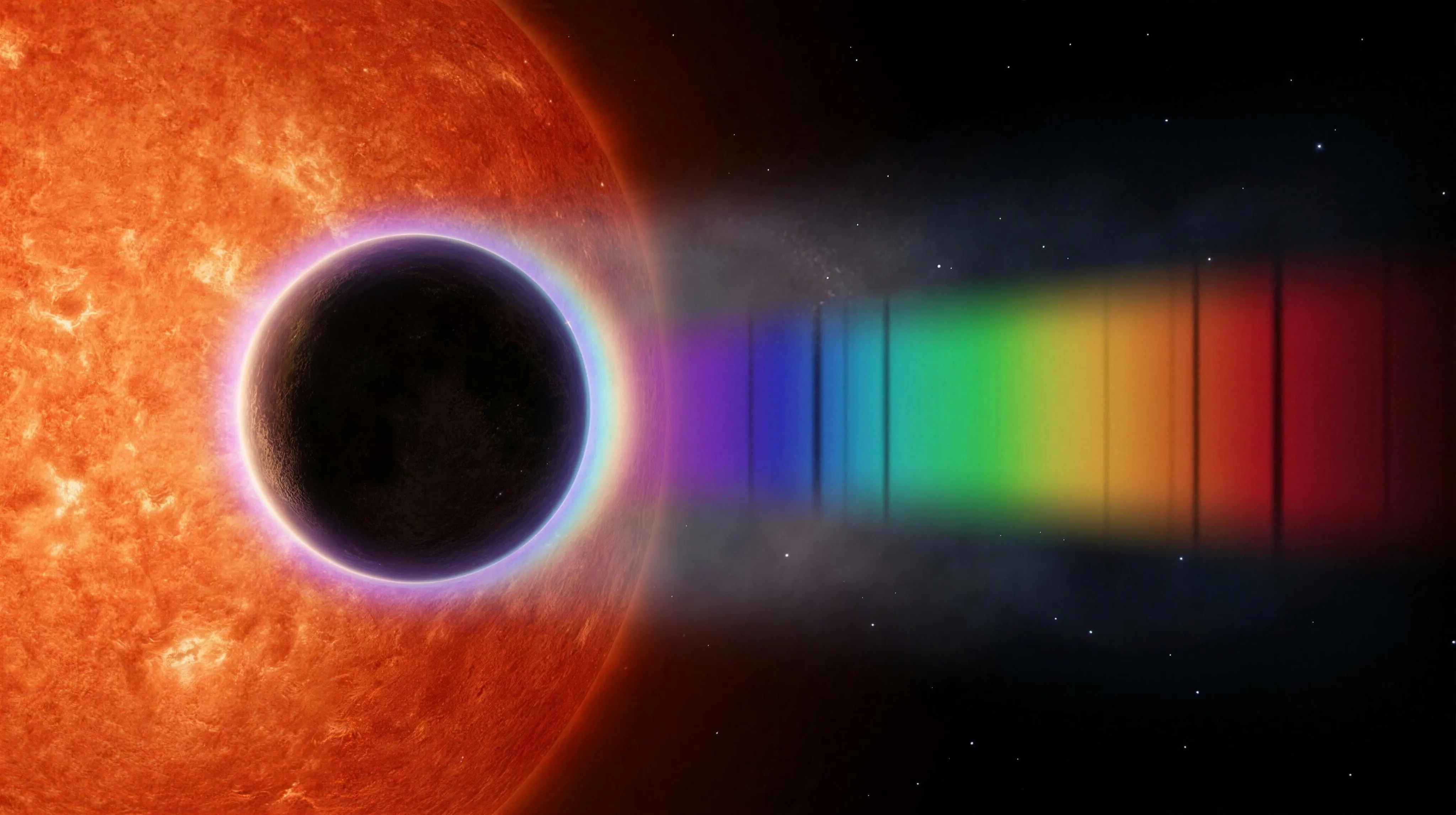
The Transit view is the geometry, and it exists to make one ratio impossible to ignore. A planet crosses its star, and around its dark disc runs a luminous ring of atmosphere drawn as the spectrum it actually is. The light curve underneath separates the two things being measured: the deep flat bottom is the planet's own disc, and the thin cyan sliver riding on top of it is five scale heights of air, the only part that carries any chemistry at all. Switch off the exaggeration and the ring nearly disappears, which is the honest picture. Switch on the star's spots and you can see the other thing in the frame that is modulating your measurement.
The Spectrum view is the instrument. Pick one of four worlds, one of six atmospheres, one of four real JWST modes and a number of transits, and read the result on a logarithmic wavelength axis from half a micron to twenty. Each gas fills in its own contribution in its own colour, the error bars are computed from a real noise budget rather than drawn for decoration, and the region outside your chosen instrument's reach is greyed out, including the physical gap between NIRSpec G395H's two detectors where nothing is recorded at all. A ladder down the right ranks every gas by signal-to-noise, live.
The Verdict view is the reasoning layer, and it is the reason this instrument exists rather than being a pretty spectrum generator. Five rungs stand between a bump in a spectrum and a claim about life: is there a signal, does it survive the data reduction, is it the planet or the star, could chemistry alone have done it, and is there anything here that chemistry cannot make. Each rung is computed from the current settings, each one shows you exactly why it passed or failed, and the noise budget beside them breaks the uncertainty into the term that improves with more observing and the two that never do.
The File view lays sixty years on a broken-scale timeline: Lovelock's 1965 proposal that life is legible as a chemical imbalance, Galileo's 1990 control experiment on Earth, the first exoplanet atmosphere in 2002, the pollution papers of 2014 to 2023, the moment it all worked on WASP-39b in 2022, and the eighteen months in which K2-18b's biosignature claim was published, amplified, and did not survive being checked. Two verdict cards hang below at equal size.
Why it's here
This station's SETI line keeps circling one question from different sides. INST-44, the Arecibo Message is the one time we transmitted. INST-25, the Dyson Swarm is the search for an entire re-engineered system in the infrared. INST-21, Tabby's Star is what happened when one real light curve was pushed, over a decade, all the way from anomaly to dust. This instrument adds the route that currently has the money, the telescope time and the best chance of actually working: not listening, and not hunting megastructures, but reading a planet's air.
There is a reason to pick it beyond fashion: it is one of the rare files where the method is proven and the goal is provably out of reach, at the same time, and both halves are computable. The proven half is not in dispute. In 2022 JWST read carbon dioxide on WASP-39b at twenty-six sigma from a single transit, and the same spectrum carried water at thirty-three sigma and a photochemical sulphur dioxide feature at 4.05 microns, the first photochemical product ever identified in another atmosphere. The unreachable half is just as clear. Put the same physics on a genuinely Earth-like planet and the signal falls to something like fifteen parts per million per scale height, while the host star's own spots imprint hundreds, and that term does not average away no matter how long you observe. This instrument does not adjudicate whether anyone will ever find a civilisation in a spectrum. It builds both halves, prints its four assumptions on the face of the machine, and hands you the dials so you can watch which rung the chain breaks on.
How it works
Two pieces of physics and one piece of bookkeeping run the whole instrument, and the panel tags every number measured, reported, modelled or read.
H = kT/µm_u·g · z(λ) = H·ln(1 + σ(λ)/σ_ref) · δ = (R_p + z)²/R_*² · σ_N² = photons²/N + floor² + star²
The geometry is unforgiving and it is just arithmetic. Transit depth is the square of the radius ratio, so an Earth in front of the Sun blocks eighty-four parts per million. The atmosphere adds an annulus, worth roughly twice the planet's radius times the height of the air over the star's radius squared. For Earth around the Sun that is about one part per million. Around TRAPPIST-1, a star an eighth the Sun's size, the same air is worth about fifteen parts per million per scale height. The star being small is the only reason any of this is possible, and everything difficult about it follows from the same fact.
Absorption enters through a logarithm, which is why nothing is ever easy. Starlight grazing the limb travels a slant path hundreds of kilometres long rather than straight down, and the altitude at which that path goes optically thick rises as the logarithm of the cross-section. A gas that absorbs a thousand times more strongly does not print a thousand times the signal; it prints about seven scale heights more. That single fact is why a pollutant at parts per trillion can compete with oxygen at twenty-one per cent, and equally why making the pollutant a hundred times more abundant barely moves the answer.
The cross-sections are solved, not asserted. This is the part of the bench worth trusting. Rather than quoting laboratory band strengths and hoping they translate, a scan inverts the model against the separately known effective altitudes of these same bands in Earth's own limb, where the answer is measured. The ladder that falls out puts the halocarbons near 10⁻¹⁸ square centimetres and oxygen's A band at 7×10⁻²⁶. That is eight orders of magnitude, it is the entire industrial-pollution argument, and it arrives here as a consequence of Earth data rather than as an assumption.
The noise budget has three terms and only one of them improves. Photon noise falls as one over the square root of the number of transits, which is the term everyone reasons about. The instrument's systematic floor does not fall at all. And stellar contamination does not either, because unocculted spots and faculae are astrophysics rather than randomness. On the four real TRAPPIST-1e visits that term measured between 134 and 376 parts per million, against a planetary signal near fifteen. When it dominates, more telescope time buys you nothing, and no amount of patience converts a non-detection into a detection.
And the whole model is pinned to one measurement. The only fitted quantity anywhere in it is WASP-39b's cloud deck, set against that planet's measured 4.3 micron carbon dioxide feature. Everything else is a consequence, which is how the checks stay honest: WASP-39b's bare transit depth comes out at 2.12 per cent against a published 2.13, its signal at 439 parts per million per scale height against a published 452, an Earth twin around the Sun at sub-ppm, and the same Earth at TRAPPIST-1e at tens. None of those four numbers was tuned.
The published parameters, the JWST detections, the Galileo retrievals and the measured contamination amplitudes are used exactly as the record gives them. The technosignature proposals, the K2-18b claim and each of its reanalyses, and CF₄'s awkward natural background are quoted rather than interpreted. Everything the bench computes on top of that is modelled from four assumptions printed on the face of the instrument, and you can move any of them and watch the answers move. What the bench refuses to do is turn a completed chain of inference into a discovery. Two cards hang at equal size, and the file stays open.
The dials that decide what happens
Four of these change the world you are looking at. Two change the telescope. One changes whether the answer is possible at all.
- The world: TRAPPIST-1e, WASP-39b, Earth around the Sun, Earth around a white dwarf. Four regimes spanning four orders of magnitude of signal. WASP-39b is where the method demonstrably works. TRAPPIST-1e is the real target that fifteen awarded JWST transits are currently pointed at. Earth around the Sun is the control that shows why nobody proposes it. The white dwarf is Lin and Loeb's scenario, where an Earth-sized planet crosses an Earth-sized star and the contrast becomes enormous, and for which no such planet has yet been found.
- The atmosphere: modern Earth, Archean Earth, abiotic oxygen, industrial, Venus-like, bare rock. Two of these are traps and they are the most instructive settings on the bench. Archean Earth is life without oxygen, which is what our own planet looked like for two billion years of its biosphere. Abiotic oxygen is oxygen without life, built by photolysis on an M dwarf, and it is why nobody serious promises oxygen as a detection.
- Seventeen molecules, each with its own abundance dial. Select any gas to see its bands, its solved cross-section, and whether that number was pinned to Earth's limb or scaled. The dial runs from parts per trillion to unity, so you can ask the question the technosignature papers ask: how much of this would there have to be before anyone could see it, and is that a plausible amount for anybody to have made.
- Four real JWST modes. NIRSpec PRISM for coverage, NIRISS SOSS for the near infrared, NIRSpec G395H for resolution, and MIRI LRS for the eight-to-twelve micron window where every halocarbon lives. Switching modes moves the wavelength window, the resolving power and the noise floor together, and G395H comes with a real hole in it where its two detectors fail to meet.
- Transits co-added, one to five hundred. The dial everyone wants to turn. Watch the error bars shrink as one over the square root, then watch them stop shrinking, and note where they stop. Then remember that only about seventeen TRAPPIST-1e transits are observable in a JWST year and the awarded campaign is fifteen.
- The star's own spots. The single most consequential switch on the instrument. Off is the assumption the optimistic papers make. On is what the four real TRAPPIST-1e visits actually measured. Flip it and watch entire detections disappear that no amount of additional observing time can bring back.
The claims, as they stand
Seven claims about reading air at a distance, with who established each and where it lands today. Three are as settled as this subject gets, two are contested by arithmetic rather than opinion, one was published and did not survive being checked, and one has been open since 1990.
| Transmission spectroscopy can read an exoplanet atmosphere established by Charbonneau et al. 2002, then the JWST ERS team in 2022 | SETTLED | Settled, and this bench reproduces it. Sodium in HD 209458b at 232 ± 57 ppm from four HST transits established the method in 2002. Twenty years later JWST read carbon dioxide on WASP-39b at twenty-six sigma from one transit, with water, sodium, carbon monoxide, a cloud deck and a photochemical product in the same spectrum. For large hot planets around bright stars this is no longer research, it is observation. |
| Oxygen and methane together are a strong biosignature established by Lovelock and Lederberg, 1965, quantified by Krissansen-Totton et al. 2018 | SETTLED | As solid as this subject gets, and sixty years old. The two gases destroy each other quickly, so their coexistence requires something replenishing both, and Earth's purely gas-phase disequilibrium of about 1.5 joules per mole is largely down to that pair. The bench treats it as the strongest available rung and still makes you clear the four rungs around it. |
| Oxygen alone can be made without life established by Luger & Barnes 2015; Wordsworth & Pierrehumbert 2014; Meadows 2017 | SETTLED | Established, and it is the reason nobody serious promises oxygen as a detection. A planet in an M dwarf's habitable zone can lose oceans to photolysis during the star's long bright youth, leaving oxygen at high partial pressure with no biology involved. The discriminants are real: the collision-induced oxygen bands at 1.06 and 1.27 microns scale as pressure squared, and a large carbon monoxide abundance points at carbon dioxide photolysis rather than life. Both are on this bench. |
| Industrial pollutants would be a decisive technosignature established by Lin, Gonzalez Abad & Loeb 2014; Haqq-Misra et al. 2022; Kopparapu et al. 2021 | CONTESTED | Contested by arithmetic rather than by opinion, and eroding in an interesting way. The physics is right: halocarbons absorb about a million times more strongly per molecule than oxygen, in a window where the rest of the atmosphere is transparent. But the reach numbers are brutal. Haqq-Misra and colleagues find Earth-level chlorofluorocarbons on TRAPPIST-1e need roughly a hundred hours of in-transit time, which is about 108 transits, and only if the noise floor is 10 ppm; at 50 ppm even five times Earth's abundance is undetectable at any integration time. And CF₄, the molecule with the strongest band, turns out to have a natural background near 34 ppt from lithospheric degassing, which is why the argument has since moved to NF₃ and SF₆. |
| The star, not the photons, is what actually stops this established by Rackham, Apai & Giampapa 2018, confirmed by Espinoza et al. 2025 | CONTESTED | Predicted, then measured, and this is the finding that reframed the field. Unocculted starspots and faculae imprint a wavelength-dependent signal that looks exactly like chemistry, and Rackham and colleagues predicted one to fifteen times the planetary signal for the TRAPPIST-1 planets. The four real TRAPPIST-1e visits landed inside that range at 134 to 376 ppm. Because it is astrophysical rather than random, it does not average down, so more telescope time buys nothing. The current campaign's answer is to observe TRAPPIST-1e beside the airless TRAPPIST-1b, and even that is threatened by flares. |
| Dimethyl sulphide was detected on K2-18b established by Madhusudhan et al. 2023 and 2025, tentatively; then four independent reanalyses | NOT SUBSTANTIATED | Did not survive, and the field is better for it. The 2025 MIRI claim sat at about three sigma. Taylor found only one binning configuration in eight recovered it. Schmidt, Luque, Welbanks and Stevenson independently found it not substantiated, with ethane and chloroethane fitting the same data, and new laboratory opacities in 2026 support a sub-Neptune without invoking it at all. Methane on that planet survived every reanalysis. Nobody behaved badly, and the correction took about eighteen months. |
| A spectrum can tell a biosphere from a civilisation established by the open question, and the one Galileo answered in the negative in 1990 | READING | Open, and unchanged in thirty-six years. Sagan's control experiment is the cleanest test ever run: point a real spacecraft at a planet known to have life. The chemistry said life without ambiguity. The only observation uniquely attributable to intelligence was a radio signal. Every technosignature molecule proposed since is an attempt to close that gap, and none of them is reachable at Earth's own abundance at any real target with any existing telescope. The bench prices the gap and does not adjudicate it. |
Try this
- Turn off the exaggeration. Transit view, and watch the glowing ring collapse to almost nothing. That sliver is the entire subject. Everything else on this bench is an argument about whether it can be separated from the noise.
- Watch it work before watching it fail. Select WASP-39b and go to the spectrum. Carbon dioxide, water and carbon monoxide are simply there, unmistakable, at significances no one argues about. The method is real. Hold on to that before you change worlds.
- Now switch to TRAPPIST-1e without touching anything else. Same air, same telescope. The features drop by a factor of about a hundred. Nothing changed except the planet got small and rocky, which is to say, interesting.
- Select oxygen and read the ladder. Twenty-one per cent of the air you are breathing, and one of the weakest absorbers in the whole table, eight orders of magnitude below the halocarbons. Abundance is doing all the work. That trade is the hinge of every technosignature argument ever made.
- Load the Archean atmosphere. The oxygen band vanishes and methane takes over. A planet that fails the oxygen test can be covered in life, and ours was, for about two billion years. Then load abiotic oxygen for the mirror image: plenty of oxygen, no methane, carbon monoxide piling up, and no biology anywhere in the story.
- Run the industrial atmosphere on TRAPPIST-1e with the star's spots switched off. Read the transits needed. Now switch the spots on. Whatever that number becomes is the honest answer, and it is the one the optimistic papers do not print.
- Open the noise budget in the Verdict view. Three numbers. Watch which one dominates as you add transits, and notice that adding more never changes it. That is the finding that reframed this field, and it was measured, not predicted.
- Select CF₄ and read its note. The strongest band in the table, a fifty-thousand-year lifetime, and a natural background of thirty-four parts per trillion from rock outgassing that was measured in thirteen-hundred-year-old ice. The cleanest technosignature argument in the literature has a floor underneath it, which is precisely why the field moved to NF₃ and SF₆.
- End at the file. Read the 1990 card and the K2-18b card next to each other. One is the cleanest experiment ever run in this subject and its answer was that chemistry cannot tell you about technology. The other is what happens when a three-sigma result meets a press office. If you leave this bench certain about anything, you are more certain than the record.
Accuracy
The honest line between what is measured, what the record reports, what is modelled here, and what is a reading:
| Feature | Tier | What that means |
|---|---|---|
| The geometry | T1 Measured | Transit depth is the square of the radius ratio and the atmospheric signal is twice the planet radius times the scale height over the stellar radius squared. Every stellar and planetary parameter here is the published value: TRAPPIST-1e from Agol et al. 2021, WASP-39b from Faedi et al. 2011 and the JWST papers. The bench reproduces WASP-39b's bare transit depth at 2.12 per cent against a published 2.13, and 439 ppm per scale height against a published 452, without being fitted to either. |
| The JWST detections | T1 Measured | Carbon dioxide at 4.3 microns in WASP-39b at 26 sigma from one transit; water at 33 sigma, sodium at 19, carbon monoxide at 7, a grey cloud deck at 21, and photochemical sulphur dioxide at 4.05 microns. These are the published significances, used as written. The carbon dioxide feature measures 1,238 to 1,327 ppm across the four independent reductions of the archived data. |
| The Galileo control | T1 Measured | Sagan et al. 1993 retrieved oxygen at a volume mixing ratio of 0.19 ± 0.05 and methane at 3 ± 1.5 parts per million from Galileo's December 1990 Earth flyby, methane being out of thermodynamic equilibrium by some 140 orders of magnitude, plus a red edge from a surface pigment matching no likely rock. The only observation the paper calls uniquely attributable to intelligence is narrow-band pulsed radio. |
| The stellar contamination | T1 Measured | The Gaussian-process amplitudes fitted to the four real TRAPPIST-1e visits came in at 134 to 376 ppm, varying visit to visit, against a planetary signal near 15 ppm per scale height. This is the measured number, not a projection, and it is the single most important quantity on the bench. |
| The cross-section ladder | T2 Modelled | Each gas's absorbing strength is SOLVED, not asserted: a scan inverts the transmission model against the separately known effective altitudes of these same bands in Earth's own limb. The result puts the halocarbons near 10⁻¹⁸ cm² against oxygen's 7×10⁻²⁶, which is the whole industrial-pollution argument arriving as a consequence of Earth data rather than an assumption. Water is deliberately excluded from that fit, because it is the one gas here that is badly not well mixed. |
| Every spectrum drawn here | T2 Modelled | The standard analytic transmission model of Lecavelier des Etangs et al. 2008, in which the altitude at which the slant path goes optically thick moves logarithmically with cross-section. The single fitted quantity in the entire model is WASP-39b's cloud deck, set against its measured carbon dioxide feature. Bands are drawn as smooth profiles rather than line by line, so this is a resolution-element picture, not a line list. |
| Every signal-to-noise and transit count | T2 Modelled | Photon noise anchored on the real four-visit TRAPPIST-1e spectrum, instrument floors from the published values, and contamination from the measured amplitudes. The bench recovers the published transit counts to within about a factor of two, which is as well as a bench like this should claim. Change any assumption and the answers move, which is the point of putting them on a dial. |
| Where a chain of inference breaks | T3 Reading | The five rungs are computed, but calling a chain complete is a judgement. The bench will say which rung failed and why. It will not convert a strong signal into a strong claim, because the last three years have mostly been a lesson in that distinction. |
| Whether this can ever work | T3 Reading | Chemistry did not separate a biosphere from a civilisation when Sagan pointed a real spacecraft at Earth in 1990, and no molecule proposed since has closed that gap at a reachable target. Whether that is a temporary engineering problem or a permanent one is a reading, and the bench hangs two cards at equal size. |
In one line: the geometry, the published stellar and planetary parameters, the JWST detections, the 1990 Galileo retrievals and the stellar contamination measured across four real TRAPPIST-1e visits are the record and simple arithmetic, auditable on the bench; the technosignature proposals, the K2-18b claim and each of its four independent reanalyses, and CF₄'s natural background are quoted and tagged REPORTED; the cross-section ladder is solved from Earth's own limb and every spectrum, signal-to-noise and transit count is MODELLED from four assumptions printed on the instrument, with the whole model pinned to a single measurement; and whether a completed chain of inference amounts to a claim about life is a reading, for which this bench hangs two cards at equal size and adds no third. Read the air, break the chain, and decide for yourself.
Sources
- Sagan, C., Thompson, W. R., Carlson, R., Gurnett, D. & Hord, C., "A search for life on Earth from the Galileo spacecraft," Nature 365, 715-721 (1993). The December 1990 Earth flyby used as a control experiment: molecular oxygen at a volume mixing ratio of 0.19 +/- 0.05, methane at 3 +/- 1.5 x 10^-6 and thus out of thermodynamic equilibrium by some 140 orders of magnitude, and a sharp red absorption edge from a widely distributed surface pigment "inconsistent with all likely rock and soil types". The only observation described as uniquely attributable to intelligence is narrow-band, pulsed, amplitude-modulated radio transmission.
- Charbonneau, D., Brown, T. M., Noyes, R. W. & Gilliland, R. L., "Detection of an Extrasolar Planet Atmosphere," ApJ 568, 377 (2002). Sodium in HD 209458b with HST/STIS over four transits: the transit is deeper inside the sodium D doublet at 589.3 nm by (2.32 +/- 0.57) x 10^-4, that is 232 +/- 57 ppm.
- The JWST Transiting Exoplanet Community Early Release Science Team, "Identification of carbon dioxide in an exoplanet atmosphere," Nature 614, 649 (2023): CO2 at 4.3 microns in WASP-39b at 26 sigma. Rustamkulov, Z. et al., Nature 614, 659 (2023), NIRSpec PRISM over 0.5-5.5 microns: H2O 33 sigma, CO2 28 sigma, Na 19 sigma, CO 7 sigma, SO2 2.7 sigma and a grey cloud deck at 21 sigma. Alderson, L. et al., Nature 614, 664 (2023), NIRSpec G395H: 221 ppm average per-bin precision at 1.46 times the photon limit. Tsai, S.-M. et al., "Photochemically produced SO2 in the atmosphere of WASP-39b," Nature 617, 483 (2023): the 4.05 micron feature, the first photochemical product identified in any exoplanet atmosphere.
- Lecavelier des Etangs, A. et al. (2008), the standard analytic transmission model used throughout this bench: the altitude at which the slant path through the limb reaches unit optical depth moves logarithmically with the absorption cross-section, because the path length is sqrt(2 pi Rp H) rather than H.
- Lin, H. W., Gonzalez Abad, G. & Loeb, A., "Detecting Industrial Pollution in the Atmospheres of Earth-like Exoplanets," ApJL 792, L7 (2014). CF4 at 7.8 microns and CCl3F at 11.8 microns around an Earth-size planet in the habitable zone of a 6000 K white dwarf at about 0.01 AU; 5 sigma at ten times present terrestrial abundance in roughly 1.2 days (CCl3F) and 1.7 days (CF4) of JWST integration.
- Haqq-Misra, J., Kopparapu, R., Fauchez, T. J., Frank, A., Wright, J. T. & Lingam, M., "Detectability of Chlorofluorocarbons in the Atmospheres of Habitable M-dwarf Planets," Planetary Science Journal 3, 60 (2022). CFC-11 at 0.225 ppb and CFC-12 at 0.515 ppb, JWST MIRI LRS, features in the 8-14 micron window: S/N >= 3 at present-Earth abundance in about 100 hours of in-transit time at an assumed 10 ppm noise floor, and undetectable at any integration time, even at five times Earth abundance, at a 50 ppm floor.
- Kopparapu, R., Arney, G., Haqq-Misra, J., Lustig-Yaeger, J. & Villanueva, G., "Nitrogen Dioxide Pollution as a Signature of Extraterrestrial Technology," ApJ 908 (2021). Present Earth-level NO2 on an Earth-like planet around a Sun-like star at 10 pc detectable at S/N ~5 within ~400 hours with a 15 m LUVOIR-like telescope over 0.2-0.7 microns, with the paper's own caveat that clouds and aerosols can reduce detectability and could mimic the feature.
- Seager, S., Petkowski, J. J., Huang, J., Zhan, Z., Ravela, S. & Bains, W., "Fully fluorinated non-carbon compounds NF3 and SF6 as ideal technosignature gases," Scientific Reports 13, 13576 (2023). The argument that Earth life produces no fully fluorinated compounds with any element, so these molecules have no biological background to subtract.
- CF4's natural background: Worton, D. R. et al. (2007) put the pre-industrial abundance at 34 +/- 1 ppt, confirmed in roughly 1300-year-old ice-core air at 34.8 +/- 0.2 ppt; the source is lithospheric degassing (Harnisch, J. & Eisenhauer, A., Geophysical Research Letters 25, 2401, 1998). The anthropogenic excess is real, but "no natural source" is false for CF4 specifically.
- Halocarbon abundances and lifetimes: NOAA Global Monitoring Laboratory global monthly means give CFC-11 peaking at 268.8 ppt in January 1993 and CFC-12 at 543.8 ppt in February 2002. Lifetimes from the SPARC reassessment: CFC-11 about 52 years, CFC-12 about 102 years, CF4 about 50,000 years.
- Rackham, B. V., Apai, D. & Giampapa, M. S., "The Transit Light Source Effect," ApJ 853, 122 (2018). Unocculted spots and faculae can alter M-dwarf transit depths by roughly 1 to 15 times the strength of the planetary features for the TRAPPIST-1 planets, and the effect is astrophysical rather than random, so it does not average down with more transits.
- Espinoza, N. et al., "JWST-TST DREAMS: NIRSpec/PRISM Transmission Spectroscopy of the Habitable Zone Planet TRAPPIST-1 e," ApJL (2025), arXiv:2509.05414: four transits observed in 2023, dominated by stellar contamination with fitted Gaussian-process amplitudes of 134-376 ppm varying visit to visit, precision about 50 ppm at R = 30 across 0.6-5 microns, cloudy H2-dominated primaries ruled out at more than 3 sigma. Glidden, A. et al., ApJL (2025), the retrieval companion: "We do not obtain strong evidence for or against an atmosphere"; pure CH4 excluded at 4.9 sigma; N2-rich atmospheres with trace CO2 and CH4 remain permitted, and so does bare rock.
- Allen, N. et al., "JWST TRAPPIST-1 e/b Program: Motivation and First Observations," AJ accepted, arXiv:2512.07695 (2025). Fifteen transits of TRAPPIST-1e observed close in time to transits of the airless TRAPPIST-1b, which crosses nearly the same chord, so that shared features can be attributed to the star; the paper reports that stellar flares break the assumption that the star does not change between transits.
- Lustig-Yaeger, J., Meadows, V. S. & Lincowski, A. P., "The Detectability and Characterization of the TRAPPIST-1 Exoplanet Atmospheres with JWST," AJ 158, 27 (2019). CO2-bearing terrestrial atmospheres detectable in fewer than ten transits for all seven planets if aerosol-free, with roughly 21 transits for a 5 sigma CO2 detection on TRAPPIST-1e under a clear sky and about 35 with clouds; the paper states that biogenic O2 and O3 will be "extremely challenging" to detect, and its noise model imposes no systematic floor and no stellar contamination.
- Agol, E. et al., Planetary Science Journal 2, 1 (2021), for the TRAPPIST-1 system: distance 40.66 ly, host M8V at 0.1192 solar radii and 2566 K; TRAPPIST-1e at 0.920 Earth radii and 0.692 Earth masses, transit depth 0.5012 per cent, transit duration 0.9293 hours. Gillon, M. et al. (2020) for the observing constraint: about 17 TRAPPIST-1e transits are observable per JWST year against the roughly 60 that occur, because of the telescope's visibility windows.
- The K2-18b sequence: Madhusudhan, N. et al., ApJL 956, L13 (2023), methane and carbon dioxide with dimethyl sulphide flagged only as tentative; Madhusudhan, N. et al., ApJL 983, L40 (2025), MIRI, DMS and/or DMDS favoured at about 3 sigma. Then the reanalyses: Taylor, J., RNAAS 9, 129 (2025), only 12.5 per cent of tested binning configurations support it; Schmidt, S. P. et al., AJ (2025), methane reproduced but DMS not substantiated; Luque, R. et al., A&A 700, A284 (2025), insufficient evidence, with other methyl-bearing species fitting equally well; Stevenson et al., AJ 170, 257 (2025), "K2-18b Does Not Meet the Standards of Evidence for Life"; and Tsai, S.-M. et al., arXiv:2603.19803 (2026), new laboratory DMS/DMDS and ethane opacities supporting a sub-Neptune scenario without invoking DMS.
- Luger, R. & Barnes, R., "Extreme Water Loss and Abiotic O2 Buildup on Planets Throughout the Habitable Zones of M Dwarfs," Astrobiology 15, 119 (2015); Wordsworth, R. & Pierrehumbert, R., ApJL 785, L20 (2014); Meadows, V. S., "Reflections on O2 as a Biosignature," Astrobiology 17, 1022 (2017). The abiotic oxygen false positive and its discriminants, including the O2-O2 collision-induced bands at 1.06 and 1.27 microns, which scale as pressure squared.
- Lovelock, J. E., "A Physical Basis for Life Detection Experiments," Nature 207, 568 (1965), and Lederberg, J., "Signs of Life: Criterion-System of Exobiology," Nature 207, 9 (1965), for the disequilibrium test; Krissansen-Totton, J., Olson, S. & Catling, D. C., Science Advances 4, eaao5747 (2018), which puts modern Earth's purely gas-phase disequilibrium at about 1.5 J/mol, largely attributable to coexisting O2 and CH4.
- Rustamkulov, Z. et al., ApJL 928, L7 (2022), for the NIRSpec PRISM instrumental noise floor, constrained in the laboratory to below 14 ppm at 3 sigma; on-sky spectra have so far been photon-limited at 50-220 ppm per bin, so no observation has yet been limited by that floor.
- The Habitable Worlds Observatory: about 6 m inscribed aperture per the Astro2020 decadal recommendation, a coronagraph contrast requirement of 1e-10, the stated goal of identifying and directly imaging about 25 potentially habitable worlds, and a launch not before the first half of the 2040s. Ground-based: Hawker, G. A. & Parry, I. R., MNRAS 484, 4855 (2019), placing an O2 detection on Proxima Centauri b within reach of the ELT in 30-70 hours by combining high-contrast imaging with high-resolution spectroscopy.
Read the air of another world. Then find the rung where the reading stops.
Open the interactiveCompiled July 2026