The Casimir Effect
In 1948 a Philips physicist asked what empty space does between two perfect mirrors and got an answer in three pages: it pushes them together. Forty-nine years later the push was measured to 5%, then 1%, then it started actuating micromachines. Read as vacuum energy, the gap between the plates holds less than nothing, the only negative energy ever pointed at in a laboratory, and the standard citation under every warp drive and held-open wormhole this site has priced. This instrument builds the bench: tighten the gap until the vacuum squeezes harder than the atmosphere, fork the thermal model the literature still fights over, and price the supply against the warp bill. It comes up sixty orders of magnitude short, and even that sliver is rationed.
 Open the interactive ▸
 What you're looking at
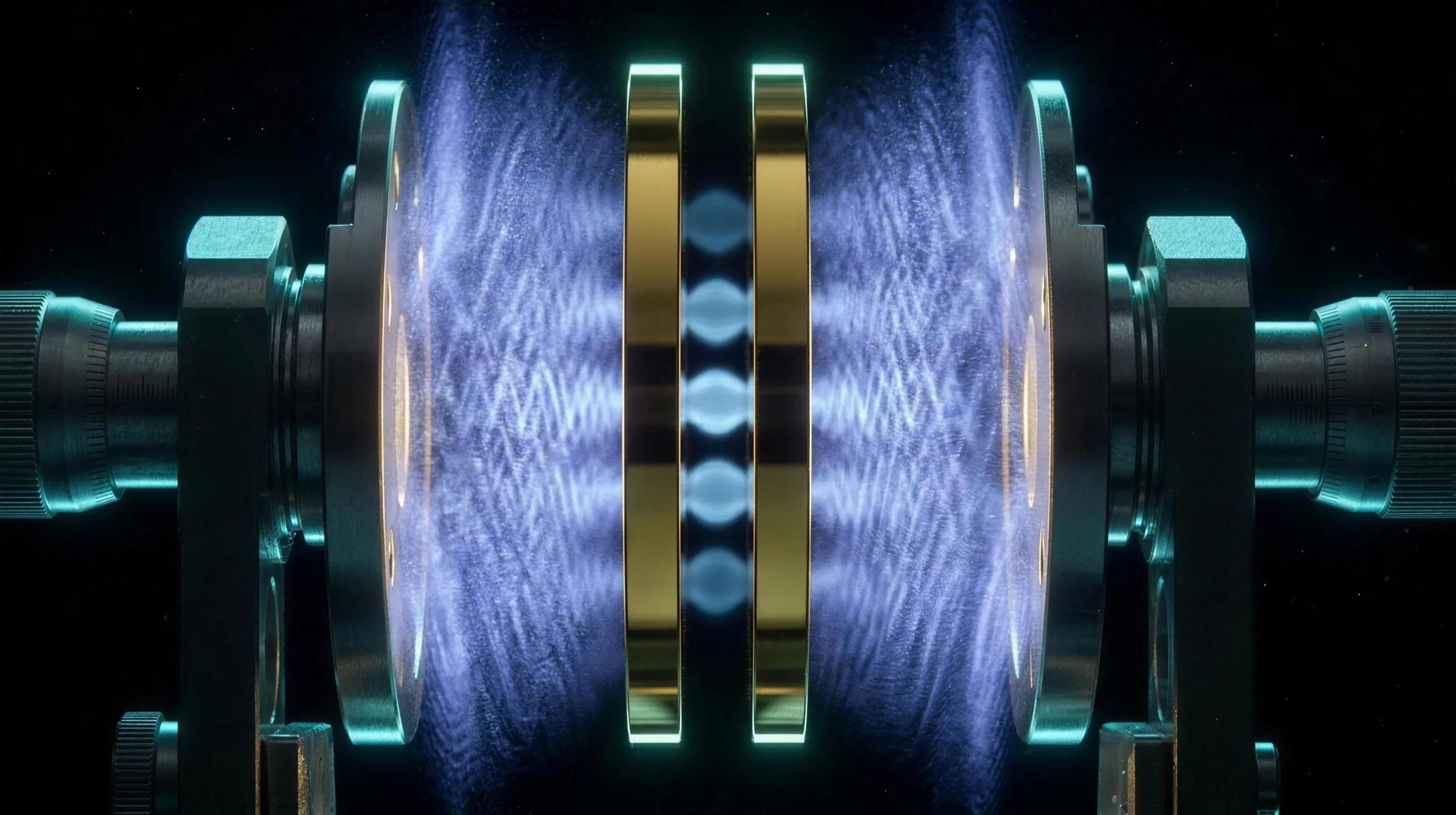
The Gap view is the bench: two gold mirrors face to face in a dark vacuum, the gap between them log-exaggerated so nanometres read at arm's length. Between the mirrors, a handful of standing waves, the only ones that fit, pinned to both surfaces like guitar strings; outside, a crowded shimmer of every wavelength the continuum allows. Tighten the separation dial and the inside waves drop out one by one while the force arrows grow by the exact fourth-power law. Switch to sphere-plate and the top mirror becomes the curved surface every modern measurement actually used.
The Modes view is the counting argument drawn honestly: discrete harmonics inside, continuum outside, and the subtraction line printed beneath: what the gap holds, minus what free vacuum holds, is a finite, negative difference, and the gradient of that deficit is the force. The view is labelled as a schematic on its face, because the real sum runs over all frequencies and angles and needs a regulator, not a cartoon.
The Curve view is the measured law: |P| against separation, log-log from 10 nm to 10 µm, with the ideal 1948 line, the gold-corrected line, and, at any temperature you dial, the thermal fork where the Drude and plasma models genuinely disagree. The four real campaigns are shaded onto the plot where they actually measured: Sparnaay's ±100%, Lamoreaux's 5%, Mohideen's 1%, Decca's sub-1%. Drag anywhere to slide your gap along the law; the one-atmosphere line is marked where the vacuum's squeeze passes it.
The Ledger view is why this instrument is on this site. Your current gap's negative energy, converted to kilograms-equivalent, takes its place on a logarithmic ladder that runs from Wilson's 2011 photon pairs up through INST-12's anchors: the serious-lab 10⁻³⁰ kg floor, White's Voyager-mass bubble, Van Den Broeck's few suns, Alcubierre's more-than-the-universe. A violet bracket spans the sixty decades between what the bench makes and what the warp wall wants, and the Ford-Roman ration is printed underneath: the more negative, the smaller and briefer it must be.
Why it's here
This site keeps writing cheques against one account: Warp Energy computes how much negative energy a warp wall costs, and the held-open throat in Wormhole stays open on the same stuff. Every time, the cheque is made out to "exotic matter", and every time the same small print follows: nobody knows where it is cashed. This instrument is the cashier's window. The Casimir effect is the one place humanity has ever produced and measured, repeatably, in a laboratory, an effect that points at negative energy: two uncharged mirrors, a gap whose vacuum holds less than the vacuum outside, and that deficit showing up as a force now confirmed to better than 1%.
It is here for a second reason too: it is the missing hinge between this site's quantum wing (Quantum Eraser and its siblings) and its propulsion wing (through to Electrogravitics). The quantum wing keeps showing that the vacuum is not empty; the propulsion wing keeps hitting the same wall marked "where does the negative energy come from". This bench joins them, and its ledger is honest to the point of cruelty: a serious laboratory configuration makes about 10⁻³⁰ kilograms-equivalent of negative energy, some sixty orders of magnitude short of a Van Den Broeck warp bubble, and the Ford-Roman quantum inequalities decree that the more negative the energy, the smaller and briefer it must be. The supply is not merely short; it is rationed. Both figures line up digit for digit with the ledger in INST-12.
How it works
One law runs the whole instrument, with two disclosed corrections and one honest blend. Every number on screen computes live from it.
P = π²ħc/240d⁴ · E/A = −π²ħc/720d³ · sphere-plate: F = 2πR·E/A(d) · gold: η = d/(d+λp), λp = 136 nm · classical limit: ζ(3)kT/4πd³ (plasma) or ½× (Drude)
The ideal law is exact and three lines long. Between perfect mirrors at zero temperature the vacuum pressure is P = π²ħc/240d⁴ and the energy per area is E/A = −π²ħc/720d³. The fourth power is the entire character of the effect: at 10 µm it is hopeless (femto-newtons on a square centimetre), at 1 µm it is measurable with heroic care (Casimir's own worked example: about a milli-pascal), and at 10 nm the extrapolated squeeze passes one atmosphere, which is why microscopic machine parts snap together.
Real gold leaks. Wavelengths shorter than gold's plasma wavelength (136 nm) are not reflected, so the shortest modes never feel the mirrors and the force falls below ideal at small gaps. The full treatment is Lifshitz theory; this bench uses the disclosed one-line stand-in η = d/(d+λp), about half strength at 136 nm and ~90% at a micron, which is the right shape and the honest size for a teaching instrument. The Curve view draws ideal and gold together so the correction is never hidden.
Heat adds real photons on top of the zero-point ones. At 300 K the crossover length sits near 4 µm; far beyond it the force goes classical, ζ(3)kT/4πd³ for a lossless (plasma-model) metal and exactly half that for a lossy (Drude-model) one. Gold is lossy, so theory says Drude; Decca's precision data prefer plasma. That factor of two has been open for twenty years, and this instrument gives it to you as a switch, with the fork drawn on the chart. The blend between the exact T=0 law and the exact classical limit is a smooth interpolation this site chose, disclosed in the panel.
The sphere is how it was really measured. Keeping two centimetre-scale plates parallel at half a micron is harder than the physics being tested, so Lamoreaux, Mohideen, Decca and Chan all curved one surface and paid a conversion instead: the proximity force approximation, F = 2πR·E/A(d), good to about d/R. The sphere presets reproduce each campaign's geometry and agreement level, and the readout says which number is a calibration and which is a test.
The negative energy is an inference, and the ledger says so. What is measured is a force on a balance. Read through the vacuum-energy framework, the measured law implies the gap holds E/A = −π²ħc/720d³: less than nothing. The instrument computes it exactly, converts it to kilograms-equivalent, and prices it against INST-12's warp anchors, and it tags every such number MODELLED, because no probe has ever read the minus sign directly. The last chapter of the story hands the microphone to Jaffe's dissent, which derives the same force with no vacuum energy at all.
The force is measured, from a 1958 shrug to a sub-1% benchmark. The laws on screen are exact where they are exact and disclosed where they approximate. The negative energy is the standard inference, printed in violet and tagged. And whether any of it proves the vacuum is a sea of zero-point energy is a reading this instrument leaves exactly where the literature leaves it: open. The bench computes; you conclude.
The six experiments on the dial
Every preset is a dated configuration from the record, including the shrug and the machine.
- Casimir 1948. The prediction itself: ideal mirrors, one micron, zero kelvin, a square centimetre. About a milli-pascal of squeeze, the weight of a few dust flecks spread over a square metre, and no way to measure it for a decade. The starting position, and the Reset target.
- Sparnaay 1958. Flat plates in the real world: dust shorting the gap, static swamping the signal, springs drifting. Errors near 100%, and the famous conclusion exactly as strong as the data: "not inconsistent". The entire experimental record for thirty-nine years.
- Lamoreaux 1997. The torsion pendulum: a gold-coated lens against a plate, 0.6 to 6 µm, and the law confirmed at the 5% level, forty-nine years after the prediction. The measurement that moved the effect from curiosity to fact.
- Mohideen 1998. A 196 µm polystyrene sphere on an AFM cantilever, 0.1 to 0.9 µm, agreement at 1%. In this range the gold correction is not optional: the ideal law alone is visibly wrong, and the data demanded the material term the panel lets you toggle.
- Decca 2003-07. A micromachined torsional oscillator, 160 to 750 nm, precision below 1%: the benchmark. Also the dataset behind the instrument's strangest dial, because his points fit the plasma model where lossy gold should follow Drude. Flip the thermal seg and watch the fork.
- Chan 2001. A sphere within ~100 nm of a MEMS see-saw, and the paddle tips with no voltage applied: the vacuum actuating a machine. Not a test of the law but a demonstration of its reality, and the reason stiction is a line item in every MEMS design review.
The readings, as they stand
Four readings of the same measured force, with who argued each and where it lands today. One leads in the textbooks, two are live open questions, and one is priced on this very bench and comes up sixty orders short.
| The zero-point reading: the plates tap the energy of empty space argued by Casimir 1948; Bohr's mumble before him; most textbooks since | LEADING | The canonical derivation and the one this instrument animates: count the modes, subtract the infinities, keep the finite difference. It predicts every measured number. Its unpaid bill: reading 2 predicts exactly the same numbers, so the data cannot yet crown it. |
| The matter reading: a relativistic van der Waals force, no vacuum energy needed argued by Lifshitz 1956; Schwinger after him; Jaffe 2005 sharpest | OPEN | Open and fully live. Derives the same force from the metals' fluctuating charges, handles real materials better (it predicted the measured repulsive case), and returns Casimir to his own starting point, since his 1948 paper began as a van der Waals calculation. If it is right, the Casimir force proves nothing about vacuum energy, and the negative-energy ledger rests on a framework choice. |
| The thermal question: which model of gold does the vacuum obey? argued by Decca's data vs Drude-model theory; the review literature since 2000 | OPEN | Open, quantitative, unresolved: dissipative gold should follow Drude, the precision data prefer plasma, and the difference is a clean factor of two in the classical limit. The one place on this bench where experiment and best-guess theory genuinely disagree, and it is a switch on the panel. |
| The propulsion reading: Casimir proves exotic matter can be engineered at scale argued by the warp and wormhole literature's hopeful footnote; parts of the UAP-propulsion genre | READING | Unpaid by about sixty orders of magnitude, and rationed besides. The effect is real, which is precisely why it is the standard citation; but Ford-Roman ties depth to briefness and smallness, and nothing measured on this bench scales. INST-12 prices the bill; this instrument prices the supply. They do not meet. |
Try this
- Feel the fourth power. Open the Curve view and drag from 10 µm down to 100 nm. Four decades of separation buy sixteen decades of pressure: the line is a cliff, not a slope. This is why the effect is invisible in daily life and unavoidable inside a microchip.
- Cross one atmosphere. In the Gap view, pull SEPARATION down toward 10 nm and watch the readout: near 10 nm the vacuum's squeeze passes 1 atm, from literally nothing between the plates. The verdict line will also tell you, honestly, that real surfaces down here are ruled by roughness and patches, and the number is the extrapolated law.
- Reproduce 1997. Load Lamoreaux and read the panel: sphere-plate geometry, the proximity-force conversion, agreement 5%. Then load Mohideen and Decca and watch the agreement tighten to 1% and below as the decades pass: a force law being nailed down in real time.
- Run the open dispute. Set temperature to 300 K, separation near 3 µm, and flip the thermal seg between Drude and plasma. Two curves fork on the chart from one dial. Theory picks Drude for lossy gold; the precision data pick plasma; nobody has closed the gap. You are looking at a live disagreement, not settled history.
- Watch the modes drop out. In the Modes view, tighten the separation slowly. Each standing wave that stops fitting deepens the deficit between inside and outside, and the deficit gradient is the force. The whole 1948 argument, in one motion of one slider.
- Price the warp dream. Open the Ledger, note where your gap sits, then find the violet bracket up to Van Den Broeck's line: about sixty orders of magnitude. Then run the story to chapter 8 and hear the counter-reading: the force is exact either way; what it proves about the vacuum is still argued.
Accuracy
The honest line between what is measured, what is modelled here, and what is a reading:
| Feature | Tier | What that means |
|---|---|---|
| The force is real, and follows the predicted law | T1 Measured | Lamoreaux's 1997 torsion pendulum confirmed Casimir's law at the 5% level; Mohideen's 1998 AFM sphere at 1%; Decca's micromachined oscillator in the 2000s below 1%. This is among the better-verified force laws in modern precision measurement, and everything this instrument computes is calibrated to it. |
| Sparnaay 1958: the first attempt | T1 Measured | Flat plates, dust, static and drift; errors comparable to the effect itself; and a conclusion exactly as strong as the data, that the observed attraction was "not inconsistent" with the prediction. For thirty-nine years that shrug was the entire experimental record. |
| Chan 2001: the vacuum actuates a machine | T1 Measured | A sphere brought within ~100 nm of a micromechanical see-saw tips it with no voltage applied: the Casimir force operating a MEMS device, published in Science. The same force snaps microscopic machine parts together, which chip designers fight under the name stiction. It is an engineering budget line now. |
| Wilson 2011: photons shaken out of the vacuum | T1 Measured | The dynamical Casimir effect: modulate a boundary at a large fraction of light speed (a SQUID-terminated microwave line standing in for a moving mirror) and real, correlated photon pairs come out of the vacuum. A detection, in Nature, of the vacuum doing work. |
| Munday 2009: the force can flip repulsive | T1 Measured | Gold and silica separated by a suitable fluid repel instead of attracting: the sign of the effect depends on the materials, exactly as the Lifshitz (matter-based) formulation predicts. A measured fact that matters for the reading question below. |
| The laws on screen, with two disclosed corrections | T2 Modelled | The exact ideal-metal results P = π²ħc/240d⁴ and E/A = −π²ħc/720d³; gold entering as η = d/(d+λp) with λp = 136 nm, a one-line stand-in for full Lifshitz theory; heat blended toward the exact classical limit ζ(3)kT/4πd³ (plasma) or half that (Drude) with a smooth interpolation this site chose. Sphere-plate data enter through the proximity-force approximation F = 2πR·E/A(d), the same conversion the real experiments used. |
| The negative energy density between the plates | T2 Modelled | No probe has ever dipped into the gap and read a negative number. The negative energy is the standard inference from the measured force law read as vacuum energy: rock-solid within that framework, and an inference all the same. The instrument prints it in violet and tags it, every time. |
| The warp gap: ~60 orders of magnitude | T2 Modelled | The Ledger's anchors are INST-12's, unchanged: a 1 cm² gap at 1 µm holds ~10⁻³⁰ kg-equivalent; a Van Den Broeck bubble wants a few solar masses of exotic matter; Alcubierre's original bill was ~10⁶⁴ kg. The bracket between what this bench makes and the smallest serious warp bill is about sixty decades, and Ford-Roman rations even the supply that exists. |
| Does the force prove vacuum zero-point energy? | T3 Reading | The textbook says yes. Jaffe (2005) showed the same force derives as the relativistic van der Waals attraction between the metals' fluctuating electrons, with zero-point energy never invoked, and Lifshitz's 1956 matter-based theory covers the measured regime including the sign flip. Identical predictions, so no measurement yet splits the two readings. This instrument shows the measured pull and leaves the metaphysics open. |
| Drude vs plasma: the unresolved factor of two | T3 Reading | Dissipative gold should thermally follow the Drude model; Decca's precision data fit the lossless plasma model instead. A factor-of-two disagreement in the thermal term, open for two decades, and honest enough that this instrument makes it a switch rather than a footnote. |
In one line: the force is measured, from Sparnaay's ±100% to Decca's sub-1%, plus Chan's machine, Wilson's photons and Munday's sign flip; the laws on screen are exact ideal results with a disclosed gold correction, a disclosed thermal blend, and the same proximity-force conversion the experiments used; the negative energy between the plates is the standard inference from that measured law, never probed directly; the sixty-order warp gap uses INST-12's own anchors; and whether any of it proves vacuum zero-point energy, and which thermal model gold obeys, are the two readings this instrument leaves open. Tighten the gap and decide for yourself.
Sources
- Casimir, H. B. G. (1948). On the attraction between two perfectly conducting plates. Proc. K. Ned. Akad. Wet. 51, 793. Three pages; the prediction this instrument is built from.
- Casimir, H. B. G., & Polder, D. (1948). The influence of retardation on the London-van der Waals forces. Phys. Rev. 73, 360. The colloid problem that started it, and the van der Waals road in.
- Sparnaay, M. J. (1958). Measurements of attractive forces between flat plates. Physica 24, 751. The first attempt: errors near 100%, "not inconsistent".
- Lifshitz, E. M. (1956). The theory of molecular attractive forces between solids. Sov. Phys. JETP 2, 73. The matter-based theory: real materials, finite temperature, and the framework the modern corrections live in.
- Lamoreaux, S. K. (1997). Demonstration of the Casimir force in the 0.6 to 6 µm range. Phys. Rev. Lett. 78, 5 (and erratum, PRL 81, 5475, 1998). The torsion-pendulum measurement, agreement at the 5% level.
- Mohideen, U., & Roy, A. (1998). Precision measurement of the Casimir force from 0.1 to 0.9 µm. Phys. Rev. Lett. 81, 4549. The AFM sphere; 1%.
- Chan, H. B., Aksyuk, V. A., Kleiman, R. N., Bishop, D. J., & Capasso, F. (2001). Quantum mechanical actuation of microelectromechanical systems by the Casimir force. Science 291, 1941. The vacuum working a machine.
- Decca, R. S., et al. (2007). Tests of new physics from precise measurements of the Casimir pressure between two gold-coated plates. Phys. Rev. D 75, 077101. The sub-1% benchmark, and the thermal data behind the Drude/plasma dispute.
- Klimchitskaya, G. L., Mohideen, U., & Mostepanenko, V. M. (2009). The Casimir force between real materials: experiment and theory. Rev. Mod. Phys. 81, 1827. The field's review, including the unresolved thermal question.
- Munday, J. N., Capasso, F., & Parsegian, V. A. (2009). Measured long-range repulsive Casimir-Lifshitz forces. Nature 457, 170. The sign flip in fluid, as Lifshitz theory predicts.
- Wilson, C. M., et al. (2011). Observation of the dynamical Casimir effect in a superconducting circuit. Nature 479, 376. Photon pairs out of the modulated vacuum.
- Ford, L. H., & Roman, T. A. (1995). Averaged energy conditions and quantum inequalities. Phys. Rev. D 51, 4277. The rationing law: how negative, for how long, over how much space.
- Jaffe, R. L. (2005). Casimir effect and the quantum vacuum. Phys. Rev. D 72, 021301(R). The counter-reading: the force without zero-point energy.