Wormhole
Two wormholes both solve Einstein's equations: one pinches shut before light can cross, the other stays open only on negative energy no one can make.
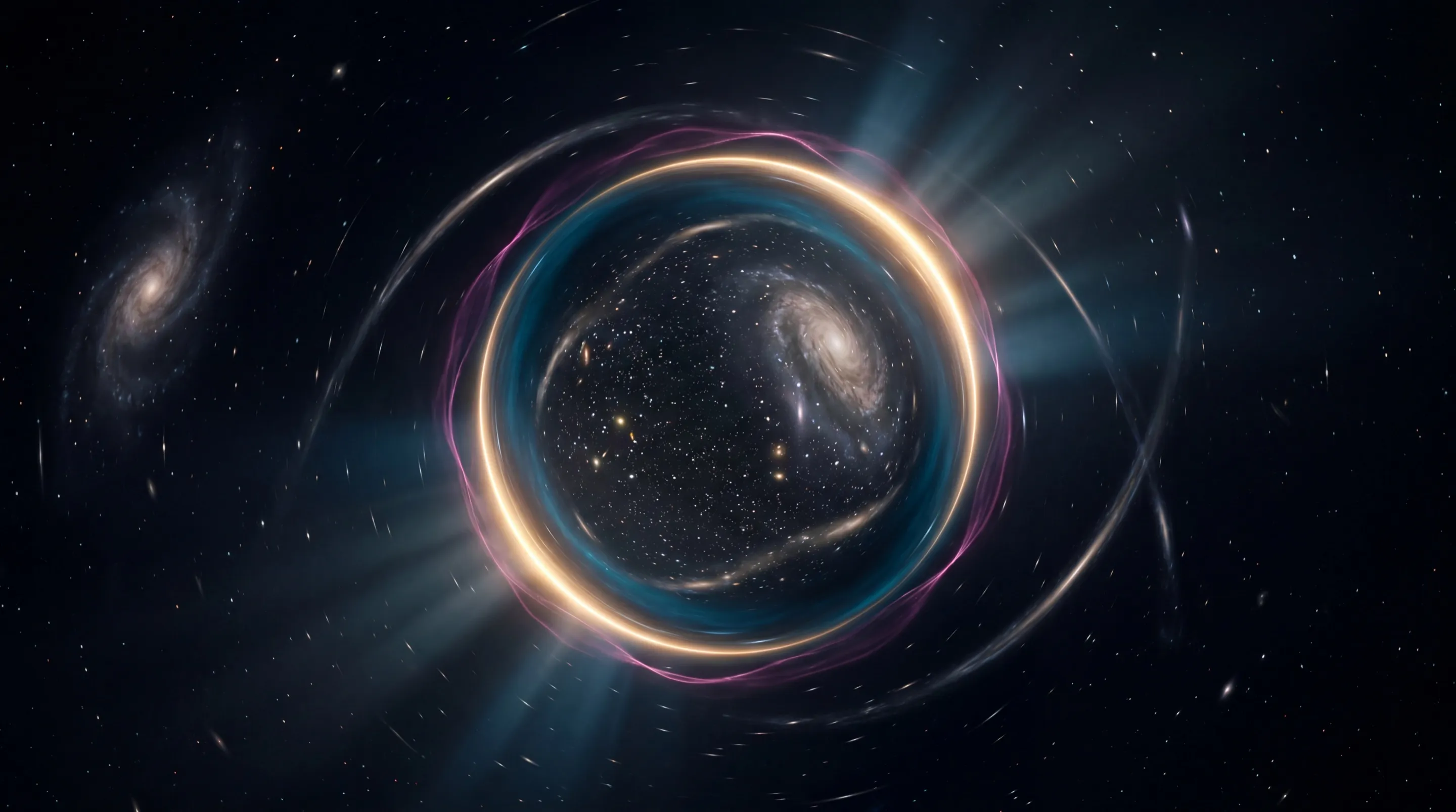 Open the interactive ▸
 What you're looking at
A tilted, slowly auto-rotating embedding funnel with a throat at its waist: take the flat sheet of space around the throat and let its curvature push it out of the page into a third direction. That extra height isn't a real dimension you could fall into; it's a way to see how stretched the geometry is. Real space has no funnel poking out of it; what is real is the throat, a region where the distance around a circle stops shrinking as you head inward and starts growing again.
The upper funnel (near) and the lower funnel (far) are two regions, two different places or even two universes, that meet only at the throat. A glowing traveller scrubs down one, through the narrow waist, and (if the geometry allows) out the far side. A view-through-the-throat inset shows the difference between a lensed window (traversable) and a black horizon disk (a black hole).
You can switch between four models, drag the throat radius (it drives the tidal stretch and the negative energy required), push the traveller through, toggle the spacetime grid, far side, exotic-matter ring, view-through and auto-rotation, flip on a live formula and on-canvas labels, or take a 🎬 guided tour through the whole physics.
Why it's here
The rest of the site keeps circling two ways to bend spacetime, named in The Bubble: extreme mass and extreme speed. The wormhole is the mass route pushed to its limit: "a black hole is half a wormhole." It shares the throat geometry with Black Hole, and the same exact general relativity, written down since 1916, as Gravitational Waves.
It also meets the speed route at one place: the same negative-energy bill. A traversable throat, like a warp bubble, needs exotic matter that violates the null energy condition, the same wall as The Warp Energy Problem, raised for a throat instead of a bubble. The geometry itself is settled, textbook general relativity; only whether you can gather enough exotic matter is the genuinely open question.
How it works
Two functions set everything. The metric is ds² = −e2Φ(ℓ)c²dt² + dℓ² + r(ℓ)²dΩ². The shape function b(r) bends space into the throat; the redshift function Φ(r) governs time and gravity. A throat exists where r reaches a minimum r₀; it is traversable only if Φ stays finite (so there is no horizon) and the throat obeys the flaring-out condition b′(r₀) < 1: the funnel must widen as you leave the waist. The example on screen, r(ℓ)=√(r₀²+ℓ²) with Φ=0, is the simplest such tunnel: the zero-tidal-force Ellis wormhole.
The Einstein–Rosen bridge (1935). Einstein and Rosen noticed the Schwarzschild solution, the geometry of a black hole, can be extended into two exterior sheets joined at the throat. It is exact, textbook general relativity. But it is a fraud as a doorway: in the fully extended (Kruskal) picture the bridge is dynamic. It grows from zero, reaches its widest, and pinches back to zero. Fuller and Wheeler (1962) showed the pinch-off is so quick that not even a light ray can cross before the throat closes and crushes it at the singularity. The bridge is non-traversable.
The Morris–Thorne tunnel (1988). It began with a phone call from Carl Sagan, who wanted a scientifically respectable way to move his heroine across the galaxy in Contact. Thorne's student Mike Morris ran Einstein's equations backwards: instead of choosing matter and solving for the geometry, they chose a geometry, a throat with no horizon, finite tidal forces, a traveller-friendly tunnel, and asked what matter it would take to hold it open. The answer was unavoidable: to make the throat flare out, the stress–energy there must violate the null energy condition: it needs exotic matter.
Does exotic matter exist? A little. The Casimir effect, two mirrors in vacuum, produces a region of genuinely negative energy density, and squeezed quantum states do the same. But quantum inequalities (Ford–Roman) sharply limit how much you can gather and for how long: borrow a lot and you must pay it back fast. No one knows a way to assemble enough, at the scale and stability a macroscopic wormhole needs.
The time-machine twist. In the same year, 1988, Morris, Thorne and Yurtsever showed how to turn a wormhole into a time machine: take one mouth on a near-light-speed round trip so its clock lags the other's, and the throat now links two different times: a loop into the past. That a shortcut through space is almost automatically a shortcut through time is why physicists take the exotic-matter barrier so seriously. Hawking's 1992 chronology protection conjecture guesses that nature quietly forbids it, unproven either way.
The geometry on screen is real general relativity: both wormholes are genuine solutions of Einstein's equations, and the throat, the two sheets and the flaring waist are drawn from their actual metrics. The liberties are all about display: the funnel is an embedding aid, the throat radius is dialled to human scale, and the playback is slowed. The one thing this visualisation never softens is the verdict: the bridge pinches shut, and the tunnel needs matter no one has ever made.
The four models
- Einstein–Rosen bridge · 1935: two sheets of spacetime joined through a Schwarzschild throat. But the bridge is dynamic: it opens and pinches off so fast that not even light can cross (Fuller & Wheeler, 1962). Drag or play and the throat pinches to zero, the traveller is trapped; verdict non-traversable.
- Morris–Thorne tunnel · 1988: a throat with no horizon that a human could cross, if it is propped open by exotic matter with negative energy. The throat stays open with the magenta exotic ring lit, the traveller crosses fully; verdict traversable.
- Schwarzschild throat: a single funnel with a black horizon disk. The traveller falls to the throat and stops ("fell through the horizon"); verdict non-traversable. A black hole is half a wormhole.
- Shortcut: a folded two-sheet schematic with the two mouths side by side, the "long way" versus the "short way"; verdict schematic.
Accuracy
The honest line between what is exact and what is stylised:
| Feature | Tier | What that means |
|---|---|---|
| Embedding profiles: Ellis throat r(ℓ)=√(r₀²+ℓ²); Flamm paraboloid z=2√(r₀(r−r₀)) | T1 Established | Exact embeddings of the spatial geometry of the Morris–Thorne and Schwarzschild solutions. Sets the shape of every funnel on screen. |
| The Einstein–Rosen bridge is a solution of GR | T1 Established | The maximally extended Schwarzschild geometry (Kruskal), two exterior sheets joined at a throat, exact since 1935. |
| The bridge pinches off before light can cross → non-traversable | T1 Established | The dynamic throat of Kruskal spacetime (Fuller & Wheeler, 1962). A real, rigorous result, not an artistic choice. |
| A traversable throat requires exotic matter (null energy condition violated) | T1 Established | A theorem: the flaring-out condition at the throat forces ρc² + pᵣ < 0 there. Morris & Thorne, 1988. |
| Tidal force ∝ 1/r₀²; no horizon ⇒ redshift stays finite (Morris–Thorne) | T1 Established | Direct from the metric. A wide throat is gentle; a horizon-free throat has no infinite-redshift surface to trap you. |
| On-canvas labels and the live metric/formula box | T1 Established | They name the real parts of the geometry and print the actual metric for the chosen model; only the funnel they annotate is an embedding aid (below). |
| Whether exotic matter exists in the amount/stability a macroscopic wormhole needs | T2 Theoretical | Casimir & squeezed states give tiny, real negative energy; quantum inequalities limit it. No known route to enough, at scale. Genuinely unsettled. |
| Wormhole as a time machine; chronology protection | T2 Theoretical | Moving one mouth relativistically would create closed timelike curves. Hawking conjectured quantum effects forbid it, though unproven. |
| Real-scale figures: negative energy ≈ planet→galaxy mass; tidal across 2 m; Casimir ≈ 10⁻⁴ J/m³, ~40+ orders short | T3 Stylised | Order-of-magnitude estimates (|E|≈(c²/G)·b₀, tidal≈c²/b₀²). Exact prefactors depend on the shape & redshift functions; the scales and the Casimir gap are robust. |
| View-through-the-throat lensing window | T3 Stylised | The far region really would appear as a round, lensed disk (and a black hole as a dark one); the inset sketches that, it is not a ray-traced image. |
| The funnel as a 3-D surface; rotation; flowing grid; the "fold/shortcut" picture | T4 Illustrative | Space is not literally a surface in a higher dimension. The funnel faithfully shows the intrinsic curvature; the extra height, the spin and the folded sheet are drawing aids. |
| Throat radius set to human scale; slowed playback / "travel time" | T4 Illustrative | Dialled so the throat and the crossing are visible. The real sizes and timescales depend entirely on the (unknown) source. |
In one line: the geometry, the pinch-off and the exotic-matter requirement are exact, established physics; only the funnel picture, the throat size and the playback speed are dialled up so you can see what the equations are saying.
Sources
- Flamm, L. (1916). Beiträge zur Einsteinschen Gravitationstheorie. Physikalische Zeitschrift 17, 448. The paraboloid embedding of the Schwarzschild geometry, the original funnel.
- Einstein, A., & Rosen, N. (1935). The Particle Problem in the General Theory of Relativity. Phys. Rev. 48, 73. The bridge between two sheets of spacetime.
- Misner, C. W., & Wheeler, J. A. (1957). Classical Physics as Geometry. Annals of Physics 2, 525. Coins "wormhole"; the geometrodynamics programme.
- Fuller, R. W., & Wheeler, J. A. (1962). Causality and Multiply Connected Space-Time. Phys. Rev. 128, 919. The Einstein–Rosen bridge pinches off before light can cross.
- Morris, M. S., & Thorne, K. S. (1988). Wormholes in spacetime and their use for interstellar travel. Am. J. Phys. 56, 395. The traversable tunnel and the exotic-matter theorem.
- Morris, M. S., Thorne, K. S., & Yurtsever, U. (1988). Wormholes, Time Machines, and the Weak Energy Condition. Phys. Rev. Lett. 61, 1446. Turning a wormhole into a time machine.
- Casimir, H. B. G. (1948). On the attraction between two perfectly conducting plates. Proc. K. Ned. Akad. Wet. 51, 793. Real, measurable negative energy density.
- Ford, L. H., & Roman, T. A. (1995). Averaged energy conditions and quantum inequalities. Phys. Rev. D 51, 4277. Limits on how much negative energy you can gather, and for how long.
- Hawking, S. W. (1992). Chronology protection conjecture. Phys. Rev. D 46, 603. Why nature may forbid the time machine.
- Visser, M. (1995). Lorentzian Wormholes: From Einstein to Hawking. AIP Press. The standard reference on the whole subject.
- Thorne, K. S. (1994). Black Holes and Time Warps: Einstein's Outrageous Legacy. W. W. Norton. The Contact phone call and the popular account.