The Corso Ledger
In the summer of 1961, the story goes, two enlisted men carried an old combination-locked file cabinet into a Pentagon office, and inside it was Roswell: silicon wafers, glass filaments, a cloth that would not crease, a stubby flashlight that cut metal. The Day After Roswell (1997) claims the technologies of the late twentieth century were seeded from that cabinet. This bench takes the book's own harvest list, fourteen items, printed on pages 125-126, and runs every row against two clocks. Clock one is the crash: July 8, 1947. Every documented chain crosses it going backwards: the laser's to 1917, the transistor's to 1926, fibre optics' to 1841; night vision was killing at night on Okinawa 27 months before the debris field existed. Clock two is the desk: the service record released a month after publication grants Corso 393 days at Foreign Technology, 91 of them in charge, against the book's opening 'two incredible years'. Three of the claimed harvest's key inventions were finished before that desk opened; one reached orbit nine days after he sat down. The bench also prices what favours the book: a fibre-optics forecast that lands on the honest year, and a control experiment, Ufimtsev's stealth mathematics, translated by the real Foreign Technology Division in 1971 and flying by 1977, proving the mechanism works, and that when it runs, it leaves receipts. Drag the crash line: to out-run this book's own list, the crash must precede 1841. The bench computes all of it and votes on none of it.
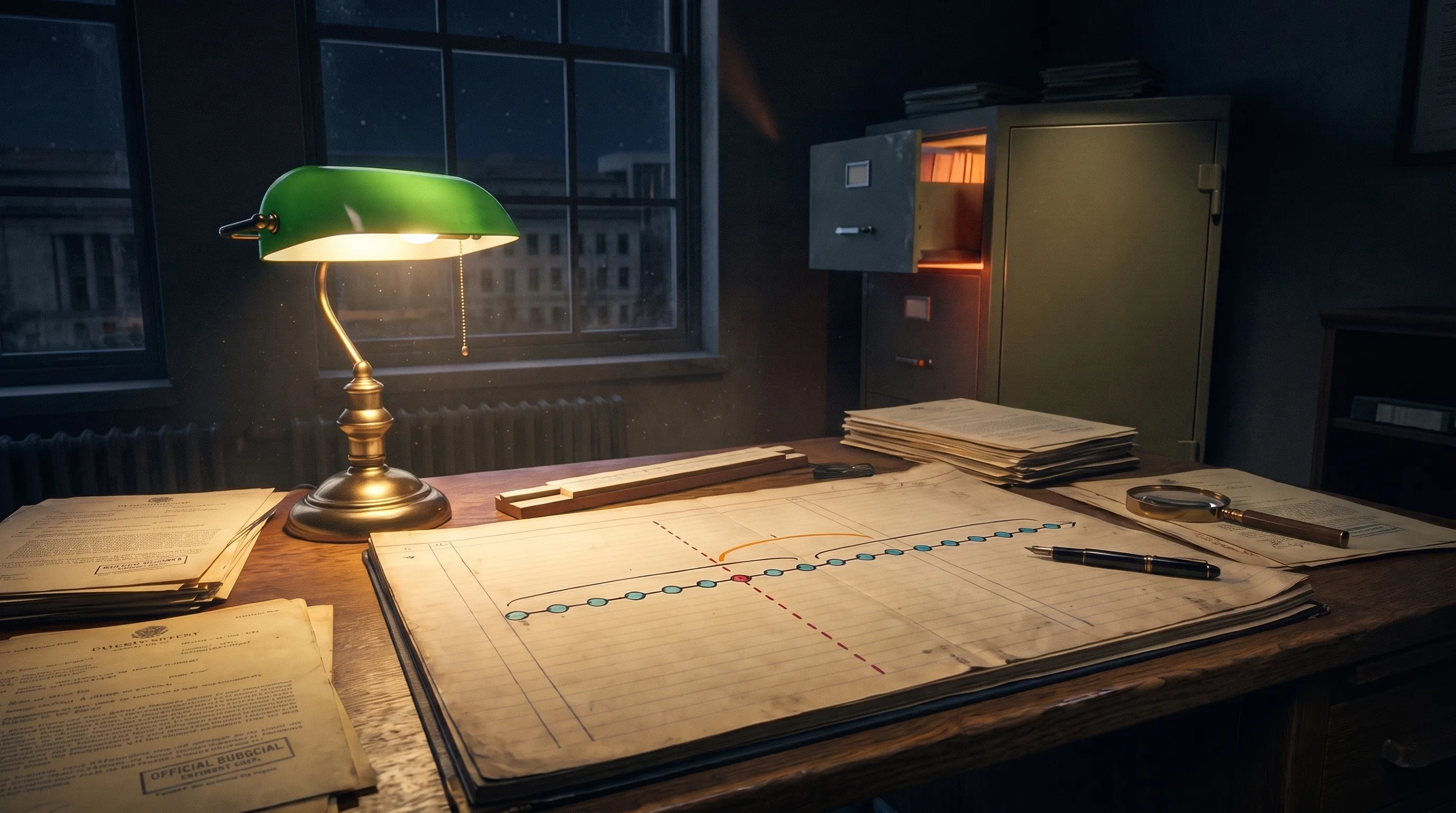 Open the interactive ▸
 What you're looking at
The Genealogy draws one row's documented chain on a timeline: person, date, artifact, citation at every node, the designated pre-1947 anchor ringed, the crash line in red, the desk window in violet. A toggle overlays the book's amber arrow, the claimed seeding, over the record, and the mismatch is the exhibit.
The Ledger hangs all fourteen rows on one axis, anchors as dots, chains as bars, claim-termini as diamonds, with the crash line on a drag. At the real date, twelve of twelve anchored rows were already under way; the readout tracks the count as you drag, and the last chain falls at 1841.
The Desk lays the book's "two incredible years" over DA Form 66: 393 days, 91 as chief, retirement in March 1963. Below it, the eleven priced termini sort themselves against the real window: three before, one nine days in, seven after he left.
The File runs fourteen cards: the cabinet's two arrival dates, the patent laundry, the seven grep silences, the laser's misplaced geography, the book's own concessions, the forecast that lands, the Ufimtsev control, the empty headband row, and what would count. Two verdicts hang below at equal size.
Why it's here
The station's source note on The Day After Roswell lays out the 1997 bestseller's claims and their external audit: Corso's account of heading the Foreign Technology desk at Army R&D in 1961-62, custodian of a cabinet of Roswell artifacts, farming them out under a foreign-technology cover to Bell Labs, DuPont and Hughes, and growing the transistor, the integrated circuit, fibre optics, the laser, night vision and Kevlar from them. The note checks the sentences that can be checked; this bench does what a note cannot: it puts the whole claim on a workbench. The fourteen-item harvest list of chapter 8, pp. 125-126, is taken at its word, each item paired with its documented invention chain, people, dates, patent numbers, journal references, and run against two clocks: the crash, July 8, 1947, and the desk DA Form 66 actually grants, June 20, 1961 to July 18, 1962.
The method follows the fiction-pricing line of INST-12 The Warp Energy Problem, INST-17 The Rendering Engine and INST-59 The Mothership Ledger: do not argue with the claim; price it. Here the currency is dates. As ever, the answer is not presupposed: Kohler's thirty-year fibre forecast is credited as landing on honest arithmetic, and the stealth row's control experiment, Ufimtsev's mathematics translated by the real Foreign Technology Division and flown as Have Blue, shows the book's mechanism genuinely works; while every chain's anchor predates the debris, three of the key inventions predate the desk, and one atomic generator reached orbit nine days after he sat down. Two verdicts hang at equal size in the file, and the dials are yours.
How it works
Everything on the bench is date arithmetic on cited records: patent filings, journal issues, programme files, one FOIA service record, and the book's own sentences with their page numbers. There are no fitted constants anywhere. A script that ships with the site re-derives every displayed number before the build is allowed to pass.
anchor lead = 1947-07-08 − anchor · desk gap = terminus − 1961-06-20 · census: {before, inside, after} · dial: count(anchor < crash)
Each row gets one designated anchor, and the choice is stated. Not the earliest conceivable precedent but the most defensible citable milestone the later invention demonstrably built on: Einstein's 1917 stimulated-emission paper for the laser, Lilienfeld's 1926 patent filing for the transistor, Carothers' 1935 nylon for Kevlar. Where a row has no referent at all, the headbands, electromagnetic propulsion, the bench prints an empty row rather than inventing a lineage.
The desk clock uses the record's window, not the book's. DA Form 66 grants June 20, 1961 to July 18, 1962. Kilby's IC (September 1958), Noyce's filing (July 1959) and Maiman's laser (May 1960) all predate it; Kwolek's Kevlar chemistry (1965), Kao's fibre paper (1966) and the stealth translation (1971) all postdate the retirement. The census, three before, one inside, seven after, is the desk verdict in one line.
The bench prices the book's favour as carefully as its debit. Kohler's thirty-year fibre forecast is credited as landing (1962 + 30 = 1992, the year fibre held the long-haul majority), against the standard rebuttal that aims at Corning 1970 and misses. And the stealth row is drawn as a control experiment: the book's exact mechanism, foreign document, Foreign Technology translation, contractor, black aircraft, demonstrably ran between 1962 and 1977, in the open, from a Soviet source.
The unfalsifiability is printed, not hidden. The book's mechanism is designed so that success is indistinguishable from the documented record: 'the history of the patent is the history of the invention.' The bench accepts this on a card, prices everything that leaves paper, and lets the two readings hang at equal size, because a claim built to survive a clean record can neither be killed nor fed by one.
What survives every dial is worth stating: every documented chain predates the crash, the crash-to-transistor interval is 161 days against a research group eighteen months older than the debris, the desk window holds 91 days of command against two claimed years, and the one watchable run of the claimed mechanism left a complete public paper trail. What also survives: one forecast that lands, and a mechanism that genuinely exists. Whether an invisible second seeding ran behind the visible record is the reading the bench leaves to you.
The dials that decide what happens
One row selector, one overlay, one draggable crash line, one sort. Between them they let the book's claim and the documented record occupy the same axes, which is the exhibit.
- The row. Fourteen items, the book's own list in the book's own order: eleven priced chains, one 1959 study, one empty referent, and the headband: a beginning with no end.
- The book's arrow. The claimed seeding drawn in amber over the cyan record: from the crash, through the desk, to the milestone the claim must explain. Toggle it off and the chain stands alone; toggle it on and the two histories argue in one frame.
- Labels. Names and dates on every node, or clean dots for the shape of the chain.
- The crash line. Drag it backwards from 1947 and watch the count of already-documented chains fall, one anchor at a time, until the last, fibre optics, falls at 1841.
- The sort. Book order, or oldest anchor first: the second ordering turns the ledger into a staircase descending into the nineteenth century.
The claims, as they stand
Six claims that carry the book's technology thesis, from its first sentence to its patent-laundry defence, with where each lands against the dated record.
| The seeds of lasers, integrated circuitry, fibre optics, particle beams and Kevlar were found in the Roswell crash proposed by Corso & Birnes, p.4, verbatim | REFUTED | Refuted in every dated implication: all twelve anchored rows carry documented milestones before July 1947, the last anchor standing in 1841. The transistor amplified 161 days after the debris inside a group chartered eighteen months before it; the IC, the laser and night vision were finished or fielded before the desk opened. |
| "For two incredible years ... heading up the Foreign Technology desk" proposed by the book's first sentence, p.1 | REFUTED | Refuted by DA Form 66, released the month after publication: 393 days as staff officer, 91 as chief, retired March 1963. Trudeau, the general the story runs through, retired in 1962. |
| Night vision was "the first project we actually seeded" proposed by Corso, p.147 | REFUTED | Refuted as a causal necessity: image-converter scopes were in combat 27 months before the debris, and the AN/PVS-2's lineage runs through Philips 1934 and Fort Belvoir's own programme. The book concedes the prehistory and calls it cover; the ledger agrees with the cover story. |
| "It'll take another thirty years ... most of the telephone traffic will be carried on fiber-optic cable" proposed by Kohler as quoted, p.232, early 1962 | MEASURED | Measured and credited, plainly: 1962 + 30 = 1992, and fibre took the majority of US long-haul traffic in the early 1990s. The standard rebuttal (Kao 1966, Corning 1970) aims at the wrong year. An accurate forecast, made 121 years into a documented chain. |
| Stealth "is true, but it was not a direct transfer of technology" proposed by Corso, p.238 | MEASURED | Displaced by a documented control: the stealth lineage is Ufimtsev (Moscow, 1962, openly published) → the Air Force Foreign Technology Division's 1971 translation FTD-HC-23-259-71 → Lockheed's Echo 1 → Have Blue 1977. The book's mechanism, running in daylight, with receipts at every step, and a Soviet source. |
| The seeding was engineered to leave no trace: "the history of the patent is the history of the invention" proposed by Corso, pp.97, 145 | READING | A reading, and the load-bearing one: it makes the claim unfalsifiable by paperwork in advance. The bench states it on a card, prices everything that does leave paper, and notes the asymmetry: the one artifact with no human lineage to borrow, the headband, is also the only one that never became a product. |
Try this
- Start on the genealogy, transistor & IC row, arrow on. The amber arc claims July 1947. The cyan chain underneath runs Lilienfeld 1926, Ohl 1940, the Bell group January 1946, then the device, 161 days after the debris.
- Tap the 1946 node. The book itself concedes Shockley was at work "as early as 1946" (p.176). The concession is on the record's side of the ledger.
- Switch to night vision. The terminus diamond sits LEFT of the crash line: fielded on Okinawa, April 1945. The only row where the claim's target predates the claim's cause.
- Switch to the laser. Maiman fires at Hughes in May 1960, a year before the desk. The book stations it at Columbia four times, then seeds Hughes in late 1961.
- Switch to stealth. This is the control: Moscow 1962 → FTD translation 1971 → Have Blue 1977. The mechanism, with receipts.
- Go to the ledger and drag the crash line to 1900. The count of already-documented chains falls from 12 to 1: only fibre optics, anchored 1841, still predates a 1900 crash. Only below 1841 does it reach zero.
- Go to the desk. The amber bar is the book's sentence; the cyan bars are DA-66. Below, watch the termini sort: three before, one nine days in, seven after.
- End on the file. Read The Cabinet, then The Names, then The Control, then both verdicts at equal size: what was claimed, what the record holds, and what neither can prove about the other.
Accuracy
The honest line between what is reported, what is measured, what is modelled on them, and what is a reading:
| Feature | Status | What that means |
|---|---|---|
| The invention chains | Reported | Every milestone on every chain carries its primary-adjacent citation: patent numbers (Lilienfeld US1745175, Kwolek US3600350, Corning US3659915), journal references (Phys. Rev. 112, 1940; Nature 187, 493; Proc. IEE 113, 1151), and programme records (BEAR final report, DTIC ADA338597). Dates verified against the source note's external audit; nothing here contradicts it. |
| DA Form 66 | Reported | Corso's service record, FOIA-released August 1997 (Aldrich / Project 1947 transcription): Foreign Technology staff officer 1961-06-20 to 1962-07-18 (393 days), chief of the division for 91 of them, retired 1963-03-01 as lieutenant colonel. The window every personally-seeded claim must fit. |
| The book's own sentences | Reported | Every quoted claim is verbatim from the Gallery 2017 printing with its page number, recovered from running heads by the same method as the source-note audit: the fourteen-item list (pp.125-126), the fourteen-vs-twelve-years pair (p.4 / p.69), the patent-laundry trio (pp.69, 97, 145), the concessions (pp.147, 176, 195, 255). |
| The name counts | Measured | A case-insensitive grep of the full-book OCR, counted for this bench: Kilby 0, Noyce 0, Fairchild 0, Texas Instruments 0, Kwolek 0, Kao 0, Ufimtsev 0; Shockley 5, Bardeen 3, Brattain 2, Maiman 1; the ruby laser placed at Columbia in four passages. |
| The two-clock arithmetic | Modelled | Anchor leads, desk gaps, the before/inside/after census and the crash dial are day-resolution date arithmetic on the record: no fitted constants anywhere on the bench. Every displayed number is re-derived by scripts/corso-ledger-tune.mjs before the build passes. |
| The designated anchors | Modelled | Each row gets ONE designated pre-1947 anchor: a stated judgment call, always the most defensible citable milestone (Einstein 1917 for the laser, not folklore; Carothers 1935 for Kevlar, not generic chemistry). "Molecular alignment alloys" has no exact referent and is priced against stealth, which the book treats in the same section, with metallic glass flagged as the loose match. |
| The invisible seeding | Reading | Whether a second, undocumented influence also ran behind the visible record is unfalsifiable by construction; the book says so itself. The bench prices what leaves paper and declines to vote on what cannot. |
In one line: the invention chains, the service record and the book's own sentences are REPORTED, each with a citation or a page number; the name counts are MEASURED by grep from the full-book OCR; the anchor leads, desk gaps, census and crash dial are MODELLED as day-resolution date arithmetic with zero fitted constants, re-derived by scripts/corso-ledger-tune.mjs before the build passes; and whether an invisible seeding also ran behind the visible record is a READING the bench declines to make, hanging the record's verdict and the claim's licence at exactly equal size. Pick a row, toggle the arrow, drag the crash line, and watch what a date is worth.
Sources
- Philip J. Corso with William J. Birnes, "The Day After Roswell" (Pocket Books 1997; Gallery Books 2017 reissue, the printing paginated here). The fourteen-item list (pp.125-126), the mechanism passages (pp.69, 97, 145), the technology chapters (10, 12, 13, 15, 16) and the postscript (pp.301-303), all quoted verbatim; pagination recovered from running heads, the same method as this site's source-note audit.
- DA Form 66 for Philip J. Corso, FOIA release August 1997; transcription by Larry W. Aldrich (Project 1947). Foreign Technology staff 1961-06-20 to 1962-07-18, division chief from 1962-04-18, retirement 1963-03-01.
- The transistor and IC chain: Lilienfeld US1745175 (filed 1926); Ohl US2402662; the Bell solid-state group (Jan 1946, institutional history); Brattain's notebook (1947-12-16); Shockley US2569347; Kilby US3138743 and the IEEE Milestone "First Semiconductor Integrated Circuit, 1958"; Noyce US2981877; Hoerni US3025589; Fairchild's Micrologic announcement (IRE Show, March 1961).
- The laser chain: Einstein, Phys. Z. 18, 121 (1917); Ladenburg & Kopfermann, Z. Phys. (1928); Gordon, Zeiger & Townes, Phys. Rev. 95, 282 (1954); Gould's notarised notebook (1957-11-13); Schawlow & Townes, Phys. Rev. 112, 1940 (1958); Maiman, Nature 187, 493 (1960), Hughes Research Laboratories.
- The fibre chain: Colladon (Comptes Rendus, 1842); Hansell US1751584; Baird GB285738; Hopkins & Kapany and van Heel, Nature 173 (1954); Kao & Hockham, Proc. IEE 113, 1151 (1966); Maurer/Keck/Schultz, US3659915 and the IEEE Milestone "First Low-Loss Optical Fiber, 1970"; Hecht, "City of Light" / fibre-optic chronology for the 1977 trials and the early-1990s long-haul majority.
- Night vision: Holst et al., Physica 1, 297 (1934); US Army M1/M3 sniperscope records (Okinawa, April 1945); ZG 1229 "Vampir" service record; AN/PVS-2 and AN/PVS-5 programme records, US Army Night Vision Laboratory.
- Kevlar: Kwolek US3600350 and US3819587; Blades US3767756; DuPont product history (Nomex 1961, Kevlar 1971); NIJ body-armour field trial records (1975).
- Stealth: Ufimtsev, "Method of Edge Waves in the Physical Theory of Diffraction" (Sovetskoye Radio, 1962); USAF Foreign Technology Division translation FTD-HC-23-259-71 (1971), DTIC AD0733203; Ben Rich, "Skunk Works" (1994) for Echo 1; USAF Have Blue programme records (first flight 1977-12-01).
- The remaining rows: BEAR final report (DTIC ADA338597); Project HARP records (Martlet 2, 180 km, 1966); Project Horizon Vols. I-II (1959, declassified); SNAP-3/3B and Transit 4A mission records (launch 1961-06-29); GB 1609 and US 788480 (1905) with the FDA food-irradiation overview; XM774/M774 programme records; Berger, Arch. Psychiatr. 87, 527 (1929).
- Philip J. Klass, Skeptics UFO Newsletter No. 49 (January 1998): the contemporary error catalogue (the 6502, the stealth reveal date, ARPA's founding year), cited where the bench repeats a catch that is originally his.
- This site's source note on the book (culture wing), whose externally audited fact baseline this bench extends; the verbatim quote bank and full-book OCR behind the page-cited quotations; and the name-count grep performed for this bench in August 2026.
Run the harvest list against its own calendar. Then read the receipts.
Open the interactiveCompiled August 2026