The Fermi Paradox
In the summer of 1950, walking to lunch at Los Alamos, Enrico Fermi asked four words that astrobiology has never put down: "Where is everybody?" The galaxy is measured, old, and enormous; probes that break no known physics cross it in a few million years; and sixty-six years of searches have returned no confirmed sign of anyone. This instrument draws all three facts at once, a wavefront devouring a galaxy, a sliver on a thirteen-billion-year clock, a staircase of priced probabilities, and leaves the only unpriced thing, the meaning of the silence, to you.
 Open the interactive ▸
 What you're looking at
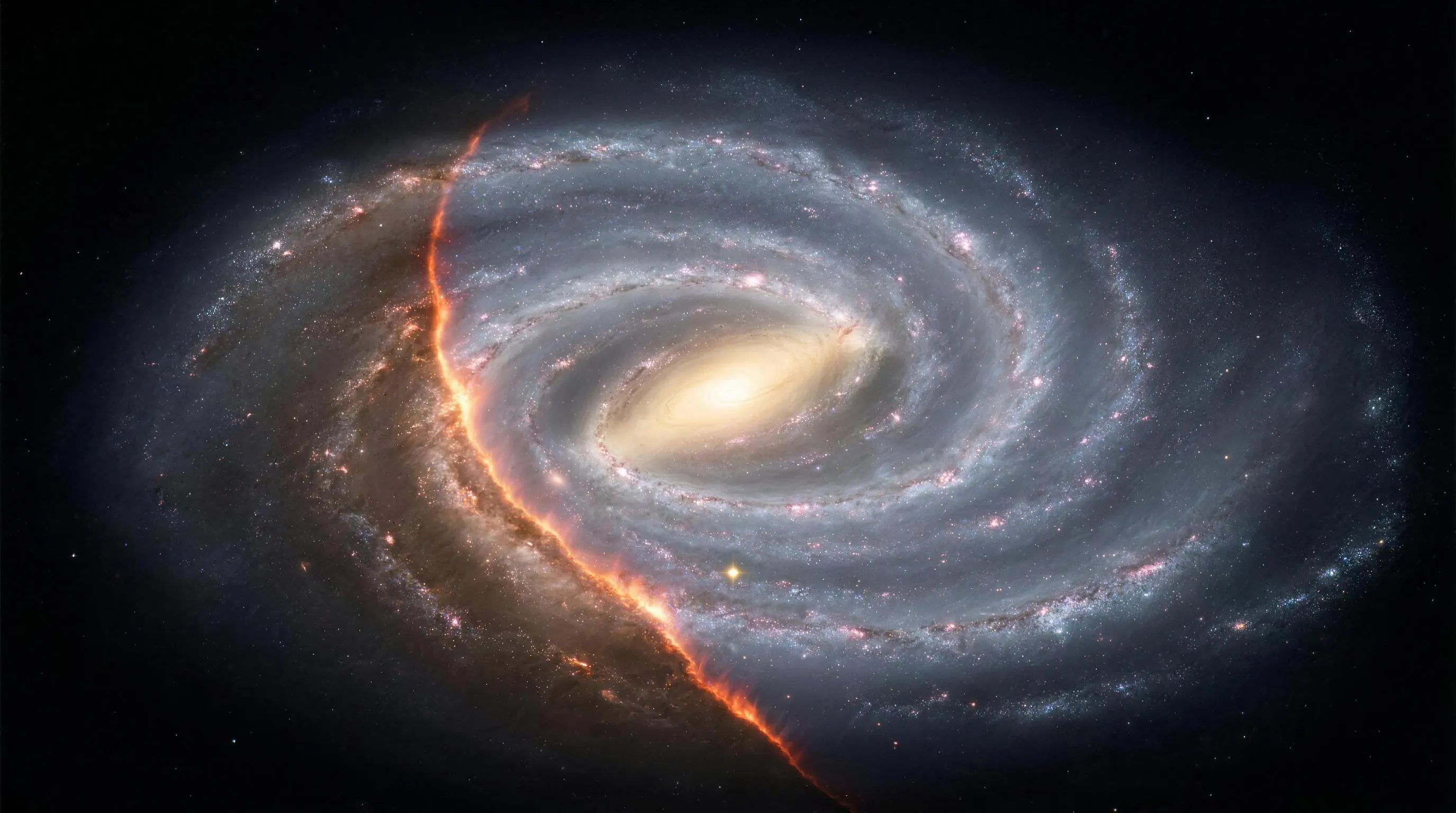
The Wave view is a galaxy being taken. A procedural Milky Way, spiral arms, a golden bar, rose HII knots, each drawn star standing for ~10⁸ real ones, and out of one marked system a colonization front expands at exactly v = d/(d/v+τ). The frontier burns; the settled interior cools to bronze (a flagged reading, not physics); the Sun waits as a gold point 26,700 ly from the core, and when the wave crosses it, the map tells you how overdue the visit is. Four sliders, probe speed, refit pause, hop distance, seed count, and ▶ Expand compresses twenty million years into forty-five seconds.
The Clock view is the whole argument as one picture: the galaxy's 13.6-billion-year bar with its measured anchors, and the conquest era drawn to scale, a sliver thin enough to need the built-in ×240 magnifier. Drag the ◆ marker anywhere in the deep past and everything after it belongs to them. The violet bracket at the bar's end is the "allowed window": for a 2026 sky this empty, every expander that ever arises must land inside it, or never exist. Six cards beneath put the published argument on the record, from Fermi's lunch to Dissolving the Paradox.
The Filter view prices the way out. A staircase runs from 2×10¹¹ star systems through eight steps, habitable rock, abiogenesis, complex cells, multicellular bodies, brains, technology, survival, the will to expand, and every step cycles EASY ×0.5, HARD ×10⁻³, FILTER ×10⁻⁹ at a click. The bottom line updates live: at one expander or more, the Wave view says the disk fills and the sky is wrong; under one, the silence is explained at the price of whichever red step you just chose to defend. Six READING cards, Rare Earth to grabby aliens, close the shelf, none endorsed.
Why it's here
This site's SETI arc closed at the Dyson Swarm on one sentence: the engineering is permitted, the silence is measured. The Fermi Paradox is the question that sentence forces. The Drake Equation puts "how many civilizations" on an abacus; the Wow! Signal and its siblings supply sixty years of search records; the Dyson swarm proves unhideable engineering should be visible. This instrument twists the three into a single knot: if the arithmetic says many, the physics says feasible, and the clock says plenty of time, then the quiet of the sky stops being background and becomes the loudest item in evidence. It is not another stop on the arc; it is the arc turning around to ask its own question.
It is also where the site's scales close ranks. The Laser Sail priced a 0.2c probe at one hundred gigawatts with no new physics; this page merely hands that probe to deep time, and to a recurrence that copies itself. The magnitude of the answer is the uncomfortable part: at Hart's 1975 settings, sweeping the entire disk takes about twenty million years, less than two parts in a thousand of the galaxy's age. This site's rule is to state, attribute, link, and then go quiet; this page keeps the rule, but the fact it states carries its own barb: either our arithmetic about life is wildly wrong, or the silence hides an explanation not yet on the table. The instrument draws both halves. The conclusion is yours.
How it works
One recurrence and one census run the whole instrument; nothing else is asserted.
v_front = d / (d/v + τ) · t_fill = max over stars of arrival · N_col(t) = census swept · N_exp = 2×10¹¹ · Π pᵢ
The wavefront is a recurrence, not a fleet. One hop of d light-years at speed v, then τ years of building before the next launch: the effective front speed is d/(d/v+τ). At Hart's settings, 6 ly at 0.1c with 1,000-year pauses, that is ~0.006 ly/yr, and the disk falls in about twenty million years. The instrument computes the union of up to eight staggered waves star-by-star against its drawn census, so the colonized fraction, the fill time and the Sun's arrival date are exact within the drawing.
The clock does no modelling at all. The 13.6-Gyr bar and its anchors, first stars, thin disk, Sun, life, animals, radio, are measured numbers drawn linear. The only modelled object on it is the sliver, whose width is the Wave view's fill time divided by the bar's span. The "allowed window" is that same number read as a fraction: at Hart's settings, ~0.1% of the clock. The bracket is not rhetoric; it is division.
The filter is bookkeeping, honestly labelled. Eight multiplications from a measured start. The first step's EASY setting is Kepler's η⊕ ≈ 0.2, the one step with a telescope behind it; every other price is a choice the panel makes you make in public. The verdict line only ever states the product and its consequence; which step deserves the 10⁻⁹ is precisely the debate the cards document.
The searches are imported, not re-argued. The nulls this instrument leans on, radio SETI since 1960, IRAS and WISE all-sky, Ĝ's galaxies, Hephaistos's stars, are the measured results this site's SETI arc already walked through instrument by instrument. The Evidence table tags them MEASURED and links the reader's memory to INST-19 through INST-25 rather than reprosecuting them.
The evidence is tagged as you go. The bottom-left table is the conscience of the sim: the galaxy and the nulls are MEASURED, the wavefront and the probes are MODELLED, and where the Filter sits, or what the silence means, is a READING. Rows flash as you touch the controls that depend on them, so the boundary between fact and model stays visible at all times.
The galaxy and the silence are measured. The wave is modelled, exactly, from stated assumptions. And whether the empty sky means rare life, patient life, or something no card yet names is the reading this site never supplies. The instrument computes; you conclude.
The four scenarios on the dial
Four stations along the same recurrence, so the robustness of the thing has somewhere to land.
- The crawl · 0.01c, 5,000-year pauses. Every pessimism the panel allows, stacked: fusion-ship speeds, civilizations that collapse and recover between launches. The disk still falls in under a hundred million years, less than one percent of the time available. The pessimist's wave is a rounding error, which is the whole point.
- Hart's wave · 0.1c, 1,000-year pauses. The 1975 baseline: laser-sail speeds this site has already priced, patient consolidation at every stop. About twenty million years to take everything, 0.15% of the galaxy's age. This is the setting the Clock view's default sliver is drawn from.
- Six hours · 0.3c, barely pausing. The Armstrong & Sandberg end: beamed launch infrastructure so capable that the pause, not the flight, stops mattering, named for their paper's claim that six hours of the Sun's output launches an intergalactic colonization. A few million years, start to finish.
- Crowded · eight expanders, staggered. A Drake-optimist's galaxy: eight seeds arising at different epochs, waves overlapping. Watch the fill time barely improve on one seed, the first mover already took everything, and note what that does to "they would compete" as an answer to the silence.
The answers, as they stand
Every serious family of explanation, with who argued it and where it lands today. All four rows are open; that is the honest state of the field.
| We are effectively alone: the filter is behind us argued by Hart 1975 · Ward & Brownlee 2000 · Sandberg, Drexler & Ord 2018 | OPEN | Open, and cheaper than its reputation. Multiply honest distributions instead of point guesses and a large share of the probability lands here without any exotic sociology. Nothing in the data refutes it. |
| Expansion is slower or stalls: diffusion and percolation argued by Newman & Sagan 1981 · Landis 1998 | OPEN | Published and quantitative, but it must bind every expander in every era: one wave above the percolation threshold anywhere in 13.6 Gyr refills the map. The instrument shows how strong the brake must be. |
| They exist and abstain: zoo, quarantine, dark forest argued by Ball 1973 · Brin 1983 · Liu 2008 | OPEN | Consistent with every observation, which is the problem: near-unfalsifiable, and dependent on unanimity across all factions, civilizations and epochs. One defector ends it. No survey can yet test the mechanism. |
| The wave is real and simply not here yet argued by Hanson, Martin, McCarter & Paulson 2021 (grabby aliens) | OPEN | Open. Fits our early arrival time and predicts a sky that looks empty right up until it does not. Makes statistical predictions about our own earliness rather than about detectable signals, so the file stays open. |
Try this
- Feel the ambush. Reset, press ▶ Expand, and watch the strip chart rather than the galaxy for the first fifteen seconds. The curve crawls, then detonates: the same S-curve the Dyson build taught, now at galactic scale. Twenty million years is a long time until you price it against thirteen billion.
- Watch the Sun get swept. Keep your eyes on the gold marker as the front approaches: the ripple, the label flip, the readout switching to "swept N Myr ago". That moment, repeated for every star on the map, is Fact A's premise: we should have been a colony long before we were a question.
- Shrink the sliver. In the Clock view, drag the ◆ to 10 Gya, then to 1 Gya, then to 100 Mya. The orange sliver never gets easier to see, and the "full for X Gyr" label barely moves. Whenever they start, they finish essentially at once, and long ago. That invariance is the paradox.
- Try to buy the silence cheaply. In the Filter view, set every step EASY and read the top line: tens of millions of expanders. Now find the single cheapest set of prices that gets under 1.0 and ask whether you would defend each red step in a seminar. That discomfort is Hanson's essay, felt from the inside.
- Put the filter ahead of us. Set steps one through six EASY and step seven FILTER, and read the note that appears. This is the one configuration where the empty sky is bad news about our own future, and the reason Hanson wrote that finding cheap alien life would be a catastrophe of information.
- End at the crawl. Run the crawl scenario to completion and check the readout: under 1% of the galaxy's age, at dials chosen to be hostile. Then open the Newman & Sagan card and note what the published rebuttal must therefore claim: a brake stronger than any dial on this panel. Both sides, on the record.
Accuracy
The honest line between what has been measured, what is modelled here, and what is a reading:
| Feature | Tier | What that means |
|---|---|---|
| The arena: a disk of ~2×10¹¹ stars, 100,000 ly across | T1 Measured | Gaia has pinned a billion of the Milky Way's stars to micro-arcsecond astrometry; the published star count spans 1-4×10¹¹ and this instrument uses 2×10¹¹ throughout. The map the wave runs on is data, not speculation. |
| The Sun's address: 26,700 ly from the galactic core | T1 Measured | The Gravity Collaboration's 2019 interferometric distance to Sgr A*, good to four digits. The gold marker in the Wave view sits exactly there, two-thirds of the way to the edge, waiting to be swept. |
| The head start: 13.6 Gyr of stars, the Sun at 4.57 | T1 Measured | The Milky Way's oldest stars predate the Sun by roughly nine billion years, and most Sun-like stars in the disk are older than ours. Any average delay from starlight to civilization leaves the first arrivals scattered billions of years deep in the past. |
| The nulls: no confirmed technosignature, 1960 → 2026 | T1 Measured | Sixty-six years of radio SETI, two all-sky infrared maps, Ĝ's hundred thousand galaxies and Hephaistos's five million stars. The file is thick and, at the level of confirmed detections, empty. This is the paradox's empirical half. |
| The wavefront: v = d / (d/v + τ) | T2 Modelled | Fly one hop d at speed v, pause τ years to build the next shipyard, repeat: the recurrence Hart argued from in 1975 and Tipler armed with self-replicating probes in 1980. The instrument runs it exactly on your dials, and the union of up to eight staggered waves is computed star by star against the drawn census. |
| The fill time: ~20 Myr at 0.1c, under 100 Myr at 0.01c | T2 Modelled | Every scenario on the panel fills the disk in a fraction of a percent of the galaxy's age. The number is exact arithmetic on stated assumptions, and its robustness to the dials is the finding: at this clock there is no such thing as a slow wave. |
| The probes: 0.1c with no new physics | T2 Modelled | Von Neumann proved self-reproducing machines logically sound in 1949; Freitas costed a starter package in 1980; this site's INST-20 prices the launch photons at 100 GW. Feasibility is a modelled claim, and it is the paradox's load-bearing one: no such machine has ever been built. |
| Where the Great Filter sits, and what the silence means | T3 Reading | Rare biology behind us, a hard step ahead of us, unanimous restraint, waves real but not yet arrived, or honest wide uncertainty dissolving the surprise altogether: every reading in the Filter view survives the current data. The instrument computes the price of each; it buys none of them for you. |
In one line: the disk's two hundred billion stars, the Sun's 26,700 ly, the 13.6-Gyr head start and sixty-six years of confirmed nothing are measured; the wavefront, its fill times and the self-replicating probes are modelled, exact arithmetic on stated dials; and where the Great Filter sits, or what the silence means, is a reading, the one this site leaves to you. Fermi asked four words at lunch; the instrument shows why they were never small talk, and keeps the facts from being confused with the readings.
Sources
- Jones, E. M. (1985). "Where is everybody?" An account of Fermi's question. Los Alamos report LA-10311-MS. The documentary record: Teller's, York's and Konopinski's recollections of the summer 1950 lunch.
- Hart, M. H. (1975). An Explanation for the Absence of Extraterrestrials on Earth. QJRAS 16, 128-135. Fact A, the four classes of explanation, and the case that the empty sky is data.
- Tipler, F. J. (1980). Extraterrestrial Intelligent Beings Do Not Exist. QJRAS 21, 267-281. The self-replicating probe argument: one departure, ever, suffices.
- Newman, W. I., & Sagan, C. (1981). Galactic civilizations: Population dynamics and interstellar diffusion. Icarus 46, 293-327. The strongest published brake: diffusion at Gyr timescales.
- Landis, G. A. (1998). The Fermi Paradox: An Approach Based on Percolation Theory. JBIS 51, 163-166. Waves that stall below a critical threshold and leave voids.
- Hanson, R. (1998). The Great Filter: Are We Almost Past It? The essay that named the Filter and framed why good news about alien life is bad news about our future.
- Sandberg, A., Drexler, K. E., & Ord, T. (2018). Dissolving the Fermi Paradox. arXiv:1806.02404. Multiply distributions, not point estimates: emptiness was never surprising.
- Hanson, R., Martin, D., McCarter, C., & Paulson, J. (2021). If Loud Aliens Explain Human Earliness, Quiet Aliens Are Also Rare. ApJ 922, 182. The grabby-aliens model.
- Ward, P., & Brownlee, D. (2000). Rare Earth: Why Complex Life Is Uncommon in the Universe. Copernicus. The conjunction case for a filter behind us.
- Ball, J. A. (1973). The Zoo Hypothesis. Icarus 19, 347-349; and Brin, G. D. (1983), The 'Great Silence', QJRAS 24, 283-309. Abstention, and the survey of everything else.
- Armstrong, S., & Sandberg, A. (2013). Eternity in Six Hours. Acta Astronautica 89, 1-13. The engineering upper bound: intergalactic colonization from one system's resources.
- GRAVITY Collaboration (2019). A geometric distance measurement to the Galactic center black hole. A&A 625, L10. The Sun's 8.18 kpc, used by the map.