A Bogey at Ten O'Clock High
Four and a half hours into a fourteen-day flight, Frank Borman keyed his radio and said five words that outlived the mission: a bogey at ten o'clock high. What follows on NASA's own press tape is not a flying-saucer report; it is two test pilots sorting their sky in real time, a spent booster at two o'clock trailing what Lovell called trillions of particles, a river of glints crossing three miles out, and a third point of light that the tape itself files as unidentified and never resolves. This bench rebuilds the sky those words were spoken into. It flies the actual orbits: the quarter-hour the crew spent holding formation with a tumbling, venting rocket stage at arm's length, the 17.8 m/s burn that finally opened the gap, and the closed-form relative motion that kept the stage a brilliant point off their windows for hours afterward. It prices the two facts the case turns on: that in orbit anything you shed keeps pace with you for free, and that a tumbling stage is, to sunlight, a five-metre sphere that cannot fade below naked-eye brightness anywhere this side of the horizon. And it leaves the third object exactly where the record left it: a bearing, a ring, and an open file.
 Open the interactive ▸
 What you're looking at
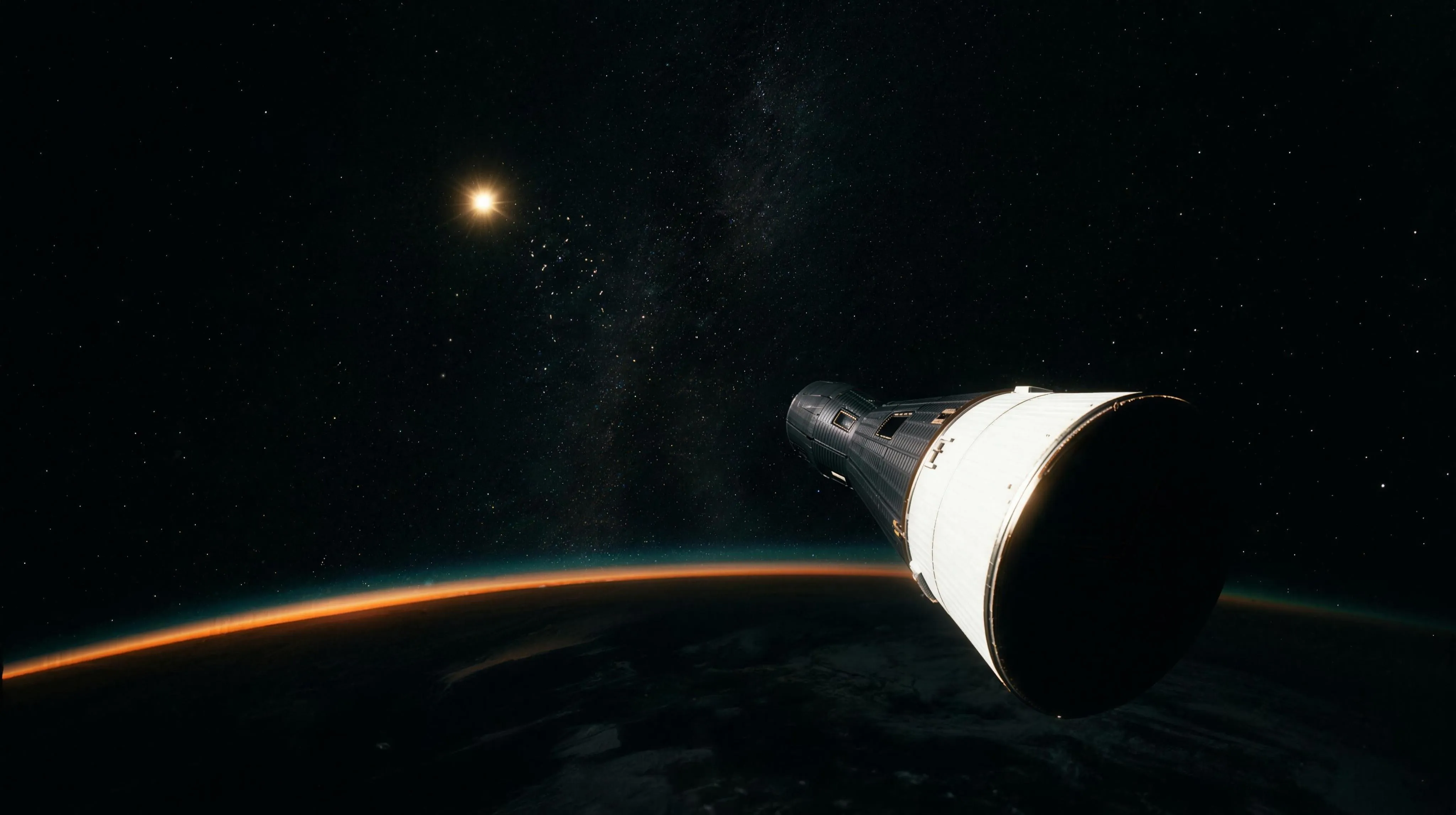
The Formation view is 3D because the subject is a dance: two vehicles on nearly the same orbit, and the counter-intuitive ways a shed object actually moves. Gemini 7 and the Titan II stage are built to reported scale, the stage tumbles at its reported 2 rpm and vents through its broken line, and one clock runs from separation through the recorded stationkeeping out past the bogey call at GET 4:24. The shed delta-v's size and direction are dials; the Clohessy-Wiltshire closed form does the flying; a staged window bearing reads the companion's position back to you in the crew's own clock vocabulary.
The Tape view restores NASA-UAP-D3 as a playable reel: thirteen lines, verbatim, PAO narrator and crew and Houston each in their own voice, with three track lamps, booster, particles, bogey, lighting as each object enters the conversation. The tape's per-line pacing is staged and says so; the words are not.
The Drift view is the case as three cards of closed-form arithmetic: the dance card runs one delta-v in four directions and shows loiter, loop and drift; the ledger card prices departure at 16.1 km per orbit per metre per second; the star card proves via Cauchy's S/4 that the tumbling stage is a 5.33 m sphere to sunlight, above naked-eye brightness beyond the horizon.
The Ledger view is the record on nine cards: the twice-public press tape, the mission, the stationkeeping, the perigee raise, the three-way sorting, the Gemini 6A rendezvous counterpoint, Borman's later reading, the siblings, and what stays open. It closes on two verdicts at equal size: the physics one and the record one.
Why it's here
This bench is the second on the astronaut line, and the planned other half of INST-55, Three Frames from STS-80. That bench's predicament is stillness: three photographs without a range, and physics can fix only one ratio. The material here is the opposite: the Gemini 7 tape in this station's Release 01 Briefing 13 is full of motion, a booster tumbling at two o'clock, particles crossing at 90 degrees, and a crew sorting them apart in real time. The briefing's boundary stays crisp: the tape names three things, identifies two, and leaves the third, in its own word, unidentified. What an instrument can pick up is the sky those three things lived in: in orbit, keeping pace with you requires no engines at all. The Gemini crew debriefings in Release 03 Briefing 12 are the wider ledger this record sits inside.
It also fills a gap in this station's physics shelf: co-orbital relative motion. INST-18, 'Oumuamua, computed how a free-tumbling elongated body reports its own rotation through brightness; the stage here is the near-field version of the same sentence, with Cauchy's theorem turning "tumbling" directly into "shows a quarter of its surface on average". INST-27, GoFast, demonstrated how far a bearing without a range can mislead; "ten o'clock high" is exactly such a bearing, the only coordinate the record ever gives the third object. Read the three together and the underlying grammar of astronaut sighting cases comes into focus: bearings are cheap, ranges are expensive, and your own hardware never leaves the stage.
How it works
Two recorded orbits, one closed-form relative motion, one theorem about tumbling bodies, and zero fitted constants. The panel tags every number exact, modelled, reported or reading.
ẍ = 3n²x + 2nẏ · ÿ = −2nẋ · Δy/orbit = 3TΔv · ⟨A⟩ = S/4 · m = m☉ − 2.5·log₁₀(p·(D/2R)²) · Δv = √(μ(2/r−1/a₂)) − √(μ(2/r−1/a₁))
The orbits, exactly. Both vehicles rode one insertion orbit, 161.6 × 328.2 km, period 89.40 minutes. Gemini's 75-second OAMS burn raised its perigee to 222 km, which vis-viva prices at 17.8 m/s and which stretched its period to 90.01 minutes. That 37-second-per-orbit difference is the entire mechanism of the later gap: 285 km per orbit, computed three independent ways in the tune script.
The relative motion, exactly. The Clohessy-Wiltshire equations govern a companion near a circular reference orbit, and their closed form is checked here against RK4 integration. The solution has no streak in it: along-track kicks drift 16.1 km per orbit per m/s, radial kicks fly a closed 2:1 loop and return every 89.4 minutes, cross-track kicks swing 854 m per m/s and go nowhere. Shed hardware loiters; that is the theorem the intuition fails on.
The brightness, exactly. Cauchy's theorem: a convex body's mean projected area over random orientations is exactly a quarter of its surface area. For the 3.05 × 7.78 m stage that is 22.3 m², a 5.33 m disc equivalent, with no fitting anywhere. Sunlit at albedo 0.5 it is magnitude -19.8 at the stationkeeping band, -3.1 at 100 km, +0.4 at 500 km, and still +6, the naked-eye limit, at 6,652 km, beyond the horizon. A shed booster does not fade from view; it sets or it stays.
The window bearing, honestly. Ten o'clock high is the record's only coordinate, so the bench builds the convention it implies: nose forward, twelve o'clock up, and a live readout of where the companion sits in that frame. The same geometry applies the exact curvature correction that pulls a departing object down toward the limb, which is where the stage reads at the bogey hour: ahead, a few degrees below level, around first magnitude.
The staging, honestly. The record gives words, not coordinates: attitudes, the sun's bearing, the venting spray, the particle river's placement and the bogey marker's direction are staging consistent with the words, each labelled. The perigee raise is staged as a single shed event at the end of stationkeeping; the gap arithmetic is unaffected and the tune script carries it.
What is deliberately not computed. No identity for the bogey, in either direction; no probability that it was the booster, because a likelihood needs priors the record refuses to supply; no per-line clock for the tape, because the release carries none. Where the record is silent, the bench carries a label instead of a guess.
The orbits, the raise delta-v, the CW motion, the drift ledger, Cauchy's area and the magnitude curve are exact and machine-checked; the attitudes, the spray, the bearing convention, the single-shed abstraction and the tape's pacing are labelled staging; the words, the stationkeeping, the mission record, the rendezvous and Borman's later reading are reported as documented; and what the third object was is a reading, for which the bench hangs two verdicts at equal size and adds no third.
The dials that decide what happens
A flight clock, a shed delta-v with four directions, a tape reel and four staged presets: between them they hold everything the record describes and everything it declines to say.
- The flight clock. GET from separation to past the bogey call, with the recorded marks pinned: separation, the quarter-hour of stationkeeping, the backing-away, and 4:24. The clock lingers through the formation quarter-hour and runs fast after, because that is where the record's texture lives.
- The shed delta-v. A log dial from a hand-push's 1 mm/s to the 17.8 m/s the perigee raise actually imposed, with named stops that snap. Every card downstream reads through it: the dance's shape, the ledger's kilometres per orbit, the range and brightness at the bogey hour.
- The direction. Posigrade, retrograde, radial, cross-track: four fates for the same delta-v. The seg is the lesson: drift, drift the other way, a closed loop, a swing. Nothing streaks.
- The presets. Stationkeeping restores the reported 18-46 m hold; the backing-away sheds at a staged 0.5 m/s; the raise sheds at the computed 17.8 m/s; the bogey hour freezes the clock at GET 4:24 with the gap and magnitude the arithmetic implies.
- The tape reel. Thirteen lines at a staged pace, scrubbable, with the three track lamps and the closing count: named 3, identified 2, open 1.
The claims, as they stand
Five readings that orbit the exchange, from the standard booster-and-debris reading to the folklore's controlled companion, with who carries each and where it lands once the arithmetic is done.
| The bogey was the crew's own booster and its debris, seen among three sorted things carried by the standard reading then and since; Borman's own later view | BEST SUPPORTED | Cheapest, and fully consistent: the stage was provably in the sky (Lovell describes it in the same exchange), venting hardware sheds exactly the particle processions described, and the physics on this bench keeps all of it brilliant and pacing for hours. What keeps it a reading rather than a finding: the tape logs the bogey as a third thing distinct from the booster, and closes without resolving it. This bench does not resolve it either. |
| The bogey was an unknown object keeping deliberate station with Gemini 7 carried by the reading the case's folklore carries | CONTESTED | Contested and open, with one leg removed: "it kept pace, so it was controlled" fails, because in orbit keeping pace is the default behaviour of anything co-orbital, at zero cost. What remains is the tape's own word, unidentified, which excludes nothing. The bench computes the sky and refuses to vote. |
| The transcript is a suppressed record surfaced by disclosure carried by a common frame around the 2026 re-publication | DID NOT SURVIVE | Did not survive the record. The document is a Public Affairs Office press tape, played for reporters in December 1965 and public ever since. Its 2026 appearance is a re-publication, which the release itself is open about. |
| The crew reported a UFO in the flying-saucer sense carried by the casual reading of the famous line | DID NOT SURVIVE | Did not survive the words. Bogey is bearing-and-contact vocabulary, not a species claim; the same crew identify their own booster one sentence later and count the particles precisely. The exchange is a sorting, and the sorting is the opposite of a saucer report. |
| Ten o'clock high marks where the third object actually was carried by the record's one coordinate | READING | Carried as reported: a clock bearing in a window is a direction and nothing else, no range, no track, no second fix. The bench stages its marker at that bearing and hangs a dashed ring on it, because a ring is a question. |
Try this
- Run the clock from separation and just watch the first quarter-hour. Two vehicles, no burns, no tether, holding 18 to 46 metres apart while one of them tumbles and vents. Nothing is holding them together except the orbit itself. That sentence is the whole bench.
- Shed at 1 cm/s and come back one orbit later. A hand-push. The gap after a full 89-minute orbit is 161 metres: you could still read the stencilling. Leaving something behind in orbit is genuinely hard, and the dial proves it in one motion.
- Switch the same delta-v through the four directions. Watch the dance card redraw: two mirror drifts, one closed loop that comes home every orbit, one flat swing. The streak your intuition keeps expecting never appears, because it does not exist here.
- Take the raise preset and let the clock run to 4:24. The stage pulls ahead 285 km per orbit and settles a few degrees below level, and its magnitude readout refuses to leave first-magnitude territory. This is what "hours later, still the brightest thing in the sky" looks like, priced.
- Play the tape with the reel and watch the lamps. The booster lamp lights, the particle lamp lights and clears, and the bogey lamp lights and never clears. The tape's own structure is the case's structure; the bench just makes it visible.
- End on the Ledger's counterpoint card. Eleven days later, Gemini 6A closed to 30 centimetres, and it took a radar, a computer, four burns and two crews. Deliberate formation flight was among the hardest things NASA had done; accidental formation flight is free. Hold both, then decide what a pacing bogey is worth.
Accuracy
The honest line between what is exact, what is modelled here, what the record reports, and what is a reading:
| Feature | Tier | What that means |
|---|---|---|
| The two orbits | T1 Exact | Two-body arithmetic on the recorded elements: the shared 161.6 × 328.2 km insertion orbit (89.40 min), Gemini's raised 222 × 328.2 km orbit (90.01 min), and the perigee-raise delta-v, 17.8 m/s by vis-viva. The limb geometry every window obeys (Earth 148.7° wide, the limb 15.63° below level) is closed form from the same elements, machine-checked in the tune script. |
| The relative motion | T1 Exact | Clohessy-Wiltshire closed form about the insertion orbit's semi-major axis, verified against RK4 integration: shed hardware loiters, loops or drifts, never streaks. The drift ledger rides the same solution: 16.1 km per orbit per m/s along-track, a closed 3.4 × 1.7 km loop per m/s radial, an 854 m swing per m/s cross-track, and 285 km per orbit for the raise itself. |
| The brightness | T1 Exact | Cauchy's theorem gives the tumbling stage's mean projected area exactly, S/4, a 5.33 m sphere equivalent, no fitting. The Lambertian sunlit-magnitude formula then holds it brighter than the full Moon at formation range, Venus-class at 100 km, first-magnitude at 500 km, and above naked-eye brightness out to 6,652 km, which is beyond the horizon. |
| The staging | T2 Modelled | The record gives words, not coordinates: the attitudes, the sun's bearing, the venting spray, the particle river's placement, the bogey marker's ten-o'clock-high direction and the window clock-bearing convention are staging consistent with the words, each labelled. The perigee raise is staged as a single shed event; the tape plays at a staged pace, since the release carries no per-line clock. |
| The vehicles | T2 Modelled | Gemini 7 and the Titan II GLV second stage are primitive builds to the reported dimensions (5.61 m capsule; 3.05 × 7.78 m stage with the GLV black roll-pattern), tumbling at the reported 2 rpm. Past the near field the stage hands over to what the eye actually recorded: a point of light at the computed magnitude. |
| The record, whole | T3 Reported | The transcript's thirteen lines verbatim per the release, the PAO framing, the 1965 press provenance, the stationkeeping record (18-46 m, about a quarter-hour, the broken fuel line), the mission record (14 days, 206 orbits), the Gemini 6A rendezvous, and Borman's later booster-and-debris reading, carried as a reading. The release's silence on the third object is carried as silence. |
In one line: the two recorded orbits, the 17.8 m/s raise by vis-viva, Clohessy-Wiltshire relative motion and its drift ledger, Cauchy's S/4 and the sunlit-magnitude curve are EXACT and machine-checked, with no fitted constant anywhere; the attitudes, the spray, the particle river, the bearing convention, the single-shed abstraction and the tape's pacing are MODELLED and labelled; the thirteen lines, the stationkeeping, the mission record, the Gemini 6A rendezvous and Borman's later reading are REPORTED as documented; and what the third object was is a READING, for which this bench hangs two verdicts at equal size and adds no third. Run the clock, play the tape, and decide.
Sources
- NASA-UAP-D3, the Public Affairs Office release commentary of the Gemini 7 and 6 flights, NASA tape T-00763, December 1965, PURSUE Release 01, U.S. Department of War, war.gov/ufo: the transcript's words, the PAO framing, and the 1965 press provenance.
- Signals from the Periphery, Release 01 Briefing 13, "A bogey at ten o'clock high": the boundary this instrument inherits, the crew's three-way sorting and the third object left open; and Release 03 Briefing 12, the Gemini crew debriefings, the wider ledger of what the crews said they were looking at.
- The public Gemini 7 mission record (NASA mission archives): launch 4 December 1965, 19:30:03 UTC; insertion 161.6 × 328.2 km at 28.87°; 13 days 18 hours 35 minutes, 206 orbits; the stationkeeping with the spent second stage (within a minute of separation, about a quarter-hour, 18 to 46 m, the stage tumbling about 2 rpm from a broken fuel line); the 75-second OAMS perigee raise to 222 km.
- Titan II GLV second stage references: 3.05 m diameter, 7.78 m length (25 ft 6.375 in), roughly 2.4 t empty, LR91 engine; the GLV roll-pattern staging is drawn from photographs.
- The Gemini spacecraft record: 5.61 m overall, 3.05 m across the adapter base, 3,663 kg at insertion for Gemini 7.
- Gemini 6A, 15 December 1965: the first true space rendezvous, closing to within 30 cm of Gemini 7; the counterpoint card's record.
- Frank Borman's later attribution of the sighting to the booster and associated debris: the standard later reading, carried as a reading; standard mission histories.
- Orbital mechanics: GM = 3.986004418×10¹⁴ m³/s²; vis-viva for the perigee-raise delta-v; the Clohessy-Wiltshire equations (Clohessy & Wiltshire 1960, after Hill 1878) for relative motion about a circular reference, verified in the tune script against RK4 integration.
- Photometry: Cauchy's mean-projected-area theorem (S/4 for a convex body, exact) for the tumbling stage's effective diameter; the Lambertian sunlit-sphere apparent-magnitude formula with the Sun at magnitude -26.74; the 0.5 albedo is the staged value and is labelled.
- All computed anchors, the CW cross-checks, the drift ledger, the Cauchy area and the magnitude curve are solved and printed by scripts/gemini-7-tune.mjs, which is re-runnable and is the only source for every constant the instrument carries. This bench fits no constant anywhere.
- Cross-referenced instruments on this site: INST-55, Three Frames from STS-80, the astronaut line's stills bench and this instrument's pair; INST-18, 'Oumuamua, a tumble read through brightness; INST-27, GoFast, what a bearing without a range is worth.
Run the clock. Play the tape. Price the drift. Then decide what a bogey that keeps pace is worth.
Open the interactiveCompiled August 2026