Three Frames from STS-80
In late 1996, somebody aboard Columbia aimed a film camera out a window and photographed the same unidentified object three times: off the Earth's limb, tumbling, then crossing onto the disc. Thirty years later the government published the three frames with descriptions that read as a sequence, and stopped there: no range, no size, no interval, no name. This bench does what can be done with what was actually released. It computes the one number a point-like photograph fixes, the ratio of size to distance, and then walks the whole ray that number allows: a 17-millimetre ice sliver thirty metres from the window, a 233-metre craft four hundred kilometres out, each satisfying every caption, each shining at the same magnitude, each crossing the frame at the pace the interval dial chooses. It stages both worlds around a to-scale Columbia at orbital dawn and lets you watch the window inset not change as the world does. And it runs the plume test, the thruster arithmetic that split the STS-48 argument, to show exactly why three silent stills cannot run it. The frames stay what the release made them: a record. The bench computes what a record without a range can hold, which is more than nothing and less than an answer.
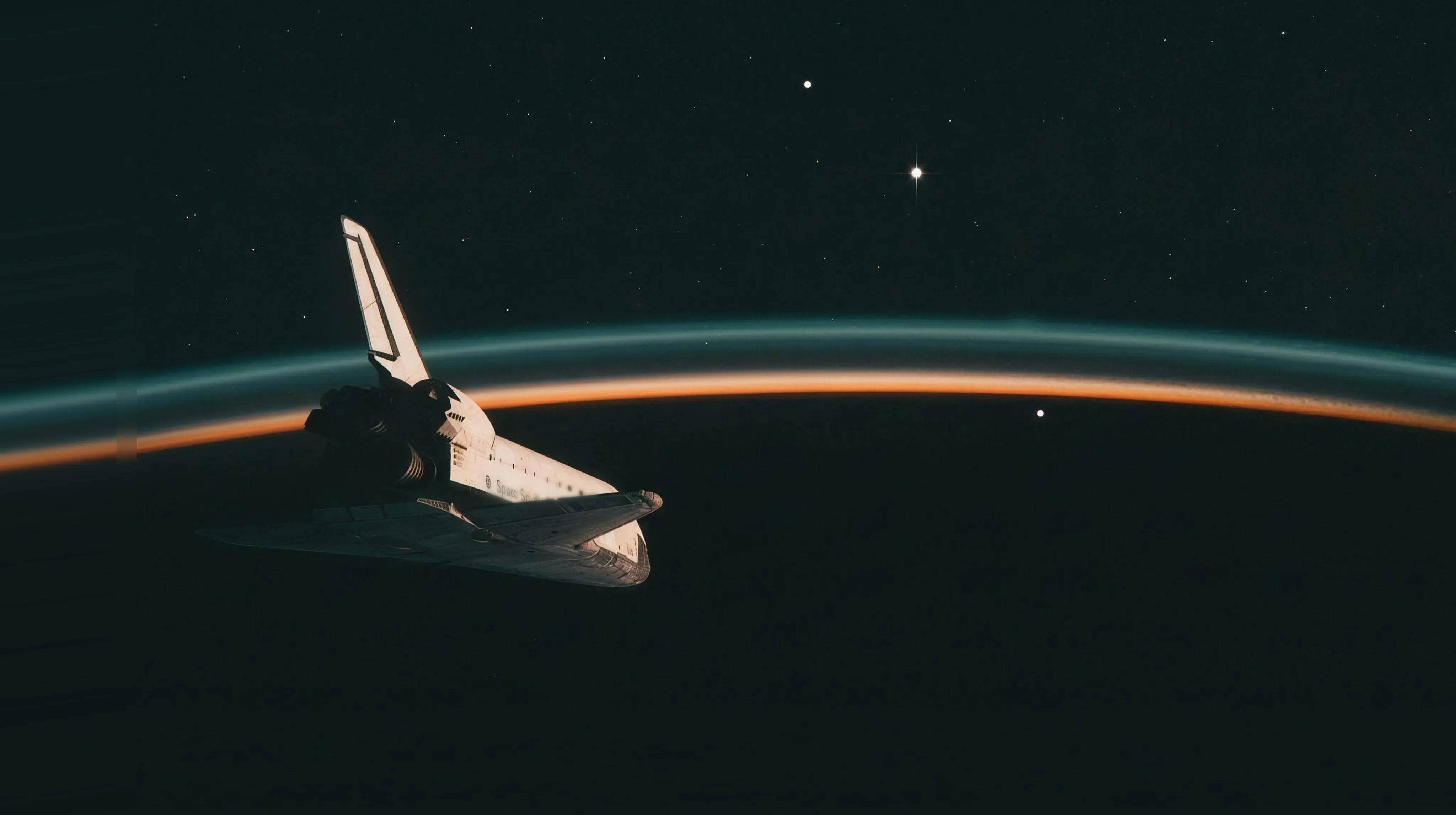 Open the interactive ▸
 What you're looking at
The Orbit view is 3D because the subject is a geometry problem: a camera, an angle, and two wildly different worlds behind the same bright point. Columbia is built to scale, the limb sits exactly where 350 km of altitude puts it, 18.6° below level, and the object runs the staged three-frame arc at whichever range the dial assumes. Switch between the two named readings, an ice flake 30 m out and a craft 400 km out, and the scene rebuilds around an unchanged film inset: what the window sees is identical, by construction, and that identity is the whole case.
The Frames view draws NASA-UAP-D030, D031 and D032 as schematics of their released captions: film chrome, edge markings, the limb's exact curve, the object where the words put it, the tumble staged as an orientation flip. Stack them and the three captions sketch the small arc the briefing describes. Four chips stay pinned over the view: no range, no size, no interval, no identification.
The Line view is the case as three cards of closed-form arithmetic: the degeneracy ray theta = D/R with the assumed range as a cursor sliding from ice flake to starship; the brightness card, where sunlit magnitude rides the same ratio and the whole ray shines at -8.5; and the plume test, delta-v ∝ 1/mass, the one lever that splits the ray and the one these three stills cannot pull.
The Ledger view is the record on nine cards: the release, the mission and its deliberate free-flyers, the captions, the scanned film, the withheld numbers, the folklore video, NASA's attribution and where it stops, and the two siblings, STS-48 and Apollo 17. It closes on two verdicts at equal size: the physics one and the record one.
Why it's here
This bench opens the casework file's longest-parked line: the astronaut line. This station's Release 04 Briefing 9 records the three STS-80 film frames that PURSUE's fourth tranche put on the record, and draws the boundary precisely: the captions give three positions and one tumble, no range, no size, no interval, no identification. The boundary the briefing keeps is exactly the kind of thing an instrument can pick up: when a record hands you only angles, what does physics still let you say. The answer is short enough to engrave on the bench: one number, D/R. This station's wiki entry carries the sequence's background; this instrument puts its geometry on the table whole.
It is also the direct kin of two older instruments. INST-27, GoFast, already demonstrated the atmospheric version of the same lever: slide an assumed altitude along a recorded line of sight and a "fast" target relaxes into a slow one skimming the sea. The orbital version here is purer still, because orbit strips away even the parallax and the sea surface, leaving angle alone. And INST-18, 'Oumuamua, is an old friend of the phrase "tumbled about its major axis": a free-floating elongated body reporting its own rotation through brightness swings, computed once on that bench, and equally true of an ice sliver 30 m from a window here. Read the three side by side and the question "how much conclusion can an observation without a range carry" gets a much steadier answer.
How it works
One staged angular track, three closed forms riding it, and zero fitted constants. The panel tags every number exact, modelled, reported or reading.
θ = D/R · m = m☉ − 2.5·log₁₀(p·(D/2R)²) · v = ωR · Δv = (ṁv̄ₑ/Ωd²)·(A/m)·t · v꜀ = √(μ/r)
The orbit, exactly. Circular-orbit closed form at 350 km: 7.70 km/s, 91.5 minutes, the Earth a 142.9° cone with the limb dipped 18.6° below the local horizontal. The limb is the only ruler the photographs contain, and the bench draws it to the arcminute.
The ray, exactly. Angular size is D/R; a point-like photograph without a range fixes that ratio and nothing else. The Line view draws the whole ray through (R, D) space with named stops: 17.5 mm at 30 m, 0.9 m at 1.5 km, 233 m at 400 km, 873 m at 1,500 km. The assumed-range dial slides along it and implied size, speed and brightness follow, exactly.
Brightness, exactly, and uselessly. The sunlit-sphere magnitude depends on (D/2R)²: the same ratio squared. The whole ray shines at one magnitude, -8.5 for the staged size, so exposure cannot split the readings either. A bare 2 mm flake at 30 m is magnitude -3.8, Venus-class, which is why shuttle film is full of brilliant near-field ice.
The plume test, exactly, and out of reach. An RCS pulse's momentum flux over a particle's mass gives delta-v ∝ 1/D: 1.67 m/s for a 2 mm flake at 20 m from a 0.08 s pulse, 2.8 mm/s for the orbiter, nothing for a craft 400 km away. An object that veers when a thruster fires has told you its mass. The test needs a firing on video. The release gives three silent stills.
The staging, honestly. The release gives captions, not coordinates, so the arc's 10° span, the 2-arcmin size, the window framing and the dawn sun are labelled staging, every one on a dial or in the accuracy table. Change the staging and the geometry lesson survives unchanged, which is the test of an honest staging.
What is deliberately not computed. No attribution for the frames, in either direction; no identification of the folklore video's lights (that footage is a different exhibit); no probability that the object was ice, because a likelihood needs priors the record refuses to supply. Where the release is silent, the bench carries a label instead of a guess.
The orbit, the limb, the degeneracy ray, the brightness identity, the CW motion and the plume arithmetic are exact and machine-checked; the arc, the apparent size, the framing, the lighting and the orbiter model are labelled staging; the captions, the mission record, the folklore and the attributions are reported as documented; and what three frames without a range amount to is a reading, for which the bench hangs two verdicts at equal size and adds no third.
The dials that decide what happens
An assumed range, an assumed interval, a flake size, a pulse length and a sequence scrubber: between them they hold everything the release declined to say.
- The assumed range. The number the release does not give, on a log dial from 5 m to 2,000 km. Implied size, implied crossing speed and sunlit magnitude follow it live. The two named readings, ice at 30 m and craft at 400 km, are stops on this dial, not conclusions.
- The frame interval. Film carries no timestamps, so the seconds between exposures are also not in the release. Every implied speed reads through this dial: 8.7 cm/s for the flake and 1.16 km/s for the craft at the default 30 s, both perfectly ordinary for their worlds.
- The sequence scrubber. The three captions restored to one motion: D030 off the limb, the D031 glint at mid-arc, D032 onto the disc, with Restore the motion playing the arc on the interval dial's clock.
- The reading switch. Ice or craft: the 3D world rebuilds, the labels re-price, and the film inset stays identical. The switch is the argument.
- The flake size and the pulse. The plume card's dials: delta-v ∝ 1/D at fixed range, against the orbiter's own 2.8 mm/s as the dashed reference. Ice answers a thruster; a ship does not; stills cannot ask.
The claims, as they stand
Five readings that orbit the three frames, from the default ice reading to the folklore's craft, with who carries each and where it lands once the arithmetic is done.
| The object was near-field ice or debris, sunlit against a dark Earth carried by the reading the shuttle-imagery literature defaults to; NASA's attribution family for the downlinked video era | BEST SUPPORTED | Cheapest, and fully consistent: the mission shed ice and debris by routine (water dumps, RCS firings, payload operations around two deliberately deployed free-flyers), a 17 mm sliver at 30 m satisfies every caption for free, and film loves near-field ice at Venus-class brightness. What keeps it a reading rather than a finding: the release stamps no attribution on these frames, and neither does this bench. |
| The frames show a large craft at range carried by the reading the mission's folklore carries | CONTESTED | Contested and open, by construction: a 233 m object at 400 km sits on the same ray, takes the same three photographs, and tumbles just as freely. Nothing in the frames supports it over the ice reading, and nothing in the frames excludes it. The bench computes the whole ray and refuses to vote. |
| These stills are the famous STS-80 video carried by internet folklore, by association | DID NOT SURVIVE | Did not survive the record. The release's descriptions neither mention the downlinked video nor connect the photographs to it; the video and the stills are separate exhibits with separate histories, and the site's briefing keeps them apart on purpose. |
| NASA's ice-and-debris answer covers these three frames carried by the casual reading of the folklore | DID NOT SURVIVE | Did not survive the record either, in the other direction. The attribution was given for the video sequences and attaches to that footage; the released records of D030-032 carry no identification of any kind. The boundary is the release's own, and it cuts both ways. |
| The tumble marks a free-floating object carried by the release's one analytical remark | READING | Carried as reported, and it is the caption's strongest sentence: consistent with torque-free rotation, which an ice sliver and a derelict hull perform identically. It is a statement about motion, not identity, and the bench stages it at mid-arc exactly as described. |
Try this
- Press Restore the motion and watch the arc once. Off the limb, a glint, onto the disc: three captions as one movement. Then remember that the interval between the frames is a dial you own, not a number anyone measured.
- Switch the reading with the inset open. The 3D world flips from a flake you could reach with a boat hook to a ship the size of a city block 400 km out. The inset does not move. Sit with that for a second; it is the entire epistemology of the case.
- Walk the range dial slowly from 5 m to 2,000 km. Watch the implied size climb from sand grain to super-tanker and the crossing speed from millimetres per second to kilometres per second, while the photograph they all take stays one photograph.
- On the Line view, find the flat line. The brightness card's horizontal line is the degeneracy in its purest form: every world on the ray, one magnitude. The dashed curve beside it shows what a real fixed-size flake would do, dim as 1/R², which is the measurement nobody got to make.
- Slide the pulse dial to a full second. The flake's delta-v climbs past 20 m/s, the orbiter's stays at parts of a millimetre. Then read the card's last line: no firing is recorded in these frames. The sharpest tool in the drawer, and no way to hold it.
- End on the Ledger's two verdicts. They do not compete. The physics refuses to pick a point on the ray; the record never made an attribution to defend. Three frames stay three frames. Look at them; decide for yourself.
Accuracy
The honest line between what is exact, what is modelled here, what the record reports, and what is a reading:
| Feature | Tier | What that means |
|---|---|---|
| The orbit and the limb | T1 Exact | Circular-orbit closed form at Columbia's 350 km: 7.70 km/s, a 91.5-minute period, the Earth filling a 142.9° cone with the limb dipped 18.6° below the local horizontal. Every window photograph obeys this geometry, and the Orbit view draws it exactly, machine-checked in the tune script. |
| The degeneracy ray | T1 Exact | theta = D/R for angular size, m = m☉ − 2.5·log₁₀(p·(D/2R)²) for sunlit brightness: both depend on size and distance only through their ratio, so a point-like photograph without a range fixes exactly one number. The staged 2-arcmin object is 17.5 mm at 30 m, 233 m at 400 km, 873 m at 1,500 km, all at the same magnitude -8.5. |
| Relative motion and the plume test | T1 Exact | Clohessy-Wiltshire closed-form relative motion (verified against RK4 integration), and the thruster arithmetic: an RCS pulse's momentum flux over a particle's mass gives delta-v ∝ 1/D. 0.08 s of one 870-lbf thruster at 20 m gives a 2 mm flake 1.67 m/s and the 110-tonne orbiter 2.8 mm/s. The test that splits the ray, and the one three stills cannot run. |
| The staged arc and the film schematics | T2 Modelled | The release gives captions, not coordinates: the 10° angular arc, the 2-arcmin apparent size, the elongation, the window framing and the dawn lighting are invented staging consistent with the caption text, each labelled. The film-frame drawings are schematics of the described scans, not the released images. |
| The orbiter | T2 Modelled | A Space Shuttle model by SPACE UNITED (Sketchfab, CC BY 4.0), surgically reduced from its launch stack to the orbiter alone and placed at true 37 m scale. Its payload-bay doors are closed, where the real orbiter flew doors-open on orbit; the scene keeps the model as-is and says so. The camera origin at the aft flight-deck windows is the part that matters. |
| The record, whole | T3 Reported | The three records and their captions, the catalogue fields, the mission record (dates, the 17 d 15 h 53 min duration, the crew, the two free-flyers deployed and retrieved, the jammed airlock), the folklore video and NASA's ice-and-debris attribution for it, the STS-48 debate, and the Apollo 17 sibling. Carried as documented, with the release's silences carried as silences. |
In one line: the orbit, the limb geometry, the degeneracy ray theta = D/R, the brightness identity that rides it, Clohessy-Wiltshire motion and the plume-test arithmetic are EXACT and machine-checked, with no fitted constant anywhere; the staged arc, the 2-arcmin size, the window framing, the dawn light and the primitive Columbia are MODELLED and labelled; the captions, the catalogue fields, the mission record, the folklore video, NASA's video attribution and the STS-48 and Apollo 17 siblings are REPORTED as documented; and what three frames without a range amount to is a READING, for which this bench hangs two verdicts at equal size and adds no third. Restore the motion, slide the range yourself, and decide.
Sources
- NASA-UAP-D030, D031 and D032, "STS-80 Unidentified Object Image 1, 2 and 3, 1996", PURSUE Release 04, U.S. Department of War, war.gov/ufo, cleared 10 July 2026: the three records, their descriptions (positions, the tumble remark, the trajectory remark), the Low-Earth Orbit and 1996 catalogue fields, and the paired-file links.
- Signals from the Periphery, Release 04 Briefing 9, "Three frames from STS-80": the boundary this instrument inherits, between the released stills, the mission's video folklore, and NASA's attributions.
- The public STS-80 mission record (NASA mission archives): Columbia, launch 19 November 1996, landing 7 December 1996, 17 days 15 hours 53 minutes (the longest shuttle flight), five crew including Story Musgrave on his sixth flight, the ORFEUS-SPAS II and Wake Shield Facility 3 free-flyers deployed and retrieved, and the two EVAs cancelled by a jammed airlock hatch.
- NASA's ice-and-debris attributions for the circulated STS-80 downlinked-video sequences, discussed since the late 1990s, standard references; James Oberg's analyses of shuttle-camera UFO footage as near-field particle phenomena.
- The STS-48 exhibit (September 1991): the flash-and-turn sequence, Oberg's thruster-and-ice analysis, and Jack Kasher's opposing papers (bibliographic record): the origin of the plume-kick test this bench runs as arithmetic.
- Apollo 17, NASA-UAP-VM6, PURSUE Release 01 (this station's Release 01 Briefing 8): the archive's other NASA photographic case, still film released without identification.
- Orbital mechanics: circular-orbit closed forms from GM = 3.986004418×10¹⁴ m³/s²; the Clohessy-Wiltshire equations (Clohessy & Wiltshire 1960, after Hill 1878) for relative motion about a circular orbit, verified in the tune script against RK4 integration.
- Shuttle reaction-control hardware: 38 primary RCS thrusters of 870 lbf vacuum thrust, storable MMH/NTO propellants at Isp ≈ 280 s (NSTS Shuttle reference documentation); the plume-cone staging is labelled as such.
- Photometry: the sunlit-sphere apparent-magnitude formula (standard asteroid photometry, geometric albedo at full phase), with the Sun at magnitude -26.74; the ice albedo 0.6 is the staged value and is labelled.
- All computed anchors, the degeneracy identities, the CW cross-check and the plume numbers are solved and printed by scripts/sts-80-tune.mjs, which is re-runnable and is the only source for every constant the instrument carries. This bench fits no constant anywhere.
- 3D orbiter model: "Space Shuttle Challenger" (skfb.ly/pI6qQ) by SPACE UNITED, licensed under Creative Commons Attribution (creativecommons.org/licenses/by/4.0/). Used with the launch stack (external tank, boosters and attach hardware) removed and the orbiter placed at its true 37 m scale; the closed payload-bay doors are the model's, and are acknowledged in the accuracy table.
- Cross-referenced instruments on this site: INST-27, GoFast, the atmospheric assumed-range lever; INST-18, 'Oumuamua, the tumbling elongated body read through its brightness; INST-47, Exoplanet Direct Imaging, what it costs to actually resolve something far away; and the station's wiki entry on the STS-80 object sequence.
Restore the motion. Stack the frames. Walk the line. Then decide what a photograph without a range can carry.
Open the interactiveCompiled August 2026