The Hollow Moon
A twenty-mile shell that must weigh what the Moon weighs is denser than osmium and reads a moment of inertia of 0.64 against the measured 0.3931; the bell peaks late because the crust is rubble and rings long because it is dry; the tiny core is the giant impact's prediction; the 400:1 ratio is a 1.6-billion-year moment. Four claims, four datasets, two verdicts at equal size.
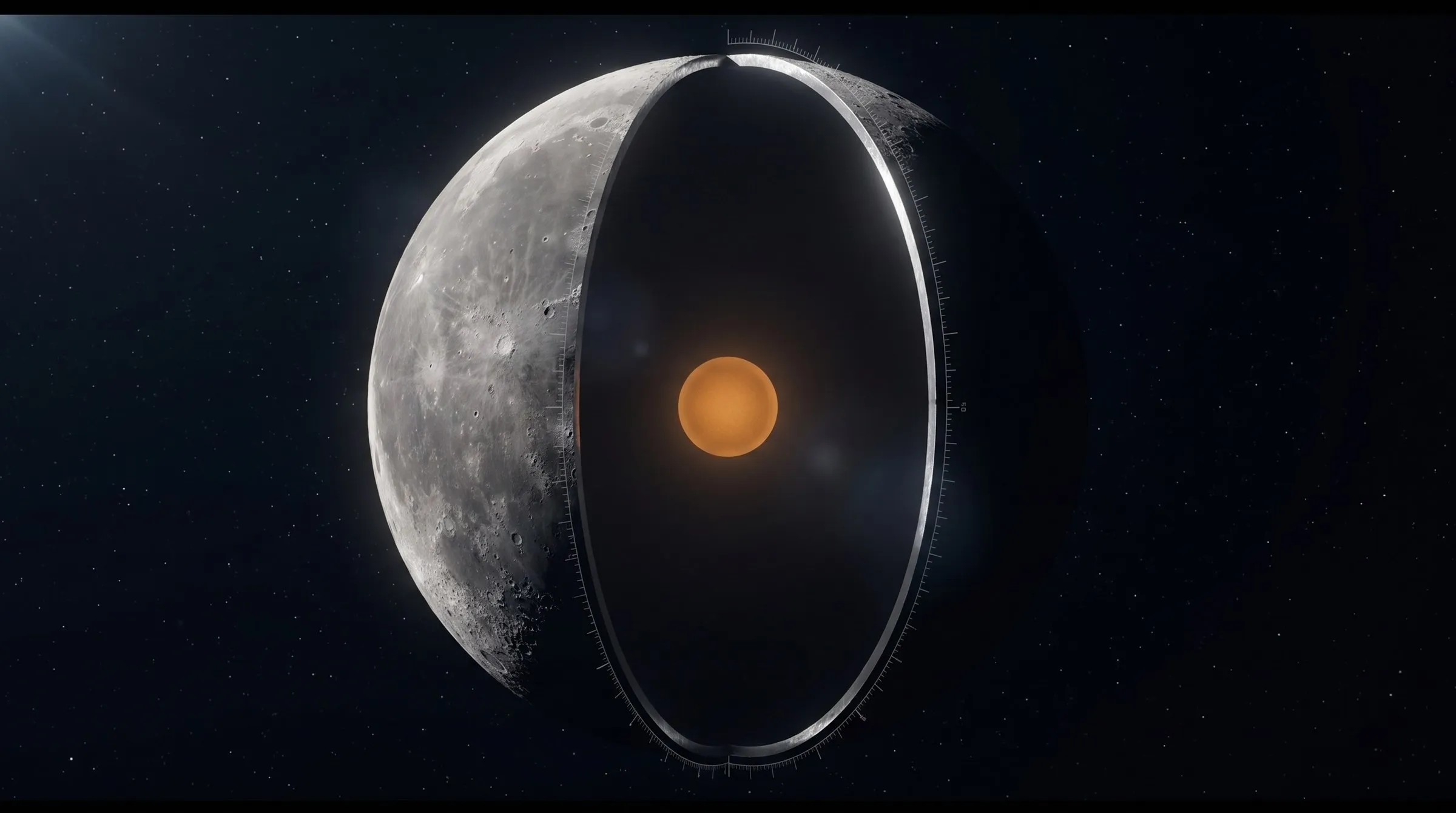 Open the interactive ▸
 What you're looking at
The Shell is the Moon cut open in three dimensions along a plane you turn. Three interiors, each carrying the measured mass: the book's, a 37 km armour around a cavity with a 340 km core; the measured, crust, mantle, partial melt, a fluid outer core and a solid inner core (Weber et al. 2011); and your own, with the armour thickness, core radius and core density on dials. A ruler at the bottom places every interior on the moment-of-inertia scale: 0.400 for a uniform sphere, ⅔ for a thin shell, 0.5 where a shell becomes 'mostly hollow', 0.3931 where the Moon is. A chip reads the armour density the mass demands. A mascon overlay paints the real basins.
The Bell is the seismogram, timed. The amplitude envelope after an impact: the Moon's scattering crust in amber, rising for minutes and fading over an hour; a struck shell in steel, loudest at the strike; the same crust with Earth's Q in blue, gone in minutes. The two Apollo events are presets with their reported numbers beside the model's. A Q ruler runs from an Apollo rock in air (60) through Earth's crust (250) to the same rock outgassed (3,300), the lunar crust (3,000-7,000) and a cast bell.
The Core draws density against radius, the measured profile against the book's empty-then-denser-than-osmium one, and lines up the core's share of the mass across the rocky bodies: Mercury, Venus, Earth, Mars, Vesta, Io, the Moon at 1-2%. The Eclipse runs the Moon/Sun apparent-size ratio through the recession from formation to 1.2 billion years ahead, shades the window in which both total and annular eclipses happen, marks the rhythmites, the book's Permian-Triassic date and today, and redraws the discs at any epoch you choose. The File runs twelve cards, the words first, then the arithmetic, then two verdicts at equal size.
Why it's here
This site's culture wing carries a review of Closer Encounters that compresses Jorjani's thesis to a breath: the UFOs are 'Nordic' time travellers from our own future, and the Moon is their headquarters. The third section of chapter 5 makes the Moon itself the evidence: 'The Moon is an artificial satellite, which is mostly hollow, and inhabited by our Ancestors. It was constructed by them as an ark, and placed into orbit in order to terraform the Earth' (p. 8), dated to after the Permian-Triassic extinction (p. 185). The case is four kinds of number (pp. 216-220): the Apollo 12 LM and Apollo 13 S-IVB impacts that made the Moon 'ring like a bell' for an hour and for three hours, where 'the shock wave built up to peak in only 8 minutes. (This is the kind of signature one sees when a hollow metallic object is struck)' (p. 217); Vasin and Shcherbakov's 'dense armoring of about 20 miles in thickness' plus Lunar Prospector's 'tiny metal core, measuring roughly 420 miles (680 km) in diameter', from which the book computes a cavity 'about 1,079 miles in radius' (pp. 218-219); MacDonald in 1962 on 'characteristics of the Moon's motion', Solomon on 'the frightening possibility' in the gravity field, Sagan on 'a natural satellite cannot be a hollow object' (p. 218); and 'the Moon is 400 times smaller than the Sun and also 1/400th the distance', with 27.322 days against 27.322 percent and a circumference product that, over 100, 'matches the circumference of the Sun to within 99.9 percent' (pp. 216-217). Then the shallow craters, the convex basins and the 'perfectly circular' mascons (pp. 219-220). The footnotes go almost entirely to Don Wilson's Our Mysterious Spaceship Moon (1975) and Knight & Butler's Who Built the Moon? (2005). The same claims are made again on the Danny Jones podcast, which this site has already filed.
It is here because each of those four kinds of number has a real instrument behind it that the book never asked. The mass comes from the orbit of every spacecraft that has circled the Moon; the moment of inertia from forty years of laser ranging and from GRAIL; the seismic Q from the Apollo seismometers and from a laboratory vacuum chamber; the core from Apollo seismograms reprocessed; the recession from lasers and from tidal rhythmites. Every one points the other way from the book, and every one can be drawn. It is also the first bench on this site that lets the reader cut the Moon open, turn the cut, and read the ruler underneath: the book's shell reads 0.64, the measurement 0.3931, and 0.3931 is below a solid sphere's 0.400. Two other claims the same author borrows already have benches here, the Corso Ledger and Electrogravitics; this is the third.
How it works
Everything on the bench is arithmetic on measured numbers: the mass and radius fix what any shell must weigh per cubic metre, the shell's geometry fixes its moment of inertia, a published diffusion law gives the coda, and the tidal record gives the distance at any epoch. The script that ships with the site re-derives every displayed number before the build passes, including the ones the book got wrong and the ones it got right.
ρ_armour = (M − ⁴⁄₃πr_c³ρ_c) / (⁴⁄₃π(R³ − (R−s)³)) · I/MR² = ⅖(1 − x⁵)/(1 − x³) · A(t) ∝ t^(−¾) e^(−r²/8dt) e^(−πft/Q) · θ_moon/θ_sun = (R_m/d)/(R_☉/a)
The shell. A sphere of radius R with an armour of thickness s and a core of radius r_c and density ρ_c must carry M = 7.346×10²² kg, so the armour's density is fixed by subtraction and division; its moment of inertia is the shell integral plus ⅖m_c r_c², normalised by MR². For a uniform shell of inner radius xR the ratio is ⅖(1 − x⁵)/(1 − x³): 0.400 solid, ⅔ thin, 0.5 at x = 0.68. The measured profile (inner core 240 km at 8,000 kg/m³, outer core 330 km at 5,100, partial melt to 480 km at 3,400, crust 38 km at 2,550) has its mantle density solved for the mass and reads 0.394 against the measured 0.3931.
The bell. In a fractured, dry crust a pulse is scattered so often that its energy diffuses: the Dainty & Toksöz envelope rises as t^(−¾)·exp(−r²/8dt) and falls as exp(−πft/Q). The peak is the root of (2πf/Q)t² + ³⁄₂t − r²/4d = 0; the duration is the time to fall 40 dB below it. The diffusivity is the published 2.5 km²/s, or refitted so the Apollo 12 LM peaks at 7 minutes. A struck shell is (1 − e^(−4ft))·exp(−πft/Q) at the same Q: no rise.
The eclipse. The Earth-Moon distance is a monotone cubic through the tidal record (formation near the Roche limit, 54.6 R⊕ at 2.45 Ga, 58.16 at 620 Ma, 60.33 today) ending at today's laser-ranged slope; into the future d^(13/2) grows linearly, the constant-lag tidal law. The Sun's radius follows Gough's luminosity with R ∝ L^0.4. The ratio of apparent sizes is taken at the extremes of both orbits, so the band between perigee-over-aphelion and apogee-over-perihelion is where both kinds of eclipse can happen.
The model is the simplest published one at every step, and where it misses, the miss is drawn: the single-layer coda makes the rise grow with distance squared where the two Apollo events both peaked near seven minutes; the early recession is a curve between a formation distance and the first rhythmite. Nothing is tuned to the book.
The dials that decide what happens
The armour's thickness, the core's radius and density, the cut and the camera; the impact, its distance, Q and the diffusivity; the epoch and whether the Sun grows. Between them they draw every hollow Moon the words could mean, which is the exhibit.
- The interior. The book's shell (20 miles of armour and 3 of cover, a 340 km core), the measured interior, or your own. The mass is the measured value throughout.
- Armour thickness. 1 to 1,737 km, logarithmic; 37 by default. Thicken it and the density falls; it reaches rock only when the armour is most of the Moon, and the moment of inertia drops below 0.400 only when the shell is the whole Moon around a denser core.
- Core radius and density. 0 to 900 km and 3,000 to 12,000 kg/m³; 340 km at 7,500 by default, the book's Lunar Prospector figure at iron density. Whatever the core does not carry, the armour must.
- The cut. −180° to 180°: the plane through the Moon. Cameras: oblique, near side, over the pole, close.
- The impact. Apollo 12 LM at 73 km or Apollo 13 S-IVB at 135 km; distance 20 to 1,200 km. The rise lengthens with distance, which is what a scattering medium does and a bell does not.
- Q and diffusivity. Q from 10 to 20,000 (3,000 by default); diffusivity 0.2 to 6 km²/s (2.5 by default, or fitted). Q sets the tail; the diffusivity sets the rise.
- The epoch. 4.4 billion years ago to 1.2 billion ahead, with presets for today, the book's Permian-Triassic date, the Elatina rhythmites and the last total eclipses; a toggle for the Sun's growth.
The claims, as they stand
Ten claims that make up the book's case for a hollow Moon, from the 1970 Sputnik article to the book's own dating, with where each lands against the measurements.
| 'Mostly hollow': a 20-mile armour around a cavity, with a tiny core proposed by Vasin & Shcherbakov 1970, via Wilson; Jorjani pp. 218-219 | REFUTED | To weigh what the Moon weighs, the 37 km armour must be 52,600 kg/m³, 2.3 times osmium; the configuration reads I/MR² 0.64 against the measured 0.3931, which is below a solid sphere and says the mass is toward the centre. |
| 'The kind of signature one sees when a hollow metallic object is struck' proposed by Wilson 1975; Jorjani p. 217 | REFUTED | The signal built for seven minutes: a struck shell is loudest at the strike. A slow rise is energy arriving by many scattered paths through a fractured, dry crust. The diffusion model reproduces the shape. |
| Ringing for an hour and for three hours means a hollow metal body proposed by Wilson 1975; Jorjani pp. 217-218 | REFUTED | Duration is set by Q: 3,000-5,000 in the lunar crust because there is no water. Apollo basalt in a vacuum chamber goes from Q 60 to 3,300 as it dries. A bronze bell is a few thousand too; the shared property is dryness. |
| The Moon's motion and gravity field indicate hollowness proposed by MacDonald 1962, Solomon 1974, as quoted by Wilson; Jorjani p. 218 | REFUTED | Pre-Apollo moment-of-inertia estimates sat at or above 0.400 with wide error bars; Solomon's paper showed a value above 0.400 would need a density inversion and set out how to test it. The measurement came in at 0.3931. None of the three quotations can be traced to a page. |
| A tiny metal core is evidence for a shell; iron-poor means not a giant impact proposed by Knight & Butler 2005; Jorjani pp. 216, 219 | REFUTED | A Moon assembled from two mantles after their iron had sunk is iron-poor with a small core: the giant impact's prediction. Mercury 70%, Earth 32%, Mars 24%, the Moon 1-2%. |
| 400:1 in size and distance is too unlikely to be natural proposed by Knight & Butler 2005; Jorjani p. 216 | REFUTED | The ratio is a moment in a recession of 3.8 cm/yr. Both total and annular eclipses occur for about 1.6 billion years of the Moon's 4.5; today is 78% of the way through that window. A coincidence lasting a third of a lifetime is an epoch. |
| Circumference product ÷ 100 = the Sun's circumference to 99.9% proposed by Knight & Butler 2005; Jorjani p. 217 | REFUTED | True in kilometres (100.08%), false in miles (62%): a product of two lengths is an area, and dividing it by 100 to get a length is a fact about the unit. The book's printed quotient also drops a digit. |
| Shallow craters and convex basins show a metal casing; mascons may be 'giant saucers' proposed by Wilson 1975, Knight & Butler 2005; Jorjani pp. 219-220 | REFUTED | Large craters are shallow on every rocky body because transient cavities collapse under gravity (Pike 1977: 5.6 km for Gagarin's 265 km). GRAIL mapped the mascons as basin excavation, mantle uplift and basalt fill (Melosh et al. 2013). |
| The Moon was placed in orbit after the Permian-Triassic extinction, 252 Ma proposed by Jorjani p. 185 | REFUTED | Tidal rhythmites count the Moon's tides at 620 Ma and 2,450 Ma; lunar zircons date the crust to 4.51 Gyr (Barboni et al. 2017). At 252 Ma the tidal record has the Moon at 59.2 Earth radii. |
| What four measured numbers and one arithmetic slip amount to proposed by this bench | READING | An artefact whose surface was designed to pass, or a list: the bench prints both readings at the same size and leaves the choice to the reader. |
Try this
- Start on the Shell with the book's interior. Turn the cut. Read the chip: 52,600 kg/m³. Read the ruler: 0.64 against 0.3931. Then switch to 'as measured' and press 'close': a crust, a mantle, a small bright core.
- Drag the armour to 400 km. The density falls to 6,000, iron; the ruler still reads 0.53, 'mostly hollow'. Drag it to the full radius: rock, and the ruler finally crosses below 0.400, because the core is there.
- Go to the Bell. The amber curve takes minutes to peak; the steel one peaks at once. Drag Q to 250: the same crust fades in nine minutes. Drag the distance to 600 km: the rise stretches, the way the later impacts showed.
- Go to the Core. Read the dashed line: empty from 340 to 1,700 km, then above osmium. Read the bars: the Moon's 1-2% at the bottom, Mercury's 70% at the top.
- Go to the Eclipse. Press 'the book's date': the Moon at 59.2 Earth radii, both kinds of eclipse already, the rhythmites behind it. Press '+600 Myr': annular only. Switch the Sun's growth off and watch the window widen.
- End on the File. The words, the shell, the motion, the bell, the tail, the core, the ratio, the numbers, the subtraction, the craters, the mascons, the clock, then both verdicts.
Accuracy
The honest line between what is reported, what is measured, what is modelled on them, and what is a reading:
| Feature | Status | What that means |
|---|---|---|
| The mass, the moment of inertia, the core, the Q, the recession | Measured | 7.346×10²² kg and 1,737.4 km; I/MR² 0.393112 ± 0.000012 (Williams et al. 2014, LLR + GRAIL); a fluid outer core of 330 ± 20 km and a solid inner core of 240 ± 10 km (Weber et al. 2011), 1-2% of the mass; Q 3,000-5,000 in the upper crust (Latham et al. 1970), 4,000-8,000 in the upper mantle (Nakamura & Koyama 1982), Apollo basalt 70215 from Q 60 in air to 3,300 outgassed (Tittmann et al. 1975-77); 38.30 ± 0.09 mm/yr (Williams & Boggs 2016); 58.16 ± 0.30 R⊕ at 620 Ma and 54.6 ± 1.8 at 2,450 Ma (Williams 2000). |
| The shell’s density and moment of inertia; the size ratio | Exact | Given the measured mass, a shell of chosen thickness and a core of chosen radius and density have one possible armour density and one I/MR²; no parameter is free. The angular-size ratio at any distance is geometry. The unit test on the circumference coincidence is arithmetic. |
| The coda envelope; the recession between the measured points; the Sun’s growth | Modelled | The Dainty & Toksöz single-layer diffusion envelope at a published diffusivity (2.5 km²/s, Garcia et al. 2019) reproduces the slow rise and the Q-controlled tail; it makes the rise grow as distance squared where the two Apollo events both peaked near seven minutes, and the misfit is shown. The distance history is a monotone cubic through the rhythmite points; the early fast phase is a curve, not a measurement. The Sun's radius follows Gough's luminosity with R ∝ L^0.4, illustrative. |
| The book’s words | Reported | Every quotation is from Closer Encounters with its page, and where the book is quoting Wilson or Knight & Butler the footnote is named. Where the book's figure is wrong on its own numbers (1,079 miles) the correction is printed beside it; where it is right (three hours) the bench says so. |
| What it amounts to | Reading | Four numbers with ordinary measurements behind them and a fifth that is a subtraction error: whether that is an artefact or a list is a reading, and the bench declines to make it. |
In one line: Every number on the bench is a measurement or arithmetic on one; the only modelled pieces are a published coda law and the curve between the rhythmite points, and both are drawn with their misfit. The book's words are quoted with pages. The reading is yours.
Sources
- Jason Reza Jorjani, "Closer Encounters" (Arktos, 2023): the hollow-Moon thesis (p. 8), its dating to the Permian-Triassic extinction (p. 185), the Apollo impacts and the bell (p. 217), Vasin & Shcherbakov, MacDonald, Solomon and Sagan (p. 218), the Lunar Prospector core and the 1,079-mile cavity (p. 219), the craters and mascons (pp. 219-220), the 400:1 ratio and the circumference sum (pp. 216-217). Reviewed in this site's culture wing.
- Don Wilson, "Our Mysterious Spaceship Moon" (Dell, 1975), and Christopher Knight & Alan Butler, "Who Built the Moon?" (Watkins, 2005): the sources named in the book's footnotes for pp. 216-220.
- J. G. Williams et al., "Lunar interior properties from the GRAIL mission", JGR Planets 119 (2014): the mean moment of inertia 0.393112 ± 0.000012 with R = 1,737.151 km, the core radius range, the tidal Love number.
- R. C. Weber, P.-Y. Lin, E. J. Garnero, Q. Williams and P. Lognonné, "Seismic Detection of the Lunar Core", Science 331 (2011): fluid outer core 330 ± 20 km, solid inner core 240 ± 10 km, partial-melt layer to 480 ± 15 km.
- L. L. Hood, D. L. Mitchell, R. P. Lin, M. H. Acuña and A. B. Binder, "Initial measurements of the lunar induced magnetic dipole moment using Lunar Prospector magnetometer data", GRL 26 (1999): core radius 340 ± 90 km, 1-3% of the mass. M. A. Wieczorek et al., "The Crust of the Moon as Seen by GRAIL", Science 339 (2013): crust 34-43 km, density 2,550.
- G. V. Latham et al., "Seismic Data from Man-Made Impacts on the Moon", Science 170 (1970), and the Apollo 12 and Apollo 14 Preliminary Science Reports (NASA SP-235, SP-272), Tables 6-I and 6-II: the impact masses, speeds, angles and distances; the 7-minute build-up and 55-minute duration of the LM signal; the Q of 3,000-5,000 and the diffusion fit.
- Y. Nakamura and J. Koyama, "Seismic Q of the lunar upper mantle", JGR 87 (1982); R. F. Garcia et al., "Lunar Seismology: An Update on Interior Structure Models", Space Science Reviews 215 (2019): Q 4,000-8,000 at 3-8 Hz; the summary Q ≈ 3,000 and diffusivity ≈ 2.5 km²/s used as defaults. A. M. Dainty et al., "Seismic scattering and shallow structure of the Moon in Oceanus Procellarum", The Moon 9 (1974).
- B. R. Tittmann, J. M. Curnow and R. M. Housley, "Internal friction quality factor Q ≥ 3100 achieved in lunar rock 70215", Proc. Lunar Sci. Conf. 6 (1975), and B. R. Tittmann, "Lunar rock Q in 3000-5000 range achieved in laboratory", Phil. Trans. R. Soc. A 285 (1977): Q ≈ 60 in air to ≈ 3,300 after outgassing.
- G. E. Williams, "Geological constraints on the Precambrian history of Earth's rotation and the Moon's orbit", Reviews of Geophysics 38 (2000), Table 1: Elatina 620 Ma, 58.16 ± 0.30 R⊕, 21.9 ± 0.4 h day, 2.17 ± 0.31 cm/yr since; Weeli Wolli 2,450 Ma, 54.6 ± 1.8 R⊕ (preferred). J. G. Williams and D. H. Boggs, "Secular tidal changes in lunar orbit and Earth rotation", LPSC 47 (2016): 38.30 ± 0.09 mm/yr.
- S. C. Solomon, "Density within the Moon and implications for lunar composition", The Moon 9 (1974): the mass-and-moment constraints and the density inversion a C/MR² above 0.400 would require. G. J. F. MacDonald, "On the internal constitution of the inner planets", JGR 67 (1962). I. S. Shklovskii and C. Sagan, "Intelligent Life in the Universe" (Holden-Day, 1966): the hollow-satellite argument, about Phobos.
- R. J. Pike, "Size-dependence in the shape of fresh impact craters on the Moon", in Impact and Explosion Cratering (Pergamon, 1977): d = 1.044 D^0.301 km for complex craters. H. J. Melosh et al., "The Origin of Lunar Mascon Basins", Science 340 (2013).
- M. Barboni et al., "Early formation of the Moon 4.51 billion years ago", Science Advances 3 (2017). S. D. Burgess, S. Bowring and S.-Z. Shen, "High-precision timeline for Earth's most severe extinction", PNAS 111 (2014): 251.902 ± 0.024 Ma. D. O. Gough, "Solar interior structure and luminosity variations", Solar Physics 74 (1981): the luminosity history used for the Sun's radius.
- S. C. Stähler et al., "Seismic detection of the martian core", Science 373 (2021); S. A. Hauck et al., "The curious case of Mercury's internal structure", JGR Planets 118 (2013): the core fractions on the Core view.
Cut the Moon open. Then read what the shell would have to weigh.
Open the interactiveCompiled August 2026