The Kaikoura Lights
In the last nights of December 1978, freight crews flying newspapers down the Kaikoura coast started seeing lights the Wellington radar was also painting, and for one flight a television crew rode along and filmed. What came back is the southern hemisphere's most documented UFO case: a light like a squashed orange that seemed to pace the aircraft, a blip three to five times a fishing boat on the aircraft's own radar, film that seemed to show a ringed oval, and a government file that ended at Venus, squid boats and a temperamental radar. The file itself was declassified whole in 2010, and it turns out to hold everything: the radar's spec sheets and its maintenance complaints, the DSIR's own field experiment that decoupled the radar from the eye, the window tests that turned film streaks into glass, the proponent's photometry filed beside its rebuttal, and a Venus explanation that concedes on its own page that the planet rose an hour late. This bench computes what can be computed: the sky, audited to a fraction of a degree; the horizons, which give the aircraft everything and the radar almost nothing; the refraction budget, a thousandfold short; the candela, which is an assumed distance squared. And it keeps what refuses to close: five blips in five seconds with a strobing light on the same path, a target that kept station at sixteen kilometres, and orange lights over the sounds that the file's own authors left unexplained. Two verdicts, equal size.
 Open the interactive ▸
 What you're looking at
The Window view is 3D because the subject is a night sky over a night sea seen from a moving cockpit. The Argosy flies the record's own fixes on the record's own clock, from wheels-up at Wellington at 2346 to Blenheim at 0315; the star shell is a J2000 catalogue on an equatorial mount oriented per frame and verified against the same alt-azimuth arithmetic the tune script audits; Venus and Jupiter ride it as computed sprites. The squid fleet glows at the file's stated 120 nautical miles east of Banks Peninsula; Kaikoura township sits on the shore; the low cloud sheet covers Christchurch. The reported light appears as an amber testimony marker at each of the record's clock calls: right of the nose at 0218:40, on the radar at 0221:30, dead ahead with no return at 0230, then left, then behind and beneath.
The Ray bench is the refraction budget. A dialled inversion (the RNZAF invoked 'a marked inversion above about 10,000 feet'), a traced ray fan from 13,000 ft, and one dashed line: where Venus actually stood at 02:25, nine and a half degrees below the horizon. Bending falls as one over the tangent of the elevation; the budget line prints what your dialled layer buys at your dialled angle, and the fan shows Venus's direction ending in the sea 22 km out, inversion or no inversion.
The Photometry view is one equation and one dial. Maccabee's I = E·A·R²/(τ·A_L·T_atm) runs live with his published film-plane inputs; his 217,000 cd at 18 km and 2.1 million at 35 km pin onto the curve, and the file's own 200 kW jigger band (300,000-400,000 candela) brackets them. Slide the distance to Ireland's 6 km and the same image collapses to a few deck lamps. Below, the angular ledger: Guard's thumb at 4.8 degrees, the film at 1-3 milliradians, and a 25-metre boat at 6 km sitting exactly on the film's scale.
The Radar view prices three sets separately. The coverage map draws Wellington's surface-target horizon (94 km) against Kaikoura's 150, with target altitude as a dial; the night timeline replays every radio call and radar event of the film flight with its verbatim quote; and the five-blip exhibit prices the 21 December event: fifteen miles, five seconds, three published speeds, and a sweep cycle that cannot draw it.
The File view is the case on ten cards, from the declassified folder to the officially unexplained residue, and two verdicts at equal size: priced separately, every channel breaks; and an explanation per channel is not an explanation of the night.
Why it's here
This station's wiki entry has carried Kaikoura in both languages from the start, and Coulthart's In Plain Sight (Culture 08) uses it as a flagship radar-visual case. But what makes this case rare is the completeness of its paper: in 2010 the New Zealand Defence Force declassified the entire working file, which holds not only the RNZAF report, the crew interviews, the DSIR physics analyses and the window-optics tests, but the radar spec sheets in full, and even the chief proponent Maccabee's own 1979 report, filed among its adversaries. Nearly every load-bearing number survives, along with the contradictions between them. An enigma built of checkable numbers whose official explanation contradicts itself on its own pages is exactly what this station is for.
It also picks up old threads. INST-30, Washington 1952, built this station's machinery for how inversion ducts paint radar scopes; this bench's Radar view carries that craft to a southern-summer night, and adds the control experiment DSIR ran on itself: eighteen echo groups, three theodolite parties, zero visual matches. INST-41, Fata Morgana, covered what refraction does to light on the horizon; this bench's Ray view supplies the converse theorem: all of refraction's magic lives within a degree of the horizon, and the official Venus explanation needed it to work nine and a half degrees under the sea. And INST-54, the Belgian Wave, lends its computed-sky pipeline for the third time, now with Standish planetary elements, placing Venus and Jupiter for both nights within a fraction of a degree of JPL Horizons.
How it works
Five exact shelves and zero fitted constants run everything. The panel tags every number exact, modelled, reported or reading.
az/el = f(GMST, α, δ) · Δθ ≈ ΔN·10⁻⁶/tan(el) · d_hor = √(2kR⊕h) · I = E·A·R²/(τ·A_L·e^(−3.912R/V)) · ψ̇ = g·tanφ/v
The sky, exactly. GMST plus the catalogue plus Standish elements, audited in the tune script against JPL Horizons rows for both nights to a third of a degree. The audit also catches the record's own errors: the 1979 documents used Venus at -4.3 (truth: -4.75, near greatest brilliancy), and Maccabee had Jupiter at -2.0 and 'nearly overhead' (truth: -2.56, at 25-28 degrees in the north).
The horizons, exactly. 7/6-Earth for eyes, 4/3-Earth for radar. From cruise the aircraft sees the sea surface to ~240 km, so squid lights need no anomaly to be visible; from Hawkins Hill a surface target at Kaikoura is ~56 km past the radar horizon, so surface returns there need ducting or better. The two channels of the case genuinely run on different physics, which is why the bench refuses to average them.
The refraction budget, exactly. The bend a layer can add is its refractivity drop over the tangent of the ray's elevation. At grazing angles this is why Fata Morgana exists; at ten degrees down it is a hundredth of a degree. The Venus explanation for the 31st needed roughly eight degrees after altitude dip. The same arithmetic clears the Venus explanation for the 21st, when the planet was genuinely up: the bench computes both and says so.
The photometry, exactly. Maccabee's equation with Maccabee's inputs reproduces Maccabee's numbers; the bench simply exposes the R² and hands you the dial. The jigger comparison uses the file's own 200 kW and Maccabee's own conversion (4-5 million lumens, 300-400 thousand candela): his measured brightness never discriminated between his object and one documented boat; only the assumed distance did.
The dynamics, exactly. ψ̇ = g·tanφ/v prices the 90-degree turn at ~40 s against the reported ~45; v/d prices the pacing: a fixed source at 26 nm drifts aft at the rate the reported bearings drifted. The record's numbers keep passing arithmetic; what fails is only the inference that something must have been flying.
What is deliberately not computed. No verdict on the five-blip pairing, no probability for the night as a whole, no reading of what forty years of insistence did to the people aboard. Where the file is silent or human, the bench carries a label instead of a guess.
The sky, the horizons, the refraction budget, the photometric equation and the flight dynamics are exact and auditable; the sea, the coast, the cloud, the aircraft model and the fleet's exact anchorage are labelled staging; the chronology, the radio calls, the radar events and the official findings are reported as documented, conflicts included; and what the night became in the lives of Startup, Fogarty and Cordy is a reading, for which the bench hangs two verdicts at equal size and adds no third.
The dials that decide what happens
A clock, an inversion, an aim, a distance, and a target altitude: between them they hold the whole public argument about Kaikoura.
- The clock, with Fly. Wheels-up to Blenheim on the record's own fixes, time-lapsed. The amber markers appear at their reported calls; Venus appears exactly when Venus appeared.
- The Venus preset. Jumps to 0257, when Guard pointed the risen planet out to the passengers, forty minutes after the big light episode ended. The crew could tell the difference; the explanation asks you not to.
- The inversion dials. Strength and base height, from nothing to brutal. Watch the ray fan: the layer moves grazing rays by fractions of a degree and Venus's ray by nothing anyone could see.
- The aim dial. Point the highlighted ray at the horizon dip, at the fleet's depression angle, at Venus's -9.5. Everything above about -2 degrees skims to the horizon; everything below lands in water within tens of kilometres.
- The distance dial. The entire photometric case in one slider: 18 km makes a 217,000-candela giant, 6 km makes a fishing boat, and nothing on the film itself chooses between them. The radar that chose was the one set nobody corroborated.
- The target-altitude dial. How high must something be at Kaikoura's range before Wellington can see it honestly? The orange ring answers live: at the surface, never; at 800 feet, barely; the aircraft itself, easily.
The claims, as they stand
Six claims that orbit Kaikoura, from the official Venus to the forty-mile track, with who made each and where it lands once the arithmetic is done.
| The visual sightings were Venus, squid-fleet lights, town lights and cars, seen through an unusual atmosphere made by the RNZAF report (11 Jan 1979) and the DSIR analysis (Collins, 12 Jan 1979) | CONTESTED | Half survives the arithmetic. The 21 December 0358 orb stands exactly where Venus rose, and the southbound lights sat on the town's and fleet's bearings. But the flagship application fails its own clock: the RNZAF concedes the big light began ~0225 while Venus rose ~0328, and no physical refraction lifts a planet 9.5 degrees. DSIR's own field party watched Venus rise through theodolites and reported it behaving normally. |
| The radar targets were anomalous propagation on a freshly modified set made by the RNZAF findings; Ireland's January scope watch; the file's own maintenance notes | BEST SUPPORTED | Best supported on its channel. The set had just been retuned, aerial depressed one degree, clutter "excessive", months of prior spurious returns; the anomalies vanished on the non-MTI scope; and the January experiment matched eighteen echo groups against three theodolite parties and found nothing. What AP cannot explain is the Argosy's own X-band blip, which neither ground radar ever saw, and which DSIR priced separately as a "mirror reflection". |
| The film shows a structured, ringed object of enormous brightness made by Crockett's live description; Maccabee's Applied Optics analysis (217,000 cd, ~20 m) | DID NOT SURVIVE | Did not survive the bench. The window tests (PEL 625) make the streaks glass; the long lens was mis-adjusted and Maccabee himself concedes the ring-giant is plausibly defocus; Ireland resolves the big images into parallel rows of lamps; and the candela is the square of a distance taken from the one radar nobody else confirmed. Slide that dial to 6 km and the same film is a few deck lamps. |
| The objects paced and tracked the aircraft for tens of miles made by Fogarty on tape; Cordy's later recollections ("they parallel-tracked the plane for forty miles") | DID NOT SURVIVE | Did not survive the contemporaneous record. The taped "in formation" target lasted 3-4 sweeps; the other targets were stationary while the aircraft flew past them; Maccabee's own annotations correct "following us" twice; and a fixed source at 26 nm drifts aft at exactly the rate the reported bearings drifted. The forty-mile track is a memory from four decades later, absent from the 1979 paper. |
| A five-blip return crossed fifteen miles in five seconds, paired with a strobing light made by Capt Powell and F/O Pirie, 21 December, ~0400; carried by the RNZAF and DSIR reports | CONTESTED | Open in the file itself. Three mutually inconsistent speeds stand in the same folder; the set's three-second sweep cannot honestly draw five returns in five seconds; and the official candidates (a meteor, a ducting double-bounce) are conjectures the authors themselves flag. This is the residue the sceptics printed. |
| The case was properly investigated made by the official position, January 1979 | READING | Did not survive its own paperwork. The Christchurch tower tape was erased under a 30-day rule despite a request to keep it; the airborne witnesses and the radar controller say nobody interviewed them while the report's annex lists "personnel interviewed"; and the analysts never saw the full film. Whatever the lights were, the investigation is the thinnest exhibit in the folder. |
Try this
- Sit at the Light preset and look right of the nose. The amber marker hangs at the crew's own altitude over a black sea, with Jupiter high to the left and no moon anywhere. That is the whole visual field the witnesses had. Now decide how far away it is. You cannot: that is the case.
- Press Fly and let the night run. The southbound calls come and go off Kaikoura, the turnaround at Christchurch, the big light at 0218:40, the corner at 0246, and then, at 0257, Venus clears the sea exactly where the record says Guard pointed. The sky keeps the record's schedule all night.
- In the Ray bench, drag the aim from -2 to -10 degrees. Watch the budget line collapse from a third of a degree to a hundredth while the gap stays at eight. This is the entire Venus argument for the 31st, in one slider motion.
- In the Photometry, slide 18 → 35 → 6. The same film image runs from two hundred thousand candela to two million to twelve thousand. Then read the angular ledger below: the only scale on which eye, film and boat agree is the 6 km one.
- In the Radar's coverage map, raise the target altitude until the orange ring reaches Kaikoura. It happens near 800 feet. Everything Wellington painted at the surface beyond that ring went through anomalous propagation, on a set whose own file complains about its clutter.
- Open the night timeline and click 0030:45. 'Your target has doubled in size' lasted three or four sweeps and was read as two aircraft abreast. Then click 0042: a blip larger than the aircraft, an orbit flown at it, and nothing there. The channels refuse to agree all night.
- Read the five-blip exhibit last. Three speeds, one file, a scan that cannot draw it, and a strobing light on the same path seen by a second officer. Then read the File's two verdicts in order. They do not fight, and the second one is not a consolation prize.
Accuracy
The honest line between what is exact, what is modelled here, what the record reports, and what is a reading:
| Feature | Tier | What that means |
|---|---|---|
| The sky, audited | T1 Exact | GMST, a J2000 catalogue and Standish mean elements, checked in the tune script against JPL Horizons rows for both nights: Venus rose at 03:31 on the 21st (DSIR's own table says 0331) and at ~03:19 apparent on the 31st, azimuth ~110. At the big light's 02:25 it stood 9.5 degrees below the horizon; at Powell's 03:58 orb ten nights earlier it was genuinely up at 3-4 degrees. One explanation, two nights, opposite verdicts, all computed. |
| The horizons | T1 Exact | From 13,000 ft the sea horizon is ~240 km: every surface light in the region was in plain sight of the aircraft with no anomaly required. From Hawkins Hill's 1,700 ft, a sea-level target at Kaikoura's 150 km is ~56 km beyond the radar horizon: every surface object Wellington painted there was painted by anomalous propagation, or was not on the surface. The case's two channels genuinely require different physics, and the bench prices each. |
| The refraction budget | T1 Exact | Bending scales as 1/tan(elevation): a generous 30 N-unit layer buys a third of a degree at grazing and a hundredth at ten degrees. The traced fan from 13,000 ft shows Venus's direction ending in the sea 22 km out, and the strongest dialled inversion moves that splash by less than a kilometre. The official reading needed about eight degrees after dip; the budget offers a thousandth of that. |
| The photometry | T1 Exact | Maccabee's own equation, I = E·A·R²/(τ·A_L·T_atm), reproduced with his published inputs: his 217,000 cd at 18 km lands within his own rounding, and his 18-to-35 km pair matches to two percent. The bench then moves the one dial he could not defend: at Ireland's 6 km the same image prices at ~12,000 cd, a few deck lamps, at exactly the film's angular scale. |
| The flight dynamics | T1 Exact | The 90-degree turn at the reported 25 degrees of bank prices to ~40 seconds against the record's "about 45"; the five-blip event's 15 miles in 5 seconds is exactly the RNZAF's 10,800 mph (the same file also prints 10,000 and 9,300); and a fixed source 26 nm abeam drifts aft at the rate the reported bearings actually drifted. |
| The night staging | T2 Modelled | The sea texture, the coast ridge, the cloud sheet, the Argosy model, the fleet cluster's exact position (the file gives words, not a fix) and the ray bench's atmosphere profile are staging around the record's own numbers, and the instrument prints that split on its face. |
| The record, whole | T3 Reported | Both nights' chronology, every radio call, the taped quotes, every radar event on all three sets, the erased tower tape, the officially unexplained residue, and the file's own internal conflicts (three speeds for one event, two fleet counts, a Venus explanation that concedes its own timing problem). Carried as documented, with the disagreements left visible. |
In one line: the routes, the horizons, Venus and Jupiter for both nights (audited against JPL Horizons), the refraction budget, Maccabee's candela equation and the turn dynamics are EXACT and machine-checked, with no fitted constant anywhere; the sea, the coast, the cloud, the Argosy model and the fleet's anchorage are MODELLED and labelled; both nights' chronology, every call, every radar event and every official conflict are REPORTED as filed; and what the night became to the people aboard is a READING, for which this bench hangs two verdicts at equal size and adds no third. Refly the night, move the three dials, and decide.
Sources
- RNZAF file AIR 1080/6/897 Vol 1, "Investigations of Unidentified & Radar Sightings East Coast South Island — December 1978" (1978-1981), declassified 22 December 2010 via Archives New Zealand; full scans and OCR on the Internet Archive. Contains the RNZAF report of 11 January 1979 (Air 39/3/3), the crew and controller interviews, the DSIR reports, PEL Reports 625 and 632, the radar technical sheets, and Maccabee's 1979 report as filed. Research pass 2026-08-07: this is the primary source for nearly every number on this bench, its conflicts included.
- The DSIR analysis: M.A. Collins, Director, Physics Laboratory, 12 January 1979, with the Venus rise table (0331 on the 21st, 0316 on the 31st), the "approximately 75 Japanese fishing boats", and the two named exceptions its own conclusion carries. Appendix 2 (R.S. Unwin, 10 January 1979): the Clarence-coast theodolite experiment, Venus "behaving normally", and the ship-plume shimmer demonstration. Appendix: W. Ireland's scope-watch memo of 9 January 1979.
- Maccabee, B.S., "Photometric properties of an unidentified bright object seen off the coast of New Zealand", Applied Optics 18(15) 2527-2528 (1979); Ireland, W. & Andrews, M.K., comments, Applied Optics 18(23) 3889-3890 (1979); Maccabee, author's reply, Applied Optics 19(11) 1745-1746 (1980), with the editor's closing note. The full derivation with all inputs is in Maccabee's 1979 report "What Really Happened in New Zealand", filed in AIR 1080/6/897.
- Ireland, W., "Ghost Squid Boats in the Sky", New Zealand Skeptic No. 57 (Spring 2000) 12-13: the focal-length challenge, the BBC Horizon frame analysis resolving the images into parallel rows of lights, and the revised group-of-boats-at-6-km reading. His earlier negative search of the compulsory fishing records is reported in Maccabee's "The Case of the Flying Squid Boat" (archived) and was not disputed in 2000.
- The Wellington radar: Marconi S264A technical data as filed (50 cm, 587 MHz, 500 kW, 5 rpm, 2.1-degree beam, ~1,700 ft antenna, 150 nm envelope, MTI >15 kt, no height information), with the CAD engineering note on the recent modifications ("cancelled radar clutter is excessive") and the one-degree aerial depression the file itself flags.
- The aircraft and its radar: Armstrong Whitworth AW.650 Argosy Series 222, ZK-SAE "Merchant Enterprise" (c/n 6802, ex CF-TAJ), Safe Air Ltd, Woodbourne; MEL E190 weather radar (3 cm, map-mode fan 3-15 degrees below the centreline, ±50-degree scan, ~3 s sweep), from Maccabee's technical sheets in the file.
- The flights: Capt W. Startup and F/O R. Guard with Q. Fogarty, D. Crockett, N. Crockett (south) and D. Grant (north), 30/31 December; Capts J. Randle and V. Powell with F/O I. Pirie, 20/21 December; all times, altitudes, headings and quotes from the RNZAF report and interviews, with the report/interview conflicts (0139 vs 0159; 0310 vs 0315) carried as printed.
- Startup, B. with Illingworth, N., The Kaikoura UFOs, Hodder & Stoughton, 1980 (ISBN 0-340-25689-3); Fogarty, Q., Let's Hope They're Friendly!, Angus & Robertson, 1982 (ISBN 0-207-14802-3); Cordy's recollections via Coulthart, In Plain Sight (2021) and UFOCUS NZ; Startup's "140 knots" line via Newshub (2017). Later recollections are labelled as such wherever they exceed the 1979 paper.
- JPL Horizons ephemerides for site 173.70 E, 42.42 S, both nights (fetched 2026-08-07): Venus, Jupiter, Mars, Mercury and the Moon; the audit rows live in scripts/kaikoura-tune.mjs. The 1979 documents' Venus magnitude (-4.3) and Maccabee's Jupiter (-2.0, "nearly overhead") are both corrected by the audit (-4.75; -2.56 at 25-28 degrees).
- Sky arithmetic: GMST per the IAU 1982 expression; the J2000 bright-star catalogue; Standish mean Keplerian elements (1800-2050) for Venus, Earth and Jupiter; a truncated Meeus lunar series with topocentric parallax. The refraction budget and ray fan integrate y'' = 10⁻⁶ dM/dz through a dialled profile. All constants are solved and checked in scripts/kaikoura-tune.mjs (97 checks), which is re-runnable and prints every number the instrument is allowed to carry. This bench fits no constant anywhere.
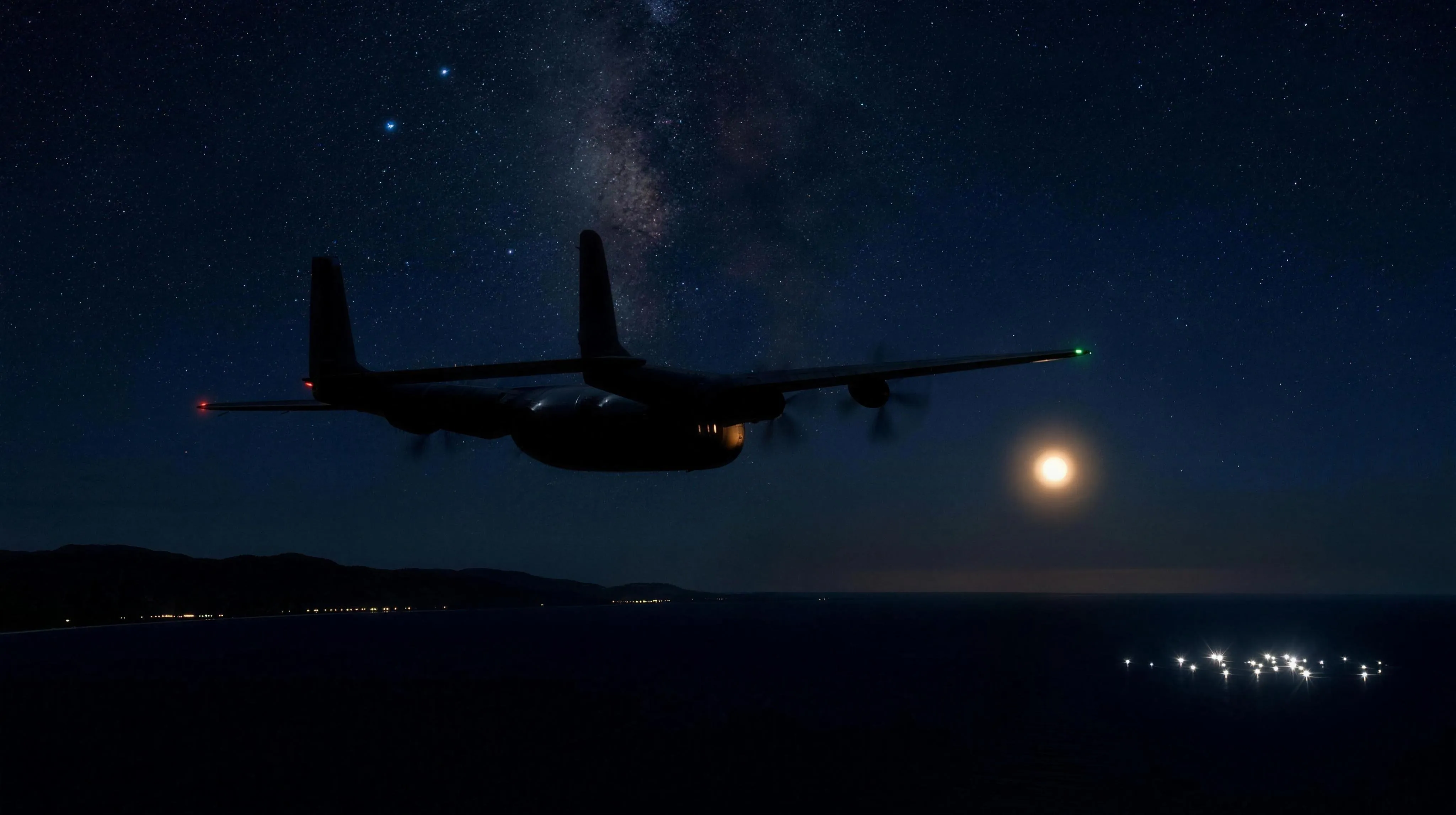
- The hero image is generated, but its airframe is not guessed: a render of this instrument's own AW.650 Argosy mesh, gear up and at the hero's viewing angle, was supplied to the image model as a shape reference, because four unguided attempts had all drawn a conventional single-fuselage transport instead of a twin-boom Argosy. The result was then checked against the bench: navigation lights measured red to port and green to starboard for an aircraft flying away, the reported light out beyond the starboard wing where the record puts it, no moon, and no reflection under the light, which is the point Maccabee's own analysis rests on. An earlier hero was withdrawn when that same check found its lights reversed, its airframe wrong and the light off the port side.
- Cross-referenced instruments on this site: INST-30, Washington 1952, for the anomalous-propagation craft; INST-41, Fata Morgana, for horizon optics; INST-54, the Belgian Wave, whose computed-sky machinery this bench extends with planets; and the station's wiki entry on the Kaikoura lights.
Refly the night. Aim the ray. Slide the distance. Raise the target. Then decide what flew beside the Argosy, and what was only ever arithmetic.
Open the interactiveCompiled August 2026