No Smoke, No Flame
Chapter 5 of Future Visions preserves the hardest eleven words in the AAWSAP canon. March 1967: Cuban radar tracks a bright metallic sphere at 660 mph, 33,000 feet; two MiG-21s close to three miles; Havana orders the leader to fire; his radar is locked, his missiles armed. Within seconds the wingman is screaming that the leader's jet has exploded. "There was no smoke or flame. The plane just disintegrated." This bench prices that sentence. The word disintegrated spans five rungs whose costs differ by five powers of ten, and every rung prints a receipt. Tearing the jet into assemblies costs a megajoule, nothing, the jet's own kinetic energy is hundreds of times more, but then five tonnes of metal rain for eighteen minutes over the radar net that was watching, ninety-eight thousand skin plates, twenty-nine thousand chaff cartridges' worth, with an engine block on Cuba inside a minute. Grinding it to dust costs gigajoules and manufactures the thing denied by name: twenty-two hectares of airborne metal is smoke, by definition. And the only rung that leaves nothing to fall, boiling the machine away at 13.7 MJ/kg, costs sixty-four gigajoules delivered in seconds: a fifty-seven-metre glow sphere at gigawatts, up to sixty suns on the wingman's canopy, and then the aluminium vapor reburns in air, seven and a half tonnes of the white smoke solid rockets make. The sentence forbids the flash, the colour, and the rain, all at once. Two verdicts at equal size; the numbers are sourced; the reading is yours.
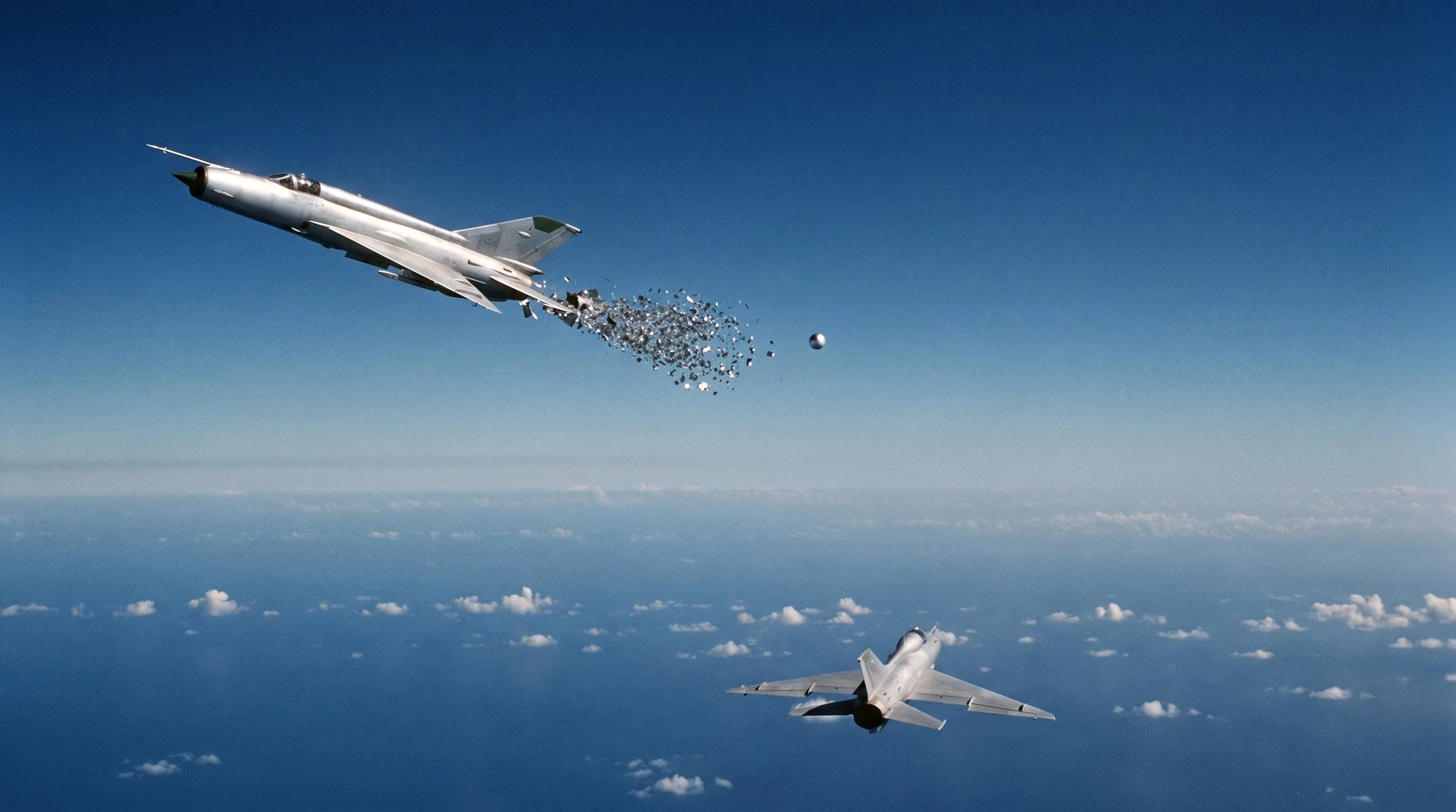 Open the interactive ▸
 What you're looking at
The ladder is the bill: the five rungs of "disintegrated" on a logarithmic energy axis, from tearing (about a megajoule, with its bracket drawn) through confetti, dust and melt to vapor at 64 GJ, against rulers the case itself supplies: the jet's own 269 MJ of kinetic energy, one K-13 warhead, a lightning flash, tonnes of TNT, milligrams of antimatter. Each rung names its receipt: it rains, it smokes, or it shines. A mass dial spans the empty jet to maximum take-off, so no single assumption is load-bearing.
The wingman is the seat: two MiG-21s at 33,000 feet, the sphere three miles ahead, and the event replayed at any rung with real drag and real fall: assemblies stop with the air and drop, confetti streams aft into a glittering rain, dust hangs as a cloud, vapor flashes and turns to white smoke. One switch replays the record's own version, in which nothing shines and nothing falls; the bench stamps it NO RUNG SOLD. The verbatim sentence stays on screen against whatever the sky is doing.
The receipts are the two bills in detail. The flash: the glow sphere's radius, power and cooling time at each settle temperature, the sun and the sphere drawn to angular scale in one sky, the aluminium reburn with its +123 GJ and 7.5 tonnes of Al₂O₃, and the whole bill converted into the book's own antimatter currency (0.36 mg). The rain: fall time against fragment size down the standard atmosphere, the plate census, the chaff arithmetic, the dust cloud's 22 hectares, the kerosene that must go somewhere.
The file hangs twelve cards: the listening post, the intercept, the sentence itself, the exit, the word-as-dial, the free bottom, the loud bottom, the expensive top, the receipts, the audited antimatter aside, the sourced counter-reading, and the paperwork trail with its NSA tape order. Below them, two verdicts at exactly equal size.
Why it's here
The station's review of Future Visions records what that book is: the AAWSAP program's own file, written by its director James Lacatski. Chapter 5, the armament overview, lines up sixty years of electromagnetic-interference cases, and the physically hardest paragraph in the line is the March 1967 Cuba intercept: a speed, an altitude, a vector range, an order sequence, and then an eleven-word closing statement: "There was no smoke or flame. The plane just disintegrated." Most anomalies in the book cannot be computed. This sentence can: every rung of what "disintegrated" could mean has a handbook price, and every price comes with a receipt a wingman cannot avoid. This bench puts the whole ladder on the table.
It also continues two existing lines. On the same-book line, INST-73 The Radiation Dose priced the medical verdicts of PMPA #6 and INST-82 The Skinwalker Spectrum audited chapter 11's RF paragraph; this bench takes up chapter 5, the third computable record this book has surrendered. On the casework line, INST-36 Mantell 1948 is the other interceptor-loss case: that one has a wreck, an autopsy and a file, a demonstration of how much paperwork a real intercept loss generates. This case is its opposite: one scream relayed by a listening post, and a sentence physics cannot buy whole. The bench does not rule on what happened that day; it computes what each reading of the sentence owes, and hangs the two verdicts at equal size.
How it works
Everything on the bench is either a quoted document or arithmetic on handbook constants: the passage and its 1978 primary print, the type masses, NIST-JANAF enthalpies, fracture work, blackbody radiation, terminal velocity. A script that ships with the site re-derives every displayed number before the build is allowed to pass, including the four the whole bench turns on: the 13.7 MJ/kg anatomy, the 64 GJ bill, the 57-metre glow sphere with its seconds-long clock, and the eighteen-minute rain.
ladder: ~1 MJ (tear) → GJ (dust · melt) → 64 GJ (vapor) · KE 269 MJ · sphere r ≈ 57 m · 12-183 GW · τ 0.3-5 s · rain: 98k plates · 18 min · 29k chaff
The ladder is integrated, bracketed, and dial-tested. Solid-aluminium heating uses NIST-JANAF's integrated enthalpy, not a constant-cp shortcut (9% low); the engine runs a separate iron ladder; estimated rungs (tearing, comminution) are drawn as bands between a physical floor and a ductile ceiling, never as false-precision lines. The mass dial moves the bill between 61 and 81 GJ without moving any conclusion.
The fireball model is deliberately minimal. Heat this large, put into air this thin, makes a sphere whose size barely depends on anything else: pressure-equilibrium heated air holding 64 GJ at 10 km is about 57 m in radius at any settle temperature on the dial. Temperature only trades brightness against duration (12 GW for five seconds, or 183 GW for a third of one), which is why there is no quiet setting: the wingman's canopy reads suns across the whole honest box.
The chemistry is not optional. Aluminium vapor in air is a rocket propellant mid-burn: reburn adds nearly twice the original bill and condenses to Al₂O₃, the dense white primary smoke of solid boosters. The strong reading cannot end at a flash; it must also paint the sky the one colour the sentence names and denies.
The cheap rungs are priced as evidence, not energy. Breaking is energetically free (the airspeed pays), and at −50 °C the bench honestly declines to force a fireball on misted kerosene. What it prices instead is the fall: terminal velocities integrated down the standard atmosphere give the engine under a minute, the plates eighteen minutes, the dust days; and the chaff arithmetic states what four tonnes of falling aluminium does to the radar net that was, by the record's own account, watching.
What survives every dial is worth stating: the loss of a jet is kept by every reading, including the sourced prosaic one; the sentence describing that loss buys none of its own clauses together; and the file around the sentence (one source, tapes to NSA, a malfunction log entry, no wreck) is exactly as strange as the sentence itself. Whether that adds up to an event that outran physics or a story that outgrew its tape is the reading the bench leaves to you.
The dials that decide what happens
A mass dial, a rung dial, a record switch, a timeline, two camera distances and a free orbit, a settle temperature, a radiated fraction. Between them they assemble and disassemble one sentence of the AAWSAP record, which is the exhibit.
- The mass dial. Empty jet, combat take-off with two R-3S, maximum. The bill runs 61 to 81 GJ; the verdicts do not move.
- The rung dial. Assemblies, confetti, dust, vapor: the four things "disintegrated" could mean, each with its price and its receipt.
- The record switch. Replays the book's version: a jet becomes absence, quietly. The bench stamps the frame NO RUNG SOLD.
- The timeline. Six seconds before the event to forty after: the scream happens at second zero; physics happens for twenty minutes.
- The spread distance. Fighting wing, combat spread, a loose mile: how far the witness sits from the receipt.
- The settle temperature. 1,500 to 3,000 K: dim-and-long against bright-and-brief. The sphere's size barely moves; the impossibility doesn't either.
- The radiated fraction. A quarter to all of it: generosity toward the quiet version, which still reads in suns.
- The camera. The seat (a fixed gaze, the honest view), track (follow the debris), orbit (free).
The claims, as they stand
Six claims that orbit the March 1967 loss, from the record's own sentences to the readings built on and against them, with where each lands.
| Two MiG-21s were vectored onto a sphere, and the leader was lost seconds after arming his missiles proposed by the record, as relayed by the AFSS listening post | AS HEARD | Taken as heard. The loss of an aircraft is the one element every reading keeps, including the sourced prosaic counter-reading; and interceptors have been lost chasing misread targets before (this station's Mantell bench is the documented case). |
| The plane "just disintegrated": no smoke, no flame, and nothing further proposed by the record's central sentence | REFUTED | Refuted as a whole sentence, at every rung. Truly unmade (dust or vapor) it must smoke by definition or shine at gigawatts and reburn white; merely broken it must rain five tonnes of metal for twenty minutes over a watching radar net and leave an engine in the ground. Each rung prints a receipt one clause of the sentence denies. What cannot be bought is the conjunction. |
| The sphere destroyed the jet with an exotic weapon proposed by the book's framing (the passage sits in its armament chapter) | CONTESTED | Contested, and not resolvable from one sentence: the bench prices what ANY mechanism must show, and the floor is unkind to the exotic version too. A weapon that vaporises pays the 64 GJ bill in public, in light and white smoke; a weapon that merely breaks leaves the same rain as an accident. The weapon reading inherits whichever receipt it picks. |
| It was an own-missile accident at the moment of arming proposed by the standard prosaic suspect for a jet lost while arming | CONTESTED | Contested by the record's own words: a K-13 warhead is tens of megajoules of high explosive whose entire signature is flame, smoke and fragments, exactly what the sentence denies; and the debris story is still owed. The mundane reading and the exotic reading die on the same clause. |
| The bogey was an SR-71 overflight and the MiG destroyed itself lighting afterburner in a zoom climb proposed by Tom Deuley (NICAP, 2001), from Homestead-era intelligence officers | CONTESTED | Contested and priced: the one sourced counter-reading on file. It explains the bogey (Cubans routinely chased U.S. reconnaissance) and the loss, and "unidentified" may be a translation artefact. But an afterburner detonation is a fireball by definition, and the fall is still unpaid: the counter-reading covers everything except the sentence's strange clause, which is the clause this bench exists to price. |
| The account reached print faithfully: specialist → Friedman → UPI → CAUS/IUR → AAWSAP → this book proposed by the provenance chain, verified against the 1978 scan | AS HEARD | Measured as far as paper goes: the 2024 passage tracks the 1978 print in every number (660 mph, 33,000 ft, three miles, the sphere, the climb past 100,000 ft). What never joined the chain is a second source: no Cuban record, no released tape, no wreck, no name. The file about the file (NSA tape order, malfunction logging, the FBI visit) is part of the same single account. |
Try this
- Start on the ladder. Five rungs, five powers of ten, and the KE line sitting hundreds of times above the bottom rung: breaking a jet is self-financing.
- Play the record switch first. Watch the book's version: the leader simply stops existing. Then flip the switch off and buy the same absence at the vapor rung.
- Play PIECES and wait one minute. The engine block is already down. The record has no crater and no search.
- Play CONFETTI and look back. Ninety-eight thousand plates stream aft and rain for eighteen minutes: the best chaff bloom in the Caribbean, over a net that was recording.
- Play DUST and read the strip. Twenty-two hectares of hanging metal. The rung that leaves nothing to find is smoke by definition.
- Play VAPOR. A 57-metre sphere at gigawatts, then the white plume. Turn the temperature dial: brighter is briefer, and there is no quiet corner.
- Open the receipts and count suns. At combat spread the canopy reads about two suns on the middle dials; at fighting wing on the hot dial, sixty.
- End on the file. The counter-reading card explains everything except the clause; the paperwork card ends at NSA. Two verdicts, equal size; the reading is yours.
Accuracy
The honest line between what is reported, what is derived, what is modelled, and what is a reading:
| Feature | Status | What that means |
|---|---|---|
| The passage | Reported | The intercept, the order, the kill sentence and the exit, verbatim from Future Visions ch. 5 (pp. 33-34). Its own note 4 was traced to the primary print: International UFO Reporter Vol 3 No 9 (September 1978), checked against the CUFOS scan, which also carries the NSA tape order, the instruction to log the loss as "equipment malfunction", and the FBI's counterespionage-captioned visit to the researcher who pressed NSA. No independent record of the event exists on either side of the Florida Straits. |
| The external baselines | Reported | MiG-21F-13 reference masses (empty 4,871 kg with a documented spread to 4,980; combat take-off 7,370 kg with two R-3S; max 8,625 kg), the R-11F-300's 1,124 kg, internal fuel 2,115 kg, skin gauges 1.2-3.5 mm D-16, per the type references; the K-13's 75 kg launch mass and 11.3 kg warhead; the Armtec RR-129A/AL chaff cartridge's 139 g ejected payload; Cuba's 1967 fleet (F-13 plus newly arrived PFM/PFMA) per the operator histories. |
| The ladder | Derived | The energy bill of each rung of "disintegrated": tearing (ductile work at K²/E with a stated ×0.3/×3 bracket), confetti and dust (crack-area geometry between the surface-energy floor and the ductile ceiling, drawn as bands), melting and vaporising (NIST-JANAF integrated enthalpies, not constant-cp shortcuts: 13.7 MJ/kg for aluminium, 8.5 for the engine's iron). Rulers: TNT at 4.184 MJ/kg, the jet's own 269 MJ of kinetic energy, one K-13 warhead, the book's own antimatter currency. Re-derived by scripts/mig21-disintegration-tune.mjs before every build. |
| The receipts | Modelled | The glow sphere: the vapor bill dumped into 0.41 kg/m³ air at pressure equilibrium, radiating as a blackbody; its ~57 m radius is set by the energy and the altitude, its brightness-duration trade by the settle temperature on the dial. Canopy flux by inverse square at the spread distance. Fall times by terminal velocity integrated down the standard atmosphere. The 3D scene is staging for these numbers, and is labelled staging. |
| The verdicts | Reading | Whether the sentence records an event that would have shone (and so disproves its own strongest sense) or an ordinary loss missing its debris story (and so starves as evidence). Two conditional prices, hung at equal size; the bench does not vote between them. |
In one line: the passage, its 1978 primary print and the type data are REPORTED, quoted verbatim with the event attributed to its single source throughout; the energy ladder is DERIVED from NIST-JANAF enthalpies and fracture work with brackets drawn on every estimated rung; the glow sphere, canopy flux, fall times and 3D staging are MODELLED and labelled as such, re-checked by scripts/mig21-disintegration-tune.mjs before the build passes; and whether the sentence records an event that outran physics or a story that outgrew its tape is a READING the bench declines to make, hanging two verdicts at exactly equal size. Read the ladder, play the seat, price the sentence yourself.
Sources
- James T. Lacatski, Colm A. Kelleher and George Knapp, "Inside the U.S. Government Covert UFO Program: Future Visions" (2024), ch. 5 (UAP Armament Overview), pp. 33-34 for the Cuba passage (quoted verbatim) and p. 37 for the antimatter aside; the chapter's references map it to the AAWSAP Technical Studies of John Schuessler and EarthTech (2008), and its note 4 is the IUR piece below.
- "Two Cuban Jets Pursue a UFO: The UFO Destroys One Jet", International UFO Reporter (CUFOS), Vol 3 No 9, September 1978, pp. 11-12, checked against the scan at cufos.org: the primary print. Chain per its own text: an anonymous specialist of the 6947th Security Squadron (HQ Homestead AFB; Detachment A at Key West NAS) told Stanton Friedman after a lecture; a UPI dispatch of 12-13 January 1978 spread it; Brad Sparks and Todd Zechel (CAUS) worked up the details with Robert Todd's FOIA follow-up. The same text carries the NSA tape order, the "equipment malfunction" logging instruction, and the 28 July 1978 FBI interview of Todd under a counterespionage caption.
- Lawrence Fawcett and Barry J. Greenwood, "Clear Intent: The Government Coverup of the UFO Experience" (Prentice-Hall, 1984), pp. 195-201: the retelling that carried the case into the literature.
- Tom Deuley, "1967 Cuban Jet Incident: Case Solved" (NICAP, 1 May 2001): the sourced prosaic counter-reading (SR-71 target; afterburner-triggered loss in a zoom climb; the translation note on "unidentified"), quoted as such and priced on the bench.
- MiG-21F-13 type references: Jane's (migavia) for masses, alloys (D-16, V-95, ML5T4, AK4-1; 30KhGSA steel at load points) and the 1.2-3.5 mm skin gauges; Skytamer and MILAVIA for the weight set (empty 4,871-4,980 kg; with two R-3S 7,370 kg; max 8,386-8,655 kg); the Smithsonian NASM record for the R-11F-300's 1,124 kg; Rubén Urribarres' Cuban air force history for the 1967 fleet (F-13 from 1962-63; PFM/PFMA arriving 1966-67).
- K-13 / R-3S (AA-2): 75 kg launch mass, 11.3 kg SB03 blast-fragmentation warhead with 5.3 kg TGAF-5 fill, per the standard missile references.
- Aluminium and iron thermodynamics: NIST-JANAF tables (solid-Al enthalpy H(933)−H(298) = 16.89 kJ/mol; liquid cp 31.75 J/mol·K; iron's integrated 1,040 kJ/kg to the melt), CRC values for melting/boiling points (933.47 K / 2,743 K) and heats of fusion/vaporisation (397 / 10,526 kJ/kg); Al₂O₃ formation −1,675.7 kJ/mol (CODATA). The white-smoke line is standard solid-rocket plume literature: condensed Al₂O₃ is the principal primary smoke of aluminised propellant exhaust.
- Fracture pricing: plane-stress tearing work G ≈ K²/E for 2024-class aluminium (K ≈ 30 MPa·√m, E ≈ 73 GPa → ≈12 kJ/m²), with the pure surface energy (1.14 J/m²) shown as the thermodynamic floor and a stated bracket on every estimated rung.
- US Standard Atmosphere (1976) at 33,000 ft / 10,058 m: 222.9 K, 26.44 kPa, 0.413 kg/m³; fall times integrate terminal velocity down the standard density profile.
- Chaff: Armtec RR-129A/AL cartridge data (167 g total, 139 g ejected payload; ~36 × 148 mm), with the aluminium-on-glass-fibre composition per the standard countermeasures references. The census counts ejected-payload equivalents.
- Scale references: Brown et al., Nature 503 (2013) and Popova et al., Science 342 (2013) for Chelyabinsk's 3.75×10¹⁴ J of radiated light and brighter-than-the-Sun reports at 100 km; solar constant 1,361 W/m².
- This site's review of Future Visions (Culture 01), its Radiation Dose bench (INST-73, the same book's PMPA #6) and its Skinwalker Spectrum bench (INST-82, the same book's ch. 11): the same-source line this bench extends.
One sentence, five rungs, two receipts it cannot pay. Price it yourself.
Open the interactiveCompiled August 2026