Entanglement
Make two particles in one quantum breath and send them apart. Measure one and the other answers in lockstep, too tightly for any "they agreed in advance" story to explain. Einstein called it spooky. John Bell turned the argument into a number you can measure.
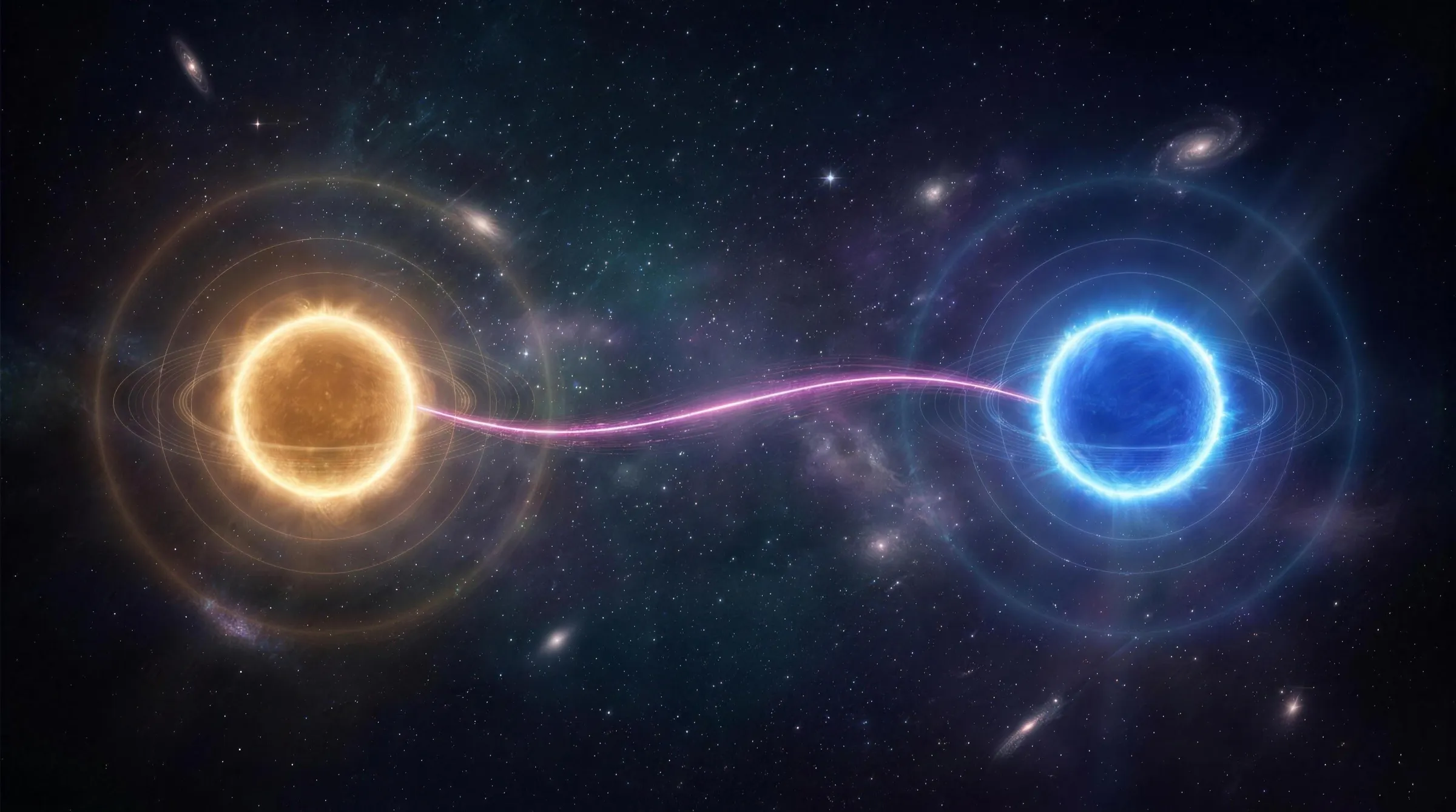 Open the interactive ▸
 What you're looking at
A source in the middle fires entangled pairs, one particle to Alice on the left, one to Bob on the right. Each runs into an analyzer set to some angle, and each gives a plain ±1: a coin-flip, 50/50, no matter the angle. Nothing you measure on one side tells you anything on its own.
The story is in the correlation between the two sides. The graph along the bottom plots that correlation, E = ⟨A·B⟩, against the angle between the analyzers. For real entangled particles it traces a smooth cosine, E(θ) = −cos θ (the cyan curve). The dashed line is the best a "local-realist" world could ever do: particles carrying secret instructions agreed on at the source. The cosine bows outside that line, and that gap is the whole game.
The gauge on the left turns the gap into one number: the CHSH parameter S. Any world where the particles had definite, locally-carried properties is stuck at |S| ≤ 2. Quantum mechanics, and our universe, runs all the way up to 2√2 ≈ 2.83. Flip the toggle between the quantum source and a local hidden-variable source and watch one sail past 2 while the other can't. Drag the analyzer angle, add detector noise, sweep the full curve, or take the guided tour.
Why it's here
This is the second of the site's quantum pieces, the partner to the Double-Slit. The slit showed a single particle behaving like a wave of possibility. Entanglement asks the next question: when that possibility is shared between two particles, how real are their properties before you look? Einstein's answer was the sane one: they must be real and local, fixed at the source, and quantum mechanics is just too coarse to see them. He was, as far as any experiment can tell, wrong.
That is why it sits at the heart of the site's recurring question, what is actually real, alongside the spacetime pieces. Where Black Hole and Wormhole bend the stage, entanglement bends our grip on the actors: it says the world cannot be both local (no instantaneous influence across distance) and real (properties that exist before measurement). One of those has to go. And, unlike most foundational arguments, this one was settled in a laboratory, and won the 2022 Nobel Prize.
How it works
Two particles are made in a joint singlet state. Measure Alice's along angle a and Bob's along b, each gets ±1, and quantum mechanics predicts their correlation depends only on the angle between the settings, θ = a − b: E(a, b) = −cos(a − b). At equal settings the outcomes are perfectly anti-correlated (E = −1); at right angles, uncorrelated (E = 0). Crucially, each side alone is still 50/50, so you cannot signal with entanglement, and relativity is safe.
To test reality itself, Clauser, Horne, Shimony & Holt (1969) combined four such correlations into one number, the CHSH parameter: S = E(a, b) − E(a, b′) + E(a′, b) + E(a′, b′).
Bell's theorem (1964): in any theory where the outcomes are set by local hidden variables carried by the particles, |S| ≤ 2. No exceptions, no loopholes in the maths, it is a theorem. Quantum mechanics, with the cosine correlation and the right angles, reaches |S| = 2√2 ≈ 2.83, the Tsirelson bound. (In this simulation the four terms collapse, by symmetry, to a single spacing φ, so the meter shows S = 3·E(φ) − E(3φ), maximal at φ = 45°.)
The simulation runs two sources. The quantum one samples each pair from the exact singlet probabilities. The local hidden-variable one gives each pair a shared random instruction λ and lets each particle answer from λ and its own local angle, a genuine local-realist model. Watch it: its correlation can only ever be the straight line, and its S sits at 2. It physically cannot reach the cosine. A noise slider mimics imperfect sources (photon experiments report S near 2.7, and the 2015 loophole-free spin test 2.42, not 2.83), and below about 71% visibility the violation vanishes entirely.
The two universes
The toggle is the whole argument in one switch.
- Quantum (entangled singlet). The particles share one state with no separate properties of their own until measured. Correlations follow −cos θ; the CHSH meter climbs to ~2.83 and the verdict reads local realism ruled out. This is our universe. Verdict: violates Bell, nonlocal/non-real.
- Local hidden-variable (secret instructions). Einstein's preferred world: each particle leaves the source carrying a definite answer for every possible measurement. Reasonable, intuitive, local. But its correlations are forced onto the straight line, and its CHSH parameter cannot pass 2. Verdict: obeys Bell, and disagrees with experiment.
The point of running both is to feel the trap close: the local-realist universe is the sensible one, and it is the one nature rejects.
Accuracy
The honest line between what is exact and what is dialled for display:
| Feature | Status | What that means |
|---|---|---|
| Singlet correlation E(θ) = −cos θ | Established | The exact quantum-mechanical prediction (Born rule) for two spin-½ particles in the singlet state. Sets the cyan curve and every sampled point. |
| Bell/CHSH bound: any local hidden-variable theory has |S| ≤ 2 | Established | A theorem (Bell 1964; CHSH 1969). Not a model or an approximation, a proof. The dashed line and the "2.0" mark are this bound. |
| Quantum maximum |S| = 2√2 ≈ 2.83 | Established | The Tsirelson bound (1980): the most any quantum state can violate CHSH. The meter's ceiling. |
| Experiments violate the bound | Established | Freedman–Clauser 1972; Aspect 1982; loophole-free 2015 (Delft, NIST, Vienna). Nobel Prize 2022. Observed fact, not theory. |
| No-signaling: each side stays 50/50 | Established | The marginals are independent of the distant setting, so entanglement can't send a message. The "Alice +%, Bob +%" readouts show this live. |
| What entanglement is; whether the influence is "real" | Theoretical | Copenhagen, many-worlds, Bohmian (explicitly nonlocal) and others agree on every number but disagree on the picture. Genuinely unsettled. |
| The remaining superdeterminism / freedom-of-choice loophole | Theoretical | If the settings aren't freely chosen but correlated with the hidden variables, local realism survives in principle. Cannot be fully closed by any experiment. |
| Real experiments reach S ≈ 2.7 with photons, 2.42 in the 2015 loophole-free spin test, not 2.83 | Stylised | Aspect, Grangier and Roger 1982 report S = 2.697 ± 0.015 and Weihs et al. 1998 report 2.73 ± 0.02, both with photon pairs; Hensen et al. 2015, the loophole-free electron-spin test, reports 2.42 ± 0.20. Detector inefficiency, noise and imperfect entanglement set how far below 2.83 a given bench lands. The visibility slider models this crudely; below ~71% the violation disappears. |
| Event rate / how fast S converges | Stylised | Dialled for watchability. Real coincidence rates and run times are far slower. |
| Outcomes sampled from the Born distribution; one representative LHV model | Illustrative | The sim draws results from the correct probabilities rather than simulating measurement/collapse, and shows one local-realist model, but the |S| ≤ 2 bound holds for all of them. |
| The analyzer cartoon and the two-universes toggle | Illustrative | A teaching staging of a real optical bench (entangled photons, polarizers, coincidence counters). Faithful to the result, not the hardware. |
In one line: the −cos θ correlation, the |S| ≤ 2 theorem, the 2√2 quantum ceiling, the experimental violation and the no-signaling rule are exact, established physics; only the event rate, the noise model and the analyzer cartoon are dialled for display, and what the violation means about reality is the part still argued over.
Sources
- Einstein, A., Podolsky, B., & Rosen, N. (1935). Can Quantum-Mechanical Description of Physical Reality Be Considered Complete? Phys. Rev. 47, 777. The EPR argument for hidden variables.
- Bohm, D. (1951). Quantum Theory. Prentice-Hall. The spin-½ ("Bohm") reformulation of EPR used here.
- Bell, J. S. (1964). On the Einstein Podolsky Rosen Paradox. Physics 1, 195. The inequality that made it testable.
- Clauser, J. F., Horne, M. A., Shimony, A., & Holt, R. A. (1969). Proposed Experiment to Test Local Hidden-Variable Theories. Phys. Rev. Lett. 23, 880. The CHSH form.
- Freedman, S. J., & Clauser, J. F. (1972). Experimental Test of Local Hidden-Variable Theories. Phys. Rev. Lett. 28, 938. First experimental violation.
- Aspect, A., Grangier, P., & Roger, G. (1982). Experimental Realization of Einstein-Podolsky-Rosen-Bohm Gedankenexperiment: A New Violation of Bell's Inequalities. Phys. Rev. Lett. 49, 91. Two-channel polarizers, S = 2.697 ± 0.015.
- Aspect, A., Dalibard, J., & Roger, G. (1982). Experimental Test of Bell's Inequalities Using Time-Varying Analyzers. Phys. Rev. Lett. 49, 1804. Closing the locality loophole.
- Cirel'son (Tsirelson), B. S. (1980). Quantum Generalizations of Bell's Inequality. Lett. Math. Phys. 4, 93. The 2√2 bound.
- Weihs, G., Jennewein, T., Simon, C., Weinfurter, H., & Zeilinger, A. (1998). Violation of Bell's Inequality under Strict Einstein Locality Conditions. Phys. Rev. Lett. 81, 5039. S = 2.73 ± 0.02.
- Hensen, B., et al. (2015). Loophole-free Bell inequality violation using electron spins separated by 1.3 km. Nature 526, 682. S = 2.42 ± 0.20. Plus Giustina et al. and Shalm et al., 2015.
- The Nobel Prize in Physics 2022, Aspect, Clauser & Zeilinger, "for experiments with entangled photons, establishing the violation of Bell inequalities."