Double-Slit
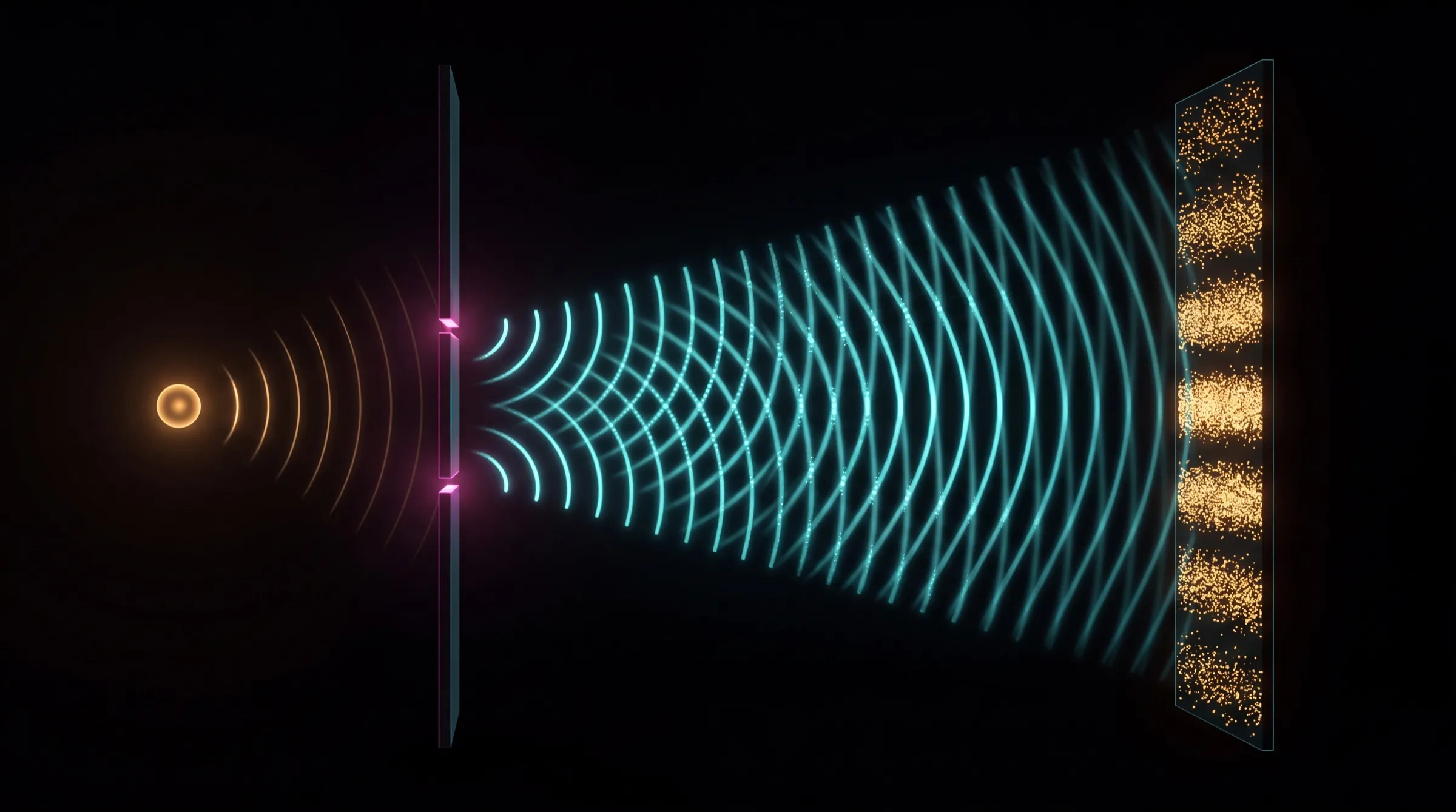
Fire one particle at a wall with two openings and it lands as a single dot, a particle. Fire thousands and they stack into stripes only a wave can make. Try to catch which slit each one used, and the stripes vanish.
 Open the interactive ▸
 What you're looking at
Two panels, one experiment. Along the top, a not-to-scale schematic: a source on the left, a barrier with two narrow slits, a screen on the right. A particle leaves the source, passes through the slits, and strikes the screen, where it leaves exactly one dot. Below is that screen, seen face-on, filling up dot by dot as the beam runs.
Watch one particle and you see a single hit: a particle, in one place. Watch thousands and a pattern emerges that no stream of tiny pellets could make: a row of bright bands separated by dark gaps. That is an interference pattern, the signature of a wave passing through both slits at once and overlapping with itself. The thin curve drawn over the screen is the probability P(y) that sets where each dot is allowed to fall; the dots are the experiment, the curve is the wave behind them.
You can fire photons, electrons, or whole C₆₀ molecules; drag the wavelength, the slit spacing and width, and the distance to the screen; speed up or slow down the beam; show or hide the wave curve and the single-slit envelope. And you can turn up a which-path detector, a device that finds out which slit each particle took. As it sharpens, the stripes fade. At full strength they are gone, leaving a single broad smear. Knowing the path costs you the wave.
Why it's here
The rest of this site bends spacetime, with mass (Black Hole, Wormhole) and with speed (Warp Drive and the relativity pieces). Those are the two great levers of the classical universe. The double-slit opens the other half of modern physics: the quantum world, where matter itself is wave-like and a thing's location is a question with no answer until it is asked.
It is the cleanest demonstration there is that nature is not made of little billiard balls. Richard Feynman put the experiment at the very front of his quantum lectures and called it "a phenomenon which is impossible … to explain in any classical way, and which has in it the heart of quantum mechanics. In reality, it contains the only mystery." Everything stranger that follows, superposition, entanglement, tunnelling, the uncertainty principle, is this mystery wearing different clothes. Start here.
How it works
In the far field (the screen far beyond the slits), the brightness across the screen is the product of two factors: P(y) ∝ sinc²(πa·sinθ / λ) · [ 1 + V·cos(2πd·sinθ / λ) ], with sinθ = y / √(y² + L²), slit width a, slit separation d, wavelength λ, and screen distance L.
The left factor is the single-slit envelope, the broad blur one slit alone makes. The right factor is the two-slit interference, the fast fringes from the two openings beating against each other. Their product is the familiar striped pattern under a wide hump. The bright fringes sit a distance Δy = λL/d apart; the central hump is about 2λL/a wide and holds roughly 2d/a fringes.
What makes a particle behave as a wave is its de Broglie wavelength, λ = h/p (h is Planck's constant, p the momentum). A red photon's is ~600 nm; a 50-keV electron's is a few picometres; a flying C₆₀ molecule's is a couple of picometres; a thrown baseball's is about 10⁻³⁴ m, so absurdly small that its fringes are about 20 orders of magnitude finer than an atom, which is why a baseball never visibly interferes. The simulation refuses to draw a pattern in that case, and says so.
The which-path detector is governed by an exact trade. Define the path distinguishability D (0 = no idea which slit, 1 = certain) and the fringe visibility V (1 = full stripes, 0 = none). For an ideal experiment they obey V² + D² = 1, so V = √(1 − D²). This is complementarity, made quantitative by Englert (1996): wave behaviour and path knowledge are a single budget you cannot overspend. The slider moves you along that curve.
The geometry and the numbers on screen are the real, established physics. What the simulation stylises is the picture: the apparatus is a cartoon, the dots are drawn from P(y) rather than from a full wavefunction calculation, the beam runs far faster than a real single-particle source, and the smooth which-path dial idealises a messy real detector. None of that softens the verdict the experiment has returned for two centuries: one particle, both paths, until you look.
The four sources
- Photon · red laser (632.8 nm): Thomas Young's original 1801 demonstration, and the one you can do with a cheap laser pointer today. Light is a wave; of course it interferes. Verdict: interference, textbook.
- Electron · 50 keV: a particle with mass, and it interferes just the same. Built up one electron at a time by Tonomura and colleagues in 1989, who filmed a blank screen turning into fringes over about twenty minutes. Verdict: interference, single particles.
- C₆₀ buckyball: a molecule of sixty carbon atoms, about 1.3 million times heavier than an electron and large enough to photograph, still draws fringes (Arndt & Zeilinger, Vienna, 1999), at a de Broglie wavelength of a few picometres. Verdict: interference, at the edge of the everyday.
- Baseball (145 g, 40 m/s): the same law, λ = h/p, applied to a thrown ball gives a wavelength near 10⁻³⁴ m. The fringe spacing is ~15 orders of magnitude smaller than an atomic nucleus: real, but forever unmeasurable. Verdict: classical. No pattern is observable.
Accuracy
The honest line between what is exact and what is dialled for display:
| Feature | Status | What that means |
|---|---|---|
| Far-field intensity P(y) ∝ sinc²(πa·sinθ/λ)·[1+V·cos(2πd·sinθ/λ)] | Established | Standard Fraunhofer diffraction of a two-slit aperture. Sets the exact shape of the curve and where every dot may land. |
| de Broglie wavelength λ = h/p for photon, electron, C₆₀, baseball | Established | Measured for all of these (electron λ relativistic from the accelerating voltage). The numbers in the readout are real. |
| Single particles interfere; the pattern builds one dot at a time | Established | Taylor 1909 (feeble light), Merli–Missiroli–Pozzi 1976, Tonomura 1989. A particle interferes with itself; this is observed fact. |
| Matter waves up to large molecules | Established | C₆₀ (Arndt & Zeilinger 1999) and, since, far heavier molecules. Wave behaviour is not special to light or electrons. |
| Complementarity bound V² + D² ≤ 1 (= 1 for a pure state) | Established | A theorem (Englert 1996). The visibility/which-path trade the detector slider rides is exact. |
| What the wavefunction is; what "collapse" means | Theoretical | Copenhagen, many-worlds, pilot-wave and others make identical, confirmed predictions but disagree on the ontology. Genuinely unsettled. |
| Where the quantum→classical boundary actually sits | Theoretical | Decoherence explains the appearance of collapse; objective-collapse models (GRW, Penrose) propose a real line and are being tested. Open. |
| Real-scale figures (e.g. baseball λ ≈ 10⁻³⁴ m; fringe spacings) | Stylised | Order-of-magnitude from λ = h/p and Δy = λL/d. The values and the baseball gap are robust; exact prefactors depend on the setup. |
| Beam rate / how fast the pattern fills | Stylised | Dialled for watchability. Tonomura's real single-electron pattern took ~20 minutes; here it is seconds. |
| Which-path shown as one smooth dial with V = √(1−D²) | Illustrative | The bound is exact, but a real detector is a messy physical system and partial decoherence is more complex than a single knob. |
| Dots sampled from P(y); apparatus cartoon; slit sizes to human scale | Illustrative | The sim draws hits from the probability rather than evolving and collapsing a wavefunction; the top strip is not to scale. Faithful to the result, not the mechanism. |
In one line: the interference, the single-particle buildup, the de Broglie wavelengths and the V² + D² ≤ 1 bound are exact, established physics; only the scale figures, the beam speed and the smooth which-path dial are turned up so you can watch what the equations are saying, and what any of it means is the part still argued over.
Sources
- Young, T. (1804). Experiments and Calculations Relative to Physical Optics. Phil. Trans. R. Soc. 94, 1. The original two-slit interference of light.
- Taylor, G. I. (1909). Interference Fringes with Feeble Light. Proc. Camb. Phil. Soc. 15, 114. Fringes survive even with one quantum in flight at a time.
- de Broglie, L. (1924). Recherches sur la théorie des quanta (doctoral thesis). Matter has a wavelength, λ = h/p.
- Davisson, C. J., & Germer, L. H. (1927). Diffraction of Electrons by a Crystal of Nickel. Phys. Rev. 30, 705. First confirmation of electron waves.
- Jönsson, C. (1961). Elektroneninterferenzen an mehreren künstlich hergestellten Feinspalten. Z. Phys. 161, 454. The first true electron double-slit.
- Feynman, R. P. (1965). The Feynman Lectures on Physics, Vol. III, Ch. 1. "It contains the only mystery."
- Merli, P. G., Missiroli, G. F., & Pozzi, G. (1976). On the Statistical Aspect of Electron Interference Phenomena. Am. J. Phys. 44, 306. Single-electron buildup, Bologna.
- Tonomura, A., Endo, J., Matsuda, T., Kawasaki, T., & Ezawa, H. (1989). Demonstration of Single-Electron Buildup of an Interference Pattern. Am. J. Phys. 57, 117. The famous filmed buildup.
- Englert, B.-G. (1996). Fringe Visibility and Which-Way Information: An Inequality. Phys. Rev. Lett. 77, 2154. The V² + D² ≤ 1 bound.
- Arndt, M., Nairz, O., Vos-Andreae, J., Keller, C., van der Zouw, G., & Zeilinger, A. (1999). Wave–Particle Duality of C₆₀ Molecules. Nature 401, 680. Interference of a 60-atom molecule.
- Bach, R., Pope, D., Liou, S.-H., & Batelaan, H. (2013). Controlled Double-Slit Electron Diffraction. New J. Phys. 15, 033018. Modern, slit-by-slit controllable version.