The Sinai Fallout Ledger
Read the book's 'vast scar' as the crater it says it is and the bomb is 5.2 gigatons, 103 Tsar Bombas; even the smallest thing 'vast' could mean is bigger than Castle Bravo. Send Bravo's own measured fallout down the wind the laments describe and Ur gets 2.4 rad, a chest CT. And 4,049 years on, everything that could have hurt anyone is gone 10⁴¹ times over, while 89 % of the plutonium lies in the plain at 53,000 times background, in the Greenland ice of 2024 B.C. at a billion times what an instrument needs, and in tree rings that show nothing. One dial, one ladder, one clock, two verdicts.
 Open the interactive ▸
 What you're looking at
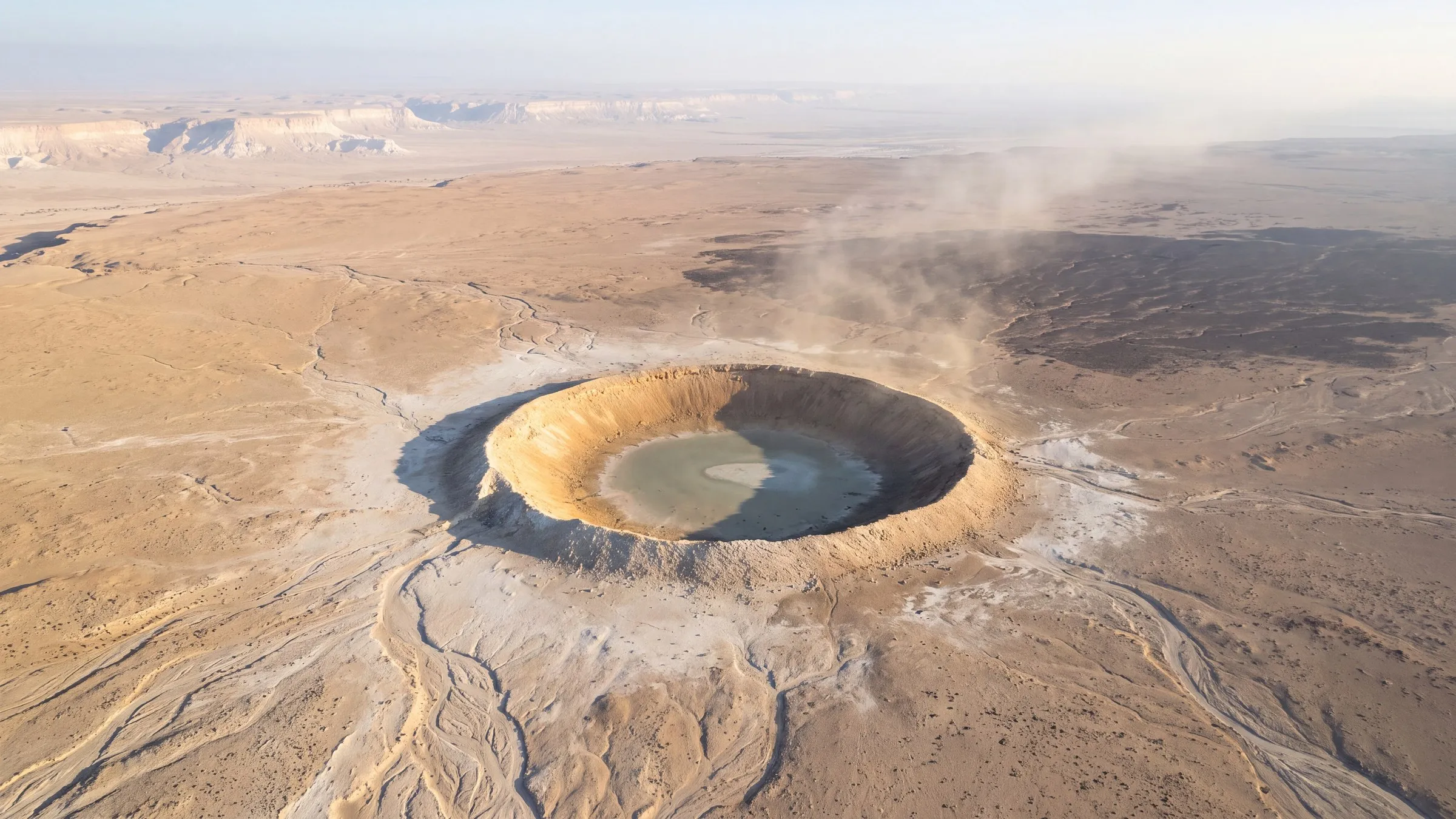
The Scar is the real peninsula in three dimensions, ETOPO relief under MODIS colour, with the crater the dial asks for cut into the central plain where the book's description puts it. A mode row reads the same scar three ways: buried at optimum depth (Sedan's way, the most generous), on the surface (Jangle Sugar's way), or as an air burst, which digs nothing. The rings of the implied yield lie on the ground, fireball, 5 psi and third-degree burns, and a wedge points down the laments' bearing toward Ur. The flash zone is tinted pale on purpose: a nuclear flash bleaches rock, it does not blacken it.
The Wind is the Near East from the scar to Anshan with the plume drawn on the bearing to Ur, 081°, and Castle Bravo's three measured doses scaled to the yield: the atolls become arcs at 160, 229 and 488 km, every Sumerian city reads its dose, and a log-log ladder shows Bravo's own curve against the dial's. Four rows price the requirement: the fission yield that puts 450 rad on Ur, the crater that yield digs, the hours to Ur at the dial wind, and the fallout's own t⁻¹·² clock for 'lingered many years'.
The Residue is the ledger: thirteen isotopes the strike would have made, each with its half-life, its remaining fraction on a forty-decade log bar, and a verdict on whether a 2026 instrument sees it, in a kilogram of local soil or a kilogram of Greenland ice from the 2024 B.C. layer. Beside it, the clocks that do not decay: Libyan Desert Glass, luminescence dating, plateau erosion, the tree ring of 2024 B.C., the ice, the hemisphere's soils, and the springs' radium. A years dial runs the whole table from 0 to 10,000. The File runs twelve cards, the words first, then the law, the wind, the half-lives, the archives, the exhibits, then two verdicts at equal size.
Why it's here
This site's source note on Sitchin's The Wars of Gods and Men carries a paragraph called 'A physical claim with no physical test': the book's title claim is a detonation, it offers three physical exhibits for it, radioactive springs by the Dead Sea, an abandonment of settlements in the twenty-first century B.C., and 'a satellite-visible scar and a field of blackened stones in the central Sinai plain', and 'what a detonation of the scale described would leave is known from 1945', none of which the book reports having looked for. That paragraph is this bench's seed. The book's words: 'He was witnessing a Hiroshima and a Nagasaki... The year was 2024 B.C.' (p. 315); 'the Spaceport in the Sinai peninsula was also obliterated with nuclear weapons, leaving behind a deadly radiation that lingered on for many years' (p. 317); 'with one nuclear blow, the Spaceport was obliterated' (p. 329); 'the scar... so vast that its features can be seen only from the skies' (p. 331); 'millions upon millions of bits and pieces of blackened rock' (p. 333); and an Evil Wind carried 'eastward all the way to the boundary of Anshan', 'its passage lasting twenty-four hours' (pp. 338-339).
It is here because this is the one claim in the whole Earth Chronicles that leaves residues by the laws of physics rather than by the reading of a text, and the book never ran the chain. The scar has an adjective and no size, so the size is a dial and every setting is read through one law calibrated on real craters; the wind has a direction and a duration and no dose, so the dose is set by the one fallout event ever measured on people; the 'radiation that lingered for many years' has a date, so every isotope is carried 4,049 years forward on its own half-life and each is asked whether an instrument in 2026 can see it. The three lines meet at one place: however the book is read, its exhibits demand gigatons, and what gigatons leave in ice cores, tree rings and hemisphere soils has already been measured and is blank at 2024 B.C., while the plain the book points at has never been sampled at all. After the Landing Corridor and the Long Day at Gibeon, this is another bench priced against the same author, and after the Osmium Fingerprint the third on the materials line to let isotopes testify.
How it works
Everything on the bench is arithmetic on measured anchors and table values: two craters give the yield, one fallout event gives the dose, the fission count and the half-lives give the residue, and every archive named exists and has a layer for 2024 B.C. The script that ships with the site re-derives every displayed number before the build passes.
W = W₀ (R/R₀)^(1/0.3) · N₀ = 1.45 × 10²³ · F · y · N(t) = N₀ · 2^(−t/t½) · D(d) = 14 rad · (F / 10 Mt) · (488 km / d)² · t = 4,049 yr
The crater. Glasstone & Dolan §6.09 give crater dimensions as scaling with W^0.3. Their own 1-kt figures overpredict the measured Jangle Sugar crater by about 40 %, so the bench keeps the exponent and anchors on measured craters instead: Sugar (1.2 kt, surface, r 13.7 m) and Sedan (104 kt, 194 m deep, r 195 m). A 10-km scar is 5.2 Gt buried and 420 Gt on the surface; a 2-km one is 24 Mt buried; a 0.5-km one, the smallest a 1972 Landsat pixel resolves, is 240 kt buried or 19 Mt on the surface.
The wind. Castle Bravo's 10 Mt of fission put 175 rad on Rongelap at 160 km, 78 on Rongerik at 229 km and 14 on Utirik at 488 km. Dose scales with fission yield; beyond Utirik the bench scales it by the inverse square of distance, which is more generous than Bravo's own fall-off. Ur is 1,186 km from the scar: Bravo there is 2.4 rad, and 450 rad takes 1.9 Gt of fission, about 190 Bravos, a device that digs a 2.4-km crater on the surface or a 9-km one buried.
The residue. 1.45 × 10²³ fissions per kiloton; Cs-137 at 5.57 % and Sr-90 at 3.50 % per fission (UNSCEAR weapons-debris values), Tc-99, I-129 and Cs-135 from JEFF-3.1; plutonium dispersed at 18 kg per megaton of fission, the test series' own ratio (3.4 t from 189 Mt); C-14 at 1.26 × 10²⁶ atoms per Mt (213 PBq from 440 Mt) and +2.2‰ of Δ¹⁴C per Mt (the +950‰ peak from 440 Mt). Each isotope decays as 2^(−t/t½) over 4,049 years: Cs-137 to 3 × 10⁻⁴¹, Pu-239 to 0.89, C-14 to 0.61. Sixty percent of the activity is taken as local over a 20,000 km² zone; the stratospheric remainder is spread over the hemisphere and read in 200 kg of ice per square metre-year.
Nothing is fitted. The only choices are the three dials the book left blank and the round partition numbers, each set the way most generous to the book; every finding quoted survives the whole range of all of them.
The dials that decide what happens
The scar diameter, the burst mode, the fission fraction, the wind speed, the years elapsed; the cameras and the overlays. Between them they draw every event the book's chapter could mean, which is itself the exhibit.
- Scar diameter. 0.5 to 30 km on a log dial; 10 km by default for a feature 'seen only from the skies'. Read on the surface, no setting prices the bomb smaller than Castle Bravo; read buried, every setting under about 1.7 km does, down to 240 kt at 0.5 km, sixteen Hiroshimas.
- Burst mode. Buried at optimum depth (Sedan's anchor, the most generous, the default), surface (Jangle Sugar's anchor), or air burst, which leaves no crater and almost no local fallout, so that the book's two exhibits cannot both survive it.
- Fission fraction. 10 to 100 %; 50 % by default. Fallout, plutonium and the dose at Ur scale with fission, not total yield; Bravo was about two-thirds fission.
- Wind speed. 20 to 120 km/h; 50 by default, which puts the cloud on Ur in 24 hours. It sets the hour ticks and the length of a day-long passage; it does not change the dose.
- Years elapsed. 0 to 10,000; 4,049 by default (2024 B.C. to 2026). Slide it to watch the gamma emitters vanish by 3,000 years and the plutonium barely move.
- Cameras and overlays. The peninsula, the scar, the black plain looking south, downwind toward Sumer, the Levant; the rings, the wedge, the pale flash zone, labels.
The claims, as they stand
The book's exhibits one by one, from the scar to the springs, with where each lands when the physics is run and the sources are checked.
| 'One nuclear blow' in the central Sinai, 2024 B.C. proposed by the book, pp. 315-329 | CONTESTED | A physical event with a date, a place and a mechanism, and the one claim in the series that leaves residues by physics. The bench takes it literally and prices exactly that: a crater, an inventory, a wind, and what each leaves in 2026. |
| 'A vast scar, so vast that its features can be seen only from the skies' proposed by the book, p. 331, Fig. 105 | READING | No size, coordinates or name are given, and no one has answered the figure in print. Read as a surface crater, every setting of the dial prices the bomb above Castle Bravo; read buried, the generous mode, anything under about 1.7 km falls below Bravo, down to 240 kt at 0.5 km. 24 Mt at 2 km buried, 5.2 Gt at 10 km buried, 420 Gt at 10 km on the surface. The central Sinai's large landforms are fault-bounded limestone escarpments. |
| 'Black is not a natural hue in the Sinai' proposed by the book, p. 333, Fig. 107 | REFUTED | The dark pavement of the Tih plateau is flint under desert varnish, the manganese-iron film that darkens exposed stone in every arid region. A nuclear flash bleaches stone (Hiroshima's granite) and makes green glass (Trinity); it does not blacken a plain. |
| The Evil Wind: 'twenty-four hours', 'to the boundary of Anshan' proposed by the book, pp. 334-339 | READING | The geometry holds: Ur is 1,186 km east-north-east, a day's travel at 50 km/h, and a day-long passage is a 1,200 km cloud. The dose does not: by Bravo's measured ladder, Bravo itself in the Sinai puts 2.4 rad on Ur; emptying Ur takes 1.9 Gt of fission. |
| 'A deadly radiation that lingered on for many years' proposed by the book, p. 317 | REFUTED | True for a gigaton surface burst (Way-Wigner t⁻¹·²), and the same physics removes every gamma emitter by about 3,000 years: caesium-137 is 135 half-lives gone, 10⁻⁴¹. What lingers in 2026 is plutonium at 89 %, iodine-129, caesium-135, technetium-99 and uranium-236 at 99-100 %: harmless, and unmissable to a mass spectrometer. |
| Radioactive springs around the Dead Sea proposed by the book, p. 315, citing Blake (PEQ 1967) | REFUTED | Real, and radium-226 with radon-222 from deep brines (Mazor 1962), uranium-chain elements no fission makes. Blake's paper concerned the Jericho spring and was answered by Mazor (1969) and Hulse (1970). |
| Settlements abandoned 'in the twenty-first century B.C.' proposed by the book, p. 315, citing Albright and Harland | REFUTED | Bab edh-Dhra and Numeira were abandoned c. 2350-2300 BC in the region-wide EB III collapse, three centuries before the book's date; the 2021 Tall el-Hammam airburst paper was retracted in April 2025. |
| The archives that already exist proposed by this bench | MEASURED | IntCal20 has no step at 2024 BC, which bounds the yield below ~60 Mt total; every Northern-Hemisphere soil profile carries the Cold War's ~50 Bq/m² of plutonium and nothing beneath it. Greenland ice and single-year tree rings for 2024 BC exist and would see even the floor reading (10¹² Pu atoms per kg; +52‰), and no one has asked them. |
| What the test amounts to proposed by this bench | READING | The residues are the easiest thing in archaeology to find; two archives already fail to show them; the plain the book points at has never been cored. Refutation, or an unrun test in the book's own back yard: the bench prints both readings at the same size. |
Try this
- Start on the peninsula. Read the yield chip: 10 km, buried, 5.2 Gt, 345 Castle Bravos. Press 'the scar' and look at the hole: 2.6 km deep in the Tih plateau.
- Switch the mode to Surface. The same hole becomes 420 Gt and the third-degree-burn ring leaves the sheet. Switch to Air: the crater vanishes, and so does the wedge.
- Turn the scar down to 2 km, then 0.5. Watch the yield fall to 24 Mt and then 240 kt buried; note that in the generous buried mode it drops below Bravo at about 1.7 km; switch to Surface and even 0.5 km is 19 Mt.
- Go to the Wind. Read Ur's chip. Then set the fission fraction to 100 % and the scar to 30 km and read it again; then find the 'requirement' row and read what 450 rad at Ur actually costs.
- Go to the Residue. Slide the years dial from 0: the Cs-137 and Sr-90 bars collapse by 3,000 years while the Pu-239 bar barely shortens. Click the ice row and the tree-ring row.
- End on the File. The claim, the scar, the law, the yield, the black plain, the wind, Bravo, Ur's requirement, the half-lives, the archives, the springs, the abandonment, then both verdicts.
Accuracy
The honest line between what is reported, what is measured, what is modelled on them, and what is a reading:
| Feature | Status | What that means |
|---|---|---|
| The anchors, the ladder, the archives | Measured | Jangle Sugar 1951 (1.2 kt on the surface: radius 13.7 m, depth 6.4 m) and Sedan 1962 (104 kt buried 194 m: radius 195 m, depth 100 m) with Glasstone & Dolan's W^0.3; Castle Bravo's three doses on three atolls; the AMS sensitivities, the GICC05 ice timescale, single-year tree-ring precision, the global-fallout plutonium inventory and its isotope ratio, IntCal20, Mazor's spring chemistry, the age of Libyan Desert Glass. Each carries its source. |
| The inventory and its decay | Exact | 1.45 × 10²³ fissions per kiloton; atoms of each product from the cumulative yield; plutonium dispersed at the test series' own 18 kg per megaton of fission; the remaining fraction 2^(−t/t½) for every isotope over 4,049 years; the great-circle distance and bearing from the scar to Ur. No parameter is fitted. |
| The dials; the partition; the rings | Modelled | The book names no yield, size, coordinates or burst mode, so the scar diameter, the mode and the fission fraction are dials, and every finding quoted holds across their whole range. The 60 % local share over a 20,000 km² zone, the stratospheric share by cloud height, the inverse-square dose beyond Utirik and the effects rings are round textbook choices, each more generous to the book than the measured behaviour. |
| The book’s words and its exhibits | Reported | Every quotation is given with its page in the edition on the site's shelf; the three exhibits (Blake's springs, Albright and Harland's abandonment, the scar and the black plain) are priced as the book states them, and the bench records that no one has answered the book's photograph in print. |
| What it amounts to | Reading | A strike whose residues would be the easiest thing in archaeology to find, which two archives that already exist fail to show, and which has never been looked for in the one place the book points: whether that is refutation or an unrun test is a reading, and the bench declines to make it for you. |
In one line: Every yield is a measured crater law on the book's own adjective, every dose is Bravo's measured ladder, every residue is a table half-life over 4,049 years, and every archive named exists; the only dials are the ones the book left blank, and the findings survive all of them. The book's words are quoted with their pages. The reading is yours.
Sources
- Zecharia Sitchin, "The Wars of Gods and Men" (Earth Chronicles III), chapter 14, "The Nuclear Holocaust", pp. 310-342 in the edition on this site's shelf: every quotation of the claim; Figs. 105-107 for the scar and the black plain.
- Samuel Glasstone & Philip J. Dolan (eds.), "The Effects of Nuclear Weapons", 3rd ed. (US DoD / ERDA, 1977): §1.45 (1.45 × 10²³ fissions per kt), §§6.05-6.10 (crater formation, the W^0.3 scaling, the Sedan figures), ch. II and IX for the fireball, thermal and fallout scalings, §9.146 for the t⁻¹·² decay.
- M. D. Nordyke, "On Cratering: A Brief History, Analysis and Theory of Cratering", UCRL-6578 (1961), and DNA 6025F, "Shots Sugar and Uncle" (1951): Jangle Sugar, 1.2 kt at 1.1 m, apparent crater radius 45 ft, depth 21 ft. USGS EROS, "Sedan Crater": 104 kt at 635 ft, 1,280 ft across, 320 ft deep.
- E. P. Cronkite et al., "Some Effects of Ionizing Radiation on Human Beings: A Report on the Marshallese and Americans Accidentally Exposed to Radiation from Fallout" (AEC-TID 5358, 1956); S. L. Simon & A. Bouville, "Health effects of nuclear weapons testing", The Lancet 386 (2015): Castle Bravo, 15 Mt (~10 Mt fission), doses of 175 rad (Rongelap), 78 rad (Rongerik), 14 rad (Utirik).
- UNSCEAR, "Sources and Effects of Ionizing Radiation", 2000 Report, Annex C, Table 9: 440 Mt total and 189 Mt fission atmospheric yield; 6.52 PBq Pu-239, 4.35 PBq Pu-240, 213 PBq C-14 released; effective weapons-debris fission yields Cs-137 5.57 %, Sr-90 3.50 %.
- F. G. Kondev et al., "The NUBASE2020 evaluation of nuclear physics properties", Chinese Physics C 45 (2021): all half-lives, including Cs-135 at 1.33 × 10⁶ yr. JEFF-3.1 cumulative fission yields (OECD/NEA) for Tc-99, I-129 and Cs-135.
- J. M. Kelley, L. A. Bond & T. M. Beasley, "Global distribution of Pu isotopes and ²³⁷Np", Science of the Total Environment 237/238 (1999): the ²⁴⁰Pu/²³⁹Pu global-fallout ratio 0.180 ± 0.014; weapons-grade 0.01-0.07. Global-fallout ²³⁹⁺²⁴⁰Pu deposition ~42-58 Bq/m² at 30-50°N (synthesis, Journal of Geographical Sciences 2022).
- Q. Hua et al., "Atmospheric radiocarbon for the period 1950-2019", Radiocarbon 64 (2022): the Northern-Hemisphere bomb peak of about +950‰ in 1963. F. Miyake et al., Nature 486 (2012); N. Brehm et al., Nature Communications (2022): the 774/775 AD event at +12‰ and single-year precision of 2-3‰. P. J. Reimer et al., "The IntCal20 Northern Hemisphere radiocarbon age calibration curve", Radiocarbon 62 (2020).
- S. O. Rasmussen et al., "A new Greenland ice core chronology for the Holocene", JGR 111 (2006): GICC05, maximum counting error ~1 % of age. M. M. Arienzo et al., "A method for continuous ²³⁹Pu determinations in Arctic and Antarctic ice cores", Environmental Science & Technology 50 (2016); J. Gabrieli et al., Atmospheric Environment 45 (2011); M. Koide et al., EPSL 72 (1985): plutonium in polar and alpine ice; Greenland SE-Dome ¹²⁹I at six-month resolution (JER 2018).
- E. Mazor, "Radon and radium content of some Israeli water sources and a hypothesis on underground reservoirs of brines, oils and gases in the Rift Valley", Geochimica et Cosmochimica Acta 26 (1962), 765-786; I. M. Blake, "Joshua's Curse and Elisha's Miracle: One Possible Explanation", Palestine Exploration Quarterly 99 (1967), with the replies by Mazor (PEQ 1969) and E. V. Hulse (Medical History 1970).
- G. Bigazzi & V. de Michele, "New fission-track age determinations on impact glasses", Meteoritics & Planetary Science 31 (1996): Libyan Desert Glass at 28.5 ± 0.8 Ma. English Heritage, "Luminescence Dating: Guidelines on Using Luminescence Dating in Archaeology" (2008): range and precision. Hiroshima Peace Memorial Museum, the Sumitomo Bank steps: exposed granite bleached, the shielded silhouette dark.
- W. F. Albright, "The Archaeology of Palestine and the Bible" (1932) and the Bab edh-Dhra excavations (Rast & Schaub, 1973-1981) for the EB III abandonment c. 2350-2300 BC; T. E. Bunch et al., Scientific Reports 11 (2021), retracted April 2025.
- NOAA NCEI, "ETOPO 2022 Global Relief Model" (public domain) and NASA GIBS, MODIS Terra Corrected Reflectance (public domain): the peninsula's relief and surface in the Scar view; NASA Blue Marble for the Wind view, served locally from this site's Landing Corridor bench.
Size the scar. Then count what four thousand years could not remove.
Open the interactiveCompiled September 2026