The Podkletnov Impulse
One measured swing, 9.23 millinewton-seconds, read by eye against a ruler. The 500,000 g is that swing divided by a time nobody measured. Radiation pressure would cost 1,107 times what the Marx bank holds, which is the book's own point. The steel is 1,988 decibels to an electromagnetic pulse and the brick is a rounding error. A 10 cm spot at 200 km needs far ultraviolet. And the push that makes the mass test work puts 19.6 kg on the beam's own path. Five claims, five bills, two readings at equal size.
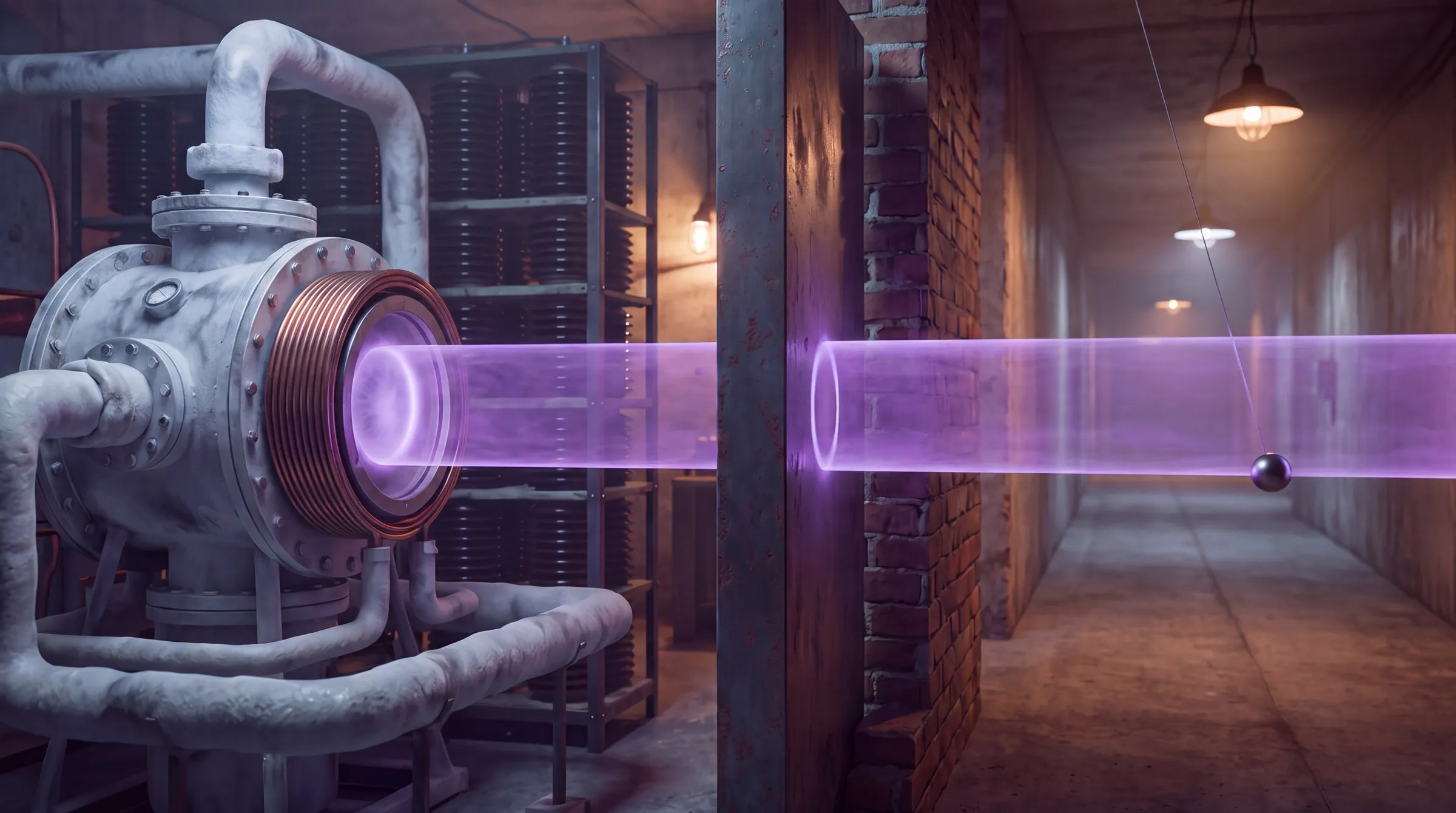 Open the interactive ▸
 What you're looking at
The Lab is the range built to scale in metres, in three dimensions: the vacuum chamber with its 10 cm YBCO disc and its two coils, the 1.5 cm copper anode, the rack of twenty capacitor stages behind, the wire-mesh Faraday cage, the 25 mm steel sheet, the brick, and 150 metres of corridor to a bob on 800 mm of thread inside an evacuated glass cylinder. Three configurations sit on a switch: the paper's near station at 3 to 6 m behind 0.3 m of brick and the steel sheet, the paper's far station at 150 m behind 0.8 m more brick, and the single stack the book describes on p. 169. Press Fire and the front crosses the range, everything in the column takes its share, and the bob swings out to the deflection Table 1 gives at the dialled voltage.
The Ledger turns one swing into one impulse in six steps and then hands you the divisor: the same launch speed becomes 509 g divided by the discharge the papers measured and 509,000 g divided by the 100 nanoseconds the book substitutes. Beside it is the radiation-pressure price, 2.77 MJ to deliver that momentum as absorbed light, against the erected Marx bank's 2.5 kJ, the paper's own 10⁵ J and the 2003 paper's 10⁶ J, with a bar chart of what 149 megajoules per kilogram does to rubber, water, copper and aluminium. A small chart underneath draws the mass test: flat under equal Δv, falling as 1/m under any kind of pressure.
The Wall runs two bills for the same stack side by side. Above, what an electromagnetic pulse pays, layer by layer, in decibels on a log scale, with the frequency, the steel's resistivity and its permeability on dials. Below, what an equal push on everything inside the 10 cm beam would weigh, layer by layer, with the range from 6 metres to 200 kilometres and the recoil it hands back to an apparatus whose mass you choose. Diffraction opens the envelope of a 10 cm aperture against range on log axes, with the wavelength on a slider and the three ceilings marked. The Timing rebuilds the 2012 speed run: the arrival ladder at 1,211 metres and what 63 nanoseconds asks of the clock that measured it. The File runs fourteen cards and then two readings at the same size.
Why it's here
This site's culture wing carries a source note on Secrets of Antigravity Propulsion that lays out the shape of LaViolette's book: a physicist argues that gravity can be controlled electrically, that Townsend Brown proved it in the laboratory, and that the United States classified the result in the mid-1950s. Chapter 6, "Gravity Beam Propulsion", is the one place in it that claims a working apparatus doing this now. The apparatus is Eugene Podkletnov and Giovanni Modanese's impulse gravity generator: a 10 centimetre YBCO superconducting disc cooled to 50 to 70 kelvin, a Marx bank erected to two million volts, an electron discharge across an evacuated gap to a 1.5 centimetre copper anode, and a "gravitational shock wave" said to carry on through the anode unstopped. The headline sentence is on p. 169: "When fired with a discharge voltage of 2 million volts, the emitted wave was found to produce a 14-centimeter deflection of an 18.5-gram pendulum bob suspended from an 80-centimeter-long thread and placed at a distance of 150 meters from the beam generator. The beam was able to exert this force after having first passed through a Faraday cage shield, an additional 2 1/2 centimeters of steel, and a 30-centimeter-thick brick wall."
It is here because that sentence can be priced item by item, and every underlying number is public. The pendulum's geometry gives one impulse of 9.23×10⁻³ N·s and 2.30 mJ. That is the whole of what was measured, and every other figure is that one multiplied or divided by something. The book's "500,000 g" and the papers' "~10⁴ m/s²" are the same swing divided by two different times, exactly a thousand apart. The bench also went to the primary papers, and three things came back. The deflection is not one number but the seven rows of Table 1 of the 2001 paper. The 14 centimetres is not tied to 150 metres: the paper has two stations, at 3-6 m and at 150 m, with shielding that is not the book's stack. And the 64 c belongs to a 2012 chapter, 63 nanoseconds over 1,211 metres between two piezoelectric sensors, not to the two laser beams the book describes. Wherever the book and the paper differ, both numbers stand side by side on the bench, the paper's in steel and the book's in amber, and the difference is named rather than resolved. The same author's other central claim already has a bench here, Electrogravitics; this is the second.
How it works
Everything on the bench is geometry and arithmetic on published numbers. The deflection comes from a printed table, not a formula. The impulse follows from the pendulum's geometry with no free parameter, and it reproduces the paper's own printed rise and energy columns. From there the divisor, the radiation bill, the skin depths, the column masses, the diffraction envelope and the arrival ladder are all one step each. The script that ships with the site re-derives every displayed number before the build passes.
Δv = √(2gL(1 − cos θ)) · J = mΔv · a = Δv/τ · E = Jc · δ = √(2ρ/ωµ₀µ_r) · w(z) = D + 2·1.22λz/D
The swing. sin θ = Δl/L with L = 0.80 m; Δh = L(1 − cos θ); Δv = √(2gΔh); J = mΔv; E = ½mΔv². At the 142.0 mm of Table 1's last row that is 10.22°, 12.70 mm, 0.4992 m/s, 9.23×10⁻³ N·s and 2.30 mJ. The paper prints 12.7 mm and 23.1×10⁻⁴ J for the same row, so the chain is reading the table the way its authors did. The book's rounded 14 cm gives 12.35 mm and 9.10×10⁻³ N·s, within 3% of it, and both are shown.
The mechanism switch. Under the gravitational reading every mass in the beam receives the same Δv, so the deflection does not depend on the bob, which is what the paper reports over 10 to 50 grams. Under the pressure reading every mass shares one impulse, so Δv = J/m and the deflection falls: a 185 g bob moves 14 mm, and below about 2 g the bob is thrown past horizontal and the thread goes slack, which is reported as slack rather than as an angle. The same switch sets the size of the column on the Wall view, which is why it is the decisive dial and not a display option.
The two bills. Electromagnetically, each conducting layer costs 8.686 t/δ decibels with δ = √(2ρ/ωµ₀µ_r), the brick costs (ω/c)√ε_r·tanδ/2 nepers per metre, and the mesh costs 20 log₁₀(λ/2g); they add. Mechanically, each layer's mass is the beam's 7.854×10⁻³ m² times its thickness times its density, its impulse is that mass times Δv, and the total is what Newton's third law returns to the generator, divided by the apparatus mass to give a speed. Diffraction: beyond z_R = D²/λ the width is D + 2·1.22λz/D, so holding the spot at D needs λ ≲ D²/z. Timing: t = b/v for each speed on the ladder, and telling v from v+1 c needs b/c·(1/v − 1/(v+1)).
Where a constant had to be assumed it is on a dial across its plausible range, and the conclusions do not move inside those ranges: at µ_r = 1 the steel still costs 199 decibels, and at the longest published discharge it still costs 629. Nothing is tuned to the book, and where the book is right, which is on the energy argument, the bench says so and prices the agreement.
The dials that decide what happens
The station, the voltage, the emitter, the mechanism and the bob; the divisor and the bank; the range, the apparatus mass, the frequency, the steel's two constants and the wavelength; the baseline, the claimed speed and the width of the feature. Between them they price every version of the sentence the sources allow.
- The station. The paper's 3-6 m, the paper's 150 m, or the single stack the book puts at 150 m. The room rebuilds, and so do both bills.
- Discharge voltage. 500 to 2,000 kV, read off Table 1 of the 2001 paper rather than any formula, with Emitter N.1 and N.2 on a switch. The curve plateaus, which is the book's own difficulty at 10 MV.
- The mechanism. Equal Δv on every mass, or one impulse shared through the 10 cm cross-section. This is the decisive dial: it is what the observation says, and it is what sets the column's bill.
- Bob mass. 5 to 200 grams, with the paper's tested 10 to 50 shaded. Flat under one mechanism, falling as 1/m under the other.
- The divisor τ. 1 nanosecond to 10 milliseconds, logarithmic, with the papers' 10⁻⁴ s and the book's 100 ns marked. Nothing about the bob changes as you drag it.
- Erected capacitance. 0.1 nF to 10 µF; 1.25 nF by default, which is twenty 25 nF stages in series. The paper's own 10⁵ J and the 2003 paper's 10⁶ J are marked beside it.
- Range, apparatus mass, frequency, resistivity, permeability, wavelength. 6 m to 200 km; 50 to 2,000 kg; 1 kHz to 100 MHz; 1.0 to 2.0 ×10⁻⁷ Ω·m; µ_r 1 to 1,000; 10 nm to 10 km.
- Baseline, claimed speed, feature width, ground speed. 0.1 m to 2 km; 1 c to 10,000 c; 1 ns to 1 µs; 200 to 6,000 m/s. The defaults are the 2012 run's own numbers.
The claims, as they stand
Twelve claims that make up the chapter's case, from the deflection in Table 1 to the concrete block, with where each lands against the papers and the arithmetic.
| A 2 MV discharge deflects an 18.5 g bob by 142 mm at 150 m proposed by Podkletnov & Modanese 2001, Table 1; Jorjani-style rounding to 14 cm at LaViolette p. 169 | MEASURED | This is the measurement, and it is a single number: an impulse of 9.23×10⁻³ N·s and an energy of 2.30 mJ, read by eye against a ruler. The bench reproduces the paper's own Δh and ΔE columns from it to better than 3%. |
| Bobs of every material and mass deflect equally proposed by Podkletnov & Modanese 2001, section 3; LaViolette p. 170 | OPEN | Reported over 10 to 50 g of metal, glass, ceramics, wood, rubber and plastic, within 5 to 7 per cent. If it holds it rules out radiation pressure, an air blast and the electrokinetic force, exactly as the book says. It has never been reproduced outside the group. |
| The bob felt 500,000 g at each 100 ns shock front proposed by LaViolette p. 170 | REFUTED | The 100 ns is the rise time the 2003 paper gives for its own laser sensor; neither paper quotes a rise time for the discharge. Divided by the discharge they did measure, 10⁻⁴ s, the same swing is 509 g, which is what the book's own footnote reports. The impulse is 9.23×10⁻³ N·s either way. |
| The electromagnetic energy is far too small to explain the force proposed by LaViolette p. 170; Podkletnov & Modanese 2003, point 3 | MEASURED | The bench agrees and prices it: an absorbed pulse delivering that momentum must carry 2.77 MJ, which is 1,107 times what the erected Marx bank holds and 149 MJ into an 18.5 g bob, where water boils dry at 2.6. The paper reports no heating of the bobs. |
| Whatever crossed the room did so as an electromagnetic pulse proposed by the alternative the papers set out to exclude | REFUTED | At the frequency content of a 10 µs discharge, mild steel has a skin depth of 109 µm, so the 25 mm sheet is 229 of them: 1,988 dB. The whole stack is 2,451 dB. Brick costs under a thousandth of one. The 15 mm copper anode is already 410 skin depths to its own pulse. |
| The beam holds a 10 cm cross-section with negligible loss to 200 km proposed by Podkletnov, in Cook, Jane's Defence Weekly, 29 July 2002 | REFUTED | Any wave leaving a 10 cm aperture spreads past D²/λ. To hold the spot you need λ under 1.7 mm at 6 m, 67 µm at 150 m and 50 nm at 200 km. The pulse's own features are 30 m for the 100 ns figure and 3 km for the 10 µs discharge. Only a particle stream escapes this, and a 2 MeV electron stops in 1.66 mm of steel. |
| The generator produces no recoil when fired proposed by Podkletnov to LaViolette, p. 172; Podkletnov & Modanese 2003 | OPEN | The 2003 paper is careful: 'We did not notice any recoil on the apparatus after the discharges, however precise measurements with strain gauges or similar were not done.' If the beam pushes only the bob the recoil on a 200 kg bench is 46 µm/s, below what a hand can feel; if it pushes everything in its own cross-section the far station's path is 19.6 kg and 9.81 N·s, and the recoil is 4.90 cm/s, well above it. |
| The pulses travel at 64 times the speed of light proposed by Podkletnov & Modanese 2012, pp. 169-182; LaViolette pp. 172, 177 | OPEN | Two piezoelectric sensors 1,211 m apart on synchronised rubidium clocks, delay 63 ± 1 ns. Light crosses the same baseline in 4.04 µs; separating 64 c from 65 c takes about a nanosecond; and 63 ns is 1.6 times the width of the attenuation feature the same authors report, or 12.5 m of ordinary coaxial cable. The same discharge radiates an EMP that Lőrincz and Tajmar found ringing piezoelectric sensors on their own. |
| Later pulses travelled at least several thousand times the speed of light proposed by Podkletnov to LaViolette, pp. 177-178 | OPEN | Attributed to a pair of synchronised atomic clocks and appearing in no published paper. At the 2012 baseline it would be a delay of 1.35 ns, a thirtieth of the width of the feature that carries it. |
| At 10 MV the beam dents 1-inch steel and punches a 4-inch hole in concrete, a thousandfold increase in force proposed by Podkletnov to LaViolette, 2003 and 2007; LaViolette p. 176 | OPEN | The book states the difficulty itself: fig. 6.5 'projects a twofold increase in the impulse strength, not a thousandfold increase', and the bench's extrapolation of Table 1 to 10 MV gives 2.0×. The damage the bench models needs 51× the pendulum's Δv on the equal-push reading and 10,800× its impulse on the momentum reading. None of the 10 MV work appears in any paper. |
| The effect is gravitational, as subquantum kinetics predicted in advance proposed by LaViolette, ch. 6 | READING | The book's reading, built on the mass-proportionality, the shielding, the absence of recoil and the superluminal timing. The bench prints it beside the arithmetic's reading at the same size and does not choose. |
| What an unexplained impulse and a set of unpayable bills amount to proposed by this bench | READING | A discovery whose mechanism is not yet known, or an artefact of a measurement read by eye and never reproduced: the bench sets out both and leaves the choice to the reader. |
Try this
- Start on the Lab at the far station and press Fire. Watch the front cross 150 metres and the bob swing to 142 mm. Then switch to the book's stack and watch the steel move in front of the bob, where the paper had 0.8 m of brick instead.
- Go to the Ledger and drag the divisor. At 10⁻⁴ s the readout says 509 g, which is what the book's footnote reports. At 100 ns it says 509,000. The impulse in the chain above never moves.
- Flip the mechanism to 'one impulse' and drag the bob to 185 g. The deflection falls to 14 mm. Drag it to 2 g and the thread goes slack. Now flip back: the line goes flat, which is what was observed, and the Wall's column bill is what that costs.
- Go to the Wall and drag the frequency from 1 kHz to 100 MHz. The steel bar never falls below a few hundred decibels; the brick bar never rises off the floor. Then drag the permeability to 1: still 199 decibels.
- Drag the range to 200 km. The air column alone becomes 1,898 kg and 948 N·s, and the recoil on a 200 kg apparatus becomes 4.7 m/s. The claim in the same paragraph is that the beam does not weaken.
- Go to Diffraction and drag the wavelength to 30 metres, the pulse's own. The envelope is 110 km wide at 150 m. Then drag it to 67 µm, the ceiling, and the spot is 34 cm.
- End on the Timing and the File. 63 nanoseconds is 1.6 attenuation features, or 12.5 metres of coaxial cable. Then read the fourteen cards, and the two readings at the same size.
Accuracy
The honest line between what is reported, what was measured, what is arithmetic on it, and what is a reading:
| Feature | Status | What that means |
|---|---|---|
| The book’s words | Reported | Every quotation from Secrets of Antigravity Propulsion carries its page. Where the book's figure differs from the paper it summarises (the deflection rounded to 14 cm, the two stations fused into one, the 100 ns attributed to the shock rather than to the sensor, the two laser beams in place of the two piezoelectric sensors), both are printed and the difference is named. |
| The apparatus and the results, as published | Measured | Table 1 of Podkletnov & Modanese 2001: 56.5 mm at 500 kV rising to 142.0 mm at 2,000 kV, an 18.5 g rubber sphere on an 800 mm string, twelve shots averaged, 5-7% scatter. Stations at 3-6 m and 150 m, 'identical within the experimental errors'. Marx bank of 20 × 25 nF at 50-100 kV, peak current ~10⁴ A, discharge 10⁻⁵ to 10⁻⁴ s, 120 s to recharge. Bobs of six materials from 10 to 50 g, read by eye against a ruler 2 mm below a pointer. The 2012 speed run: 63 ± 1 ns over 1,211 m. Lőrincz & Tajmar 2015-16: a null with a 15 mg upper limit at 2.2 kV and 8 kA. |
| The swing, the divisor, the bills | Exact | sin θ = Δl/L, Δh = L(1 − cos θ), Δv = √(2gΔh), J = mΔv: geometry, no free parameter, and it reproduces the paper's own printed Δh and ΔE columns to better than 3%. a = Δv/τ. E = Jc. δ = √(2ρ/ωµ). The column mass is the beam's own cross-section times each thickness times each density. The diffraction envelope and the arrival ladder are algebra. |
| The assumed constants | Modelled | Brick's permittivity and loss tangent, the mesh's shielding effectiveness, steel's resistivity and permeability, the concrete plug's shear strength and the depth of the steel dent, the electron's range in steel. Every one is on a dial across its plausible range, and the conclusions do not move inside those ranges. |
| What the file amounts to | Reading | An impulse that no ordinary mechanism explains, and a set of bills that nothing on the bench can pay: whether that is an artefact of the measurement or a discovery is a reading, and the bench declines to make it. |
In one line: One swing of 9.23 millinewton-seconds is the whole measurement; the accelerations, the powers and the forces are that number divided by a time nobody recorded; and every mechanism the bench can price runs up a bill the apparatus cannot pay, including the gravitational one. The book's words are quoted with pages, the papers' numbers with their papers. The reading is yours.
Sources
- Paul A. LaViolette, "Secrets of Antigravity Propulsion: Tesla, UFOs, and Classified Aerospace Technology" (Bear & Company, 2008), chapter 6 "Gravity Beam Propulsion", pp. 167-178: the apparatus (p. 168), the headline sentence about the 14-centimetre deflection at 150 metres (p. 169), the 500,000 g footnote and the mass test (p. 170), fig. 6.5 and the Jane's report (p. 171), "no back mechanical reaction" and the 63 to 64 c letter (p. 172), the 10 MV damage and the twofold trend (p. 176), the superluminal section (pp. 177-178), and the 20 kilowatts in the ship arithmetic (p. 186). Summarised in this site's culture wing.
- E. Podkletnov and G. Modanese, "Impulse Gravity Generator Based on Charged YBa₂Cu₃O₇−y Superconductor with Composite Crystal Structure", arXiv:physics/0108005 (2001): the emitter, the Marx bank of twenty 25 nF capacitors at 50-100 kV, the vacuum chamber and coils, the stations at 6 m and 150 m with their shielding, the pendulums in evacuated glass cylinders read by eye, Table 1 and Table 2, the microphone runs, and the Ft = √(2gl[1 − √(1 − (d/l)²)]) estimate that gives ~10³ g at t = 10⁻⁴ s.
- E. Podkletnov and G. Modanese, "Investigation of high voltage discharges in low pressure gases through large ceramic superconducting electrodes", arXiv:physics/0209051, published in Journal of Low Temperature Physics 132 (2003), 239-259: the pressure-imprint beam measurement to about 5 mm, "we did not notice any recoil ... however precise measurements with strain gauges or similar were not done", the ruby-laser interaction over about 57 m with its 7-10% intensity dip and the sensor rise time of 10⁻⁷ s or less, the estimate of 10⁻³ J/m lost to air, and the radiation-pressure argument against the observed impulse.
- E. Podkletnov and G. Modanese, in "Gravity-Superconductors Interactions: Theory and Experiment" (Bentham Science, 2012), pp. 169-182, DOI 10.2174/978160805399511201010169: the speed measurement with two piezoelectric sensors 1,211 m apart on synchronised rubidium clocks, a delay of 63 ± 1 ns read as 64 ± 1 c, and the laser attenuation feature lasting 34 to 48 ns.
- Nick Cook, "Anti-gravity propulsion comes out of the closet", Jane's Defence Weekly, 29 July 2002: Podkletnov "maintains that a laboratory installation in Russia has already demonstrated the 4in (10cm) wide beam's ability to repel objects a kilometre away and that it exhibits negligible power loss at distances of up to 200km"; the Boeing Phantom Works "Gravity Research for Advanced Space Propulsion" briefing. Boeing's subsequent statement (Slate, October 2002) that it was "not funding any activities in this area at this time".
- István Lőrincz and Martin Tajmar, "Design and First Measurements of a Superconducting Gravity-Impulse-Generator" and "Null-Results of a Superconducting Gravity-Impulse-Generator", Institute of Aerospace Engineering, TU Dresden, AIAA Joint Propulsion Conference 2015 and 2016: a 61 mm YBCO disc at up to 2.2 kV and 8 kA, an optical accelerometer, an upper limit of 15 mg on any anomaly, and the finding that the discharge's own electromagnetic pulse "produced a mechanical vibration within the sensor, thus making any measurement unreliable".
- G. Hathaway, B. Cleveland and Y. Bao, "Gravity modification experiment using a rotating superconducting disk and radio frequency fields", Physica C 385 (2003): a null on the other Podkletnov claim, the rotating-disc shielding effect, at about fifty times better sensitivity. Distinguished here so the two are not confused.
- Constants and standard relations: skin depth δ = √(2ρ/ωµ₀µ_r) with mild steel at 1.0-2.0×10⁻⁷ Ω·m and relative permeability 1 to 1,000, copper at 1.68×10⁻⁸ Ω·m; the loss tangent and permittivity of fired brick; mesh shielding effectiveness 20 log₁₀(λ/2g); the CSDA range of electrons in iron (NIST ESTAR); the far-field spread of a circular aperture, D + 2·1.22λz/D beyond z_R = D²/λ; the enthalpies used in the vaporisation column.